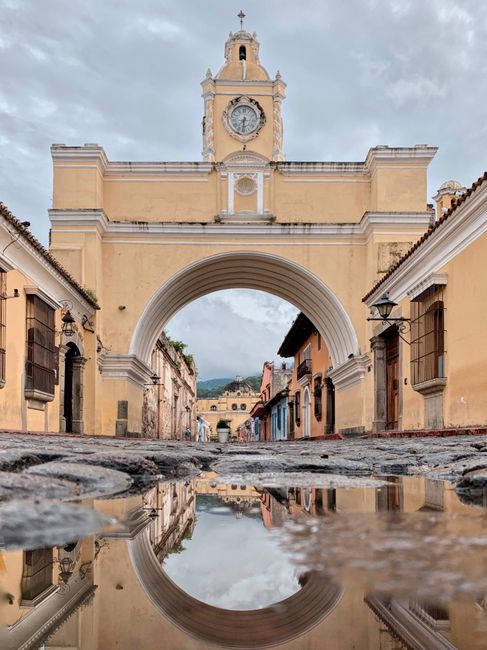
Guatemala is the heart of the Maya world and one of the most rewarding countries in the Americas to travel. In a single trip you can walk the cobbled streets of Antigua, a colonial city ringed by three volcanoes; cross Lake Atitlán by boat between Maya villages where people still wear handwoven clothing; and climb a temple above the rainforest canopy at Tikal, the greatest of the ancient Maya cities. Between them are cloud forests, turquoise pools at Semuc Champey, colorful markets such as Chichicastenango, and a volcanic chain where Fuego erupts almost every day. More than 40% of Guatemalans are Indigenous, and Maya languages, food and festivals are part of everyday life. Flights from the United States are short, distances are modest, and prices are low by regional standards. Plan around the seasons, a dry season from about November to April and a rainy one from May to October, and give a first trip 10 days to two weeks.
Right now in Guatemala
- Tue 15–26°C 59–79°F 2 mm Rain
- Wed 17–26°C 63–78°F 12 mm Rain
- Thu 17–24°C 63–75°F 8 mm Heavy rain
Weather: MET Norway (CC BY 4.0) · Air quality: OpenAQ
Multi-day tours of Guatemala
Multi-day tours from local operators. You check dates and book on Viator, our partner; we may earn a commission at no extra cost to you. How we earn money
Guatemala at a glance: volcanoes, highlands and rainforest
Guatemala is a republic of about 17 million people, divided into 22 departments. It borders Mexico to the north and west, Belize to the north-east, and Honduras and El Salvador to the south-east, with a short Caribbean coast on the Gulf of Honduras and a long Pacific coast of black volcanic sand. Spanish is the official language, and more than 20 Maya languages, such as K’iche’, Kaqchikel, Q’eqchi’ and Tz’utujil, are spoken across the highlands. Guatemala uses Central Standard Time (UTC−6) all year with no daylight saving time, the same as Mexico City and Costa Rica.
Guatemala’s regions
- The central highlands: Antigua, Guatemala City, the volcanoes of Agua, Fuego, Acatenango and Pacaya, and the market towns of Chimaltenango and Sacatepéquez.
- The western highlands: Lake Atitlán and its villages, Chichicastenango’s market, Quetzaltenango (Xela), and the cold mountain towns around Huehuetenango and Todos Santos Cuchumatán.
- Petén: the northern lowland rainforest, with Tikal, Yaxhá, Uaxactún and the island town of Flores on Lake Petén Itzá.
- Las Verapaces: cloud forest, coffee and cardamom farms, Cobán and the limestone pools of Semuc Champey.
- The Caribbean: Lake Izabal, the Río Dulce gorge and Livingston, a Garifuna town reached only by boat.
- The Pacific coast: black-sand beaches and surf at Monterrico, El Paredón and Sipacate, sea turtles and mangroves.
Regions
Where to go: Antigua, Lake Atitlán and Tikal
Most first trips link the “big three”: Antigua, Lake Atitlán and Tikal. Antigua and Atitlán are about three hours apart by road, and Tikal is a short flight or a long bus ride north, so many travelers fly from Guatemala City to Flores and back.
Antigua Guatemala
The former colonial capital, founded in 1543 and left in ruins by earthquakes in 1773, is a grid of pastel houses, baroque churches and convent ruins at about 1,500 m (4,900 ft), declared a UNESCO World Heritage Site in 1979, according to the Guatemalan Tourism Institute (INGUAT). It is the country’s travel hub, with Spanish schools, cafés, coffee farms and volcano hikes, and is famous for its Holy Week processions. See our Antigua Guatemala travel guide.
Lake Atitlán
A volcanic lake more than 300 m (980 ft) deep in places, formed by the collapse of a caldera about 84,000 years ago and overlooked by the San Pedro, Tolimán and Atitlán volcanoes, according to INGUAT. Boats link Panajachel with Maya villages such as San Juan, San Pedro, San Marcos and Santiago Atitlán, each with its own character. See our Lake Atitlán travel guide.
Tikal National Park
The great Maya city in the rainforest of Petén protects more than 570 km² (220 sq miles) of forest around an archaeological core of about 16 km² (6 sq miles), with temples that rise above the canopy; Temple IV is more than 60 m (200 ft) high, according to INGUAT. It is about 63 km (39 miles) from Flores. See our Tikal National Park travel guide.
More places worth the trip
- Chichicastenango: the highland market town whose Thursday and Sunday markets fill the streets around the church of Santo Tomás.
- Semuc Champey: a natural limestone bridge with stepped turquoise pools near Lanquín in Alta Verapaz, reached on rough roads.
- Flores and Yaxhá: the island town on Lake Petén Itzá, the gateway to Tikal, and the lakeside Maya site of Yaxhá, known for its sunsets.
- Río Dulce and Livingston: a boat trip through a jungle gorge to the Caribbean and the Garifuna town of Livingston.
- Quetzaltenango (Xela): Guatemala’s second city, a base for Spanish schools and hikes to hot springs and volcanoes.
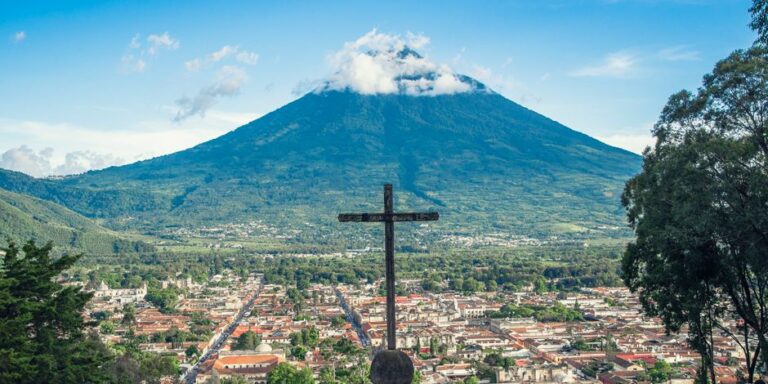
Antigua Guatemala Travel Guide
Plan a trip to Antigua Guatemala: the Parque Central, cathedral ruins, the Santa Catalina Arch, La Merced and the convents, Cerro de la Cruz,…
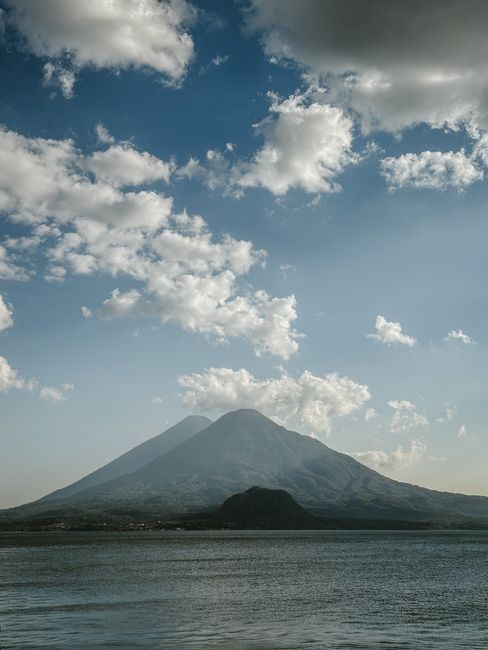
Lake Atitlán Travel Guide
Plan a trip to Lake Atitlán in Guatemala: Panajachel, San Juan, San Pedro, San Marcos, Santa Cruz and Santiago Atitlán, public boats between the…
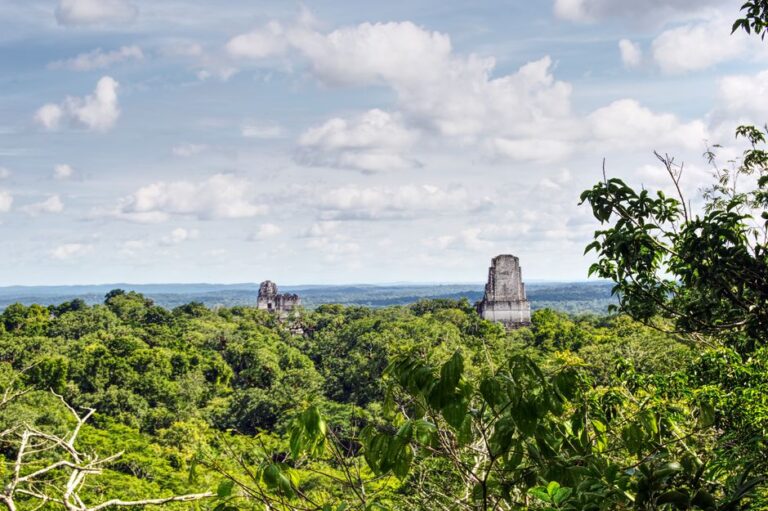
Tikal National Park Travel Guide
Plan a visit to Tikal National Park in Guatemala: the Ministry of Culture's 2026 fees and online tickets, sunrise and sunset rules and guides,…
Best time to visit Guatemala: dry and rainy seasons
Guatemala has two seasons. The dry season runs from about November to April, with sunny days, cool nights in the highlands and the clearest volcano views; INGUAT recommends it for Atitlán and Antigua. The rainy season runs from about May to October, when mornings are often clear and afternoons bring heavy showers; the landscape is green and prices are lower. Temperatures depend on altitude, not the month: Antigua and Atitlán, at about 1,500 m (4,900 ft), are spring-like, with days of about 22–26 °C (72–79 °F) and cool nights; Petén and the coasts are hot and humid, often above 30 °C (86 °F).
| Region | Dry season | Rainy season | Temperatures |
|---|---|---|---|
| Antigua, Guatemala City and Atitlán | November to April; sunny, cool nights | May to October; afternoon storms | Days about 22–26 °C (72–79 °F); nights can drop to 10 °C (50 °F) |
| Petén (Tikal, Flores) | February to May, hottest in April–May | June to November | Hot and humid, about 30–35 °C (86–95 °F) by day |
| Caribbean (Río Dulce, Livingston) | No true dry season; March to May driest | Rain in any month, heaviest June to December | Hot and humid |
| Pacific coast | November to April | May to October | Hot, often above 32 °C (90 °F) |
El Niño in 2026: the National Institute of Seismology, Volcanology, Meteorology and Hydrology (INSIVUMEH) said in October 2026 that El Niño conditions are almost certain to last until early 2027. Its outlook for October 2026 still forecasts heavy rain in Petén, the Pacific slope and the Caribbean, but with a rainfall deficit for the country as a whole.
Hurricanes: the Atlantic hurricane season runs from June 1 to November 30 and the eastern Pacific season from May 15 to November 30, according to NOAA’s National Hurricane Center. Storms rarely hit Guatemala directly, but tropical storms from either ocean can bring days of heavy rain, floods and landslides that close roads in the highlands. Check forecasts before long road trips.
Crowds, prices and events through the year
- Holy Week (Semana Santa): the biggest event of the year, especially in Antigua, with processions over carpets of colored sawdust and flowers. In 2027, Palm Sunday is March 21 and Easter Sunday March 28; book months ahead and expect higher prices.
- November 1: All Saints’ Day, when giant kites fly over the cemeteries of Sumpango and Santiago Sacatepéquez near Antigua, and the town of Todos Santos Cuchumatán holds its horse race.
- December to April: the dry high season, busy at Christmas and New Year.
- May to October: the green season, with fewer visitors and lower prices; Tikal is muddier, and rain usually comes in the afternoon.
Public holidays
Banks and government offices close on national holidays, and Guatemalans travel, especially at Holy Week and Christmas. The next ones, from October 2026:
| Holiday | Date | Good to know |
|---|---|---|
| Revolution Day | Tuesday, October 20, 2026 | Remembers the 1944 revolution |
| All Saints’ Day | Sunday, November 1, 2026 | Kite festivals in Sumpango and Santiago Sacatepéquez |
| Christmas Eve (afternoon) | Thursday, December 24, 2026 | Half day |
| Christmas Day | Friday, December 25, 2026 | Nationwide |
| New Year’s Eve (afternoon) | Thursday, December 31, 2026 | Half day |
| New Year’s Day | Friday, January 1, 2027 | Nationwide |
| Holy Thursday to Holy Saturday | March 25–27, 2027 | Peak travel; Antigua processions |
| Labor Day | Saturday, May 1, 2027 | Nationwide |
| Army Day | Wednesday, June 30, 2027 | Nationwide |
| Independence Day | Wednesday, September 15, 2027 | Torch runs and parades on the 14th and 15th |
Towns also close for their own patron saint’s fair, such as Guatemala City on August 15.
How long to stay: sample itineraries
Guatemala is compact but roads are slow and winding, so allow more time than the map suggests.
7 days: Antigua, Atitlán and Tikal
Three nights in Antigua, two at Lake Atitlán, then back through Guatemala City for a morning flight to Flores and two nights near Tikal, with a sunrise or early visit to the ruins.
10 days: the highlands in depth
Add Chichicastenango’s market on a Thursday or Sunday, a night in a quieter Atitlán village, and a guided overnight hike on Acatenango, if the authorities allow it, to watch Fuego.
2 weeks: from the volcanoes to the Caribbean
Add Semuc Champey and Cobán, then continue to the Río Dulce and Livingston on the Caribbean, or cross from Flores into Belize. Travelers heading north can continue to Mexico; see our Mexico travel guide. Copán’s Maya ruins are just over the Honduran border, about five to six hours from Antigua by shuttle.
Entry, money and costs
Entry requirements (last reviewed October 2026)
Citizens of the United States, Canada, the UK and the European Union need no visa for a tourist stay of up to 90 days, according to the Canadian and UK governments. The officer at your first entry point decides how many days you get. What you need:
- A passport valid for at least six months beyond your arrival, with at least two blank pages, according to the UK government.
- The online immigration declaration, which every traveler must complete before entering and before leaving Guatemala. You receive a QR code by email; keep it on your phone or printed. Terminals at the airport let you fill it in on arrival, but that can delay you.
- An entry stamp: check that your passport is stamped when you arrive. Without it you can be fined and delayed when you leave.
- A yellow fever certificate, only if you arrive from a country with a risk of yellow fever transmission.
Children under 18 traveling alone or with only one parent need a notarized letter in Spanish from the parent or parents not traveling, according to the UK government.
The CA-4 agreement: Guatemala, El Salvador, Honduras and Nicaragua
Guatemala is one of the four countries of the Central America-4 (CA-4) Border Control Agreement, with El Salvador, Honduras and Nicaragua. Under it, tourists get a single permitted stay of up to 90 days for the whole region, which starts in the first CA-4 country you enter and does not restart when you cross between them. You still go through immigration at each border and should get a stamp each time, according to the Canadian government. You can ask Guatemala’s Migration Institute (IGM) for an extension before your time runs out; to start a new 90 days you normally have to leave the CA-4 region, for example to Mexico, Belize or Costa Rica. British citizens should note that, according to the UK government, they now need a visa for Honduras even though it is part of CA-4.
Departure tax and customs
The airport departure tax of US$30 (or the same in quetzales) is normally included in your ticket, according to the UK government. There is no official fee to enter Guatemala by land: if an officer asks for an “entry fee”, ask for an official receipt, and the request is often dropped. Declare anything that may be prohibited or taxed. Leaving Belize by land toward Guatemala costs BZ$40 (US$20) in Belize.
Money: the quetzal
Guatemala’s currency is the quetzal (Q, GTQ). The Bank of Guatemala’s reference rate on October 4, 2026, was Q7.64 to US$1, so Q100 is about US$13. US dollars are the easiest foreign currency to change, at banks and some hotels; British pounds and Canadian dollars are hard to exchange. ATMs are common in Antigua, Guatemala City, Panajachel and Flores; use machines inside banks or malls and check for tampering. Cards are accepted in hotels and better restaurants, but markets, small shops, boats and tuk-tuks take cash, often in small notes.
Taxes and tipping
Prices usually include Guatemala’s 12% value-added tax (IVA). Hotels also charge a 10% tourism tax for INGUAT, so a hotel bill can carry 22% in taxes; check whether a quoted rate includes them. In restaurants, a 10% tip is customary and is often added to the bill as “propina sugerida”; tip guides and drivers for good service.
Typical travel costs
Guatemala is one of the cheaper countries in the region. These per-person, per-day estimates are a planning guide as of October 2026:
| Style | Estimated cost per day | What that looks like |
|---|---|---|
| Budget | about Q300–500 (US$40–65) | Hostel bed, comedores (local eateries), chicken buses or shared shuttles, public boats at Atitlán |
| Mid-range | about Q900–1,500 (US$120–200) | Boutique hotel room shared by two, restaurant meals, shuttles, guided tours most days |
| High-end | about Q3,000+ (US$400+) | Colonial luxury hotels in Antigua, lakeside lodges, private drivers and a domestic flight to Flores |
The figures are our estimates, not official statistics.
Volcanoes: status and climbing rules (October 2026)
Guatemala has more than 30 volcanoes, and the authorities monitor the active ones daily. Before any hike, check the bulletins of INSIVUMEH and the disaster agency, CONRED, and follow local instructions.
- Fuego (3,763 m / 12,346 ft): one of the most active volcanoes in the world, visible from Antigua. INSIVUMEH reported an intense eruptive phase on August 3–4, 2026, with pyroclastic flows down several ravines and ash carried up to 120 km (75 miles), and CONRED, under an orange institutional alert, stationed police at the start of the Acatenango trail to stop tourists from climbing. On October 1, 2026, CONRED reported weak to moderate explosions with ash columns of 4,200–4,500 m (13,800–14,800 ft) and advised people not to stay on the “meseta”, the high saddle near the crater, because of falling volcanic bombs. Don’t sign up for tours that walk toward Fuego’s crater.
- Acatenango (3,976 m / 13,045 ft): the classic overnight hike, with a camp facing Fuego. Access depends on Fuego’s activity, so check that the trail is open before you book, go with a licensed guide, and bring warm clothes: nights near the summit drop below freezing.
- Pacaya (2,552 m / 8,373 ft): the easiest active volcano to visit from Antigua or Guatemala City, inside a national park with guided walks. On September 1, 2026, CONRED reported only degassing at its Mackenney crater. Stay on the guided route and away from the crater.
- The Atitlán volcanoes: San Pedro, Tolimán and Atitlán around Lake Atitlán are not currently erupting; San Pedro is a popular guided day hike from the village of San Pedro La Laguna.
- Santiaguito: near Quetzaltenango, an active lava dome that produced one to four explosions an hour in early September 2026, according to CONRED; it can be viewed from Santa María volcano with a guide.
There is no mountain rescue service in Guatemala, and tour companies may underestimate the risks, according to the UK government.
Getting there and getting around
Arrival airports
- La Aurora International (GUA), Guatemala City: the main gateway, with direct flights from US hubs such as Houston, Miami, Dallas, Atlanta, Los Angeles and New York. Antigua is about 45 minutes to an hour and a half away by road, according to INGUAT. Buy pre-paid taxi vouchers at the INGUAT desk in arrivals or use a hotel shuttle.
- Mundo Maya International (FRS), Flores: the airport for Tikal, with domestic flights from Guatemala City and some regional flights.
See our United States travel guide if you are connecting there.
Domestic flights
Flights between Guatemala City and Flores take about an hour, compared with eight to ten hours by road. The Ministry of Culture puts Tikal 484 km (301 miles), or nine hours, from the capital.
Shuttles and buses
Tourist shuttles, shared minivans with hotel pick-up, are the easiest way to travel between Antigua, Atitlán, Chichicastenango, Semuc Champey and the airport, and across the borders to Copán and El Salvador. First-class coaches run from Guatemala City to Flores, Quetzaltenango and the borders. The cheap local “chicken buses”, old US school buses, are colorful but crowded and fast, and the UK government notes that criminals have targeted them; most visitors use shuttles or private coaches instead.
Driving
Main highways such as the Inter-American (CA-1) are paved, but mountain roads are steep and winding, trucks are slow, speed bumps (“túmulos”) are everywhere, and landslides can close roads in the rainy season. Visitors can drive on a valid foreign license for up to three months, according to the UK government; police checkpoints are common, so carry your license, passport and rental papers. Drive only by day, keep to main roads, and don’t stop for strangers.
Borders
Guatemala has land crossings with Mexico (including Tecún Umán–Ciudad Hidalgo, La Mesilla and El Ceibo), Belize (Melchor de Mencos–Benque Viejo, for Tikal from San Ignacio), Honduras (El Florido for Copán, and Agua Caliente) and El Salvador (Pedro de Alvarado, Valle Nuevo, San Cristóbal and Anguiatú). Cross in daylight, use only official crossings, get your passport stamped, and be wary of people offering to “help” with paperwork for a fee.
Getting around towns
Antigua is easy to explore on foot, with taxis and tuk-tuks for longer trips. In Guatemala City, use radio-dispatched taxis, hotel taxis or ride-hailing apps rather than hailing taxis in the street. At Lake Atitlán, public and private boats (lanchas) link the villages.
Culture, food and everyday etiquette
Guatemala’s identity is shaped by its Maya majority in the highlands, its Spanish colonial heritage and the Garifuna culture of the Caribbean coast. Many Maya women wear the huipil, a handwoven blouse whose patterns identify their town. Food to try: pepián (a rich, spiced meat stew), kak’ik (a turkey soup from Alta Verapaz), jocón (chicken in green sauce), chiles rellenos, black beans and fresh tortillas with every meal, and tamales on Saturdays and at Christmas. Guatemala’s highland coffee, from Antigua, Atitlán and Huehuetenango, is world-class, and many farms run tours.
Etiquette: greet people with “buenos días” before asking anything, dress modestly in villages and churches, and always ask before photographing people, especially children; some people expect a small payment, and others will say no. Carry ID at all times: a copy of your passport photo page is accepted in most places, but local authorities in San Pedro La Laguna may ask for the original, according to the UK government. Alcohol sales can be restricted on election days, and drug penalties are severe.
Safety, health, accessibility and connectivity
Safety
Most visitors travel without problems, but Guatemala has a high rate of violent crime, mostly among local gangs. In Guatemala City, stay in Zones 10, 13 and 4 and take care in Zone 1, the historic center; avoid the outer zones. Pickpocketing and bag snatching happen in busy areas, markets and around volcanoes; don’t carry much cash, keep phones out of sight, and don’t resist if robbed. Use shuttles or private transport rather than local buses, travel by day, and use ATMs inside banks or malls. Criminals sometimes pose as police, and “express kidnappings” using unlicensed taxis have been reported, according to the UK government.
On the roads to Lake Atitlán, the tourist assistance service PROATUR suggests avoiding the Godínez bypass through Patzún and the road between Cocales and San Lucas Tolimán; the Inter-American Highway via Sololá is the usual route, and lake boats are a good alternative between villages. Violence linked to drug trafficking is higher near the Mexican border in Huehuetenango and San Marcos, and parts of Izabal, Zacapa, Chiquimula and Petén away from tourist sites, so stay in the visitor areas there. Demonstrations can block roads, and sometimes the airport, with little notice.
For help, call PROATUR on 1500 (+502 2290 2810 from abroad), a 24-hour tourist assistance line with English-speaking staff. Police: 110; fire and ambulance: 122 or 123.
Health and insurance
Guatemala City has good private hospitals, but care elsewhere is limited, so buy travel insurance that covers medical evacuation. Dengue, Zika and chikungunya occur, and malaria is present in some lowland areas; use repellent and see a travel clinic before you go. Altitude can affect you on Acatenango and other volcanoes. Don’t drink tap water; bottled and filtered water is cheap and widely available. Pharmacies are plentiful.
Accessibility
Antigua’s cobblestones, high curbs and uneven sidewalks are hard for wheelchairs, and boats at Atitlán and trails at Tikal have no step-free access. Some newer hotels in Guatemala City and Antigua have adapted rooms; ask in advance.
Connectivity and power
Mobile coverage is good in towns and along main roads but patchy in the mountains and Petén’s forest. Prepaid SIM cards from Tigo and Claro are sold at the airport and in shops; bring your passport. Guatemala uses 120 V and US-style plugs, so visitors from the United States and Canada need no adapter.
Things to do: hiking, Maya sites, lakes and beaches
- Hiking: volcanoes such as Acatenango, Pacaya and San Pedro, the ridge trails between Atitlán villages, and multi-day treks such as the jungle walk to El Mirador in Petén.
- City sightseeing: Antigua’s churches, ruins and museums, Guatemala City’s museums, and Quetzaltenango.
- Boat trips: village-hopping on Lake Atitlán, the Río Dulce gorge to Livingston, and Lake Petén Itzá around Flores.
- Surfing and beaches: the black-sand Pacific coast at El Paredón, Sipacate and Monterrico, best for surf from about March to October.
- Cycling: mountain-bike tours from Antigua through coffee farms and villages.
- Maya culture: markets, weaving cooperatives, coffee and cacao tours, and Spanish lessons in Antigua or Xela.
What to pack
Pack layers: the highlands are warm by day and cool at night, and Acatenango’s summit is freezing. Bring a warm jacket, hat and gloves for volcano hikes, sturdy hiking shoes, a light rain jacket for the rainy season, sunscreen and a hat for the strong highland sun, insect repellent for Petén and the coasts, a headlamp, a reusable water bottle with a filter, small quetzal notes, and modest clothes for villages and churches. Plugs are the same as in the US.
Guatemala travel FAQ
When is the best time to visit Guatemala?
The dry season, from about November to April, is best for volcano views, Antigua and Lake Atitlán. Holy Week in Antigua is spectacular but very busy.
Do I need a visa for Guatemala?
Not if you are from the US, Canada, the UK or the EU. You can stay up to 90 days, which counts toward the shared CA-4 limit with El Salvador, Honduras and Nicaragua. Your passport should be valid for six months.
What is the CA-4 agreement?
An agreement between Guatemala, El Salvador, Honduras and Nicaragua that gives tourists one stay of up to 90 days for all four countries combined. The clock doesn’t restart when you cross between them.
Is there a departure tax in Guatemala?
Yes, US$30 when you fly out, normally included in your ticket. There is no official fee to enter by land.
How much does it cost to visit Tikal?
Q150 (about US$20) for foreign visitors, plus Q100 (about US$13) for a sunrise or sunset ticket, which also requires a licensed guide, according to the Ministry of Culture’s ticket site.
Can I climb a volcano in Guatemala?
Yes, with a licensed guide. Pacaya, San Pedro and Acatenango are popular, but access to Acatenango is closed when Fuego’s activity increases. Check INSIVUMEH and CONRED updates before you go.
Is Fuego erupting?
Fuego erupts almost constantly. It had an intense eruptive phase in early August 2026, and in early October 2026 it was producing weak to moderate explosions and ash, according to CONRED.
What currency does Guatemala use?
The quetzal. The rate was about Q7.64 to US$1 in October 2026. US dollars are easy to change; cards are accepted in hotels and better restaurants.
What are the taxes on hotels in Guatemala?
Hotel bills carry 12% value-added tax and a 10% tourism tax, about 22% in total. Check whether quoted rates include them.
How do I get from Guatemala City to Antigua?
By shuttle, taxi or hotel transfer, in about 45 minutes to an hour and a half depending on traffic.
Can I drink the tap water in Guatemala?
No. Drink bottled or filtered water, which is cheap and widely available.
Is Guatemala safe for tourists?
Most visits are trouble-free in the main tourist areas. Use shuttles instead of local buses, travel by day, avoid showing valuables, and call PROATUR on 1500 if you need help.
Sources and last review
Researched and last reviewed on 4 October 2026. Tikal fees, hours, the guide rule for sunrise and sunset tickets, and the distance from Guatemala City: the Ministry of Culture and Sports’ ticket site; Antigua’s UNESCO listing and altitude, Lake Atitlán’s depth and volcanoes, Tikal’s size and Temple IV, and the best seasons: the Guatemalan Tourism Institute (INGUAT); Fuego’s August 2026 eruption, El Niño and the October 2026 rainfall outlook: INSIVUMEH; Fuego, Pacaya and Santiaguito activity and the Acatenango closure: CONRED; the quetzal rate: the Bank of Guatemala; hurricane seasons: NOAA’s National Hurricane Center; visa-free stays, the CA-4 rules and the online declaration: the Canadian and UK governments; passport validity, the departure tax, land-border fees, PROATUR’s road advice, safety, ID, driving and emergency numbers: the UK government. Population, languages, regions, temperatures, holiday dates, hotel taxes, food, plugs, SIM providers, volcano heights and daily costs come from secondary sources or general knowledge and are flagged for checking; daily costs are our estimates. Prices and rules change, so check the official sites before you travel. For other trips in the region, see our Mexico, Costa Rica and Panama travel guides.
Plan your trip
Partner links: TravelerCenter may earn a commission if you book, at no extra cost to you.
🇪🇸 Useful Spanish phrases for Guatemala
All 38 Spanish phrases: restaurant, hotel, emergencies, romance (printable) →