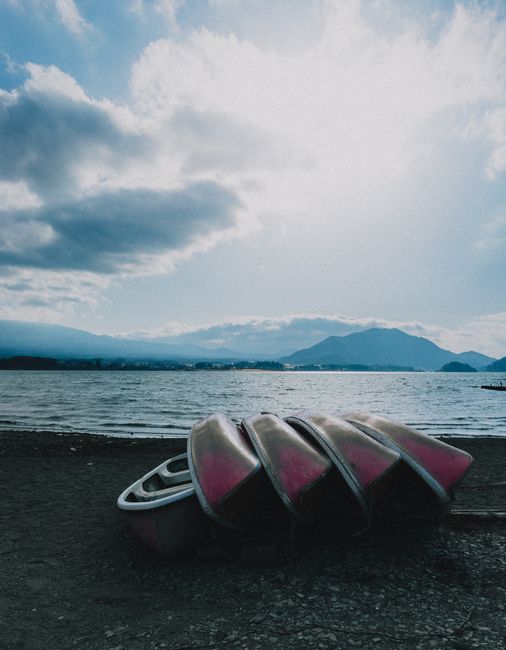
The Fuji Five Lakes (Fujigoko) lie at the northern foot of Mount Fuji in Yamanashi Prefecture, about 100 km (62 miles) west of Tokyo: five lakes formed when lava flows dammed the rivers, surrounded by forests, hot springs and some of the closest, most famous views of Japan’s highest mountain, 3,776 m (12,388 ft). Lake Kawaguchi is the main base, with ryokan, museums and lakeside paths; Fujiyoshida, next door, has the Chureito Pagoda framed by cherry blossoms and the old pilgrims’ shrine at the start of the Yoshida Trail up Fuji. Come for the views, the lakes and the lava caves of the Aokigahara forest, and, from July 1 to September 10, to climb the mountain itself. The best views are from late October to February, on cold, clear mornings.
Right now in Fuji Five Lakes (Kawaguchiko)
- Wed13–16°C55–62°F19 mm rain
- Thu11–19°C52–66°FMostly clear
- Fri11–19°C53–66°FClear
- Mon 12 Oct Sports Day (スポーツの日)
Top tours in Fuji Five Lakes
See all tours for Fuji Five Lakes →
From local operators, with prices and reviews; you check availability and book on Viator, our partner. We may earn a commission at no extra cost to you. How we earn money
The Fuji Five Lakes at a glance
- Best for: close-up Mount Fuji views, climbing Fuji in summer, lakes and hot springs, cherry blossoms and fall colors, and easy nature walks.
- How long: a day trip from Tokyo is possible; one or two nights gives you the best chance of a clear morning view.
- Best time: late October to February for clear views, with snow on Fuji; April for cherry blossoms; July 1 to September 10 for climbing.
- Getting there: about two hours from Shinjuku by highway bus or the Fuji Excursion limited express train to Kawaguchiko.
- Getting around: sightseeing buses around the lakes, rental bikes, taxis or a rental car.
- Fees to know: climbing Mount Fuji costs ¥4,000 per person on every trail, with advance registration; the 2026 season ran from July 1 to September 10.
- Before you go: entry rules, rail passes, money and general safety are in our Japan travel guide; see also our Tokyo and Hakone guides.
The lakes and towns: where things are
The five lakes form an arc of about 30 km (19 miles) around Fuji’s northern slopes, at about 800–1,000 m (2,600–3,300 ft) above sea level. The area belongs to Fuji-Hakone-Izu National Park, and Mount Fuji, with the lakes, shrines and other sites, is a UNESCO World Heritage cultural site, “Fujisan, sacred place and source of artistic inspiration”, listed in 2013.
Lake Kawaguchi (Kawaguchiko)
The busiest and best-equipped lake, in the town of Fujikawaguchiko, with the railway terminus, most hotels and ryokan, hot springs, museums and the famous reflections of Fuji from the north shore. The natural base for most visitors.
Fujiyoshida
The city beside Kawaguchiko, with the Chureito Pagoda, the Kitaguchi Hongu Fuji Sengen Shrine, the old Honcho Street with Fuji at its end, and the Fuji-Q Highland amusement park.
Lake Yamanaka (Yamanakako)
The largest and highest of the lakes, to the east, with water sports, cycling paths, campsites and holiday villas; close to Oshino Hakkai and the road to Gotemba and Hakone.
Lakes Saiko, Shoji and Motosu
The three smaller, quieter lakes to the west, ringed by the Aokigahara forest and lava caves. Lake Motosu’s view of Fuji is the one printed on the back of the ¥1,000 note, and Lake Shoji is the smallest and most peaceful.
Climbing Mount Fuji: season, fee and reservations
Mount Fuji can be climbed only in the official summer season, when the mountain huts, first-aid stations and trails are open. Outside it, the trails above the fifth stations are closed, and climbing in snow and ice is extremely dangerous. According to the official Mount Fuji climbing website, run by the Yamanashi and Shizuoka authorities, the rules in the 2026 season were:
- Season: the Yoshida Trail (Yamanashi side) and the Subashiri Trail opened on July 1, and the Fujinomiya and Gotemba trails (Shizuoka side) on July 10; all closed on September 10, 2026. Dates for 2027 are announced in the spring.
- Fee: a Hiking Fee of ¥4,000 (about US$25) per person, the same on all four trails, paid once per climb.
- Night restriction: entry from the fifth stations is not allowed between 2 p.m. and 3 a.m. unless you have a reservation at a mountain hut, to stop people climbing through the night without rest (“bullet climbing”).
- Yoshida Trail (Yamanashi): register and pay in advance through Yamanashi Prefecture’s online Mt. Fuji Yoshida Trail access reservation system, and show the QR code at the gate at the fifth station; the number of climbers is capped at 4,000 a day, after which only those with a hut booking can pass.
- Shizuoka trails: pre-register, complete a short e-learning course on rules and manners, and pay through the “Shizuoka Prefecture FUJI NAVI” app (or register on site), then collect a wristband at the trailhead.
The Yoshida Trail, from the Fuji Subaru Line Fifth Station above Kawaguchiko, is the most popular route, taking about 5 to 7 hours up and 3 to 4 hours down. Most climbers sleep in a hut near the 7th or 8th station and climb to the summit for sunrise. Bring warm clothes, rain gear, a headlamp, water, cash for huts and toilets (100-yen coins), and acclimatize slowly; altitude sickness is common. See our guide to hiking.
Top things to see in the Fuji Five Lakes
Chureito Pagoda (Arakurayama Sengen Park)
A five-story pagoda on a hillside in Fujiyoshida, reached by almost 400 steps, with Fuji rising behind: in April, with cherry blossoms, and in November, with red maples, one of the most photographed views in Japan. Go at sunrise. It sits in a residential area, so keep to the paths, don’t block roads or private driveways, and take your rubbish with you.
Lake Kawaguchi’s north shore
The Oishi Park flower gardens, the Kawaguchiko Music Forest and the Itchiku Kubota Art Museum, devoted to one artist’s spectacular dyed kimono, line the quieter north shore, with Fuji reflected in the lake on calm mornings. Walk or cycle along the shore, or take the sightseeing bus.
Mount Tenjo and the Kachi Kachi Ropeway
A short ropeway from the east shore of Lake Kawaguchi climbs to an observation deck at about 1,075 m (3,527 ft), with views of Fuji above the lake and town.
Oshino Hakkai
Eight clear spring-fed ponds, fed by snowmelt filtered through Fuji’s lava for decades, in a thatched-roof village between Fujiyoshida and Lake Yamanaka. Very busy with tour groups by late morning.
Aokigahara and the lava caves
A dense forest growing on a lava flow from an eruption in 864, with mossy roots and well-marked nature trails. Near Lake Saiko, the Fugaku Wind Cave and the Narusawa Ice Cave keep ice inside even in summer; Saiko Iyashi-no-Sato Nenba is a village of rebuilt thatched houses with craft workshops. Stay on the marked trails, where phone signals and compasses can be unreliable.
More classic sights
- Kitaguchi Hongu Fuji Sengen Shrine: a cedar-shaded shrine in Fujiyoshida, the traditional start of the Yoshida Trail, with a huge wooden torii.
- Fuji-Q Highland: an amusement park with record-breaking roller coasters.
- Honcho Street, Fujiyoshida: a shopping street with Fuji framed at its end; stay on the sidewalk and never stand in the road for photos.
- Fuji Shibazakura Festival: fields of pink moss phlox near Lake Motosu, usually from mid-April to late May.
- Fuji Subaru Line Fifth Station: a road to 2,305 m (7,562 ft) on Fuji’s slopes, open from spring to fall, for views and short walks even if you don’t climb.
Monuments
- Kitaguchi Hongū Fuji Sengen Shrine
- Lake Kawaguchi
- Lake Sai
- Lake Yamanaka
- Oshino Hakkai
Parks and gardens
- Arakurayama Sengen Park
Theme parks
- Fuji-Q Highland
Caves
- Fugaku Wind Cave
- Narusawa Ice Cave
Nature
- Aokigahara
Other things to do in the Fuji Five Lakes
Food and hot springs
Try hoto, thick flat noodles simmered in a miso broth with pumpkin and vegetables, the local comfort food, and Yoshida udon, very chewy noodles from Fujiyoshida. Fuji’s spring water makes good local beer and sake. Many ryokan around Lake Kawaguchi have hot spring baths with views of the mountain; some have private baths for guests with tattoos.
Lakes, cycling and outdoor activities
Rent a bike to circle Lake Kawaguchi, a ride of about 20 km (12 miles), or Lake Yamanaka, take a boat or a duck-shaped “swan” pedal boat, paddle a canoe on Lake Saiko or Motosu, or camp by the lakes in summer. See our cycling guide.
Activities and best months
- HikingJulAugSepMount Fuji's climbing season in 2026 ran 1 July-10 September on the Yoshida and Subashiri trails (10 July-10 September on Fujinomiya and Gotemba); climbers pay a ¥4,000 hiking fee, register online and may not start between 14:00 and 3:00 unless staying in a mountain hut; off-season climbing is extremely dangerous.
Day trips from the Fuji Five Lakes
- Hakone: hot springs, Lake Ashi and Owakudani, about 1.5 to 2 hours by bus via Gotemba. See our Hakone guide.
- Gotemba Premium Outlets: a large outlet mall with Fuji views, about 40–50 minutes by bus.
- Shiraito Falls: wide curtains of spring water on the western side of Fuji, about an hour by car.
- Kofu and the wine country: Yamanashi’s vineyards and wineries around Katsunuma, about 1 to 1.5 hours.
- Tokyo: about two hours by bus or train. See our Tokyo guide.
Nearby destinations
Getting there and getting around
From Tokyo
Highway buses run frequently from the Busta Shinjuku terminal (and some from Tokyo Station and Haneda) to Kawaguchiko Station and Fuji-Q Highland in about 1 hour 45 minutes to 2 hours 15 minutes, traffic permitting; book seats ahead at weekends. By train, the Fuji Excursion limited express runs directly from Shinjuku to Kawaguchiko in about two hours; otherwise take a JR train to Otsuki and change to the Fujikyu Railway. The Japan Rail Pass covers JR as far as Otsuki but not the Fujikyu section, which costs extra. From Hakone or Gotemba, buses cross the mountains to Lake Yamanaka and Kawaguchiko.
Around the lakes
Fujikyu’s sightseeing buses run loops around Lake Kawaguchi and to Lakes Saiko and Shoji, the Aokigahara caves and Iyashi-no-Sato, with day passes; other buses link Kawaguchiko, Fujiyoshida, Oshino Hakkai and Lake Yamanaka. Buses to the Fuji Subaru Line Fifth Station leave from Kawaguchiko Station from spring to fall. Rental bikes are good on the flat lakeshores; for the western lakes and the Shibazakura festival, a car or taxi saves time. Pay with an IC card on most trains and many buses.
When to go and how long to stay
The lakes are high and cool: winters are cold and very sunny, summers mild by Japanese standards. The table uses the Japan Meteorological Agency’s (JMA) 1991–2020 normals for its Kawaguchiko station, at 860 m (2,821 ft): average daily highs and lows, total rain and days with at least 1 mm of rain.
| Month | Average high / low | Rain (days with 1 mm or more) | What to expect |
|---|---|---|---|
| January | 6 °C (42 °F) / −6 °C (22 °F) | 61 mm (2.4 in), 5 days | Freezing nights, very sunny days; the clearest Fuji views; Kawaguchiko Winter Fireworks |
| February | 7 °C (44 °F) / −5 °C (23 °F) | 55 mm (2.2 in), 5 days | Cold and clear; ice and snow; lake can partly freeze |
| March | 10 °C (51 °F) / −1 °C (30 °F) | 108 mm (4.2 in), 9 days | Snow melting; Fuji still white; occasional late snow |
| April | 16 °C (61 °F) / 4 °C (39 °F) | 106 mm (4.2 in), 8 days | Cherry blossoms usually in mid- to late April; Shibazakura starts |
| May | 21 °C (69 °F) / 9 °C (48 °F) | 123 mm (4.9 in), 9 days | Shibazakura and fresh green; Golden Week crowds |
| June | 23 °C (73 °F) / 14 °C (57 °F) | 157 mm (6.2 in), 12 days | Rainy season usually from about June 7 (JMA normal for Kanto-Koshin); Fuji often hidden |
| July | 27 °C (81 °F) / 18 °C (64 °F) | 178 mm (7.0 in), 12 days | Climbing season opens July 1; humid, cloudy afternoons |
| August | 28 °C (83 °F) / 18 °C (65 °F) | 177 mm (7.0 in), 10 days | Climbing season peak; lake fireworks; pleasant but cloudy |
| September | 24 °C (75 °F) / 15 °C (59 °F) | 265 mm (10.4 in), 11 days | Climbing ends September 10; the wettest month; typhoons possible |
| October | 18 °C (65 °F) / 9 °C (48 °F) | 230 mm (9.1 in), 10 days | Clearing skies; first snow on the summit; maples late in the month |
| November | 14 °C (57 °F) / 2 °C (36 °F) | 76 mm (3.0 in), 7 days | Fall colors around Lake Kawaguchi early to mid-month; clear views |
| December | 8 °C (47 °F) / −3 °C (27 °F) | 50 mm (2.0 in), 5 days | Very cold and clear; snow-capped Fuji; quiet |
Kawaguchiko gets about 1,590 mm (62 in) of rain a year, most of it from June to October, when clouds often hide Fuji for days. From December to February, skies are clear on most mornings, with about 190 to 210 hours of sunshine a month, but nights fall well below freezing and about 1 m (3 ft) of snow falls over a winter. The JMA’s normal rainy season for the Kanto-Koshin region runs from about June 7 to July 19.
Weather month by month
Seeing Fuji: the mountain is most often visible early in the morning, before clouds build up. Even in winter, plan for at least one morning with a backup.
Cherry blossoms and fall colors: because of the altitude, cherries bloom two to three weeks after Tokyo, usually in mid- to late April; the Fuji Kawaguchiko Autumn Leaves Festival takes place in early to mid-November along the “maple corridor” on the north shore.
Crowds: Golden Week, the cherry blossom weeks, the climbing season, the autumn leaves festival and weekends are busiest, with traffic jams around Kawaguchiko and long bus queues. Visit on weekdays and stay overnight for quiet mornings.
A day trip from Tokyo
Take an early bus or the Fuji Excursion to Kawaguchiko, ride the retro bus to the north shore and the Itchiku Kubota Art Museum, have hoto for lunch, then go to Chureito Pagoda in Fujiyoshida in the afternoon before returning to Tokyo.
Two days around the lakes
Day one, Chureito Pagoda at sunrise, Kitaguchi Hongu Fuji Sengen Shrine and Oshino Hakkai, then a lakeside ryokan with a hot spring. Day two, the Kachi Kachi Ropeway, the caves and forest trails around Lake Saiko, and the view from Lake Motosu.
Where to stay in the Fuji Five Lakes and taxes
- Lake Kawaguchi: the widest choice of ryokan, hotels and guesthouses, many with Fuji-view rooms; book a lake-view room facing south.
- Fujiyoshida: good-value hotels near the station and Chureito Pagoda.
- Lake Yamanaka: resort hotels and holiday rentals, convenient by car.
- Lakes Saiko and Motosu: campgrounds, lodges and a few small inns.
As of October 2026, neither Yamanashi Prefecture nor the towns around the lakes charge an accommodation tax; the town of Fujikawaguchiko has set up a committee to study one. Hot spring ryokan add the standard bathing tax (nyuto-zei), usually about ¥150 per person per night, and Japan’s 10% consumption tax is usually included in rates.
What a trip to the Fuji Five Lakes costs
Prices are approximate, for October 2026, converted at about ¥158 to the US dollar.
| Item | Typical cost |
|---|---|
| Mount Fuji Hiking Fee (all trails) | ¥4,000 (about US$25) |
| Mountain hut with dinner and breakfast, per person | ¥12,000–25,000 (about US$76–160) |
| Highway bus from Shinjuku, one way | ¥2,000–2,600 (about US$13–16) |
| Bowl of hoto | ¥1,200–1,800 (about US$7.6–11) |
| Bike rental, per day | ¥1,000–2,000 (about US$6.3–13) |
| Guesthouse or business hotel double, per night | ¥8,000–18,000 (about US$51–115) |
| Ryokan with Fuji view, dinner and breakfast, per person | ¥20,000–50,000 (about US$125–315) |
Practical tips for the Fuji Five Lakes
- Fuji forecasts: check webcams and the weather in the morning, and change your plan to chase the clear views.
- Residential areas: at Chureito, Honcho Street and other viral photo spots, don’t stand in the road, block driveways or trespass; locals and police enforce this.
- Book ahead: buses at weekends and Fuji-view ryokan rooms sell out.
- Cash: carry yen for buses, small shops and, if you climb, the mountain huts and toilets.
- Visitor hotline: the JNTO’s Japan Visitor Hotline, 050-3816-2787, answers in English 24 hours a day.
Safety
The lakes are peaceful and safe; the hazards are mountain ones. On Fuji, altitude sickness, cold, strong wind, lightning and falling rocks are real dangers even in summer; climb only in the official season, follow the rules and turn back in bad weather. In winter, roads can be icy and the lakes are well below freezing at night. Mount Fuji is an active volcano: the JMA monitors it continuously and the area has evacuation plans, and the JMA’s warnings are what matter. Japan is earthquake country: take cover in strong shaking and follow local instructions. In an emergency, call 110 for the police or 119 for an ambulance or fire.
What to pack for the Fuji Five Lakes
Warm layers all year (mornings are cool even in summer), a down jacket, hat and gloves from November to March, good walking shoes, a rain jacket from June to October, and, for climbing Fuji, hiking boots, a headlamp, warm and waterproof clothing, and a small backpack. Japan uses 100 V and two-pin type A plugs like the US.
What to pack
- Day packs and anti-theft bagsA 20–30 litre pack carries layers, water, a head torch and snacks on full-day levada walks.
- Fleeces and warm layersSummits like Pico do Areeiro averaged about 11 °C over 2024, so a fleece is needed even in summer.
- HeadlampsLevada routes such as PR1 and PR9 pass through long, dark, wet tunnels.
- Hiking shoes and bootsMadeira's levadas and the Azores' crater rims are wet, rocky and slippery, so grippy shoes matter more than anywhere else in Portugal.
- Rain jacketsMountain and island weather changes fast; a real shell beats an umbrella in the wind.
- Trekking polesLong stone staircases and steep descents on Madeira's peaks and the Azores' crater rims are easier on the knees with poles.
- Water bottles and hydration packsAlgarve and Alentejo trails are hot and exposed with few refill points.
Fuji Five Lakes travel FAQ
When can I climb Mount Fuji?
Only in the official season: in 2026, July 1 to September 10 on the Yoshida and Subashiri trails, and July 10 to September 10 on the Fujinomiya and Gotemba trails.
How much does it cost to climb Mount Fuji?
The Hiking Fee is ¥4,000 per person on every trail (2026). Add bus fares, and about ¥12,000–25,000 for a night in a mountain hut.
Do I need a reservation to climb Mount Fuji?
Yes, register in advance: on the Yoshida Trail through Yamanashi’s online reservation system, capped at 4,000 climbers a day, and on the Shizuoka trails through the FUJI NAVI app. Without a hut booking you cannot start between 2 p.m. and 3 a.m.
Which Fuji Five Lake is best to stay at?
Lake Kawaguchi, for its views, transport, ryokan and museums; Lake Yamanaka if you have a car; Saiko or Motosu for quiet nature.
When is the best time to see Mount Fuji?
From late October to February, early in the morning, when the air is cold and dry. In summer, Fuji is often hidden by cloud.
How do I get to Lake Kawaguchi from Tokyo?
By highway bus from Busta Shinjuku, about 1 hour 45 minutes to 2 hours 15 minutes, or by the Fuji Excursion train from Shinjuku, about two hours.
Does the JR Pass cover the trip to Kawaguchiko?
Only the JR section to Otsuki; the Fujikyu Railway from Otsuki to Kawaguchiko costs extra.
When do the cherry blossoms bloom at the Fuji Five Lakes?
Usually in mid- to late April, two to three weeks after Tokyo, because of the altitude.
Can I visit the Fuji Five Lakes and Hakone in one trip?
Yes. Buses link them via Gotemba in about 1.5 to 2 hours; two nights, one in each, is ideal.
Is there an accommodation tax at the Fuji Five Lakes?
Not as of October 2026; hot spring ryokan add a bathing tax of about ¥150 per person per night.
Plan your trip
Partner links: TravelerCenter may earn a commission if you book, at no extra cost to you.
🇯🇵 Useful Japanese phrases for Fuji Five Lakes
All 38 Japanese phrases: restaurant, hotel, emergencies, romance (printable) →
Sources · last reviewed 4 October 2026
Researched and last reviewed on 4 October 2026. Mount Fuji season, fee, entry hours, reservation systems and daily cap: the official Mount Fuji climbing website (Yamanashi and Shizuoka prefectures); climate normals and rainy season: the Japan Meteorological Agency (JMA); local tax status: the Town of Fujikawaguchiko; JR Pass: the official Japan Rail Pass website; visitor hotline: JNTO; exchange rate: the US Federal Reserve. Sight descriptions, journey times, festival dates, hut prices, bus fares and typical prices are general references or estimates, flagged for checking. Prices and timetables change, so check the official sites before you go. For entry rules, money and general safety, see our Japan travel guide.
Also: fujisan-climb.jp · JMA normals 1991–2020, Kawaguchiko (climate)
Data: Weather: MET Norway (CC BY 4.0) · Air quality: OpenAQ · Rates: ECB · Holidays: Nager.Date · Costs: World Bank ICP and price levels · Wikidata (CC0)