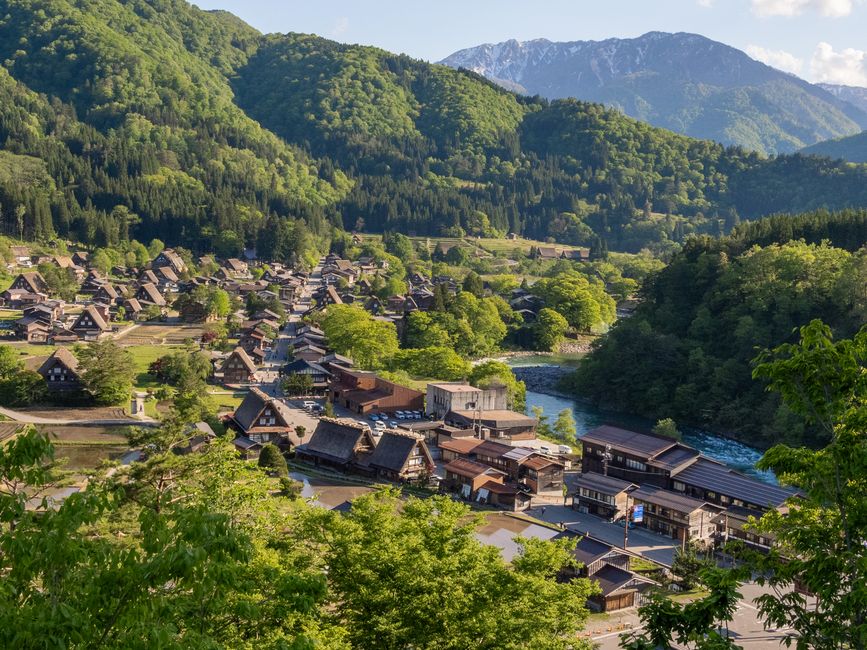
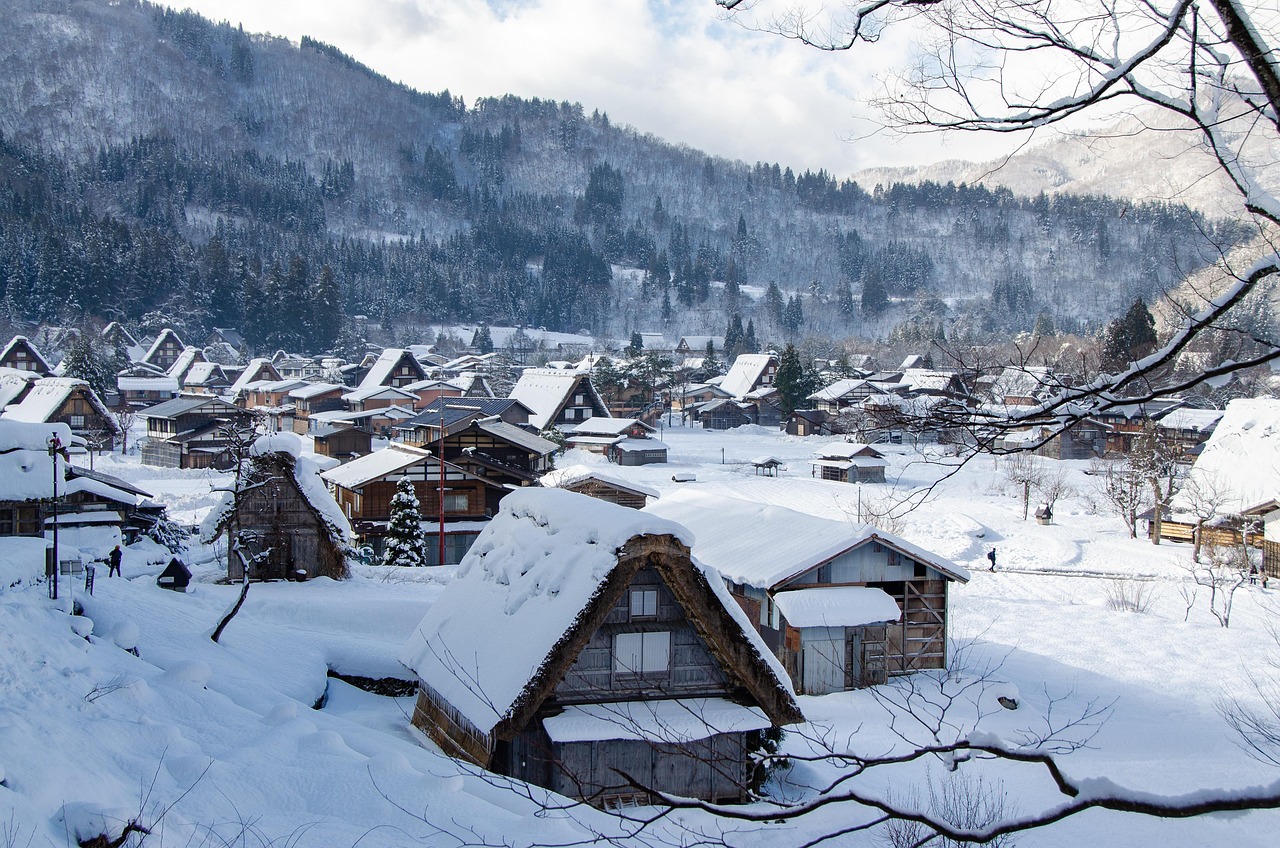
Shirakawa-go is a mountain village in the Shogawa River valley of Gifu Prefecture, famous for its gassho-zukuri farmhouses: huge, steep thatched roofs shaped like hands joined in prayer, built to shed the deep snow of one of Japan’s snowiest regions. Its main settlement, Ogimachi, keeps more than a hundred of these houses among rice paddies and vegetable plots, and together with the villages of Gokayama in neighboring Toyama it has been a UNESCO World Heritage site since 1995. It is also a real village, where about 1,500 people live and farm, so visitors are asked to come during the day, respect private homes and follow a few simple rules. Come for the view from the observation deck, a walk through the lanes, a farmhouse museum, a night in a thatched inn, and in winter, the famous snow and evening light-up. The best seasons are May to June for fresh green, October to early November for fall colors, and January to February for snow.
Right now in Shirakawa-go
- Wed9–17°C47–62°F1 mm rain
- Thu6–21°C44–70°FMostly clear
- Fri10–22°C50–72°FClear
- Mon 12 Oct Sports Day (スポーツの日)
Top tours in Shirakawa-go
See all tours for Shirakawa-go →
From local operators, with prices and reviews; you check availability and book on Viator, our partner. We may earn a commission at no extra cost to you. How we earn money
Shirakawa-go at a glance
- Best for: thatched gassho-zukuri farmhouses, rural scenery, a night in a farmhouse inn, snow scenes and photography.
- How long: 3–4 hours on a day trip; one night to see the village quiet in the evening and morning.
- Best time: May to June and October to early November, with highs of about 19–25 °C (66–77 °F); January and February for deep snow.
- Getting there: no railway; reserved Nohi Bus services from Takayama (about 50 minutes) and from Kanazawa (about 1 hour 15 minutes), and highway buses from Nagoya.
- Getting around: entirely on foot; a shuttle bus climbs to the observation deck.
- Fees to know: village parking costs ¥2,000 per car since October 2025; tour buses need a parking reservation from December 1, 2026; the 2027 winter light-up is reservation-only.
- Before you go: entry rules, rail passes, money and general safety are in our Japan travel guide; combine your visit with our Takayama and Kanazawa guides.
Shirakawa-go’s areas: where things are
The village of Shirakawa covers a long, forested valley; nearly all visitors come to Ogimachi, the largest gassho settlement, on the east bank of the Shogawa River.
Ogimachi village
A compact grid of lanes about 1.5 km (1 mile) long, with gassho houses, rice paddies, a temple, a shrine, small museums, cafés, souvenir shops and farmhouse inns. The houses face north and south so that the roofs dry evenly in the sun and catch the wind along the valley.
The bus terminal and Seseragi Park
The bus terminal sits at the south end of Ogimachi, and across the river, the village-run Seseragi Park parking lot with a tourist information center and toilets. A suspension bridge, Deai-bashi, links the parking lot with the village.
The observation deck
On a hill north of the village, the site of the old Ogimachi Castle gives the classic view of the thatched roofs in the valley. Walk up in about 15–20 minutes or take the shuttle bus from the village center.
Hirase Onsen and the south
About 30 minutes south by road, a hot spring village and the start of trails into the forests of Mount Hakusan.
Gokayama
The smaller gassho villages of Ainokura and Suganuma, across the prefectural border in Nanto, Toyama, about 30–40 minutes north. Part of the same World Heritage site and much quieter, with a few farmhouse inns.
Top things to see in Shirakawa-go
Ogimachi’s gassho-zukuri houses
The houses, many 200 to 300 years old, have roofs of thatch up to about 1 m (3 ft) thick, built without nails, tied with rope and straw. The large attic floors were used to raise silkworms, and the open hearth (irori) below keeps the thatch dry and free of insects with its smoke. Every 30 to 40 years a roof must be re-thatched, a job done by the whole community in a tradition of mutual help called yui. Wander the lanes, the rice paddies and the riverside path, but enjoy the houses from the outside unless they are open to visitors.
Wada House
The largest gassho house in Ogimachi and an Important Cultural Property, home of a wealthy family of village heads who traded saltpeter for gunpowder. You can see the living rooms, the irori and the upper floors where silkworms were raised; a small entry fee is charged.
Kanda House and Nagase House
Two more family houses open to visitors. Kanda House has four floors and a fine view of the roof structure; Nagase House, five stories tall, shows the family’s Buddhist altar and medical tools from the doctors who lived there.
Myozen-ji temple
A Buddhist temple with a thatched main hall, a thatched bell tower and a priests’ quarters in gassho style, with a small folk museum of farming tools.
The observation deck
The view over the roofs to the mountains is lovely in every season, but famous on winter evenings during the light-up. Arrive early in the day for clearer light and fewer crowds.
More classic sights
- Shirakawa-go Gassho-zukuri Minkaen: an open-air museum of about 25 gassho buildings moved from around the valley, across the river from Ogimachi, with craft demonstrations.
- Shirakawa Hachiman Shrine: the village shrine, home of the Doburoku Festival in mid-October, when cloudy homemade sake is shared.
- Deai-bashi: the suspension bridge over the Shogawa, with views of the river and village.
- Gokayama’s Ainokura and Suganuma: quieter thatched villages in Toyama.
Museums
- Wada House
Monuments
- Shirakawa-go (Ogimachi gassho village)
Churches and cathedrals
- Shirakawa Hachiman Shrine
Other things to do in Shirakawa-go
A night in a gassho inn
A handful of gassho houses are run as minshuku, family inns, where you sleep on futons on tatami, share bathrooms and eat a home-cooked dinner of mountain vegetables, river fish, tofu and sometimes Hida beef around the irori. Rooms are simple and few, so book months ahead, especially in winter; some inns don’t take credit cards and ask guests to arrive before dinner. Staying overnight lets you see the village after the day-trippers leave and in the early morning mist.
The winter light-up
On a few winter evenings, the village lights up its houses in the snow, a scene that has become one of Japan’s most photographed. It is a fully reserved event: according to the Shirakawa-go Tourist Association, the 2027 light-up takes place on January 11, 17, 24 and 31, 2027, from 5:30 p.m. to 7:30 p.m., and nobody can join without a booking made in advance; no tickets are sold on the day. Ways to attend are a night at an inn in the village (by lottery, with applications in October 2026), a reserved parking space for a car or taxi, a reserved route bus tour or a travel agency tour. On light-up days the Seseragi Park lot is reserved for booked buses from the afternoon.
Food and drink
Try gohei mochi, grilled rice cakes with sweet walnut miso, Hida beef croquettes and skewers from village stands, soba noodles, river fish grilled on sticks, and doburoku, the village’s unfiltered sake, also used in pudding and ice cream. Most cafés and restaurants in Ogimachi close by about 5 p.m.
Seasons and walking
Spring brings cherry blossoms in late April and rice planting in May; summer is green and lively with frogs and fireflies; October sees the rice harvest and fall colors, as well as the village’s annual fire drill, when water cannons spray the roofs. For trails in the mountains around the valley, see our guide to hiking.
Activities and best months
- CultureOgimachi is a lived-in village: visit 8:00-17:00 unless staying overnight, don't enter private land, fields or houses, take your rubbish home and smoke only in designated places; village car parks charge ¥2,000 a car.
Day trips from Shirakawa-go
- Gokayama: the thatched villages of Ainokura and Suganuma, about 30–40 minutes by bus, part of the same World Heritage site.
- Takayama: the old merchant town of Hida, about 50 minutes by bus. See our Takayama guide.
- Kanazawa: Kenroku-en garden and the teahouse districts, about 1 hour 15 minutes by bus. See our Kanazawa guide.
- Hirase Onsen: hot spring baths in the south of the village.
- Toyama and the Alpine Route: Toyama is about 1.5 hours by bus, the gateway to the Tateyama Kurobe Alpine Route.
Nearby destinations
Getting there and getting around
By bus
There is no railway. The easiest way in is by Nohi Bus and its partners on the Takayama–Shirakawa-go–Kanazawa/Toyama/Takaoka route. According to Nohi Bus, as of October 2026 one-way fares to Shirakawa-go are ¥2,800 (about US$18) from Takayama (about 50 minutes) or Kanazawa, ¥2,400 from Toyama and ¥2,200 from Takaoka, with 16 round trips a day to Takayama. Some services require reservations, which you can make online; book well ahead in peak seasons. Nohi Bus warns that delays of two hours or more can happen when traffic backs up waiting for parking in the village, in heavy snow, or when the expressway closes. Highway buses from Nagoya’s Meitetsu Bus Center take about 2.5–3 hours. Buses stop at the terminal at the south end of Ogimachi, with lockers for luggage.
By car and parking rules
Shirakawa-go has its own interchange on the Tokai-Hokuriku Expressway. Visitors must use the village-run parking lots; driving into the World Heritage village is restricted. According to the Village of Shirakawa:
- Fees: since October 1, 2025, parking at Seseragi Park and the overflow lots at Midashima and Terao costs ¥2,000 (about US$13) per car, ¥10,000 per bus and ¥500 per motorcycle, per visit. Surcharges were planned for peak periods such as Golden Week and the Obon holidays.
- Hours: the lots are open from 8 a.m. to 5 p.m. (last entry 4:30 p.m.), and the village asks day visitors to come between those hours.
- Reservations: cars can’t book a space on ordinary days; staff direct you to an overflow lot when Seseragi Park is full. In busy seasons, such as the fall colors, space for cars may be reduced.
- Tour buses: from December 1, 2026, bus parking at Seseragi Park becomes fully reserved in advance through the village’s “Shirakawa-go Parking” website, with no same-day bookings.
- Light-up days: only reserved vehicles are admitted in the evening.
From December to March, the roads need winter tires or chains, and heavy snow can close the expressway; most visitors come by bus in winter.
Getting around
Ogimachi is small enough to walk everywhere in a few hours. A shuttle bus runs from the village center to the observation deck. In winter, lanes are packed with snow and ice, so wear boots with good grip.
Rail passes
The JR Pass doesn’t cover the buses, but JR West’s Hokuriku Area Pass, ¥7,000 (about US$44) for 4 days as of October 2026, is useful for reaching Kanazawa and Toyama, and the nationwide Japan Rail Pass (¥50,000 (about US$315) for 7 days on the official site) covers the JR Hida to Takayama and the Hokuriku Shinkansen to Kanazawa.
When to go and how long to stay
Shirakawa-go has a heavy-snow mountain climate, with warm, wet summers and long winters. The table uses the Japan Meteorological Agency’s (JMA) 1991–2020 normals for its Shirakawa weather station, at 478 m (1,568 ft) near the village: average daily highs and lows and total precipitation (rain and melted snow).
| Month | Average high / low | Precipitation | What to expect |
|---|---|---|---|
| January | 3 °C (37 °F) / −4 °C (24 °F) | 282 mm (11.1 in) | Deep snow; very cold; light-up evenings in 2027 |
| February | 4 °C (39 °F) / −5 °C (23 °F) | 205 mm (8.1 in) | The deepest snow of the year, often about 1.7 m (5.7 ft) on the ground |
| March | 8 °C (47 °F) / −2 °C (28 °F) | 196 mm (7.7 in) | Snow lingers; cold |
| April | 16 °C (60 °F) / 3 °C (37 °F) | 152 mm (6.0 in) | Snow melting; cherry blossoms in late April |
| May | 22 °C (71 °F) / 9 °C (47 °F) | 129 mm (5.1 in) | Fresh green; rice planting; Golden Week crowds |
| June | 25 °C (77 °F) / 14 °C (57 °F) | 187 mm (7.4 in) | Rainy season usually from about June 6 (JMA normal for Tokai) |
| July | 28 °C (83 °F) / 19 °C (65 °F) | 278 mm (10.9 in) | Warm and humid; heavy rain possible; rainy season usually ends around July 19 |
| August | 30 °C (85 °F) / 19 °C (67 °F) | 191 mm (7.5 in) | The warmest month; green paddies; summer crowds |
| September | 25 °C (77 °F) / 15 °C (59 °F) | 215 mm (8.4 in) | Rice turns gold; typhoons possible |
| October | 19 °C (67 °F) / 9 °C (48 °F) | 168 mm (6.6 in) | Harvest and fall colors from mid- to late month; Doburoku Festival |
| November | 13 °C (55 °F) / 3 °C (37 °F) | 182 mm (7.1 in) | Colors linger early in the month; first snow |
| December | 6 °C (43 °F) / −2 °C (29 °F) | 283 mm (11.1 in) | Snow arrives; cold and gray |
Shirakawa gets about 2,460 mm (97 in) of precipitation a year, much of it as snow: the JMA’s normals add up to almost 10 m (32 ft) of snowfall over a winter, and the snow on the ground is normally deepest in February, at about 1.7 m (5.7 ft). The JMA’s normal rainy season for the Tokai region, which includes Gifu, runs from about June 6 to July 19; in 2026 it ran from about June 2 to July 9.
Weather month by month
Crowds: Shirakawa-go receives large numbers of tour groups, especially from late morning to mid-afternoon, in the fall colors and on snowy weekends. Arrive on an early bus, or stay overnight. Gokayama is a calmer alternative.
Half a day in Shirakawa-go
Arrive on a morning bus, take the shuttle to the observation deck, walk down into Ogimachi, visit the Wada House and Myozen-ji, and have gohei mochi and soba for lunch before an afternoon bus to Takayama or Kanazawa.
An overnight stay
Add a night in a gassho minshuku: walk the lanes at dusk and dawn, visit the open-air museum on the second morning, and continue to Gokayama by bus.
Where to stay in Shirakawa-go and taxes
- Ogimachi’s gassho minshuku: simple farmhouse inns with dinner and breakfast, the most memorable stay.
- Hirase Onsen: hot spring ryokan in the south of the village.
- Gokayama: a few farmhouse inns in quieter villages.
- Takayama or Kanazawa: the widest choice of hotels for a day trip.
Rooms in Ogimachi are few and usually priced per person with two meals. As of October 2026, the Village of Shirakawa does not list an accommodation tax; hot spring inns add a small bathing tax. If you stay in Takayama, the city’s accommodation tax applies (¥100 to ¥300 per person per night), and in Kanazawa, the city’s tax of ¥200 or ¥500 on rooms from ¥5,000.
What a trip to Shirakawa-go costs
Prices are approximate, for October 2026, converted at about ¥158 to the US dollar.
| Item | Typical cost |
|---|---|
| Nohi Bus from Takayama or Kanazawa, one way | ¥2,800 (about US$18) |
| Parking per car, per visit | ¥2,000 (about US$13) |
| Wada House or another open house | about ¥400–500 (about US$2.5–3.2) |
| Open-air museum (Minkaen) | about ¥600 (about US$3.8) |
| Gohei mochi or Hida beef croquette | ¥300–600 (about US$1.9–3.8) |
| Soba lunch | ¥1,000–1,800 (about US$6.3–11) |
| Gassho minshuku with dinner and breakfast, per person | ¥15,000–30,000 (about US$95–190) |
Practical tips for Shirakawa-go
- Reserve the bus: many services between Takayama, Shirakawa-go and Kanazawa need a seat reservation and sell out in peak season.
- Take your trash with you: there are no trash bins in the village.
- Respect homes: don’t enter yards, fields or houses, peek inside or open doors; most gassho houses are private.
- Fire rules: no smoking except in designated areas, and no fireworks or campfires; the thatch burns easily.
- No drones: the village asks visitors not to fly drones over the houses.
- Visitor hotline: the JNTO’s Japan Visitor Hotline, 050-3816-2787, answers in English 24 hours a day.
Safety
Shirakawa-go is very safe, and its main hazards come from the weather. In winter, deep snow and ice make lanes slippery, snow can slide from the steep roofs (keep clear of the eaves), and heavy snowfall can close the expressway or delay buses for hours. In summer and fall, heavy rain and typhoons can cause landslides on mountain roads. Fire is the greatest danger to the houses, which is why smoking and open flames are banned outside designated places. Bears live in the forests around the valley; stay on the paths. Japan is earthquake country: take cover in strong shaking, follow staff instructions, and keep the JNTO’s Safety Tips app on your phone. In an emergency, call 110 for the police or 119 for an ambulance or fire.
What to pack for Shirakawa-go
Waterproof boots with good grip, a warm coat, hat and gloves in winter; a rain jacket and comfortable shoes the rest of the year; cash for small shops and inns; and a small overnight bag if you stay in a minshuku, leaving big luggage in lockers at the bus terminal or in Takayama. Japan uses 100 V and two-pin type A plugs like the US.
Shirakawa-go travel FAQ
How do I get to Shirakawa-go?
By Nohi Bus from Takayama, about 50 minutes, or from Kanazawa, about 1 hour 15 minutes, for ¥2,800 each way as of October 2026; there is no train.
Do I need to reserve the bus to Shirakawa-go?
Many services require a reservation, and the others fill up in peak seasons, so book online as early as you can.
How much is parking in Shirakawa-go?
¥2,000 per car per visit since October 1, 2025, at the village-run lots, open from 8 a.m. to 5 p.m.; buses pay ¥10,000.
Do I need a parking reservation?
Not for ordinary cars on normal days. Tour buses need an advance reservation from December 1, 2026, and only reserved vehicles can come on light-up evenings.
When is the Shirakawa-go light-up in 2027?
On January 11, 17, 24 and 31, 2027, from 5:30 p.m. to 7:30 p.m. It is fully reserved in advance; no tickets are sold on the day.
Is there an entrance fee for Shirakawa-go?
No. Walking in the village is free; you pay for parking and to enter houses and museums that are open to visitors.
Can I stay overnight in a gassho house?
Yes, several farmhouses are run as minshuku with dinner and breakfast. Rooms are few, so book months ahead.
How long should I spend in Shirakawa-go?
Three to four hours is enough for a day trip; a night lets you see the village at its quietest.
When is the best time to visit Shirakawa-go?
May to June and October to early November for scenery; January and February for snow.
What are the rules for visitors?
Visit between 8 a.m. and 5 p.m. unless you are staying, take your trash home, don’t enter private property, don’t smoke outside designated areas, and don’t fly drones.
Plan your trip
Partner links: TravelerCenter may earn a commission if you book, at no extra cost to you.
🇯🇵 Useful Japanese phrases for Shirakawa-go
All 38 Japanese phrases: restaurant, hotel, emergencies, romance (printable) →
Sources · last reviewed 4 October 2026
Researched and last reviewed on 4 October 2026. Parking fees, hours, bus parking reservations and visitor rules: the Village of Shirakawa; 2027 light-up dates and booking: the Shirakawa-go Tourist Association; bus fares, routes and delays: Nohi Bus; Hokuriku Area Pass: JR West; JR Pass: the official Japan Rail Pass website; climate normals, snow and rainy season: the Japan Meteorological Agency (JMA); visitor hotline: JNTO; exchange rate: the US Federal Reserve. Population, house ages and history, sight descriptions, journey times, seasonal events, house admission prices, the absence of an accommodation tax and typical prices are general references or estimates, flagged for checking. Prices and hours change, so check the official sites before you go. For entry rules, money and general safety, see our Japan travel guide.
Also: vill.shirakawa.lg.jp · JMA normals 1991–2020, Shirakawa (climate)
Data: Weather: MET Norway (CC BY 4.0) · Rates: ECB · Holidays: Nager.Date · Costs: World Bank ICP and price levels · © OpenStreetMap contributors (ODBL) · Wikidata (CC0)