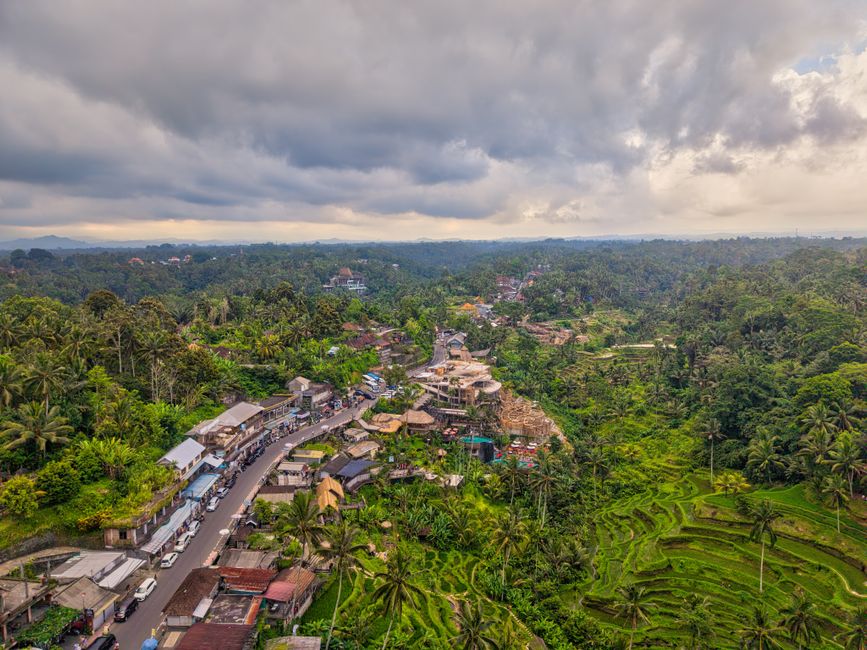
Ubud, in the green foothills of Gianyar about 35 km (22 miles) north of the airport, is Bali’s cultural heart: a former royal town surrounded by rice terraces, river gorges and villages of painters, carvers and dancers. Its center is compact and busy, with the palace, the market, temples, galleries and a steady stream of cafés, yoga studios and spas, but a short walk takes you along ridges and through rice fields where farmers still work the land by hand. Ubud is the best base for Bali’s inland temples and terraces, the Mount Batur sunrise hike and evening dance performances, and it is cooler and wetter than the coast. Come from April to October for drier weather; the rainy season, from about November to March, brings afternoon storms but turns the rice fields a vivid green.
Right now in Ubud
- Wed21–30°C70–85°FMostly clear
- Thu21–29°C70–85°F3 mm rain
- Fri21–29°C71–85°FMostly clear
Top tours in Ubud
See all tours for Ubud →
From local operators, with prices and reviews; you check availability and book on Viator, our partner. We may earn a commission at no extra cost to you. How we earn money
Ubud at a glance
- Best for: Balinese culture, temples and ceremonies, rice-terrace walks, dance, art museums and crafts, yoga, spas and food.
- How long: 3 days for the town and nearby sights; 4–5 with day trips to Mount Batur, East Bali or the highlands.
- Best time: April to October, the dry season; mornings are fresh and evenings mild all year.
- Getting there: about 1.5–2 hours by car from Ngurah Rai International Airport (DPS), depending on traffic; shuttle buses link Ubud with the south coast and Padang Bai.
- Getting around: walking in the center, Grab and Gojek where allowed, local drivers and scooters for the villages.
- Good to know: wear a sarong and sash in temples, and keep food and loose items out of reach of the Monkey Forest’s macaques.
- Before you go: the Bali Tourism Levy and temple etiquette are in our Bali travel guide; visas, the arrival card, money and general safety are in our Indonesia travel guide.
Ubud’s areas and where to stay
“Ubud” refers both to the village around the palace and to the wider district of 13 villages, including Peliatan, Mas, Sayan and Kedewatan. The center is walkable, but sidewalks are narrow and traffic is heavy at peak times, so choose your base carefully.
Ubud’s reputation as an art town goes back to the 1930s, when the local royal family welcomed foreign artists such as Walter Spies and Rudolf Bonnet, who worked with Balinese painters and helped found the Pita Maha artists’ association in 1936. Their influence, and the Balinese painters who followed, fill the town’s museums today.
Central Ubud
The streets around the palace, Jalan Monkey Forest, Jalan Hanoman and Jalan Raya Ubud have the market, the main temples, restaurants and most guesthouses. Everything is close, but it can be noisy and congested.
Penestanan and Campuhan
West of the center, across the Campuhan river, these villages of artists’ homes and rice fields are quieter, with yoga studios, cafés and the start of the Campuhan Ridge Walk, 10–15 minutes’ walk from town.
Sayan and Kedewatan
Luxury resorts and villas perched above the Ayung River gorge, with spectacular valley views; you’ll depend on hotel shuttles or drivers.
Peliatan and Pengosekan
South and east of the center, with good-value homestays, traditional dance troupes and painting studios, and easy access to the Monkey Forest.
Tegallalang and the north
Rice-terrace villages about 20–30 minutes north, with jungle villas and swing parks; peaceful at night but far from restaurants.
Top things to see in Ubud
Sacred Monkey Forest Sanctuary
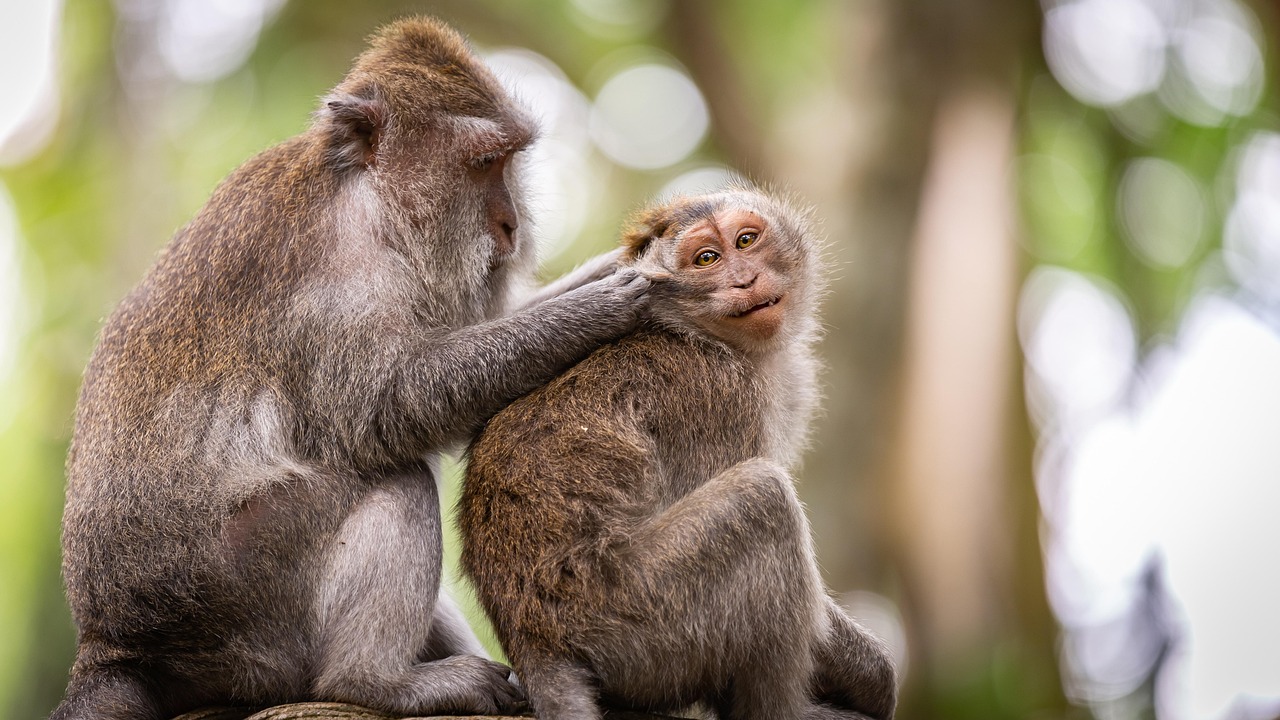
Officially the Mandala Suci Wenara Wana, and managed by the village of Padangtegal, this is a temple forest of giant banyan trees, mossy statues and ravines on the southern edge of town, home to hundreds of long-tailed macaques and three 14th-century temples. The monkeys are wild: don’t feed them, don’t carry food or plastic bags, secure sunglasses and phones, avoid eye contact and stay calm if one climbs on you. Bites can transmit rabies, so seek treatment immediately if you are scratched or bitten.
Ubud Palace and Ubud Market
Puri Saren Agung, still the residence of Ubud’s royal family, whose ancestors ruled the area before Dutch colonial rule, has carved gateways and courtyards open to visitors and hosts dance performances in the evenings. Across the road, the traditional market sells produce early in the morning and becomes an art and souvenir market later in the day; bargaining is expected but should stay polite.
Tegallalang rice terraces
The most famous terraces near Ubud, carved into a steep valley north of town and irrigated by the subak system. Go early in the morning to avoid crowds and heat; local farmers’ groups charge small donations or fees to walk through, and some cafés and swing parks have their own charges.
Tirta Empul and Gunung Kawi
At Tirta Empul, in Tampaksiring, Balinese Hindus bathe in spring-fed pools for purification; visitors can join with a proper sarong and should follow the order of the fountains and the instructions of temple staff. Nearby, Gunung Kawi has 11th-century royal shrines cut into the cliffs of a river valley, reached by more than 300 steps.
Campuhan Ridge Walk
A paved path along a grassy ridge between two rivers, starting near the Warwick Ibah hotel and Pura Gunung Lebah. It takes about an hour there and back; go at sunrise or late afternoon, as there is little shade.
More classic sights
- Goa Gajah: the Elephant Cave, an 11th-century sanctuary with a carved demon-mouth entrance and bathing pools.
- Pura Taman Saraswati: a lotus-pond temple in the center, with evening dance performances.
- ARMA, Neka and Puri Lukisan museums: the best collections of Balinese painting, from classical to modern.
- Blanco Renaissance Museum: the flamboyant home and gallery of the painter Antonio Blanco, above the Campuhan river.
- Jatiluwih: Bali’s UNESCO-listed subak rice terraces, about 1.5 hours west.
Other things to do in Ubud
Dance and music
Every evening, troupes perform Legong, Barong, kecak and other dances at the palace, temples and village halls, usually starting around 7 or 7:30 p.m.; tickets are sold at the door and by street vendors. Gamelan orchestras accompany most performances.
Food and drink
Ubud’s dining scene ranges from family warungs and night-market stalls to some of Bali’s most celebrated fine-dining restaurants, many with views over the rice fields or the river valleys. Try babi guling (spit-roast pork) at its famous local stalls, bebek betutu or crispy duck in the rice fields, nasi campur at a warung, and Balinese cooking classes that start with a market visit. Plant-based cafés, coffee roasters and smoothie bowls are everywhere. Many plantations around Ubud offer coffee tastings, including kopi luwak; the civet coffee trade has animal-welfare concerns, so many visitors skip it. Drink only labeled alcohol.
Arts, crafts and classes
The villages around Ubud specialize: wood carving in Mas, silver in Celuk, stone carving in Batubulan and painting in Penestanan and Batuan. Workshops teach batik, silver-making, offerings and Balinese cooking.
Yoga, wellness and spas
Ubud is one of Asia’s yoga capitals, with drop-in classes, retreats and sound-healing sessions, and spas offering Balinese massage at moderate prices.
Festivals and ceremonies
Ubud’s temples hold their anniversary festivals, odalan, every 210 days on the Balinese calendar, so there is almost always a ceremony somewhere nearby, with offerings piled high, gamelan and dancing. During Galungan and Kuningan, also every 210 days, the streets are lined with tall, curved bamboo penjor. The Ubud Writers and Readers Festival, held in October, brings authors and speakers from Indonesia and abroad to venues around town, and Nyepi, the Day of Silence, usually in March, closes everything for 24 hours; on the night before, Ubud’s villages parade their ogoh-ogoh monster figures through the center, one of the most spectacular sights of the Balinese year.
Cycling and rafting
Downhill bike tours start near Kintamani and roll through villages and rice fields to Ubud; white-water rafting runs on the Ayung River. See our cycling guide.
Day trips from Ubud
- Mount Batur sunrise: a pre-dawn hike of about two hours to the rim, around 1.5 hours’ drive north. PVMBG listed Batur at Level I (Normal) in early October 2026, with advice not to linger or stay overnight at the active crater. See our hiking guide.
- East Bali: Besakih, Bali’s mother temple, Lempuyang’s gates and the Tirta Gangga water palace, in a long day.
- Central highlands: Jatiluwih’s terraces, Ulun Danu Beratan temple and the twin lakes, with waterfalls around Munduk.
- Sidemen: a valley of rice fields and weaving villages under Mount Agung, about an hour east.
- The south coast: Uluwatu for the kecak dance at sunset, or a beach day in Sanur. See our Bali guide.
Nearby destinations
- Sanur19 km
- Canggu20 km
- Kuta26 km
- Bali27 km
- Nusa Penida39 km
- Gili Islands89 km
- Lombok116 km
- Bromo Tengger Semeru National Park259 km
Getting there and getting around
From the airport
Ubud has no airport or rail link. From Ngurah Rai International Airport, a pre-booked hotel transfer, an airport taxi or Grab and Gojek (from the designated pickup zone) takes about 1.5 hours outside rush hour and more than 2 hours in heavy traffic. Tourist shuttle buses connect Ubud with Kuta, Sanur and Padang Bai for the boats to the Gilis and Lombok.
Around town
Central Ubud is walkable, though sidewalks are narrow and uneven; carry a flashlight at night. Some village transportation cooperatives restrict app pickups in the center, so you may need to walk to a pickup point or use a local driver. A car with driver for a day of temple visits is the best way to see the surroundings. Scooters are convenient but traffic is dense; ride only if you are licensed and wear a helmet.
When to go and how long to stay
Ubud lies about 200 m (650 ft) above sea level, so it is a little cooler and noticeably wetter than the south coast, with more afternoon storms in the rainy season. BMKG has no published WMO normals for Ubud. The table uses the nearest official data for Bali’s south: average daily highs and lows are 1991–2020 averages of BMKG’s observations at Ngurah Rai Airport, from NOAA’s global daily records, and rainfall and rain days are BMKG’s long-term normals for Denpasar (1961–1990), as published by the World Meteorological Organization. Expect Ubud to be slightly cooler and wetter than these figures.
| Month | Average high / low (south Bali) | Rain (rain days), Denpasar | What to expect in Ubud |
|---|---|---|---|
| January | 31 °C (88 °F) / 25 °C (77 °F) | 345 mm (13.6 in), 27 days | Wettest month; heavy afternoon rain; New Year crowds |
| February | 31 °C (88 °F) / 25 °C (76 °F) | 274 mm (10.8 in), 22 days | Wet and humid; few visitors |
| March | 31 °C (88 °F) / 25 °C (77 °F) | 234 mm (9.2 in), 20 days | Rain easing; Nyepi usually falls this month |
| April | 31 °C (88 °F) / 25 °C (77 °F) | 88 mm (3.5 in), 9 days | Fresh and green; dry season begins |
| May | 31 °C (87 °F) / 24 °C (76 °F) | 93 mm (3.7 in), 8 days | Sunny, pleasant walking weather |
| June | 30 °C (86 °F) / 24 °C (75 °F) | 53 mm (2.1 in), 6 days | Dry; cool nights |
| July | 29 °C (85 °F) / 24 °C (75 °F) | 55 mm (2.2 in), 4 days | Dry and breezy; peak season |
| August | 29 °C (85 °F) / 24 °C (74 °F) | 25 mm (1.0 in), 4 days | Driest; busiest month |
| September | 30 °C (86 °F) / 24 °C (74 °F) | 47 mm (1.9 in), 8 days | Dry and calmer; excellent month |
| October | 31 °C (88 °F) / 24 °C (76 °F) | 63 mm (2.5 in), 12 days | Warmer; Ubud Writers and Readers Festival |
| November | 32 °C (89 °F) / 25 °C (77 °F) | 179 mm (7.0 in), 16 days | Rains begin; low season |
| December | 31 °C (88 °F) / 25 °C (77 °F) | 276 mm (10.9 in), 22 days | Wet; busy over Christmas and New Year |
BMKG’s outlook for the 2026–27 rainy season, published in September 2026, expected the rains across Bali to start later than normal, in November or December 2026, because of a very strong El Niño, to peak in January in central Bali, and to be shorter than usual.
Three days in Ubud
Day one, the Monkey Forest early, the palace and market, lunch in a warung, the museums in the afternoon and a dance performance at night. Day two, sunrise at Tegallalang, then Tirta Empul, Gunung Kawi and Goa Gajah with a driver. Day three, the Campuhan Ridge Walk at dawn, a cooking class and a massage.
Five days with day trips
Add the Mount Batur sunrise hike and a long day to East Bali or the central highlands.
Where to stay in Ubud
- Central Ubud: guesthouses and boutique hotels within walking distance of everything.
- Penestanan and Campuhan: quieter, near the ridge walk and yoga studios.
- Sayan and Kedewatan: luxury resorts above the Ayung gorge.
- Peliatan: family homestays and good value.
- Tegallalang: villas among the rice terraces, best with your own transportation.
Book ahead for July, August and the Christmas and New Year period. Many homestays are family compounds; respect the household temple and ceremonies.
What a trip to Ubud costs
Prices are approximate, for October 2026, converted at about 17,900 rupiah to the US dollar.
| Item | Typical cost |
|---|---|
| Bali Tourism Levy, per person, once per visit | 150,000 rupiah (about US$8.40) |
| Sacred Monkey Forest Sanctuary entry, adult | about 80,000–100,000 rupiah (about US$4.50–5.60) |
| Tirta Empul or Goa Gajah entry | 50,000–75,000 rupiah (about US$2.80–4.20) |
| Evening dance performance | 100,000–150,000 rupiah (about US$5.60–8.40) |
| Nasi campur at a warung | 25,000–45,000 rupiah (about US$1.40–2.50) |
| Balinese cooking class | 400,000–700,000 rupiah (about US$22–39) |
| Balinese massage, 60 minutes | 150,000–300,000 rupiah (about US$8.40–17) |
| Car with driver, full day | 600,000–900,000 rupiah (about US$34–50) |
| Homestay double, per night | 300,000–600,000 rupiah (about US$17–34) |
| Valley-view resort, per night | 3,000,000 rupiah and up (about US$168 and up) |
Practical tips for Ubud
- Temple dress: carry a sarong and sash; at Tirta Empul, change into the provided bathing sarong.
- Monkeys: no food, no plastic bags, and keep sunglasses in a zipped bag.
- Ceremonies: processions may close roads; wait patiently and don’t block the way.
- Offerings: step around the canang sari placed on sidewalks.
- Go early: visit Tegallalang, Tirta Empul and Lempuyang before 8 a.m.
- Cash: carry small notes for entrance donations, parking and sarong rental.
Safety
Ubud is safe and relaxed. The main hazards are traffic on narrow roads with few sidewalks, slippery steps at temples and waterfalls in the rainy season, and the macaques. Rabies is present on Bali: avoid touching monkeys and stray dogs, and get post-exposure treatment at a clinic immediately after any bite or scratch. “Bali belly” is common, so drink bottled water and eat at busy, clean places. If you ride a scooter, you need a motorcycle license and an International Driving Permit, and a helmet. Avoid unlabeled arak because of the risk of methanol. For the Batur hike, go with a licensed guide and check the volcano’s alert level on PVMBG’s MAGMA Indonesia. In an emergency, call 112.
What to pack for Ubud
Light clothes that cover shoulders and knees for temples, a sarong, comfortable walking shoes for ridges and terraces, sandals, insect repellent, a light rain jacket or umbrella from November to March, a warm layer for sunrise hikes and cool evenings, and a reusable water bottle. Indonesia uses 230 V and round two-pin plugs.
Ubud travel FAQ
How many days do I need in Ubud?
Three days for the town, the Monkey Forest, the temples and rice terraces nearby; four or five with Mount Batur and day trips.
How do I get from Bali airport to Ubud?
By pre-booked transfer, airport taxi or Grab and Gojek, in about 1.5 hours, or longer in heavy traffic.
Is the Ubud Monkey Forest safe?
Generally yes, if you follow the rules: no food, no plastic bags, no touching or staring at the monkeys, and secure your belongings. Get treatment immediately after any bite or scratch.
What should I wear to Ubud’s temples?
A sarong and sash with shoulders covered. Most temples lend them; at Tirta Empul you’ll need to change into a bathing sarong to enter the pools.
When is the best time to visit Ubud?
April to October, the dry season. May, June and September are quieter than July and August.
When is the rainy season in Ubud?
Usually from November to March, and Ubud gets more rain than the coast. BMKG expected the 2026–27 rains to begin late, around November or December 2026.
Can I walk around Ubud?
Yes, in the center and to the Campuhan Ridge and rice fields, but sidewalks are narrow; use a driver for Tegallalang, Tirta Empul and the outlying sights.
When are the dance performances in Ubud?
Every evening, at the palace, temples and village halls, usually from around 7 or 7:30 p.m.
Can I climb Mount Batur from Ubud?
Yes. Tours pick you up around 2 a.m. for a sunrise hike with a licensed guide; check PVMBG’s alert level beforehand.
Is Ubud better than Seminyak or Canggu?
They are different: Ubud is for culture, nature and wellness; Seminyak and Canggu are for beaches, surfing and nightlife. Most visitors split their stay.
Plan your trip
Partner links: TravelerCenter may earn a commission if you book, at no extra cost to you.
🇮🇩 Useful Indonesian phrases for Ubud
All 38 Indonesian phrases: restaurant, hotel, emergencies, romance (printable) →
Sources · last reviewed 4 October 2026
Researched and last reviewed on 4 October 2026. The Bali Tourism Levy: the Bali provincial government’s Love Bali website; guidelines for foreign tourists: Bali Governor Circular Letter 7 of 2025; Batur’s alert level and recommendations: PVMBG’s MAGMA Indonesia; the subak World Heritage site: UNESCO; the 2026–27 rainy season outlook: BMKG; temperatures: BMKG observations at Ngurah Rai Airport via NOAA GHCN-Daily (1991–2020 averages); rainfall normals: BMKG for Denpasar via the WMO World Weather Information Service (1961–1990); exchange rate: Bank Indonesia. Entrance fees, performance times, journey times and typical prices are general references or estimates, flagged for checking. Prices and hours change, so check before you go. For entry rules, money and general safety, see our Indonesia travel guide.
Data: Weather: MET Norway (CC BY 4.0) · Air quality: OpenAQ · Rates: ECB · Costs: World Bank ICP and price levels · Wikidata (CC0)