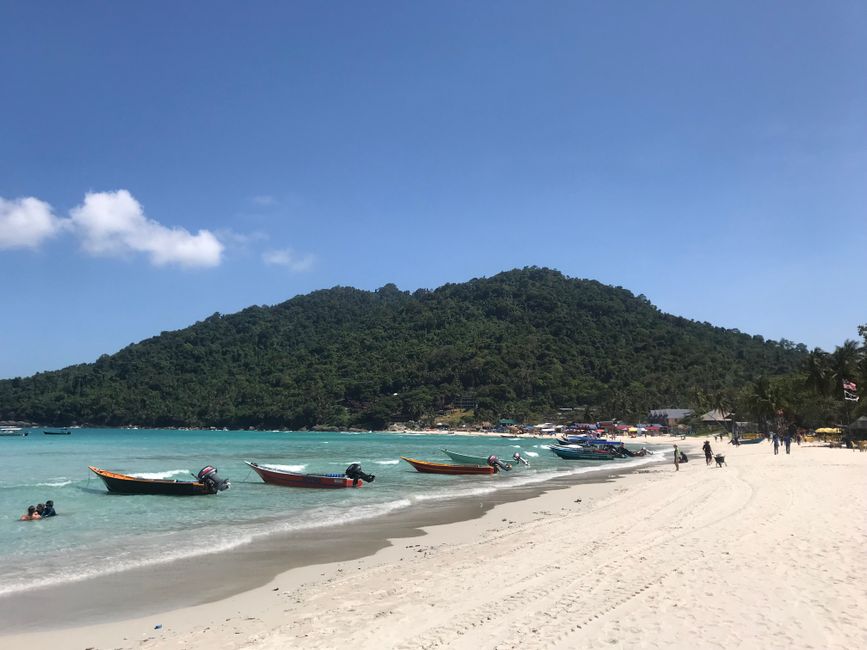
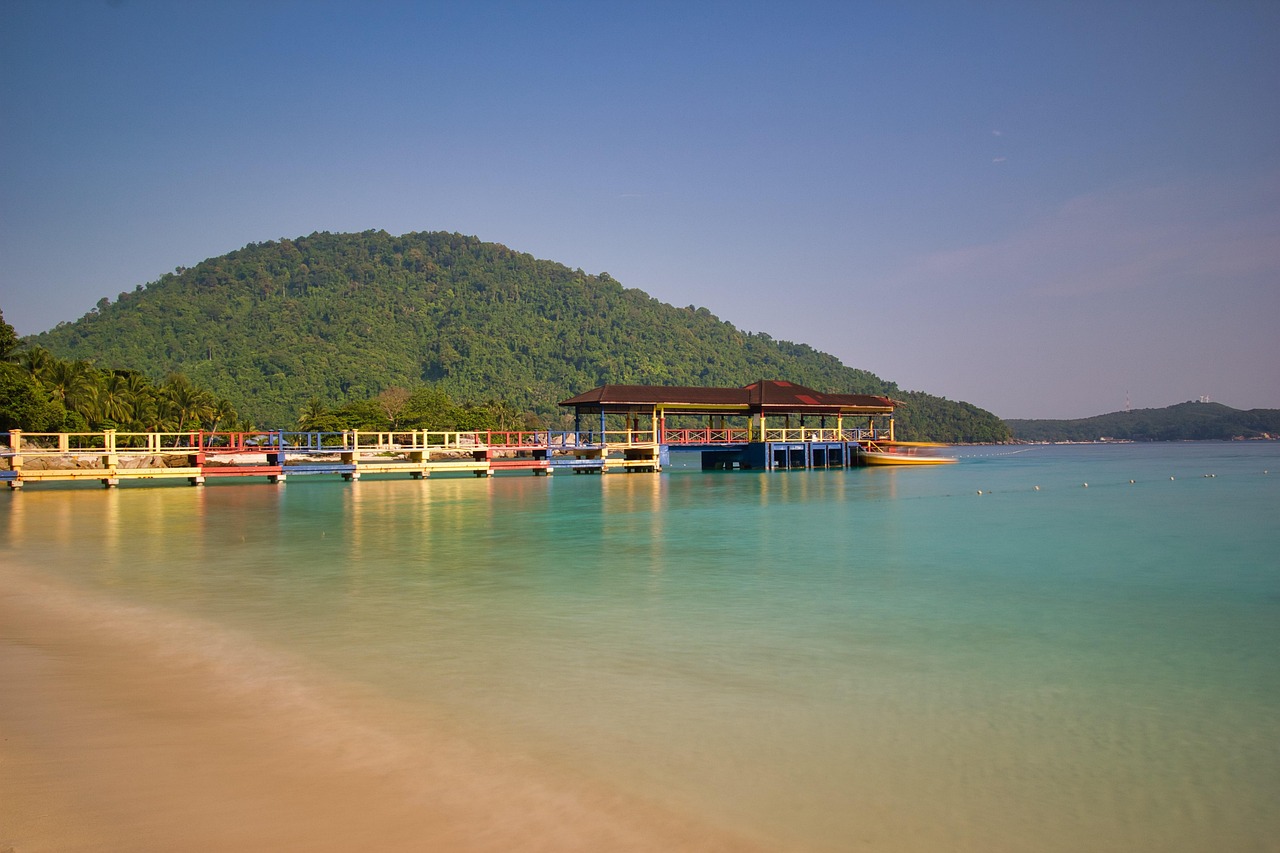
The Perhentian Islands are two small, jungle-covered islands off the coast of Terengganu, in the South China Sea near the northeastern tip of Peninsular Malaysia: Perhentian Besar (“big”) and Perhentian Kecil (“small”). There are no roads and no cars, just white-sand bays, turquoise water, coral reefs, guesthouses and a few resorts linked by forest paths and water taxis. The islands lie within a marine park, and the snorkeling and diving are among the best in Malaysia, with reef sharks, green and hawksbill turtles and colorful corals close to shore. Life on the Perhentians follows the monsoon: from roughly November to February or March, the northeast monsoon brings rough seas and heavy rain to the east coast, boats are reduced or suspended, and most resorts close. The season to go is from about March to October, when the sea is calm and clear.
Right now in Perhentian Islands
- Wed27–28°C80–82°F6 mm rain
- Thu27–29°C80–84°F3 mm rain
- Fri27–28°C81–82°F3 mm rain
Top tours in Perhentian Islands
See all tours for Perhentian Islands →
From local operators, with prices and reviews; you check availability and book on Viator, our partner. We may earn a commission at no extra cost to you. How we earn money
The Perhentian Islands at a glance
- Best for: snorkeling, diving, beaches, turtles and reef sharks, a car-free island escape; Kecil for backpackers and divers, Besar for families and couples.
- How long: 3 to 5 nights; longer if you are learning to dive.
- Best time: from about March to October, with April to August usually the calmest and clearest; the islands largely close during the northeast monsoon, roughly November to February.
- Getting there: by speedboat from Kuala Besut jetty on the mainland, about 30 to 45 minutes; the nearest airport is at Kota Bharu, about an hour’s drive from Kuala Besut.
- Getting around: on foot along jungle trails and beaches, and by water taxi between bays and islands.
- Fees to know: the islands are part of a marine park; according to the Department of Fisheries, visitors without a Malaysian identity card pay a conservation charge of RM30 (RM15 for children aged 6 to 12 and seniors aged 60 and over).
- Before you go: the Malaysia Digital Arrival Card (MDAC), visa-free stays, money and general safety are in our Malaysia travel guide.
The Perhentian Islands: where things are
The two main islands are separated by a narrow channel, a few minutes across by boat. Neither has roads; boats drop passengers directly at the beaches or at small jetties, and you will often wade ashore with your bags.
Perhentian Kecil: Long Beach
Long Beach (Pasir Panjang), on the east coast of Perhentian Kecil, is the liveliest beach on the islands, with a long stretch of white sand, budget chalets and mid-range resorts, dive schools, cafés and beach parties in the season. The surf can be stronger here in the early and late season.
Perhentian Kecil: Coral Bay and the west coast
A 15-minute walk across the island through the forest, Coral Bay (Aur Bay) on the west coast is smaller and calmer, with sunsets, good snorkeling off the rocks and a mix of chalets and restaurants. Other quiet bays on Kecil, such as Petani Beach and Mira Beach, have a single resort each and are reached by boat. The fishing village on the southwest coast of Kecil is the islands’ only real settlement.
Perhentian Besar
The larger island is quieter and more family-oriented, with resorts and chalets along a string of beaches on the west coast facing Kecil, linked by paths over the headlands, and a few bays on the south and east coasts. It has calmer water and more comfortable accommodation, and good snorkeling directly off many of the beaches.
Top things to see on the Perhentian Islands
Snorkeling with turtles and sharks
You don’t need to go far: coral and fish begin a few meters from many beaches. Green and hawksbill turtles graze on seagrass in several bays, and blacktip reef sharks patrol the shallows, especially at Shark Point, off Perhentian Besar. Snorkeling trips by boat visit several spots in a half day, often including Turtle Point, Shark Point, the coral gardens off the lighthouse and Rawa island. Do not touch or chase turtles or stand on coral. See our snorkeling guide.
Diving
The Perhentians are one of Malaysia’s most popular places to learn to dive, with many dive schools offering courses at reasonable prices. Well-known dive sites include Tokong Laut (Temple of the Sea), a pinnacle with soft corals; Tiga Ruang, with swim-throughs; D’Lagoon; and the Sugar Wreck, a sunken freighter covered in marine life. Visibility is best in the middle of the season. See our diving guide.
The beaches
Every bay has its own character: Long Beach for a social scene, Coral Bay for sunsets, Petani and Mira for seclusion on Kecil, and the beaches along Besar’s west coast for calm swimming with children. On Besar, the beach at the southern end, sometimes called Turtle Beach, is a nesting site; follow any closures or rules for nesting areas.
Jungle trails
Footpaths cross both islands, linking beaches through the rainforest, with monitor lizards, squirrels, fruit bats and hornbills. The walk between Long Beach and Coral Bay on Kecil is the easiest; longer trails lead to the windmills on Kecil and around the coast of Besar. Trails can be steep and muddy; wear proper shoes and carry water. See our hiking guide.
More classic sights
- Kampung Pasir Hantu: the small fishing village on Perhentian Kecil, with a mosque, school and local cafés.
- Romantic Beach and Adam and Eve Beach: tiny secluded coves on Kecil, reached by boat or steep trails.
- The lighthouse point: a viewpoint at the northern tip of Besar.
- Sunset at Coral Bay: the best place to watch the sun go down over the mainland hills.
Snorkeling, diving and boat trips
Water taxis wait on every main beach and charge fixed fares per trip, usually posted on boards; prices are higher after dark. Snorkeling tours, sold by guesthouses and dive shops, usually include masks, fins and life jackets, but bring your own mask if you can. Dive schools offer open-water courses, fun dives and night dives; choose a well-reviewed, certified operator, check the equipment and ask about the nearest decompression chamber and evacuation arrangements. Trips are run only in suitable sea conditions. See our boat trips guide.
Other things to do on the Perhentian Islands
Food and drink
Food on the islands is simple and a little more expensive than on the mainland, as everything comes by boat: grilled fish and seafood barbecues on the beach at night, nasi goreng and mee goreng, roti canai for breakfast and Western dishes at the resorts. Fresh fruit shakes are everywhere. Terengganu is a conservative state, and alcohol is not widely sold; some resorts and restaurants on Kecil serve beer, and bringing your own may be restricted, so ask your accommodation.
Kayaking and paddleboarding
Kayaks and stand-up paddleboards can be rented on most beaches; calm mornings are best for paddling around the headlands to small coves.
Turtle and reef conservation
Green and hawksbill turtles nest on some Perhentian beaches, mainly from about May to September. Local conservation projects patrol nesting beaches, relocate eggs to hatcheries and run reef clean-ups, coral monitoring and education programs, and some accept short-term volunteers or visitors for talks. If you see a nesting turtle, keep your distance, stay behind it, use no lights or flash and let it return to the sea undisturbed.
Relaxing
There are no malls, nightclubs or roads, and on many beaches electricity in budget chalets runs only in the evening. Bring a book and slow down.
Day trips and onward travel
- Pulau Redang: a larger island to the south with resorts and coral reefs, also a marine park with the same conservation charge and the same monsoon closure, reached by boat from Merang or Kuala Terengganu.
- Pulau Lang Tengah and Pulau Kapas: smaller resort islands further south along the coast.
- Kota Bharu: the capital of Kelantan, known for its central market, Malay crafts and food, about an hour from Kuala Besut.
- Kuala Terengganu: the state capital, with the Crystal Mosque and a riverside Chinatown, about 2 hours by road.
- Kuala Lumpur: by overnight bus or via a flight from Kota Bharu or Kuala Terengganu. See our Kuala Lumpur guide.
Nearby destinations
- Cameron Highlands218 km
- George Town (Penang)272 km
- Genting Highlands296 km
Getting there and getting around
By boat from Kuala Besut
All boats to the Perhentians leave from Kuala Besut, a fishing town on the Terengganu coast. Speedboats run several times a day in the season, taking about 30 to 45 minutes to the islands; they drop passengers at the main beaches and resort jetties. Return tickets are sold at agencies around the jetty; keep your ticket and confirm the pickup time with your accommodation. The conservation charge for the marine park is collected before departure. Boats may be delayed or canceled in rough weather, and services are greatly reduced or stop entirely during the northeast monsoon.
By air and road to Kuala Besut
The nearest airport is Sultan Ismail Petra Airport in Kota Bharu (KBR), with flights from Kuala Lumpur of about an hour; a taxi or Grab to Kuala Besut takes about an hour. Sultan Mahmud Airport in Kuala Terengganu (TGG) is about two hours away by road. Express buses run overnight from Kuala Lumpur to Kuala Besut in about eight to nine hours, and some go via Jertih, the nearest bus hub. Kuala Besut has guarded car parks if you drive.
On the islands
Walk, or take water taxis between beaches and across the channel. There are no cars or motorbikes for visitors. Pack light, as you may carry your bags over sand and through shallow water.
When to go and how long to stay
The Perhentians have two seasons. According to the Malaysian Meteorological Department (MetMalaysia), the northeast monsoon, from November to March, brings heavy rain, strong winds and rough seas to the east coast of Peninsular Malaysia, while the southwest monsoon, from late May to September, is relatively dry on this coast; the east coast states receive their heaviest rain in November, December and January, and June and July are their driest months. In practice, most resorts and boat services close from about November to February, opening again in March. The islands have no long-term weather station, so the table uses MetMalaysia’s 1991–2020 normals for its Kota Bharu station, about 60 km (37 miles) to the northwest, as submitted to the World Meteorological Organization (WMO).
| Month | Average high / low | Rain (days with 1 mm or more) | What to expect |
|---|---|---|---|
| January | 30 °C (85 °F) / 24 °C (74 °F) | 150 mm (5.9 in), 10 days | Monsoon; most resorts closed |
| February | 30 °C (87 °F) / 24 °C (74 °F) | 69 mm (2.7 in), 5 days | Drier, but seas can still be rough; few places open |
| March | 31 °C (89 °F) / 24 °C (75 °F) | 140 mm (5.5 in), 7 days | Season opens; visibility improving |
| April | 33 °C (91 °F) / 25 °C (76 °F) | 92 mm (3.6 in), 6 days | Calm and clear; excellent diving |
| May | 33 °C (91 °F) / 25 °C (77 °F) | 116 mm (4.6 in), 8 days | Peak conditions; turtle nesting begins |
| June | 33 °C (91 °F) / 25 °C (76 °F) | 138 mm (5.4 in), 10 days | Calm seas; school holidays bring crowds |
| July | 32 °C (90 °F) / 24 °C (76 °F) | 155 mm (6.1 in), 10 days | Busy high season; book ahead |
| August | 32 °C (90 °F) / 24 °C (75 °F) | 158 mm (6.2 in), 12 days | Busy; haze possible |
| September | 32 °C (89 °F) / 24 °C (75 °F) | 163 mm (6.4 in), 12 days | Quieter; still good conditions |
| October | 31 °C (88 °F) / 24 °C (75 °F) | 267 mm (10.5 in), 16 days | End of season; seas getting rougher |
| November | 30 °C (86 °F) / 24 °C (75 °F) | 677 mm (26.6 in), 20 days | Northeast monsoon; the wettest month; most places closed |
| December | 29 °C (85 °F) / 24 °C (75 °F) | 572 mm (22.5 in), 18 days | Monsoon; islands largely closed |
Kota Bharu gets about 2,700 mm (106 in) of rain a year, more than 40% of it in November and December. If you travel at the start or end of the season, in March or October, check that your accommodation and boats are operating.
Two nights
Arrive in the morning, snorkel off your beach in the afternoon and watch the sunset at Coral Bay; next day, take a half-day boat snorkeling trip to Shark Point and Turtle Point, and walk the jungle trail between beaches.
Four or five nights
Add a discover-scuba session or an open-water course, a kayak around the headlands and a lazy day on a quiet beach on Besar.
Where to stay on the Perhentian Islands
- Long Beach, Kecil: budget chalets, hostels and mid-range resorts; lively and social.
- Coral Bay, Kecil: chalets and small resorts; calmer, with sunsets.
- Petani and Mira beaches, Kecil: single secluded resorts, reached by boat.
- Perhentian Besar’s west coast: family resorts and chalets with calm water.
Book ahead from June to August and during Malaysian school holidays, when the islands are busy. Many resorts include meals or boat transfers in packages. Foreign guests pay Malaysia’s tourism tax of RM10 per room per night.
What a trip to the Perhentian Islands costs
Prices are approximate, for October 2026, converted at about RM4.08 to the US dollar.
| Item | Typical cost |
|---|---|
| Speedboat, Kuala Besut to the islands, return | RM70–100 (about US$17–25) |
| Marine park conservation charge, adult without MyKad | RM30 (about US$7.35) |
| Water taxi between beaches | RM10–25 per person (about US$2.50–6) |
| Half-day snorkeling trip | RM50–90 (about US$12–22) |
| Fun dive, including equipment | RM100–150 (about US$25–37) |
| Open-water diving course | RM1,200–1,600 (about US$295–390) |
| Simple chalet, per night | RM80–200 (about US$20–49) |
| Resort double, per night | RM300–700 (about US$74–172) |
| Tourism tax, per room per night | RM10 (about US$2.45) |
Practical tips for the Perhentian Islands
- Bring enough cash: ATMs on the islands are few and unreliable, and many small places accept only cash.
- Check the season: confirm that your resort and the boats are running if you travel in March or October.
- Pack light: you may have to wade ashore with your bags.
- Respect local customs: Terengganu is conservative; cover up away from the beach, and keep swimwear for the beaches.
- Protect the reef: use reef-safe sunscreen, don’t stand on coral and never touch turtles or sharks.
Safety
The Perhentians are peaceful, but they are remote, and there is no hospital on the islands, only basic clinics; serious medical problems need a boat transfer to the mainland. The biggest seasonal factor is the northeast monsoon: from about November to February, the sea becomes dangerously rough, boat services are cut back or stop and most accommodation closes; do not try to reach the islands in a storm. In the season, watch for boat traffic when snorkeling (swim close to shore or with a float and a guide), wear a life jacket on boats and avoid swimming at night. Jellyfish and sea urchins occur at times; wear water shoes in rocky shallows and seek first aid for stings. Currents can be strong off headlands. Dive only with certified operators and within your limits. Lock valuables in your room, as petty theft happens in budget chalets. In an emergency, call 999 and contact your accommodation, which can arrange a boat.
What to pack for the Perhentian Islands
Swimwear and a rash guard, reef-safe sunscreen, a hat, your own snorkel mask, water shoes, a dry bag for boat trips, a headlamp for the evenings, insect repellent, a light rain jacket, modest clothing for the mainland and enough cash for your stay. Malaysia uses 240 V and British-style three-pin plugs (type G). See our water shoes and wetsuits guides.
Perhentian Islands travel FAQ
When are the Perhentian Islands closed?
Most resorts and boat services close during the northeast monsoon, from about November to February, when MetMalaysia reports heavy rain and rough seas on the east coast. The season usually runs from March to October.
What is the best time to visit the Perhentian Islands?
April to August, when seas are calm and the water is clearest. June to August is the busiest period.
How do I get to the Perhentian Islands?
Travel to Kuala Besut in Terengganu, by road from Kota Bharu airport (about an hour) or by overnight bus from Kuala Lumpur, then take a speedboat to the islands in about 30 to 45 minutes.
Is there a fee to visit the Perhentian Islands?
Yes. The islands are part of a marine park, and visitors without a Malaysian identity card pay a conservation charge of RM30 for adults and RM15 for children aged 6 to 12 and seniors, according to the Department of Fisheries.
Which is better, Perhentian Kecil or Perhentian Besar?
Kecil is cheaper and more social, with Long Beach and Coral Bay; Besar is quieter and better for families, with more comfortable resorts.
Can you see turtles and sharks at the Perhentians?
Yes. Green and hawksbill turtles and blacktip reef sharks are commonly seen while snorkeling, especially at Turtle Point and Shark Point.
Are there ATMs on the Perhentian Islands?
There are very few, and they are unreliable. Bring enough cash from the mainland for your stay.
Can you drink alcohol on the Perhentian Islands?
It is limited. Terengganu is a conservative state; a few resorts and restaurants, mainly on Kecil, serve beer. Ask your accommodation.
Is the Perhentian Islands good for learning to dive?
Yes. It is one of Malaysia’s most popular places for open-water courses, with calm, warm water and many dive schools.
How many days do I need on the Perhentian Islands?
Three to five nights; longer if you are taking a diving course.
Plan your trip
Partner links: TravelerCenter may earn a commission if you book, at no extra cost to you.
🇲🇾 Useful Malay phrases for Perhentian Islands
All 38 Malay phrases: restaurant, hotel, emergencies, romance (printable) →
Sources · last reviewed 4 October 2026
Researched and last reviewed on 4 October 2026. Marine park conservation charges: the Department of Fisheries Malaysia; monsoon seasons and the east coast’s rainfall pattern: the Malaysian Meteorological Department (MetMalaysia); climate normals: MetMalaysia’s Kota Bharu station, via the World Meteorological Organization; exchange rate: the US Federal Reserve. Resort and boat closure months, boat times and fares, dive sites, ATMs, alcohol availability, the tourism tax rate and typical prices are general references or estimates, flagged for checking; the Terengganu state tourism website could not be read. Prices and hours change, so check with your accommodation before you go. For entry rules, money and general safety, see our Malaysia travel guide.
Data: Weather: MET Norway (CC BY 4.0) · Sea temperature: NOAA CoastWatch · Rates: ECB · Costs: World Bank ICP and price levels · Wikidata (CC0)