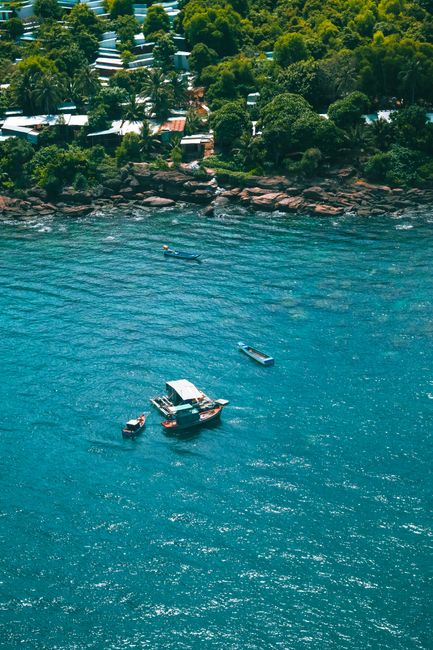
Phu Quoc is Vietnam’s largest island, a long, mountainous triangle of forest, pepper farms and white-sand beaches in the Gulf of Thailand, closer to Cambodia than to the Vietnamese mainland. Once a sleepy fishing island known for its fish sauce, it has become one of Asia’s fastest-growing beach destinations, with big resorts, a vast cable car to the An Thoi islands, theme parks and sunset bars, while its national park, quiet coves and fishing villages still give glimpses of the old island. Phu Quoc has a special entry rule: foreign visitors who stay only on the island can visit for up to 30 days without a visa. Since July 2025, it has been a special administrative zone of An Giang province, and it will host the APEC Economic Leaders’ Week in November 2027, so new roads, an expanded airport and other projects are under construction. The best time to go is the dry season, from November to April; from May to October, the southwest monsoon brings heavy rain and rough seas, especially on the west coast.
Right now in Phu Quoc (Duong Dong)
- Wed25–29°C77–83°F16 mm rain
- Thu25–28°C77–82°F18 mm rain
- Fri24–26°C76–79°F20 mm rain
Top tours in Phu Quoc
See all tours for Phu Quoc →
From local operators, with prices and reviews; you check availability and book on Viator, our partner. We may earn a commission at no extra cost to you. How we earn money
Phu Quoc at a glance
- Best for: beaches and sunsets, snorkeling and island-hopping, resorts and family holidays, seafood, and visa-free short stays.
- How long: 4 to 5 days; a week if you want to explore the north and south of the island at a slow pace.
- Best time: November to April, the dry season; December to March has the calmest seas.
- Getting there: Phu Quoc International Airport has flights from Hanoi, Ho Chi Minh City and many Asian cities; ferries cross from Rach Gia and Ha Tien on the mainland.
- Getting around: Grab and Xanh SM cars, taxis, resort shuttles, rented motorbikes and boats to the southern islands.
- Good to know: the 30-day visa exemption applies only if you stay on Phu Quoc; to visit the mainland, you need an e-visa or another valid entry permission.
- Before you go: the e-visa, other visa-free stays, money and general safety are in our Vietnam travel guide.
Phu Quoc’s areas: where things are
Phu Quoc is about 50 km (30 miles) from north to south. The main town and most hotels are on the west coast, facing the sunset; the east coast is wilder and quieter.
Duong Dong
The island’s main town, halfway down the west coast, has the night market, the Dinh Cau shrine on its rock at the river mouth, local markets, fish-sauce factories, budget hotels and seafood restaurants. It is lively and practical rather than beautiful.
Long Beach (Bai Truong)
South of Duong Dong, Long Beach runs for about 20 km (12 miles) and is lined with resorts, hotels, bars and restaurants, with famous sunsets. The airport is just inland, and a new urban area of hotels and convention buildings is growing at its southern end.
The north: Ganh Dau and Bai Dai
The north of the island has the Phu Quoc National Park’s forests, the quiet beach of Bai Dai, the fishing village of Ganh Dau and a huge resort area of hotels, a theme park, a safari park and the “Grand World” entertainment district. It feels remote outside the resorts.
The south: An Thoi, Sao Beach and Hon Thom
The southern tip has An Thoi port, the departure point for boats to the An Thoi archipelago, the Sun World cable car to Hon Thom island, the Mediterranean-style “Sunset Town,” and some of the island’s best beaches, including Sao Beach and Khem Beach.
The east coast
The east coast, with the fishing village of Ham Ninh and long, quiet beaches, has fewer hotels and is the place to see a more traditional side of the island.
Top things to see on Phu Quoc
The beaches
Sao Beach (Bai Sao), on the southeast coast, has fine white sand and turquoise water, with beach restaurants and water sports; it is best in the dry season. Long Beach is the main sunset beach, with beach bars and plenty of space. Bai Dai in the north and Ong Lang on the west coast are quieter, with clear water and a few resorts. Khem Beach in the south is fronted by luxury resorts. See our beaches guide.
The An Thoi islands and snorkeling
Off the southern tip, the An Thoi archipelago is a chain of small islands with coral reefs, reached by boat from An Thoi. Day trips usually visit two or three islands, such as May Rut, Gam Ghi and Mong Tay, for snorkeling, swimming and a seafood lunch. The water is clearest from about December to April. See our snorkeling and boat trips guides.
Hon Thom cable car
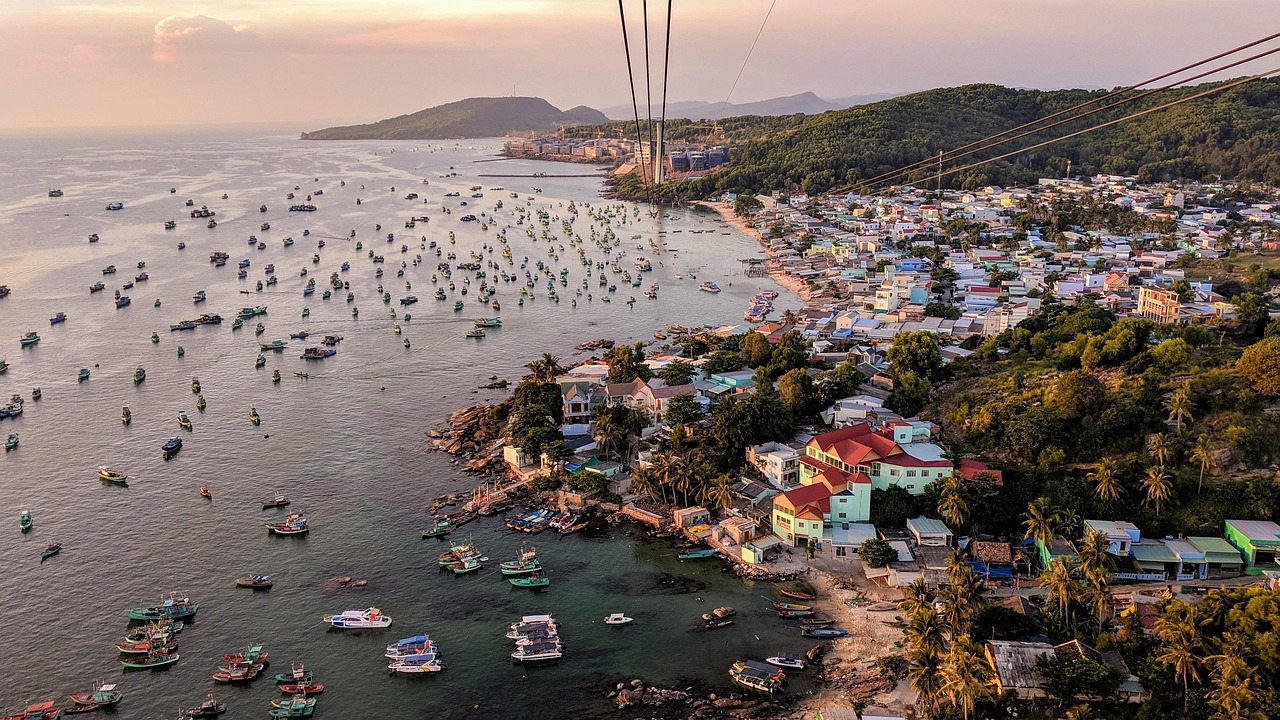
The cable car run by Sun World from An Thoi to Hon Thom island, about 7.9 km (4.9 miles) long, glides over the sea and the fishing boats of the archipelago in about 15 minutes. Hon Thom has a water park, an amusement park and a beach. Tickets usually combine the cable car with the parks; go early to avoid the long midday queues.
Phu Quoc National Park
More than half of the island is protected forest, part of the Kien Giang Biosphere Reserve recognized by UNESCO. Trails lead into the northern hills, and the road through the park is a scenic drive. The Tranh and Da Ban streams have small waterfalls, which flow only in the rainy season. See our hiking guide.
Fish sauce, pepper and pearls
Phu Quoc’s fish sauce (nuoc mam) is famous throughout Vietnam; several family factories in and around Duong Dong let you see the giant wooden fermentation barrels. Black-pepper farms dot the interior, and pearl farms and showrooms are found on the west coast.
Phu Quoc Prison
The Phu Quoc Prison relic site, known as the Coconut Tree Prison, near An Thoi, was a prisoner-of-war camp during the French and American wars. Its reconstructed cages and exhibits are harrowing.
More classic sights
- Dinh Cau shrine: a small temple to the goddess of the sea on a rock at the mouth of the Duong Dong River, popular at sunset.
- Duong Dong night market: seafood grills, ice cream rolls and souvenirs every evening.
- Ham Ninh fishing village: stilt houses, a long pier and fresh crab on the east coast.
- Ho Quoc Pagoda: a hillside pagoda with views over the sea on the southeast coast.
- Sunset Town and the Kiss Bridge: colorful promenades and an evening show at the southern tip.
Beaches, diving and the sea
Phu Quoc’s seas depend on the monsoon. From November to April, the northeast monsoon brings calm, clear water to the west coast and the southern islands, ideal for swimming, snorkeling and diving. From May to October, the southwest monsoon brings waves, murkier water and strong currents to the west coast, while the east coast becomes calmer; some boat trips are canceled in rough weather. Dive centers run trips to the southern islands from about November to May. The reefs are modest compared with Southeast Asia’s best but still have corals, reef fish and the occasional turtle. See our diving guide.
Other things to do on Phu Quoc
Food and drink
Seafood is the island’s pride: try grilled squid, sea urchins grilled with spring onion oil, herring salad (goi ca trich), rolled in rice paper with herbs and coconut, bun quay, noodles stirred to order with fish and shrimp paste, and ghe, small blue crabs. Everything is dipped in Phu Quoc fish sauce or salt with black pepper and lime. The local liqueur is sim wine, made from rose-myrtle berries. Eat at the Duong Dong night market, the seafood restaurants of Ham Ninh and the beach bars of Long Beach.
Theme parks and family attractions
The northern resort area has a theme park, a water park and a safari park, and Hon Thom has another water park; they are popular with families. Grand World, nearby, is an evening entertainment district of canals, shops and shows.
Sunset and nightlife
Sunsets over the Gulf of Thailand are the island’s daily ritual, best from Long Beach, Dinh Cau or the beach clubs of Ong Lang and Sunset Town. Nightlife is relaxed: beach bars, cocktail bars in Duong Dong and evening shows in the resort areas.
Day trips around the island
- The south: take the Hon Thom cable car, spend the afternoon at Sao Beach, and watch the sunset from Sunset Town.
- The An Thoi islands: a full-day boat trip with snorkeling and lunch from An Thoi port.
- The north: drive through the national park to Ganh Dau and Bai Dai, with a swim and a seafood lunch.
- The east coast: Ham Ninh fishing village, the pepper farms and Ho Quoc Pagoda.
- The mainland: with an e-visa, take the ferry to Ha Tien or Rach Gia to explore the Mekong Delta; if you are using the island’s visa exemption, you cannot leave Phu Quoc for the mainland.
Nearby destinations
- Kampot47 km
- Sihanoukville67 km
- Can Tho169 km
- Phnom Penh182 km
- Ko Chang272 km
Getting there and getting around
By air
Phu Quoc International Airport (PQC), just inland from Long Beach, is about 15 minutes from Duong Dong and 30 to 45 minutes from the north or south of the island. It has frequent domestic flights from Ho Chi Minh City (about 1 hour), Hanoi (about 2 hours), Da Nang and other cities, and international flights from Singapore, Bangkok, Kuala Lumpur, Seoul, Busan, Taipei, Hong Kong and other Asian cities. According to the government, the airport is being expanded to handle far more passengers ahead of APEC 2027. An 18 km (11-mile) metro line from the airport to the APEC Convention Center is scheduled for completion in the second quarter of 2027.
By sea
Fast ferries and car ferries cross from Rach Gia (about 2.5 to 3 hours) and Ha Tien (about 1.5 to 2 hours) on the mainland, docking at Bai Vong on the east coast; schedules depend on the weather and crossings can be rough from May to October.
The 30-day visa exemption
According to the government, a special visa exemption allows foreign tourists to stay on Phu Quoc for up to 30 days without a visa, provided they remain on the island throughout their stay. It applies to visitors flying in directly on international flights and, generally, to those who connect through an international airport in Ho Chi Minh City or Hanoi without leaving the transit area; confirm the connection rules with your airline, as some itineraries require passing through immigration on the mainland, which would need a visa. If you want to visit the rest of Vietnam, apply for the e-visa instead.
Around the island
Grab and Xanh SM cars, and metered taxis, are easy to find in Duong Dong and Long Beach; many resorts run free shuttles to town and the night market. Renting a motorbike is popular but carries the usual risks, and a license valid in Vietnam is required. Roads are good on the main routes, but some coastal and forest roads are rough and dark at night.
When to go and how long to stay
Phu Quoc is hot all year, with daytime highs of about 30–33 °C (86–91 °F) and nights around 23–26 °C (73–79 °F). The dry season, from November to April, is sunny, with calm seas on the west coast; December to March is the peak season, and prices are highest around Christmas, New Year and Tet. The rainy season, from May to October, brings heavy downpours, often in the afternoon or overnight, rough seas on the west coast and more insects, but also lower prices and green landscapes. Vietnam’s National Center for Hydro-Meteorological Forecasting does not publish long-term climate normals for Phu Quoc through the World Meteorological Organization, so the rainfall figures below are satellite-based estimates from NASA’s POWER climate data (2001–2020 averages) and should be taken as approximate.
| Month | Rain (estimate) | Sea on the west coast | What to expect |
|---|---|---|---|
| January | 25 mm (1.0 in) | Calm and clear | Dry, sunny and breezy; peak season |
| February | 16 mm (0.6 in) | Calm and clear | The driest month; Tet on February 6 in 2027 |
| March | 51 mm (2.0 in) | Calm | Hot and sunny; excellent for snorkeling |
| April | 109 mm (4.3 in) | Calm | The hottest month; first showers |
| May | 221 mm (8.7 in) | Getting rough | Rainy season begins |
| June | 310 mm (12.2 in) | Rough | Wet and windy on the west coast |
| July | 346 mm (13.6 in) | Rough | One of the wettest months; boat trips may be canceled |
| August | 293 mm (11.5 in) | Rough | Wet; the east coast is calmer |
| September | 346 mm (13.6 in) | Rough | Very wet; low prices |
| October | 247 mm (9.7 in) | Calming late in the month | Rains easing |
| November | 146 mm (5.7 in) | Calming | Dry season returns |
| December | 62 mm (2.4 in) | Calm and clear | Sunny; holiday crowds |
That adds up to roughly 2,200 mm (85 in) of rain a year, almost all from May to October.
4 days on Phu Quoc
Day one, settle in on Long Beach and watch the sunset. Day two, the southern islands by boat with snorkeling. Day three, the Hon Thom cable car, Sao Beach and Sunset Town. Day four, a fish-sauce factory, a pepper farm, Ham Ninh and the Duong Dong night market.
A week or more on Phu Quoc
Add time in the north, with the national park, Ganh Dau and Bai Dai, a dive trip, the theme parks if you are traveling with children, and slow days on the beach.
Where to stay on Phu Quoc
- Long Beach: the widest choice of hotels and resorts, close to the airport and Duong Dong, with sunset views.
- Duong Dong: budget hotels and guesthouses near the night market and restaurants.
- Ong Lang: small boutique resorts on a quieter stretch of the west coast.
- The north (Bai Dai and Ganh Dau): large resorts and theme parks; good for families who stay put.
- The south (Khem Beach, Sao Beach and An Thoi): luxury resorts, Sunset Town and easy access to the islands.
What a trip to Phu Quoc costs
Prices are approximate, for October 2026, converted at about 26,000 dong (VND) to the US dollar.
| Item | Typical cost |
|---|---|
| Seafood meal at the night market | 150,000–400,000 VND per person (about US$6–15) |
| Bowl of bun quay | 50,000–80,000 VND (about US$1.90–3.10) |
| Island snorkeling tour with lunch | 600,000–1,200,000 VND (about US$23–46) |
| Hon Thom cable car with water park | about 600,000–900,000 VND (about US$23–35) |
| Grab car from the airport to Duong Dong | 100,000–180,000 VND (about US$3.85–7) |
| Motorbike rental, per day | 150,000–250,000 VND (about US$6–10) |
| Fast ferry from Rach Gia or Ha Tien | 250,000–400,000 VND (about US$10–15) |
| Mid-range resort double, per night | 1,500,000–4,000,000 VND (about US$58–154) |
| Guesthouse double, per night | 400,000–800,000 VND (about US$15–31) |
Practical tips for Phu Quoc
- Know the visa rule: the 30-day exemption covers Phu Quoc only; leave the island and you need a visa.
- Pick the right coast: in the rainy season, east-coast beaches are calmer than the west coast.
- Bring insect repellent: sand flies on some beaches and mosquitoes inland can bite hard.
- Go early to Hon Thom: the cable car and parks get crowded by late morning.
- Carry cash in the north and east: small restaurants and fishing villages may not take cards.
Safety
Phu Quoc is relaxed and generally safe. The main risks are on the water and the roads. On July 11, 2026, a tourist boat capsized in bad weather off the island, with heavy casualties among Indian visitors, according to the government. Choose licensed operators, check the weather before boat trips, make sure life jackets are provided and wear one on speedboats and small boats, especially from May to October, when the southwest monsoon brings sudden squalls and rough seas. On the west coast, waves and rip currents can be strong in the rainy season; swim at beaches with lifeguards or stay out of the water. On the roads, traffic is lighter than in the cities, but construction trucks, sand and unlit roads make night riding risky. Helmets are compulsory, and a motorbike license valid in Vietnam is required, such as an international driving permit issued under the 1968 Convention with your home license. Drink only sealed, branded spirits, as methanol-contaminated alcohol has caused poisonings in Vietnam. In an emergency, call 113 for police, 114 for fire and 115 for an ambulance.
What to pack for Phu Quoc
Swimwear, reef-safe sunscreen, a hat and sunglasses, light clothes, insect repellent, water shoes for rocky coves, a dry bag for boat trips, and a light rain jacket from May to October. Vietnam uses 220 V, with sockets for flat (type A) and round (type C) two-pin plugs. See our water shoes, rain jackets and travel adapters guides.
Phu Quoc travel FAQ
Do I need a visa for Phu Quoc?
Not for a stay of up to 30 days if you remain on the island, under Phu Quoc’s special visa exemption. To visit the mainland too, you need an e-visa or another valid entry permission.
Can I fly to Phu Quoc via Ho Chi Minh City without a visa?
Generally yes, if you stay in the international transit area and connect to Phu Quoc, but rules depend on how your ticket is issued; check with your airline before you travel.
What is the best time to visit Phu Quoc?
November to April, the dry season, with the calmest seas from December to March. May to October is wet, with rough seas on the west coast.
How many days do I need on Phu Quoc?
Four to five days for the beaches, the southern islands and the cable car; a week to explore the north and east at a slower pace.
Which is the best beach on Phu Quoc?
Sao Beach for white sand and turquoise water, Long Beach for sunsets and choice, and Bai Dai or Ong Lang for quiet.
How long is the Hon Thom cable car?
About 7.9 km (4.9 miles), from An Thoi to Hon Thom island, a ride of about 15 minutes.
Is Phu Quoc part of Kien Giang or An Giang?
Since July 2025, Phu Quoc has been a special administrative zone of An Giang province, which absorbed the former Kien Giang province.
What is Phu Quoc famous for?
Its fish sauce, black pepper, pearls, seafood, white-sand beaches and sunsets.
Can I take a ferry to Phu Quoc?
Yes, from Rach Gia or Ha Tien on the mainland to Bai Vong on the east coast; crossings can be rough or canceled in the rainy season.
Is Phu Quoc hosting APEC?
Yes. The APEC Economic Leaders’ Week is scheduled for November 2027 on Phu Quoc, and major construction is under way ahead of it.
Plan your trip
Partner links: TravelerCenter may earn a commission if you book, at no extra cost to you.
🇻🇳 Useful Vietnamese phrases for Phu Quoc
All 38 Vietnamese phrases: restaurant, hotel, emergencies, romance (printable) →
Sources · last reviewed 4 October 2026
Researched and last reviewed on 4 October 2026. The 30-day Phu Quoc visa exemption, the e-visa, the island’s special-zone status in An Giang, APEC 2027, the airport expansion, the planned metro line and the July 2026 boat accident: the Government of Vietnam’s news portal; rainfall estimates: NASA POWER climatology (2001–2020), as no official long-term normals for Phu Quoc are published through the WMO; exchange rate: Vietcombank. Transit rules for the visa exemption, the temperature range, the cable car length, the biosphere reserve, beach and reef details, ferry times, airport routes and typical prices are general references or estimates, flagged for checking; driving-license and helmet rules and the methanol information are from the UK government’s factual safety pages. Prices and hours change, so check the official sites before you go. For entry rules, money and general safety, see our Vietnam travel guide.
Data: Weather: MET Norway (CC BY 4.0) · Sea temperature: NOAA CoastWatch · Rates: ECB · Costs: World Bank ICP and price levels · Wikidata (CC0)