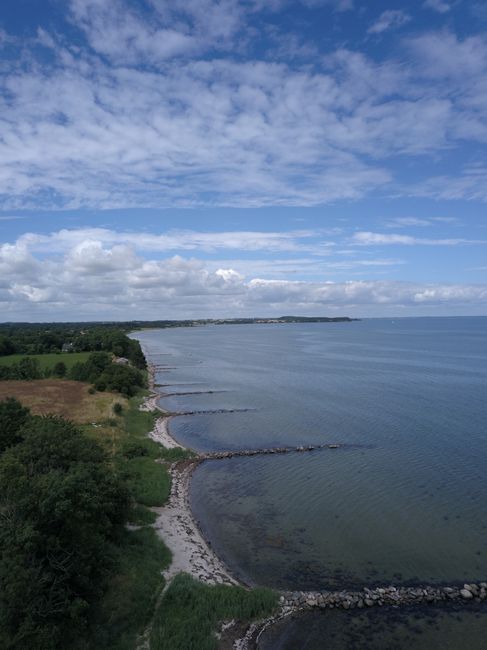
Bornholm is Denmark’s sunny Baltic island, closer to Sweden and Poland than to Copenhagen, and unlike anywhere else in the country: granite cliffs instead of flat farmland, fishing villages of half-timbered houses, white round churches built as fortresses, and some of the finest sand in Europe at Dueodde. Hammershus, a vast castle ruin, guards the north; Gudhjem and Svaneke smoke herring and blow glass; and quiet lanes cross the forested interior. Most visitors arrive on the fast ferry from Ystad in Sweden, 80 minutes from Rønne, with a through ticket from Copenhagen. Come between late May and mid-September, and give it four days to a week.
Right now in Bornholm (Rønne)
- Wed 12–16°C 53–62°F Cloudy
- Thu 12–15°C 53–60°F 2 mm Light rain
- Fri 10–14°C 51–56°F 4 mm Rain
Weather: MET Norway (CC BY 4.0) · Sea temperature: NOAA CoastWatch · Rates: ECB
Top tours in Bornholm
See all tours for Bornholm →
From local operators, with prices and reviews; you check availability and book on Viator, our partner. We may earn a commission at no extra cost to you. How we earn money
Bornholm at a glance
- Best months: June to early September for beaches and long evenings; May and late September for walking, cycling and space. Summer afternoons average about 19–21 °C (DMI, Bornholm Airport).
- Days needed: 2–3 for Hammershus, Gudhjem and one beach; 5–7 to cycle the coast, visit the round churches and take the boat to Christiansø.
- Getting there: fast ferry from Ystad (Sweden) to Rønne in 80 minutes, with combined train-and-ferry or bus-and-ferry tickets from Copenhagen; an overnight ferry from Køge; a ferry from Sassnitz in Germany; and flights from Copenhagen.
- Getting around: BAT buses on a loop of routes from Rønne, timed with the ferries; more than 230 km of signposted cycle routes; a car for the most freedom.
- Budget level: Danish prices, so not cheap, but holiday houses, campsites and smokehouse lunches keep costs down. July and early August are busiest and dearest.
Bornholm’s coasts and towns, and who each one suits
Bornholm is about 40 km across, so nowhere is more than an hour’s drive away.
- Rønne and the west coast: the island’s capital and ferry port, with cobbled lanes of low, colourful houses, Bornholms Museum and most of the shops. Practical without a car.
- Allinge, Sandvig and Hammeren (the north): rocky coast, Hammershus, the Hammeren headland and small harbours. Ideal for walkers and climbers, and the base for the Folkemødet festival in June.
- Gudhjem and the north-east: a steep harbour village with the Helligdommen cliffs, the art museum and the boat to Christiansø next door. The prettiest base, but busy in July.
- Svaneke and the east: Denmark’s easternmost town, full of craft studios, glass-blowers and food producers. Good for foodies and couples.
- Nexø, Snogebæk, Balka and Dueodde (the south-east): long sandy beaches, holiday houses, campsites and shallow water. The best choice for families with small children.
- The interior: the Almindingen forest, the Ekkodalen valley, farmland and the round churches of Østerlars, Nylars, Nyker and Olsker.
Top things to see on Bornholm
Prices and hours below are as of October 2026 and are in Danish kroner (DKK); many places shorten their hours or close from late October to Easter.
Hammershus
On a cliff 74 m above the sea at the northern tip of the island stands Hammershus, one of the largest castle ruins in Northern Europe and Bornholm’s biggest attraction. It was built for the Archbishop of Lund, probably in the 1290s, and later held by the Danish crown and, from 1525, for 50 years by Lübeck. Walk the steep medieval cobbles up for views of the Hammeren headland. The ruin is open 24 hours a day all year and free. The award-winning visitor centre, 200 m east, has a free exhibition, a restaurant and a shop. Parking at the main car park on Slotslyngsvej costs DKK 35 for six hours from the Saturday before Palm Sunday until the end of the October school holidays, and is free the rest of the year. Buses and the round-island cycle route stop here; the ruin is not suitable for wheelchairs or pushchairs.
The round churches
Four of Denmark’s seven medieval round churches are on Bornholm, built in the 12th century as churches and refuges from raiders, with thick white walls and arrow slits. Østerlars, the largest and oldest, from about 1150, stands on a hill between Gudhjem and the forest; inside, a hollow central pillar is painted with 14th-century frescoes of the life of Christ. In 2026 it is open to visitors from 1 May to 19 October, Monday to Saturday 9:00–17:00 and on Sundays after the service, with shorter winter hours; entry is DKK 30 for adults, DKK 10 for 10- to 18-year-olds and free for under-10s. It closes for church services and ceremonies; check its online calendar. Olsker is the tallest, on high ground in the north; Nylars, near Rønne, is the best preserved; and Nyker is the smallest. All are working parish churches.
Gudhjem and the Helligdommen cliffs
Gudhjem (“God’s home”) tumbles down a steep slope to a tiny harbour, with red roofs, hollyhocks and the chimneys of its smokehouse; Bornholm’s first smokehouse opened here in 1866. A coastal path runs north-west for about 5 km past the Helligdomsklipperne, sea cliffs and rock pillars up to about 22 m high, to Bornholms Kunstmuseum, the island’s art museum, in a light-filled building above the sea. It shows the painters drawn by Bornholm’s light, such as Oluf Høst and Kristian Zahrtmann. In 2026 it opens Tuesday to Sunday 10:00–17:00 from April to October and Friday to Sunday 10:00–17:00 from November to March; adults pay DKK 100, students DKK 50 and under-18s go free.
Svaneke
Svaneke, Denmark’s easternmost town, is a protected cluster of ochre and red merchants’ houses around a small harbour and square. It is Bornholm’s craft and food capital: watch glass-blowers at work, buy hand-pulled boiled sweets and caramels, try the local brewery’s beers, and eat at the smokehouse on the rocks by the sea. Look out for the unusual water tower designed by Jørn Utzon, the architect of the Sydney Opera House.
Dueodde and the south-coast beaches
Dueodde, at Bornholm’s southern tip, is the island’s most famous beach: a wide strand of sand so fine that it was once used in hourglasses, backed by high dunes and pine forest, with shallow water that is ideal for children. Lonely Planet has listed it among Europe’s best beaches. Nearby, the Bornholmertårnet (Bornholm Tower), a former Cold War listening post of the Danish intelligence service with a 70 m tower and a lift, tells the story of Bornholm between East and West.
Christiansø and Frederiksø
About 18 km north-east of Bornholm lie the Ertholmene, a group of rocky islets that include Denmark’s easternmost point. Two of them, Christiansø and Frederiksø, joined by a footbridge, were turned into a naval fortress by King Christian V from 1684 and have hardly changed since: granite walls, two round towers and a car-free community of about 90 people. The islands are a bird sanctuary, with Europe’s largest eider duck colony and guillemots and razorbills on neighbouring Græsholmen. Christiansøfarten’s ferry leaves from Gudhjem and takes about an hour; in October 2026 there is a daily departure at 10:00, with more sailings in summer. As of October 2026, a return costs DKK 260 for adults and DKK 145 for children 6–14 (summer fares, to 18 October), DKK 220 and DKK 120 in winter, and DKK 320 and DKK 180 from late June to early August; under-6s travel free. Dogs and other animals are not allowed on the islands, bikes cannot be taken on board, and the towers cost DKK 75 to enter. You can stay overnight at the inn or the campsite.
Nature
- Almindingen
- Christiansø
- Dueodde Beach
- Helligdomsklipperne
Churches and cathedrals
- Østerlars Round Church
Museums
- Bornholm Art Museum
Castles and forts
- Hammershus
Nature, cycling and the coastal path
Cycling
Bornholm is one of the best islands in Northern Europe to cycle, with more than 230 km of signposted routes, many on old railway lines and forest tracks; follow the dark green signs. National cycle route 10 loops right around the island The north and east are hilly, so many visitors rent an e-bike; bike hire is available in Rønne and the main towns, and some BAT buses carry bikes. See our cycling guide.
Walking the coast
A coastal path runs almost all the way round Bornholm. The finest stretches are in the north: around the Hammeren headland past the quarry lake of Opalsøen, from Sandvig past Hammershus to the cliff of Jons Kapel, and from Gudhjem past the Helligdommen cliffs. See our hiking guide.
Almindingen, Ekkodalen and the bison
Almindingen, in the middle of the island, is one of Denmark’s largest forests, with lakes, the ruins of Lilleborg castle and the island’s highest point, Rytterknægten (about 162 m), crowned by a lookout tower. The Ekkodalen (Echo Valley) is a long rift valley with steep rock walls. In a 200-hectare enclosure, the Bisonskoven, a small herd of European bison has roamed since 2012; walk the forest roads and marked paths and allow at least an hour, keep 100 m from the animals and keep dogs on a lead.
Beaches and the sea
The south and south-east coasts have the sand: Dueodde, Balka, Sømarken, Boderne and Sandkås in the north. The north has rocks to swim from, granite cliffs for guided climbing and sea kayaking along the coast in calm weather. See our beaches guide and our boat trips guide.
Activities and best months
- Beaches and swimmingAlmost 50 km of sandy beach run from Hasle south to Balka; the south-coast beaches are shallow and good for small children. Dueodde, at the southern tip, is the best known: sand so fine it was once used in hourglasses, dunes and pines behind it, and water that stays knee-deep a long way out; Lonely Planet put it among Europe's 20 best beaches. · source
- Boat tripsChristiansøfarten sails from Gudhjem to Christiansø, Denmark's easternmost islands, in about an hour. The islands have a fortress from 1684, about 90 residents and big seabird colonies: razorbills and guillemots breed in Denmark only here, on Græsholmen. Dogs are not allowed. · source
- CyclingBornholm has more than 230 km of signposted cycle paths across the island, away from car traffic, with short distances between sights; follow the dark green cycle-route signs. Destination Bornholm says a cycling holiday suits all levels, from families and beginners to keen cyclists, and there are mountain-bike trails and e-bike charging points too. · source
- HikingThe Coastal Path (Kyststien) runs about 120 km right round the island in seven stages, past cliffs, forests, sandy beaches and more than 30 harbours and coastal villages; some stages are harder than others. Most hikers start in Rønne, and the leg from Hasle via Jons Kapel and Hammershus to Sandvig is among the most beautiful. · source
Food, crafts and Folkemødet
Smoked herring and the smokehouses
The tall white chimneys of Bornholm’s smokehouses are a symbol of the island. Gudhjem was once nicknamed the town of a hundred chimneys. About ten smokehouses still work today, in Allinge, Hasle, Gudhjem, Svaneke, Aarsdale, Nexø and Snogebæk, most with tables by the water and smoked salmon and mackerel as well as herring. Order Sol over Gudhjem and eat it outside. Bornholm also has its own breweries, cheeses, caramels and farm stalls selling vegetables and honey on trust, and fine restaurants that have put the island on Denmark’s food map.
Ceramics, glass and museums
Bornholm’s clay and light have drawn potters and glass-blowers for over a century; studios open in summer in Svaneke, Gudhjem, Rønne and Hasle. In Rønne, Bornholms Museum covers the island’s history and Hjorths Fabrik is a working ceramics museum. A museum punch card for DKK 250 covers six sights within seven days: NaturBornholm, Bornholms Museum, Erichsens Gård, Hjorths Fabrik, Melstedgaard and Bornholms Kunstmuseum; buy it at any of them.
Folkemødet 2027
Every June, Allinge hosts Folkemødet, Denmark’s “democracy festival”, with free debates and concerts around the harbour. In 2027 it runs from Thursday 17 to Saturday 19 June. Rooms and ferries sell out months ahead.
Beyond Bornholm
The ferry port of Ystad, on the south coast of Sweden, is a pretty medieval town with the stone ship of Ales Stenar nearby. From Sassnitz on Rügen, continue to Berlin or Hamburg.
Nearby destinations
- Kołobrzeg114 km
- Rügen123 km
- Malmö131 km
- Copenhagen160 km
- Gdańsk255 km
Getting there and getting around
Ferries
All ferries to Rønne are run by Bornholmslinjen. Fares depend on the season, the day and how early you book; the 2026 peak season runs from 8 June to 9 August, and the 2027 peak season from 14 June to 15 August.
- Ystad – Rønne (fast ferry, 80 minutes): the main route, with several departures a day. As of October 2026, car tickets (car with up to five people) start from DKK 99 for a non-refundable Lowprice fare, rising for flexible fares and peak dates; children under 12 travel free with a paying adult (two per adult). Check the adult foot-passenger fare when booking.
- Køge – Rønne (overnight ferry, about 5 hours 30 minutes): from the port of Køge, south of Copenhagen, leaving late at night and arriving early in the morning, with cabins (a bed in a shared cabin was DKK 349 in 2026). Car fares start from DKK 199.
- Sassnitz – Rønne (about 3 hours 20 minutes): from the island of Rügen in Germany, with fewer sailings than the Ystad route and more in summer; car fares start from DKK 199.
Check-in closes 10 minutes before departure in Ystad, 15 minutes in Køge and 20 minutes in Sassnitz. The authorities regularly check travellers to and from Bornholm, so carry a passport or ID card. Storms can delay or cancel sailings.
From Copenhagen by train or bus and ferry
The easiest way without a car is a through ticket. DSB sells a combined train and ferry ticket to Rønne: take the Øresund train across the bridge to Malmö C, Hyllie or Triangeln, change to a Swedish Pågatåg train to Ystad, and walk to the ferry. The whole trip takes about two and a half to three hours. The ticket includes a free ferry seat reservation; DSB has a limited number of places, so if they are sold out, try another departure. Two children under 12 travel free with an adult, and border checks continue on trains between Denmark and Sweden.
The Kombardo Expressen bus also runs from Copenhagen and Copenhagen Airport via Ystad, riding on the ferry to Rønne; a BAT add-on for buses on Bornholm costs DKK 40.
Flights
DAT (Danish Air Transport) flies between Copenhagen and Bornholm Airport, just outside Rønne, several times a day, in roughly 35–40 minutes; city buses 22 and 22C link the airport with Rønne harbour.
Buses on the island
BAT, the island’s bus company, runs regional routes from Rønne to every town, timed with the ferries; routes 2 and 10 serve Hammershus, and routes 4 and 6 follow the east and south-east coasts. As of October 2026, Bornholm is divided into zones and an adult single ticket costs DKK 18 for one zone up to DKK 90 for five. For visitors, the best value are the passes for unlimited travel on the whole island: DKK 174 for 24 hours, DKK 406 for 4 days and DKK 582 for 7 days for adults, and half price for children under 16. Buy tickets in the Rejsebillet app.
Coming change: from 17 January 2027, the whole island becomes one zone. A single ticket will then be valid for two hours anywhere on Bornholm and can be bought from the driver in cash again; punch cards will be withdrawn, and the new prices are still being set, so check bat.dk.
When to go and how long to stay
Bornholm is known in Denmark as the “sunshine island”: it is often brighter and drier than the rest of the country in spring and early summer. June has the longest days and Folkemødet; July and early August are busiest; late August and September bring warm seas and fewer people. Many places close from late October to Easter.
| Season | Average daily high | Average nightly low | Rain per month | What it’s like |
|---|---|---|---|---|
| Winter (Dec–Feb) | 4–6 °C | 0–3 °C | 41–65 mm | Grey, windy and quiet; many places closed; snow on the dunes some years |
| Spring (Mar–May) | 6 °C rising to 15 °C | 1–8 °C | 24–31 mm | The driest season; cool sea, flowering fields and empty paths |
| Summer (Jun–Aug) | 19–21 °C | 12–15 °C | 40–66 mm | Warm, long light evenings; beaches and crowds in July and early August |
| Autumn (Sep–Nov) | 18 °C falling to 9 °C | 12 °C falling to 5 °C | 51–64 mm | Mild September and the warmest sea; autumn holidays in October, then storms |
Temperatures are our averages from DMI station records for Bornholm Airport (Rønne) for 2011–2025, and rainfall from DMI’s Hammer Odde lighthouse station for the same years (DMI’s open station data start in 2011, so these are not the official 1991–2020 normals). Hammer Odde gets about 600 mm of rain a year.
Weather month by month
Averages from DMI station series 1991–2020, Hammer Odde Fyr (Bornholm) (temperature); DMI normals 1991–2020 as submitted to the WMO (rain) · Last reviewed 4 Oct 2026
Bornholm in 3 days
Day 1: arrive in Rønne, walk the old lanes, and head north to Hammershus for the late-afternoon light and a smokehouse supper in Allinge or Hasle. Day 2: Østerlars round church, Gudhjem, the coastal walk past Helligdommen to the art museum, and an evening in Svaneke. Day 3: Dueodde beach and the Bornholm Tower, then back to Rønne for the ferry.
Bornholm in 6 days
Add a day trip by boat to Christiansø from Gudhjem, a walk around the Hammeren headland and Opalsøen, a cycle through Almindingen to Ekkodalen and the bison forest, the round churches at Olsker and Nylars, and a beach day at Balka.
Where to stay on Bornholm
- Without a car: Rønne, for the ferry, airport and all bus routes.
- Romance and atmosphere: Gudhjem or Svaneke, with harbour views and restaurants on the doorstep.
- Walkers and climbers: Allinge or Sandvig, close to Hammershus and Hammeren.
- Families: a holiday house or campsite near Dueodde, Balka or Snogebæk, by the sandy beaches.
- Something different: a night on Christiansø, when the day visitors have gone.
Holiday houses are usually rented by the week in summer. Book early for July and the Folkemødet week.
Practical tips for Bornholm
- Book the ferry early: Lowprice fares go first, and summer weekends sell out.
- Carry ID: a passport or national ID card on routes via Sweden and Germany, where checks are frequent.
- Payment: cards work almost everywhere, but carry a little cash for bus tickets and farm stalls.
- Cliffs and sea: keep away from cliff edges in the north, and follow lifeguard flags and beach safety signs.
- Emergencies: call 112.
What to pack for Bornholm
Pack layers whatever the season: a windproof, waterproof jacket, a warm fleece or jumper for evenings and ferry decks, and comfortable walking shoes with grip for the granite paths, the cobbles at Hammershus and the coastal path. Add swimwear, sunglasses and sunscreen in summer, and a small backpack and water bottle for bike rides. Binoculars are worth it for the birds on Christiansø.
What to pack
- Day packs and anti-theft bagsCarries water, towel and sunscreen down the long stairways to Algarve coves.
- Dry bags and phone pouchesProtects phones and cameras from sand and spray on beaches reached by ferry or steep paths.
- Fleeces and warm layersIt is cooler at sea than on land, especially on morning whale-watching trips.
- HeadlampsLevada routes such as PR1 and PR9 pass through long, dark, wet tunnels.
- Hiking shoes and bootsMadeira's levadas and the Azores' crater rims are wet, rocky and slippery, so grippy shoes matter more than anywhere else in Portugal.
- Quick-dry beach towelsA sand-shedding quick-dry towel packs small for beach days and lido visits.
- Rain jacketsA windproof, waterproof shell keeps you warm on open boats, where wind and spray cool you quickly.
- Reef-friendly sunscreenSummer UV is strong on Portuguese beaches and there is little shade below the cliffs.
- Trekking polesLong stone staircases and steep descents on Madeira's peaks and the Azores' crater rims are easier on the knees with poles.
- Water bottles and hydration packsRiding in the Algarve and Alentejo heat needs more water than you expect.
- Water shoesRocky coves, lava pools and weever fish in shallow sand make water shoes useful.
- WetsuitsOn the west and north coasts the sea stays around 16–18 °C even in summer, so a thin suit helps for long swims.
Bornholm travel FAQ
How do I get from Copenhagen to Bornholm?
Take a DSB train-and-ferry ticket via Malmö and Ystad, or the Kombardo Expressen bus, then the 80-minute fast ferry to Rønne: about two and a half to three hours in all. DAT also flies from Copenhagen, and an overnight ferry sails from Køge.
Do I need a passport to go to Bornholm?
Bornholm is part of Denmark, but the usual routes pass through Sweden or Germany, and the authorities regularly check travellers. Carry a passport or national ID card.
Is Hammershus free?
Yes. The ruin is open around the clock all year, and the visitor centre’s exhibition is free. Only the main car park charges, DKK 35 for six hours in season.
Which round church should I visit?
Østerlars, the largest and oldest, with its painted central pillar; entry is DKK 30 for adults. Olsker is the most elegant, Nylars the best preserved and Nyker the smallest.
How do I get to Christiansø?
By Christiansøfarten’s ferry from Gudhjem, about an hour each way. As of October 2026 an adult return costs DKK 220–320 depending on the season; dogs and bikes are not allowed.
Can you get around Bornholm without a car?
Yes. BAT buses reach every town and Hammershus, the island has more than 230 km of cycle routes, and a 4-day bus pass cost DKK 406 for adults as of October 2026. The bus fares change on 17 January 2027, when the island becomes one zone.
What is the best beach on Bornholm?
Dueodde, at the southern tip, with fine white sand, dunes and shallow water. Balka and Snogebæk are also good for children, and Sandkås is the sandy choice in the north.
What is Sol over Gudhjem?
Bornholm’s signature dish: smoked herring on rye bread with a raw egg yolk, radishes and chives, served at the island’s smokehouses.
When is Folkemødet in 2027?
From Thursday 17 to Saturday 19 June 2027 in Allinge. Book accommodation and transport early.
How many days do you need on Bornholm?
Three days for the highlights; five to seven to cycle, walk the coast, visit Christiansø and enjoy the beaches at an island pace.
Sources
- © OpenStreetMap contributors · ODbL · fetched 4 Oct 2026
- Wikidata · CC0 · fetched 4 Oct 2026
Sources and last review
Researched and last reviewed on 4 October 2026. Ferries and fares come from Bornholmslinjen; the train-and-ferry ticket from DSB; bus fares and the 2027 one-zone change from BAT; Hammershus from the Danish Nature Agency; Østerlars, the art museum, Christiansøfarten and Folkemødet from their own sites; and climate from our averages of DMI station data for 2011–2025. Flight times and a few heights and history details come from general sources and are flagged for checking. Prices, timetables and rules change, so check the official sites and operators before you travel.
Plan your trip
Partner links: TravelerCenter may earn a commission if you book, at no extra cost to you.
🇩🇰 Useful Danish phrases for Bornholm
All 38 Danish phrases: restaurant, hotel, emergencies, romance (printable) →