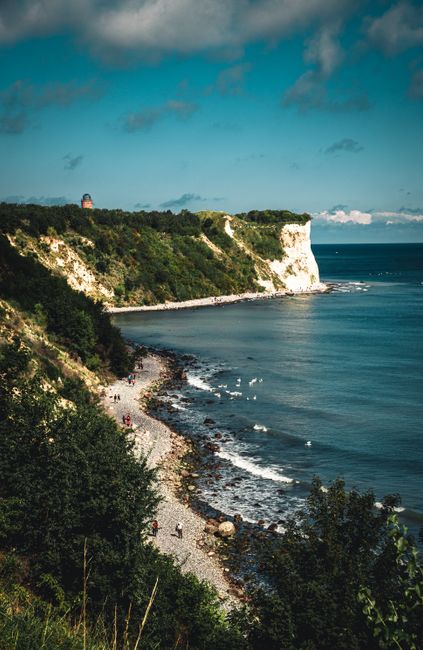
Rügen is Germany’s largest island, a sprawling, many-armed piece of land in the Baltic Sea off the coast of Mecklenburg-Vorpommern, joined to the mainland at Stralsund by a bridge and a causeway. It is best known for the white chalk cliffs of Jasmund National Park, painted by Caspar David Friedrich, and for its old seaside resorts, Binz, Sellin and Göhren, with white villas, long piers and fine sandy beaches. Beyond them you find beech forests, quiet lagoons called Bodden, the lighthouses of Cape Arkona, a narrow-gauge steam train and a short boat ride to car-free Hiddensee. Rügen also has the vast Nazi-era holiday block at Prora. Come from late May to September for the beaches, or in spring and autumn for walking, and give it four or five days.
Right now in Rügen (Binz)
- Wed 13–16°C 55–60°F Partly cloudy
- Thu 12–15°C 53–59°F 5 mm Rain
- Fri 11–13°C 51–55°F 3 mm Rain
Weather: MET Norway (CC BY 4.0) · Sea temperature: NOAA CoastWatch · Air quality: OpenAQ · Rates: ECB
Top tours in Rügen
See all tours for Rügen →
From local operators, with prices and reviews; you check availability and book on Viator, our partner. We may earn a commission at no extra cost to you. How we earn money
Rügen at a glance
- Best for: chalk cliffs and beech forest walks, sandy family beaches, seaside architecture, cycling, and slow days on Hiddensee.
- How long: 2–3 days for Binz, the Königsstuhl and Prora; 4–5 to add Cape Arkona, Hiddensee and Putbus; a week for a relaxed beach holiday.
- Best time: June to early September for swimming; May, September and early October for walking and quieter resorts. July and August average about 17–18 °C over day and night (DWD, Arkona station), and the north of the island is one of the sunniest corners of Germany.
- Getting in: by train via Stralsund to Bergen, Binz or Sassnitz, or by car over the Rügen Bridge. Allow about three to four hours from Berlin or Hamburg.
- Getting around: regional trains, island buses and the Rasender Roland steam train link the main resorts; a bike or car helps for the north and west.
- Before you go: resorts charge a daily spa tax, and rooms on the coast sell out in summer. See our Germany guide for money, entry rules and trains.
Rügen’s areas and who each one suits
- Binz: the biggest resort, with a promenade, a pier and the most hotels and restaurants. Best for first-timers and anyone without a car.
- Sellin, Baabe and Göhren: smaller resorts on the south-east coast, on the steam train line. Sellin has the famous pier, Baabe a gentle beach for children.
- Sassnitz and Jasmund: an old fishing port at the edge of the national park; good for walkers.
- The north (Wittow, Cape Arkona, Juliusruh): windswept and rural, with the Schaabe beach and the lighthouses. Best with a car or bike.
- Putbus and the south: a white neoclassical town with a park and a harbour at Lauterbach. Calm and pretty, with few beaches.
- The west coast and Hiddensee: reed-lined lagoons, birdlife, and the boat harbour at Schaprode for Hiddensee.
Top things to see on Rügen
Prices and hours below are as of October 2026; small sites change them each season and some are flagged in our sources.
The chalk cliffs and the Königsstuhl
The chalk coast of the Jasmund peninsula, north of Sassnitz, is Rügen’s signature sight: bright white cliffs rising about 100 m out of a turquoise sea, topped by old beech woods. The highest point is the Königsstuhl (“king’s chair”), 118 m above the water. You reach it through the Nationalpark-Zentrum Königsstuhl, a visitor centre with an exhibition, a cinema and outdoor trails. Its highlight is the Skywalk, an oval walkway that hangs out over the cliff edge, so you look down and along the coast without standing on the crumbling chalk itself.
As of October 2026 a ticket costs €14 for adults, €8 for children aged 6 to 14 and €30 for a family; under-sixes go free. The ticket covers the Skywalk, the exhibition and the guided tours. The centre is open every day of the year, currently 09:00–18:00. Cars cannot drive to the Königsstuhl: park at the large car park in Hagen and walk about 3 km through the forest or take the shuttle bus. A combined ticket with parking, shuttle and entry costs €23.50 for adults. Online tickets come with a time slot.
Jasmund National Park and the high cliff path
Jasmund is Germany’s smallest national park, created in 1990, and its old beech forests are part of a UNESCO World Heritage Site shared with forests across Europe. Walk the Hochuferweg, a marked path of about 12 km along the top of the cliffs between Sassnitz and Lohme, with the Königsstuhl and the Victoriasicht viewpoint on the way. Steep wooden stairs lead down to the stony beach at several points.
The rules are simple and they matter. The chalk is soft and the cliffs collapse often, especially after rain and frost in winter and spring. Stay on marked paths and behind fences, don’t go to the cliff edge, and on the beach keep well away from the foot of the cliffs. Stairs and beach sections are closed after slides; obey the signs. Cycling is not allowed on the cliff path, and it is not suitable for pushchairs.
Binz and the resort architecture
Binz grew from a fishing village into a fashionable seaside resort in the late 19th century, and its Bäderarchitektur (resort architecture) is the best on the island: white villas with wooden balconies, turrets and fretwork, lining the 4 km promenade and the side streets behind it. The landmark is the Kurhaus, the big white spa hotel facing the pier. The pier itself is about 370 m long and a good place for sunset. The beach is fine, pale sand that runs north for kilometres, with wicker beach chairs (Strandkörbe) to rent.
Sellin pier
Sellin’s pier is the most photographed on the Baltic coast: a long wooden walkway leading to a white pavilion with green roofs, rebuilt in 1998 in the style of the original from the early 1900s. Wilhelmstraße, lined with restored villas, leads down to it. At the end of the pier, a diving gondola lowers visitors a few metres below the surface for a look at the Baltic seabed; check the operator’s current prices and times on the day.
Prora and the documentation centre
Just north of Binz, a single concrete building runs for about 4.5 km behind the beach. This is Prora, built from 1936 by the Nazi leisure organisation Kraft durch Freude (Strength through Joy) as a seaside resort for 20,000 holidaymakers. It was never finished as planned; after the war it served the Soviet and East German armies. Today parts are flats, holiday apartments and a youth hostel. The Dokumentationszentrum Prora, in Block III, tells the story in its permanent exhibition “MACHTUrlaub”, about how the Nazi state organised leisure. It is open daily from March to October, 10:00–18:00, with shorter hours in winter. Adult admission is €7 (€3 reduced; under-12s free); daily guided tours cost €3 extra.
Cape Arkona and Vitt
Cape Arkona, on the northern tip of the Wittow peninsula, is where Rügen faces open sea on cliffs of chalk and clay. It has two lighthouses side by side: the square brick tower designed by Karl Friedrich Schinkel, finished in 1827, and the taller round lighthouse of 1902, which you can climb for a view over the coast and, on clear days, towards Denmark. Nearby are an old naval radio tower and the ramparts of the Jaromarsburg, a Slavic temple fortress destroyed in 1168. Towers and small museums charge separate, modest entry fees; check current prices on the official Kap Arkona website.
Cars must stay at the car park in Putgarten, about 1.5 km from the cape. From there you walk, cycle or take the little road train. A path leads on along the cliffs to Vitt, a tiny fishing village of thatched cottages in a ravine leading down to the sea, with a white octagonal chapel above it. The full loop, Putgarten–Arkona–Vitt–Putgarten, makes a lovely half-day walk.
Putbus and the Rasender Roland
Putbus is unlike anywhere else on the island: a planned town founded in 1810 by Prince Wilhelm Malte I, with white neoclassical houses around a circular plaza called the Circus and a large landscape park.
Putbus is also the western end of the Rasender Roland (“racing Roland”), a narrow-gauge steam railway running since 1895 through fields and woods to Binz, Sellin, Baabe and Göhren at no more than 30 km/h. In the 2026 main timetable, valid until 1 November, trains run every two hours between Putbus and Göhren, with extra hourly trains between Binz and Göhren in summer; in the main season some trains start at Lauterbach Mole. Putbus to Göhren takes about an hour and a quarter. As of October 2026 a single ticket costs from €3.20 for a short hop to €16 for the full line, and a day ticket is €35 (€77.50 for a family). Deutschlandticket holders pay a €12 day supplement, and resort spa cards are not valid. A bike costs €3 per trip.
Hiddensee, the car-free island
Hiddensee is a thin island about 17 km long off Rügen’s west coast, with no private cars, a few villages, heath, dunes and a lighthouse on a hill. Its villages are Neuendorf in the flat south, Vitte in the middle and Kloster in the hilly north, home to the writer Gerhart Hauptmann’s house. Walk or rent a bike in Vitte or Kloster, climb to the Dornbusch lighthouse, and swim from the long western beach.
- Ferries: FRS Reederei Hiddensee sails from Schaprode on Rügen all year, with up to nine departures a day to Neuendorf, Vitte and Kloster, plus seasonal boats from Stralsund, Breege, Wiek and Dranske.
- Fares: as of October 2026, from Schaprode a single is €17.10 for adults, a same-day return €24.60 and a return on different days €31.50; children aged 4 to 14 pay about half. A bike costs €7.40 one way. The Deutschlandticket is accepted between Schaprode and Hiddensee.
- Visitor tax: adults pay a daily visitor tax of €2.50 on Hiddensee.
Take an early boat, or stay a night: the island is very quiet once day visitors leave. See our boat trips guide.
Beaches on Rügen
Rügen has about 60 km of sandy beach, mostly on the east coast. The best are the long, gently shelving beaches of Binz, Prora (quieter and wilder north of the resort), Sellin, Baabe and Göhren, and the 10 km Schaabe spit between Juliusruh and Glowe in the north, backed by pine woods. Main resort beaches have lifeguards in summer, beach chair rentals and marked areas for dogs and for nude bathing (FKK), a long tradition on the East German coast. The Baltic is calm and has almost no tide, which suits children, but it is cool: about 17–20 °C in late summer. See our beaches guide.
Spa tax (Kurtaxe) on Rügen
Rügen’s seaside resorts are recognised spa towns (Ostseebad) and charge a daily spa tax, called Kurtaxe or Kurabgabe, for every night you stay and often for day visits too. Your host adds it to the bill and gives you a guest card, which can bring small discounts. In Binz, as of October 2026, the rate is €3.40 per adult per day all year, and the days you arrive and leave both count; children under three are exempt. Other resorts set their own rates and seasons, usually a few euros a day. The guest cards are not valid on the Rasender Roland.
Other things to do on Rügen
Cycling
Rügen is mostly flat or gently rolling, and cycling is one of the best ways to see it. The Baltic Sea Cycle Route (part of EuroVelo 10) crosses the island, and quiet routes link the resorts with Putbus, the Mönchgut peninsula and the north. Rent bikes in every resort and avoid the busy main roads. See our cycling guide.
Granitz hunting lodge and the Mönchgut
In the beech forest between Binz and Sellin stands Jagdschloss Granitz, a 19th-century hunting lodge built for the Prince of Putbus, with a cast-iron spiral staircase climbing its central tower to a view over the whole island. Walk up from Binz or take the steam train.
Food and drink
Fish is the thing: fresh and smoked herring, mackerel and eel from the smokehouses in Sassnitz harbour and the small fishing villages, and a Fischbrötchen (fish roll) on the go. Look for sea buckthorn (Sanddorn) in juices, jams and liqueurs, and for Rügen chalk in spa treatments.
Nearby destinations
Getting there and getting around
By train and car
- By train: everything goes through Stralsund, on the mainland. Regional trains run from Stralsund over the causeway to Bergen, then on to Binz or Sassnitz; Deutsche Bahn also runs some long-distance trains straight through to Binz, especially in summer. Allow about three to four hours from Berlin or Hamburg, and check bahn.de for the day’s connections. The Deutschlandticket is valid on regional trains.
- By car: the B96 crosses the Strelasund on the Rügen Bridge, a 2.8 km high bridge opened in 2007; the older Rügendamm causeway of 1936 carries the railway and local traffic alongside. Summer Saturdays bring long queues on the B96 across the island.
On the island
Regional trains link Bergen, Binz, Sassnitz and Lietzow; island buses serve the resorts, the Königsstuhl car park, Putgarten and Schaprode; and the Rasender Roland connects Putbus, Binz, Sellin, Baabe and Göhren. A car is useful for the north and west, but parking in Binz and Sellin is paid and full in summer, and the Königsstuhl and Cape Arkona can only be reached on foot, by bike or by shuttle from their car parks.
When to go and how long to stay
Rügen has a mild, breezy Baltic climate. The sea is only pleasant for swimming from late June. July and August are the warmest and busiest months, with German school holidays filling the resorts. September is often settled and sunny, and the sea is at its warmest. Autumn brings storms, beech woods turning gold and thousands of cranes resting on the lagoons around Hiddensee and the west coast in October. Winter is grey and quiet.
| Season | Mean temperature | Rain a month | What it’s like |
|---|---|---|---|
| Spring (Mar–May) | 3–11 °C | 28–42 mm | Dry and increasingly sunny; cool by the sea; beech woods turn green in May. |
| Summer (Jun–Aug) | 15–18 °C | 57–68 mm | Long days and the most sunshine; beach season; busy resorts and roads. |
| Autumn (Sep–Nov) | 15 °C falling to 6 °C | 46–54 mm | September is lovely; cranes and autumn colour in October; windy and grey by November. |
| Winter (Dec–Feb) | 1–3 °C | 29–45 mm | Cold, damp and windy; quiet resorts and winter walks. |
Figures are DWD long-term monthly averages for 1991–2020 at Arkona, on the island’s northern tip. They are means over day and night: summer afternoons usually reach about 21–23 °C. Arkona gets about 1,950 hours of sunshine and 550 mm of rain a year; Putbus, in the south, is slightly warmer in summer and wetter, with about 650 mm.
3 days on Rügen
Day 1: Binz, the promenade and pier, and the Prora documentation centre. Day 2: the Königsstuhl and the Skywalk, then the cliff path to Sassnitz and a fish supper by the harbour. Day 3: the Rasender Roland from Binz to Putbus, the Circus and the park, then back to Sellin for sunset on the pier.
5 days on Rügen
Add a day on Hiddensee by ferry from Schaprode, with a bike ride to the Dornbusch lighthouse, and a day in the north at Cape Arkona and Vitt with a swim on the Schaabe. On the way out, stop in Stralsund’s Hanseatic old town, or continue to Hamburg via the Baltic coast.
Where to stay on Rügen
- First visit and no car: Binz, with trains, buses, the steam train and the most restaurants.
- Families: Baabe or Göhren for gentle beaches and calmer evenings, or a holiday flat in Prora.
- Walkers: Sassnitz or Lohme, at either end of the cliff path.
- Quiet and nature: the north around Juliusruh and Putgarten, the west coast near Schaprode, or a night on Hiddensee.
Book early for July and August and for the Easter and autumn school holidays. Many hotels ask for a minimum stay in high season.
Practical tips for Rügen
- Cliffs: stay on marked paths and away from the cliff edge and the foot of the cliffs; slides happen without warning.
- Guest card: keep the spa tax card your host gives you; you may be asked for it, and it brings small discounts.
- Traffic: avoid driving onto the island on summer Saturdays, when holiday flats change over.
- Emergencies: call 112.
What to pack for Rügen
Even in summer, pack layers: a windproof jacket and a warm top for evenings and boat trips, as the Baltic breeze is cool. Bring swimwear, sunscreen and sunglasses. Good walking shoes with grip are essential for the cliff path and its wooden stairs. Add a rain jacket and insect repellent for lagoon evenings.
Rügen travel FAQ
How much does the Königsstuhl cost?
As of October 2026, entry to the Nationalpark-Zentrum Königsstuhl, including the Skywalk, costs €14 for adults, €8 for children aged 6 to 14 and €30 for a family. A combined ticket with parking in Hagen and the shuttle bus is €23.50 for adults.
Can you drive to the Königsstuhl?
No. Park at the car park in Hagen, then walk about 3 km through the beech forest or take the shuttle bus. You can also arrive on foot along the cliff path from Sassnitz or Lohme.
How do I get to Rügen by train?
Take a train to Stralsund, then a regional train over the causeway to Bergen, Binz or Sassnitz. Some long-distance trains run straight through to Binz, especially in summer. The Deutschlandticket covers the regional trains.
What is the Kurtaxe on Rügen?
A daily spa tax charged by the seaside resorts and added to your accommodation bill. In Binz it is €3.40 per adult per day all year, as of October 2026; other resorts set their own rates.
Is the Deutschlandticket valid on the Rasender Roland?
Not on its own. As of October 2026, Deutschlandticket holders pay a €12 supplement for a day on the steam train. A normal day ticket costs €35, and resort guest cards are not accepted.
How do I get to Hiddensee?
By FRS passenger ferry from Schaprode on Rügen’s west coast, all year, to Neuendorf, Vitte and Kloster; in season also from Stralsund and the north of Rügen. As of October 2026 a same-day return from Schaprode is €24.60 for adults. No cars are allowed on the island.
What is Prora?
A 4.5 km holiday complex built by the Nazi Strength through Joy organisation from 1936 and never finished. Parts are now flats and a youth hostel, and the Dokumentationszentrum Prora explains its history.
Which is the best beach on Rügen?
Binz for facilities, Baabe for small children, Prora for space, and the Schaabe between Juliusruh and Glowe for a long, wild beach backed by pines.
Can you swim in the Baltic on Rügen?
Yes, from late June to early September, when the water reaches about 17–20 °C. The sea has almost no tide and the main beaches have lifeguards in summer. Don’t swim below the chalk cliffs.
How many days do you need on Rügen?
Two or three days for Binz, the chalk cliffs and Prora; four or five to add Cape Arkona, Putbus and Hiddensee; a week for a relaxed beach holiday.
Sources and last review
Researched and last reviewed on 4 October 2026. Königsstuhl prices and hours come from the Nationalpark-Zentrum Königsstuhl; Prora hours and prices from the Dokumentationszentrum Prora; Rasender Roland fares and timetable from the Rügensche BäderBahn; Hiddensee ferry fares and visitor tax from FRS Reederei Hiddensee; the Binz spa tax from the municipality of Ostseebad Binz; and climate from the German Weather Service (DWD). Cape Arkona tower prices, the Sellin diving gondola and train journey times are flagged for checking. Prices, timetables and rules change, so check the official sites before you travel, and see our Germany guide for country-wide information.
Plan your trip
Partner links: TravelerCenter may earn a commission if you book, at no extra cost to you.
🇩🇪 Useful German phrases for Rügen
All 38 German phrases: restaurant, hotel, emergencies, romance (printable) →