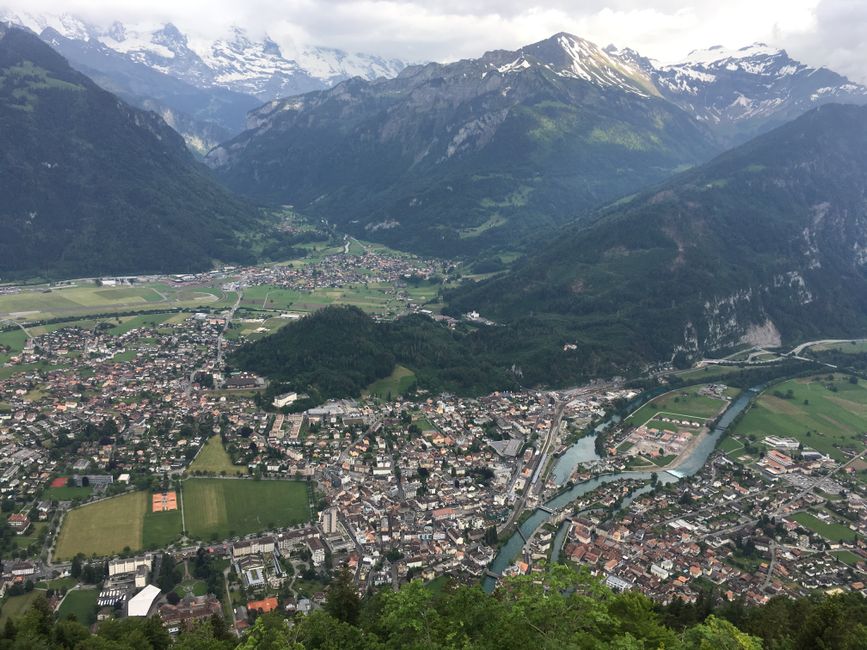
Interlaken is the base camp of the Bernese Oberland. The town itself is a long, flat strip of hotels, shops and parkland between two lakes, the turquoise Lake Thun and Lake Brienz, but look up from the Höhematte meadow and the snowy summit of the Jungfrau fills the sky. From here, trains, cogwheel railways and cable cars fan out into the Jungfrau region: the waterfall valley of Lauterbrunnen and the car-free villages of Wengen and Mürren, Grindelwald under the north face of the Eiger, the Schilthorn, and the Jungfraujoch, Europe’s highest railway station at 3,454 m. Add paragliding, lake cruises and some of the best walking in the Alps, and it is easy to fill a week. Give it at least three days; five to seven if you love the mountains.
Right now in Interlaken
- Thu8–16°C47–60°F53 mm rain
- Fri9–13°C48–55°F2 mm rain
- Sat11–15°C52–59°F11 mm rain
Top tours in Interlaken
See all tours for Interlaken →
From local operators, with prices and reviews; you check availability and book on Viator, our partner. We may earn a commission at no extra cost to you. How we earn money
Interlaken at a glance
- Best for: the Jungfraujoch and the big Alpine views, hiking, adventure sports, lake cruises, skiing and a car-free mountain village stay.
- How long: 3 days for the Jungfraujoch, Lauterbrunnen and one more mountain; 5–7 days to hike and explore both lakes.
- Best time: late June to September for hiking and all lifts; December to March for skiing; May and October are quieter, but some lifts close.
- Getting in: under an hour from Bern by train, about 2 hours from Zurich, 1 hour 50 minutes from Lucerne on the Luzern–Interlaken Express.
- Getting around: the Interlaken Guest Card gives free local buses; regional trains and lifts are covered or discounted by the Swiss Travel Pass and the Jungfrau Travel Pass.
- Before you go: rail passes, money, entry rules and mountain safety are in our Switzerland travel guide.
Interlaken and the Jungfrau region, area by area
Interlaken has two main stations: Interlaken West, closer to the shops and Lake Thun boats, and Interlaken Ost, where the Lake Brienz boats leave, the trains from Lucerne arrive and the Bernese Oberland Railway (BOB) climbs into the Jungfrau region. At Zweilütschinen, about 10 minutes south, the line splits: right to Lauterbrunnen, left to Grindelwald.
Interlaken and Unterseen
The town centre runs along the Höheweg, with grand hotels such as the Victoria-Jungfrau facing the Höhematte, a huge meadow where paragliders land. Across the Aare river, Unterseen keeps a small old town. Best for: convenience, restaurants and budget stays, with every excursion an easy train ride away.
Lauterbrunnen, Wengen and Mürren
The Lauterbrunnen valley is a deep, glacier-carved trough with sheer rock walls and waterfalls pouring down them; the Staubbach Falls drop almost straight onto the village. On the terraces above, Wengen (reached by train) and Mürren (by cable car or train) are car-free villages with views of the Eiger, Mönch and Jungfrau. Best for: romance, hiking and quiet.
Grindelwald
A busy mountain resort in a wide green valley under the Eiger’s north face, with the Eiger Express to the Jungfraujoch, the gondola to First and access to the Männlichen. Best for: active holidays, families and skiing.
Lake Thun and Lake Brienz
Lake Thun, to the west, has castles at Thun, Oberhofen and Spiez; Lake Brienz, to the east, is greener and quieter, with Iseltwald on its peninsula, the Giessbach Falls and the woodcarving village of Brienz. Best for: lakeside stays and boat days.
Top excursions from Interlaken
Mountain prices in the Jungfrau region are high and change by season and route. The prices below were checked on the official sites in October 2026 where possible; always check jungfrau.ch or the operator before you go, and check the summit webcams in the morning.
Jungfraujoch – Top of Europe
The Jungfrau Railway, opened in 1912, tunnels for 7 km through the Eiger and the Mönch to the Jungfraujoch, a saddle between the Mönch and the Jungfrau at 3,454 m, Europe’s highest railway station. At the top, the Sphinx observatory terrace looks down the Aletsch Glacier, the longest in the Alps at about 22 km, part of a UNESCO World Heritage area; there is also an Ice Palace carved into the glacier, the Alpine Sensation tunnel, a Snow Fun Park with a zip line in summer, restaurants and a Lindt chocolate shop.
Getting up. The fastest route is the Eiger Express gondola from Grindelwald Terminal to the Eiger Glacier station, then the train through the mountain: about 45 minutes from Grindelwald Terminal to the top. The classic route goes by train via Lauterbrunnen and Wengen or Grindelwald to Kleine Scheidegg, then up the Jungfrau Railway. From Interlaken, allow about 2 hours each way. Many visitors go up by the Eiger Express and down via Kleine Scheidegg and Wengen.
Prices. As of October 2026, Jungfrau Railways quoted return tickets “from CHF 129.60” from Grindelwald Terminal (the lowest seasonal fare). From Interlaken Ost the full adult return is much higher, well over CHF 200 in summer according to ticket resellers; the Half Fare Card halves it, and the Swiss Travel Pass covers the trip to Grindelwald or Wengen and gives a discount from there. A seat reservation (CHF 10) is strongly recommended on fine days, especially from May to October, when trains sell out. Go early on a clear day, and take it slowly at the top: the altitude can cause headaches and breathlessness.
Grindelwald First
A 25-minute gondola climbs from Grindelwald to First (2,168 m), where the First Cliff Walk clings to the rock face with a viewing platform over the drop. From the top, the First Flyer (a zip line reaching about 84 km/h), the First Glider, mountain carts and Trottibike scooters bring you back down. The one-hour walk to the Bachalpsee, a lake that reflects the Schreckhorn and Wetterhorn, is one of the most beautiful easy walks in Switzerland. The adventure activities ran from mid-April to 25 October in 2026.
Schilthorn – Piz Gloria
Above Mürren, the Schilthorn (2,970 m) has a revolving restaurant, Piz Gloria, made famous by the James Bond film On Her Majesty’s Secret Service (1969), with an exhibition on the film and a 360° view of more than 200 peaks. On the way up, the Birg station has the Thrill Walk, a steel path with glass floors bolted to the cliff. A brand-new cableway now runs all the way from Stechelberg in the Lauterbrunnen valley: its first section to Mürren, opened in December 2024, is the world’s steepest cable car, and the last new section to the summit opened in April 2026, completing the CHF 135 million rebuild. The Schilthorn listed a return from Stechelberg at CHF 115 for adults (about CHF 46 with the Swiss Travel Pass); check schilthorn.ch for current prices.
Harder Kulm
Interlaken’s own viewpoint, 1,322 m, is reached by a 10-minute funicular from near Interlaken Ost. The Two-Lakes Bridge platform looks down on both lakes and across to the Eiger, Mönch and Jungfrau, and there is a restaurant with folk music in the evening. In 2026 it ran from 3 April to 29 November. It is half price with the Swiss Travel Pass and discounted with the Interlaken Guest Card.
Schynige Platte and the Männlichen
From Wilderswil, a historic cogwheel train takes about an hour to Schynige Platte (1,967 m), with an alpine garden of about 800 plants and the start of the Panorama Trail to First, one of the classic day hikes. The Männlichen, reached by gondola from Grindelwald Terminal or cable car from Wengen, starts the easy Panorama Trail to Kleine Scheidegg, about 1 hour 30 minutes, with the Eiger, Mönch and Jungfrau in front of you the whole way. Both run in summer only.
Lauterbrunnen’s waterfalls
The Staubbach Falls, almost 300 m high, can be seen from the village and visited along a short path. Further up the valley, the Trümmelbach Falls are glacier meltwater thundering through a gorge inside the mountain, reached by a tunnel lift and lit galleries; they open from about April to early November, cost around CHF 18 for adults and are not covered by the Swiss Travel Pass. Walk the flat valley path between them past grazing cows and BASE jumpers’ landing fields.
Caves
- St. Beatus Caves
Nature
- Staubbach Falls
- Trümmelbach Falls
Peaks and mountains
- Eiger
- Jungfrau
- Schilthorn
Viewpoints
- Jungfraujoch
Things to do in Interlaken
Hiking
The Jungfrau region has hundreds of kilometres of marked trails, from flat valley walks to high routes. Favourites include First to Bachalpsee, the Männlichen to Kleine Scheidegg Panorama Trail, Mürren to Gimmelwald, the Schynige Platte–First Panorama Trail and the Eiger Trail below the north face. Yellow signs show walking times; white-red-white marks mountain trails that need sure footing. Most high trails are free of snow from late June to October. See our hiking guide.
Paragliding and adventure sports
Interlaken is one of Europe’s adventure capitals. A tandem paragliding flight from Beatenberg, landing on the Höhematte, costs about CHF 170–200 for 10 to 20 minutes with licensed operators. Canyoning, rafting, skydiving and bungee jumping are also offered; book with established companies, and follow their safety advice.
Lake cruises
BLS runs boats on both lakes: on Lake Thun all year, and on Lake Brienz from early April to early December (in 2026, from 3 April to 6 December), with the fullest timetable from late May to mid-October. The paddle steamers Blümlisalp and Lötschberg sail in summer. Stop at the Giessbach Falls, where a historic funicular climbs to a grand hotel beside the cascades, at Iseltwald, or at Spiez and Oberhofen castles. See our boat trips guide.
Ballenberg and the St. Beatus Caves
The Ballenberg open-air museum near Brienz has more than 100 old farmhouses and workshops from all over Switzerland, with animals and craft demonstrations; in 2026 it opened daily from 9 April to 1 November (adults CHF 32). On Lake Thun, the St. Beatus Caves have about a kilometre of lit passages, waterfalls and a legend of a dragon-slaying monk; in 2026 they opened from 28 March to 8 November (adults CHF 20).
Skiing and winter
In winter, the Jungfrau Ski Region (Grindelwald-Wengen and Mürren-Schilthorn) has 211 km of slopes with views of the Eiger. For 2026/27 the season is due to start from late November and run until 25 April 2027. Two famous races take place in January 2027: the 97th Lauberhorn World Cup races in Wengen, home of the longest downhill on the World Cup circuit, from 15 to 17 January, and the amateur Inferno race in Mürren from 20 to 23 January. Sledging runs, winter walks and the Jungfraujoch are open to non-skiers.
Activities and best months
- Boat tripsPassenger boats cross turquoise Lake Brienz and deep-blue Lake Thun from Interlaken; the old-time steamer Blümlisalp takes about two hours from Thun to Interlaken, and themed and culinary cruises run in summer and autumn. Lake Thun is lined with five castles, including Oberhofen, near the landing stages.
- HikingThe Interlaken holiday region offers panorama trails, ridge walks, circular tours to mountain lakes and peak treks in the Bernese Oberland, lakeside paths around lakes Thun and Brienz, and themed trails for families; autumn favourites include the Niederhorn-Gemmenalphorn ridge (chamois, ibex and marmots) and the Hinterburgseeli circuit on the Axalp.
Day trips from Interlaken
Bern, with its UNESCO old town and bear park, is under an hour away by train. Lucerne is 1 hour 50 minutes away on the Luzern–Interlaken Express over the Brünig Pass. The GoldenPass Express runs from Interlaken through Gstaad to Montreux on Lake Geneva in about 3 hours 15 minutes, without a change. Thun has a castle, an old town and a covered bridge on the Aare. Further afield, the Blausee, a small turquoise lake near Kandersteg, and the Oeschinensee, high above Kandersteg, are lovely half-day trips. For Zermatt, take the Lötschberg line via Spiez and Visp, about 2 hours.
Nearby destinations
Getting to Interlaken
By train. Fast trains from Bern (under an hour), Zurich and Basel (about 2 hours) run via Spiez to Interlaken West and Ost. From Lucerne, the Luzern–Interlaken Express takes 1 hour 50 minutes, hourly. From Geneva, change in Bern (about 2 hours 45 minutes), or take the scenic GoldenPass Express from Montreux.
By air. Zurich Airport is about 2 hours 15 minutes by train; Geneva Airport about 3 hours; Bern’s small airport has few flights.
By car. The A8 motorway from Bern or Lucerne reaches Interlaken (vignette required). You can drive to Lauterbrunnen, Stechelberg and Grindelwald, but not to Wengen or Mürren, which are car-free.
Getting around: the Guest Card and the Jungfrau Travel Pass
If you stay overnight in Interlaken or neighbouring villages (including Matten, Unterseen, Wilderswil, Bönigen, Iseltwald and Ringgenberg), you receive the Interlaken Guest Card, with free local public transport in its area and discounts such as 20% off the BLS boat day pass and the Schynige Platte railway and 15% off the Harder funicular. Check the conditions when you check in, as the scheme is reviewed regularly.
For several days of mountain excursions, the Jungfrau Travel Pass gives unlimited travel on the region’s trains, lifts and boats for 3 to 8 consecutive days in the summer season. As of October 2026, it cost:
| Days | Adult | With Half Fare Card or Swiss Travel Pass |
|---|---|---|
| 3 days | CHF 210 | CHF 165 |
| 4 days | CHF 235 | CHF 180 |
| 5 days | CHF 270 | CHF 210 |
| 6 days | CHF 290 | CHF 225 |
| 7 days | CHF 310 | CHF 240 |
| 8 days | CHF 330 | CHF 255 |
Children aged 6–15 pay CHF 30. The Jungfraujoch itself is not included: pass holders buy a discounted connecting ticket from Kleine Scheidegg or the Eiger Glacier, from CHF 89 in summer 2026. The Swiss Travel Pass alone covers trains to Lauterbrunnen, Grindelwald, Wengen and Mürren and gives discounts on most lifts.
When to go and how long to stay
Interlaken sits at about 570 m, so it is warm in summer while the summits above are freezing. Clouds can cover the peaks for days, especially in late spring and autumn, so build spare days into your plan. The table uses MeteoSwiss 1991–2020 averages for Interlaken (read via a secondary summary); the Jungfraujoch averages below freezing even in the warmest month.
| Month | Average daily high in Interlaken | What it’s like |
|---|---|---|
| January | 3.2 °C | Cold and snowy higher up; ski season and the Lauberhorn races |
| April | 14.7 °C | Spring in the valley, snow on high trails; some lifts closed |
| July | 24.3 °C | Warm, all lifts and trails open; afternoon thunderstorms |
| October | 14.1 °C | Clear, golden days; lifts start to close for the season |
Interlaken gets about 1,180 mm of rain a year, with summer the wettest season. On the Jungfraujoch, the average July high is only about 3 °C and the annual average is around −7 °C.
Interlaken in 3 days
Day one: Lauterbrunnen, the Trümmelbach Falls, cable car to Mürren and the Schilthorn. Day two: on the clearest day, Grindelwald and the Eiger Express to the Jungfraujoch, returning via Kleine Scheidegg and Wengen. Day three: First and the Bachalpsee walk, then Harder Kulm for sunset.
Interlaken in a week
Add the Männlichen Panorama Trail, Schynige Platte, a Lake Brienz cruise with Giessbach and Ballenberg, a paragliding flight, and a day in Bern or Thun for rainy weather.
Weather month by month
Where to stay
- Interlaken: the widest choice and the best transport hub, from hostels to grand hotels.
- Lauterbrunnen: waterfall views and campsites, central for Mürren and Wengen.
- Wengen and Mürren: car-free mountain villages with the best views and the most peace.
- Grindelwald: lively, with chalets, family hotels and quick access to the Jungfraujoch and First.
- Iseltwald or Brienz: quiet lakeside alternatives.
Summer and the Christmas and February holidays are peak season; book months ahead, especially for the mountain villages.
Practical tips and mountain safety
- Check the webcams: don’t pay for the Jungfraujoch on a cloudy day; jungfrau.ch has live cameras.
- Respect the altitude: walk slowly at 3,454 m and drink water; people with heart or breathing conditions should ask a doctor first.
- Watch the weather: start hikes early and be off exposed ridges before afternoon thunderstorms.
- Stay on marked paths: and never walk onto glaciers without a guide.
- Know the numbers: 112 for emergencies, 144 for an ambulance and 1414 for Rega air rescue.
- Compare passes: work out whether the Jungfrau Travel Pass, the Swiss Travel Pass or the Half Fare Card is cheapest for your plan.
What to pack for Interlaken
Warm layers, a hat and gloves for the Jungfraujoch and the Schilthorn even in July, sunglasses and high-factor sun cream (snow reflects strong sunlight), hiking shoes with good grip, a waterproof jacket, a small backpack and a refillable bottle. In winter, add proper snow boots. Bring a Type J plug adapter.
What to pack
- Day packs and anti-theft bagsA 20–30 litre pack carries layers, water, a head torch and snacks on full-day levada walks.
- Dry bags and phone pouchesSpray soaks phones and cameras on open boats to the Algarve caves and on whale-watching trips.
- Fleeces and warm layersIt is cooler at sea than on land, especially on morning whale-watching trips.
- HeadlampsLevada routes such as PR1 and PR9 pass through long, dark, wet tunnels.
- Hiking shoes and bootsMadeira's levadas and the Azores' crater rims are wet, rocky and slippery, so grippy shoes matter more than anywhere else in Portugal.
- Rain jacketsA windproof, waterproof shell keeps you warm on open boats, where wind and spray cool you quickly.
- Reef-friendly sunscreenSun reflects off the water on cruises and cave tours.
- Trekking polesLong stone staircases and steep descents on Madeira's peaks and the Azores' crater rims are easier on the knees with poles.
- Water bottles and hydration packsAlgarve and Alentejo trails are hot and exposed with few refill points.
- Water shoesKayak and small-boat trips to the Algarve grottoes land on rock and wet sand.
Interlaken travel FAQ
How much does it cost to go to the Jungfraujoch?
As of October 2026, returns started from CHF 129.60 from Grindelwald Terminal in the cheapest season; from Interlaken expect well over CHF 200 in summer at full fare. The Half Fare Card halves it, and the Swiss Travel Pass gives a discount. Add CHF 10 for a seat reservation in peak times.
How long does it take to get to the Jungfraujoch?
About 45 minutes from Grindelwald Terminal via the Eiger Express, and about 2 hours from Interlaken Ost. Allow at least 2 to 3 hours at the top.
Is the Jungfrau Travel Pass worth it?
If you plan three or more days of lifts and trains in the region, usually yes. As of October 2026, it cost CHF 210 for 3 days (CHF 165 with a Half Fare Card or Swiss Travel Pass). The Jungfraujoch needs an extra discounted ticket.
Are Wengen and Mürren car-free?
Yes. Leave your car in Lauterbrunnen or Stechelberg and take the train to Wengen, or the train or cable car to Mürren.
What is the new Schilthorn cableway?
A completely rebuilt cableway from Stechelberg via Mürren and Birg to the summit. The section to Mürren, opened in December 2024, is the world’s steepest cable car, and the last new section opened in April 2026.
Does the Interlaken Guest Card include free transport?
Yes, local public transport in its area is free for overnight guests, plus discounts on boats and some mountain railways. It does not cover trains into the Jungfrau region.
Should I stay in Interlaken, Lauterbrunnen or Grindelwald?
Interlaken is best for transport and budget; Lauterbrunnen, Wengen and Mürren for views and quiet; Grindelwald for an active mountain resort with fast access to the Jungfraujoch.
How many days do you need in Interlaken?
At least three for the Jungfraujoch, Lauterbrunnen and one more mountain; five to seven to hike and allow for cloudy days.
When is the Lauberhorn race in 2027?
The 97th Lauberhorn World Cup races in Wengen run from 15 to 17 January 2027, with the downhill on Saturday 16 January.
When is the best time to visit Interlaken?
Late June to September for hiking with all lifts open, and December to March for skiing. September is often the clearest and calmest month.
Plan your trip
Partner links: TravelerCenter may earn a commission if you book, at no extra cost to you.
🇩🇪 Useful German phrases for Interlaken
All 38 German phrases: restaurant, hotel, emergencies, romance (printable) →
Traveler centers in Interlaken
Tourist information offices, visitor centers and travel agencies in Interlaken, from OpenStreetMap.
- Tourist information office
Wengen Tourismus
- Tourist information office
Grindelwald Tourismus
- Tourist information office
Tourist Information Interlaken
- Tourist information office
Kiental
- Tourist information office
Krattigen Tourismusbüro
- Tourist information office
Lauterbrunnen
Sources · last reviewed 4 October 2026
Researched and last reviewed on 4 October 2026. Jungfraujoch, Eiger Express, Jungfrau Travel Pass, First, Harder Kulm, Schynige Platte and the ski region: Jungfrau Railways (jungfrau.ch); Interlaken Guest Card: Interlaken Tourism; Schilthorn cableway: Schilthornbahn press releases and schilthorn.swiss; BLS boat seasons: BLS; Ballenberg; St. Beatus Caves; Lauberhorn and Inferno dates: Switzerland Tourism and inferno-muerren.ch. The full Jungfraujoch fare from Interlaken, Trümmelbach Falls, paragliding prices, the Schilthorn price year, train times and the Interlaken climate figures come from secondary sources and are flagged for checking. Prices, timetables and rules change, so check the official links before you go. For rail passes, money, entry rules and mountain safety, see our Switzerland travel guide.
Also: interlaken.swiss · MeteoSwiss normals 1991–2020, Interlaken (climate)
Data: Weather: MET Norway (CC BY 4.0) · Rates: ECB · Costs: World Bank ICP and price levels · © OpenStreetMap contributors (ODBL) · Wikidata (CC0)