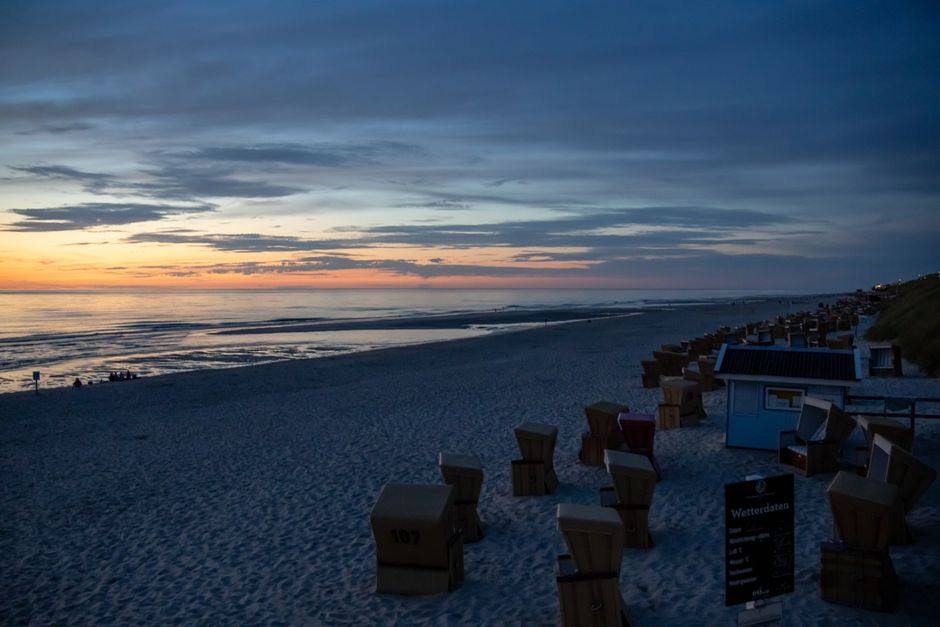
Sylt is Germany’s northernmost island, a thin strip of dunes, heath and thatched villages in the North Sea, close to the Danish border and joined to the mainland only by a railway causeway. Its west coast is one long sandy beach of about 40 km, pounded by surf; its east side faces the calm mudflats of the Wadden Sea, a UNESCO World Heritage Site. Westerland is the busy resort town, Kampen the glamorous village of red cliffs and designer shops, Keitum the prettiest of the old Frisian villages, and List the fishing harbour at the northern tip. You come for wind, big skies, long beach walks, fresh oysters and fish, surfing and cycling, and a famously expensive social scene that is easy to dip into or ignore. Come from June to September, and give it three to five days.
Right now in Sylt (Westerland)
- Wed 13–16°C 55–61°F Cloudy
- Thu 13–15°C 55–60°F 3 mm Showers
- Fri 12–16°C 54–60°F 7 mm Rain
Weather: MET Norway (CC BY 4.0) · Sea temperature: NOAA CoastWatch · Rates: ECB
Top tours in Sylt
See all tours for Sylt →
From local operators, with prices and reviews; you check availability and book on Viator, our partner. We may earn a commission at no extra cost to you. How we earn money
Sylt at a glance
- Best for: long sandy beaches and dunes, mudflat walks, cycling, surfing, seafood, and a stylish seaside break.
- How long: 2–3 days for Westerland, Kampen and List; 4–5 to add Keitum, the Ellenbogen, Hörnum and a mudflat hike.
- Best time: June to September; July and August average about 17–18 °C over day and night (DWD, List auf Sylt station). May and September are quieter, and autumn is stormy and dramatic.
- Getting in: by train from Hamburg over the Hindenburgdamm, by car on the Sylt Shuttle or the blue Autozug car train from Niebüll, by ferry from the Danish island of Rømø, or by plane.
- Getting around: island buses link all the villages; cycle paths run the length of the island.
- Before you go: every village charges a daily guest tax, and Sylt is one of the most expensive places in Germany. See our Germany guide for money, entry rules and trains.
Sylt’s villages and who each one suits
- Westerland: the island’s town, with the train station, a pedestrian shopping street, the beach promenade and most hotels. For first-timers, families and anyone arriving by train; built-up rather than pretty.
- Kampen: thatched villas, the Red Cliff, the Uwe dune, chic bars and the boutiques of the “Whisky mile”. Expensive, scenic and lively in summer.
- Wenningstedt: a relaxed family resort between Westerland and Kampen, with a gently sloping beach.
- Keitum: on the Wadden Sea side, with old captains’ houses, lilac and roses, galleries and cafés. Romantic and quiet.
- List: Germany’s northernmost village, with the harbour, seafood stalls, ferries to Denmark and the Ellenbogen.
- Rantum and Hörnum: the narrow south of the island, between dunes and mudflats; Hörnum has a harbour and a red-and-white lighthouse.
Top things to see on Sylt
Prices and hours below are as of October 2026; small sites change them each season and some are flagged in our sources.
Westerland
Westerland became a seaside resort in 1855 and is still Sylt’s main town. Head straight through the Friedrichstraße shopping street to the promenade, where the sea views open up and the beach stretches out of sight in both directions. Look for the “Wanderer” sculptures, giant figures on the seafront, and the music pavilion where summer concerts are held. Westerland’s beach is lifeguarded in season, with plenty of wicker beach chairs to rent, and the town’s busy evenings make it the easiest base without a car.
Kampen, the Red Cliff and the Uwe dune
North of Westerland, the beach rises into the Rotes Kliff (Red Cliff), a band of reddish-brown cliffs of sand and clay above the beach at Kampen, glowing at sunset. A boardwalk runs along the top of the cliff. Inland of the village, wooden steps climb the Uwe-Düne, at about 52 m the highest natural point on the island, with a view over the whole of northern Sylt, the Wadden Sea and, on clear days, the Danish coast. Kampen itself is a village of thatched brick houses behind high hedges, with smart restaurants, bars and the boutiques along the Strönwai lane. Prices are high, but walking around costs nothing.
Keitum
Keitum, on the east coast, was once the main village of the island, home to wealthy sea captains who sailed with Dutch and Danish whaling fleets. Their thatched houses, with gardens full of roses and lilac, line the lanes behind the Wadden Sea shore. Visit the Sylt Museum and the Altfriesisches Haus, an 18th-century captain’s house, and the late Romanesque church of St Severin, one of the oldest buildings on the island. From the green cliff path below the village you look across the mudflats to the mainland. Keitum’s cafés serve Frisian tea and cake, a ritual worth keeping.
List harbour and the Ellenbogen
List is Germany’s northernmost community, with a small harbour lined with seafood stalls and restaurants where you eat fish rolls and oysters looking at the boats. The ferry to Rømø in Denmark and excursion boats leave from here. The Erlebniszentrum Naturgewalten, a hands-on exhibition centre about the North Sea, wind and climate, sits beside the harbour and is good with children.
North of List, the Ellenbogen (“elbow”) is a curving spit of dunes and beaches at the very top of Germany, with two lighthouses, List-West and List-Ost, and sheep grazing beside the road. It is private land, and cars pay a toll at the entrance: the tourist board lists €8 per day, with an evening rate after 18:00; walkers and cyclists enter free. Swimming is strictly forbidden on the whole Ellenbogen because of strong, unpredictable currents where the open sea meets the tidal channel.
The dunes and the Listland
Between Kampen and List lies the Listland, a nature reserve with some of the largest moving dunes in Europe. Pale sand hills up to about 35 m high creep slowly eastwards each year. You can’t walk on the protected dunes themselves, but marked paths and a viewpoint let you see them. Elsewhere, the dune heath turns purple in August, and the Braderuper Heide, between Wenningstedt and Kampen, has a lovely short walk to the Wadden Sea shore.
The Wadden Sea and mudflat hikes
The east side of Sylt belongs to the Schleswig-Holstein Wadden Sea National Park, part of the Wadden Sea World Heritage Site. Twice a day the tide goes out and leaves a wide plain of mud and sand, full of worms, crabs and shellfish that feed huge flocks of migrating birds in spring and autumn. A guided mudflat hike (Wattwanderung) is one of the best things to do on the island. The Schutzstation Wattenmeer, a nature conservation group, leads walks from Morsum, Keitum, Rantum, Hörnum and List at low tide; as of October 2026 its 90-minute walk at Morsum costs €13 for adults and €8 for children aged 4 to 14. Buy tickets online or at the tourist information offices, and bring old trainers or go barefoot in summer; boots are not rented.
Never walk far onto the mudflats alone. The tide comes back fast, channels fill first and fog can roll in; walk only with a guide who knows the tide times.
Beaches, currents and the guest tax
Sylt’s west coast is one continuous beach of fine sand from Hörnum to the Ellenbogen. Each village has its own sections: lifeguarded family beaches, beaches for dogs, and nude (FKK) beaches, a long tradition here, at Kampen, List, Rantum and Hörnum. Wicker beach chairs (Strandkörbe) shelter you from the wind and cost roughly €10 a day. The east coast faces the mudflats, and swimming there depends on the tide. See our beaches guide.
Swim only at lifeguarded beaches. The North Sea here is rough, cold (about 17–19 °C in August) and has dangerous rip currents between the sandbars that pull swimmers out to sea. Lifeguards watch marked areas from about May to early October, 10:30–17:00, according to the island’s tourist board. Red and yellow flags mark the safe swimming zone; a yellow flag means danger, swim only in the guarded area; a red flag means no swimming at all. If a current takes you, don’t fight it: swim parallel to the shore until you are free. Every year people drown off Sylt, often outside guarded hours.
All Sylt communities charge a guest tax (Kurabgabe), which pays for the beaches and lifeguards. Your host adds it to the bill and gives you a guest card, which you need to show at beach entrances; day visitors buy a day card at the beach. As of October 2026 the daily rates per adult are:
- Westerland, Rantum, Tinnum, Keitum, Munkmarsch, Archsum and Morsum (Gemeinde Sylt): €4.10 from 1 May to 31 October, €2.05 the rest of the year.
- Hörnum: €4.10 in the main season, €2.05 off-season.
- Kampen: €4.00 from 1 April to 31 October, €2.00 off-season.
- List: €3.60 in the main season, €1.80 off-season.
- Wenningstedt-Braderup: €3.00 in the main season, €1.50 off-season.
Children and teenagers under 18 and dogs are exempt.
Other things to do on Sylt
Cycling
Sylt is flat and has a good network of cycle paths, many on old railway lines through the dunes, so it is easy to ride from Hörnum to List, about 40 km, in a day. The catch is the wind, which can turn a gentle ride into hard work; plan to ride into it on the way out. Bike and e-bike rental is everywhere. Good rides include Westerland to Kampen and List through the dunes, and Keitum to Morsum along the Wadden Sea. See our cycling guide.
Surfing and kitesurfing
Sylt is Germany’s surf capital. The west coast gets the most consistent waves in the country, especially in autumn, and Westerland hosts a windsurfing World Cup event most years. Surf schools in Westerland, Wenningstedt and Rantum teach surfing, windsurfing and kitesurfing from late spring to autumn, with wetsuits essential even in summer. Beginners learn on the calmer days; when the swell is big, leave it to the experts. See our surfing guide.
Seal and oyster trips
Excursion boats from List and Hörnum sail out to the sandbanks where harbour seals and grey seals rest at low tide, often combined with a demonstration of fishing nets and sea life on board. Trips run mainly from spring to autumn and depend on the tide and weather; book with the boat operators at the harbours. List is also home to Germany’s only oyster farm, which raises the “Sylter Royal” oyster in the Wadden Sea; you can taste them at the harbour. See our boat trips guide.
Food and drink
Seafood rules: fish rolls with herring or North Sea shrimp, oysters in List, and plaice in season. Try Friesentorte, puff pastry layered with plum compote and cream, with strong Frisian tea, and a Pharisäer, coffee with rum under whipped cream. Kampen’s beach bars and restaurants are part of the island’s scene; book ahead in summer. Supermarkets in Westerland help keep costs down.
Nearby destinations
- Aarhus183 km
- Hamburg185 km
- Copenhagen282 km
- Giethoorn282 km
Getting there and getting around
Train, car train, ferry and plane
- By train from Hamburg: regional trains and some Intercity trains run along the Marschbahn via Husum and Niebüll, then over the Hindenburgdamm, an 11 km causeway opened in 1927, to Westerland. Allow about three hours or more from Hamburg. The Deutschlandticket is valid on the regional trains. The line is single-track in places and known for delays; in 2026 Deutsche Bahn is renewing track and signals, with some weekend and evening closures, so check bahn.de before you travel.
- Car trains from Niebüll: there is no road to Sylt. Cars go on a car train from Niebüll to Westerland, about 35 minutes; you stay in your car. The DB Sylt Shuttle runs up to 36 departures a day, and as of October 2026 its standard fare for a car is €79 one way or €137 return, including all passengers, with cheaper online fares on some trains. The rival Blauer Autozug Sylt runs on the same line with online fares from €19.90. Book ahead for summer weekends.
- Ferry from Denmark: the Syltfähre sails from Havneby on Rømø to List in about 40 minutes. As of October 2026 a car with passengers costs from €67.80 one way or €111.90 return, and a foot passenger from €13.30 one way, with a temporary fuel surcharge. Rømø is reached by a causeway from the Danish mainland.
- By plane: Sylt airport, near Westerland, has seasonal flights from several German cities; check the airport’s website for current routes.
On the island
Island buses link Westerland with every village, from Hörnum in the south to List in the north, and are the easiest way around without a car. Cycling is the other good option. A car is handy but not needed: parking is paid and scarce near beaches and in Kampen in summer, and many visitors leave the car at home and take the train.
When to go and how long to stay
Sylt has a mild, windy maritime climate. Winters are milder than inland Germany and summers are cool, rarely hot. June and July have the longest days, July and August the warmest sea and the biggest crowds, and September is often sunny and quieter. From October the autumn storms arrive, with the best surf, dramatic skies and much lower prices; it is also the wettest time of year. Winter is grey, windy and quiet.
| Season | Mean temperature | Rain a month | What it’s like |
|---|---|---|---|
| Spring (Mar–May) | 4–12 °C | 32–38 mm | The driest season; bright, windy and cool; bird migration on the mudflats. |
| Summer (Jun–Aug) | 15–18 °C | 51–90 mm | Long days and beach season; busy and expensive; showers more frequent in August. |
| Autumn (Sep–Nov) | 15 °C falling to 7 °C | 73–84 mm | September is lovely; storms, surf and wet days from October. |
| Winter (Dec–Feb) | 2–4 °C | 39–64 mm | Mild for Germany but grey and windy; quiet villages and winter walks. |
Figures are DWD long-term monthly averages for 1991–2020 at List auf Sylt. They are means over day and night: summer afternoons are usually around 20 °C. List gets about 1,745 hours of sunshine and 690 mm of rain a year.
3 days on Sylt
Day 1: Westerland, the promenade and the beach. Day 2: cycle north through the dunes to Kampen, the Red Cliff and the Uwe dune, then on to List for seafood at the harbour. Day 3: Keitum, the museum and St Severin, and a guided mudflat hike.
5 days on Sylt
Add the Ellenbogen and its lighthouses, a seal trip from List or Hörnum, a surf lesson in Westerland, and a ride south to Rantum and Hörnum. Return via Hamburg, or take the ferry to Rømø and continue into Denmark.
Where to stay on Sylt
- First visit and no car: Westerland, next to the station, buses and beach.
- Families: Wenningstedt or Rantum, with gentle beaches and calmer evenings.
- Style and nightlife: Kampen, at a price.
- Romance and quiet: Keitum or Morsum on the Wadden Sea side, or List at the northern tip.
Sylt is one of the most expensive places to stay in Germany. Book early for summer, look at holiday flats as well as hotels, and consider a base on the mainland if you’re on a budget. Many hosts ask for a minimum stay in high season.
Practical tips for Sylt
- Swimming: only at lifeguarded beaches, inside the flags, during guarded hours.
- Mudflats: never walk out alone; go with a guide who knows the tides.
- Guest card: carry it to the beach; inspectors check at the entrances.
- Trains: leave slack in your plans, especially for a flight connection in Hamburg.
- Dunes: stay on paths and boardwalks; the dunes protect the island from the sea.
- Emergencies: call 112.
What to pack for Sylt
Wind is the constant, so pack a windproof and waterproof jacket, a warm fleece and a hat even in summer. Bring swimwear, sunscreen and sunglasses, as the wind hides how strong the sun is. Old trainers or neoprene socks help on mudflat walks, and good walking shoes for the dunes and cliff paths. Surfers need a wetsuit or can rent one. Add a small backpack for cycling days.
Sylt travel FAQ
How do you get to Sylt?
By train from Hamburg over the Hindenburgdamm to Westerland, by car on a car train from Niebüll, by ferry from Rømø in Denmark to List, or by plane to Sylt airport. There is no road bridge.
How much is the Sylt Shuttle?
As of October 2026 the standard fare for a car is €79 one way and €137 return, including all passengers, with cheaper online fares on some trains. The crossing from Niebüll takes about 35 minutes.
How much is the Kurabgabe on Sylt?
As of October 2026, between €3.00 and €4.10 per adult per day in the main season, depending on the village, and half that off-season. Under-18s are exempt.
Can you take the Deutschlandticket to Sylt?
Yes, on the regional trains from Hamburg to Westerland, but not on Intercity trains or the car trains.
Is it safe to swim on Sylt?
Only at lifeguarded beaches, inside the red and yellow flags. Strong rip currents run between the sandbars, and swimming is banned on the Ellenbogen.
Do I need a car on Sylt?
No. Buses reach every village and cycle paths cover the island. A car costs extra on the car train and is hard to park in summer.
Where can I do a mudflat hike on Sylt?
Guided walks start from Morsum, Keitum, Rantum, Hörnum and List at low tide. As of October 2026 the Schutzstation Wattenmeer’s walk at Morsum costs €13 for adults.
Can you see seals on Sylt?
Yes. Boat trips from List and Hörnum visit sandbanks where seals rest at low tide, mainly from spring to autumn.
Which is the best beach on Sylt?
Kampen below the Red Cliff for scenery, Wenningstedt for families, Westerland for convenience, and the Ellenbogen for wild walks, though not for swimming.
How many days do you need on Sylt?
Two or three days for Westerland, Kampen and List; four or five to add Keitum, the Ellenbogen, a mudflat hike and a seal trip.
Is Sylt expensive?
Yes, it is one of Germany’s priciest holiday spots, especially Kampen in summer. Save with a holiday flat, buses and bikes, fish rolls at the harbour, and a visit in spring or autumn.
Sources and last review
Researched and last reviewed on 4 October 2026. Car train fares come from DB Sylt Shuttle and Blauer Autozug Sylt; ferry fares from FRS Syltfähre; guest tax rates, beach rules, lifeguard hours and the Ellenbogen toll from Sylt Marketing (sylt.de); mudflat hike prices from the Schutzstation Wattenmeer; and climate from the German Weather Service (DWD). The 2026 Marschbahn works come from press reports, and the Ellenbogen toll and lifeguard season are flagged for checking. Prices, timetables and rules change, so check the official sites before you travel, and see our Germany guide for country-wide information.
Plan your trip
Partner links: TravelerCenter may earn a commission if you book, at no extra cost to you.
🇩🇪 Useful German phrases for Sylt
All 38 German phrases: restaurant, hotel, emergencies, romance (printable) →