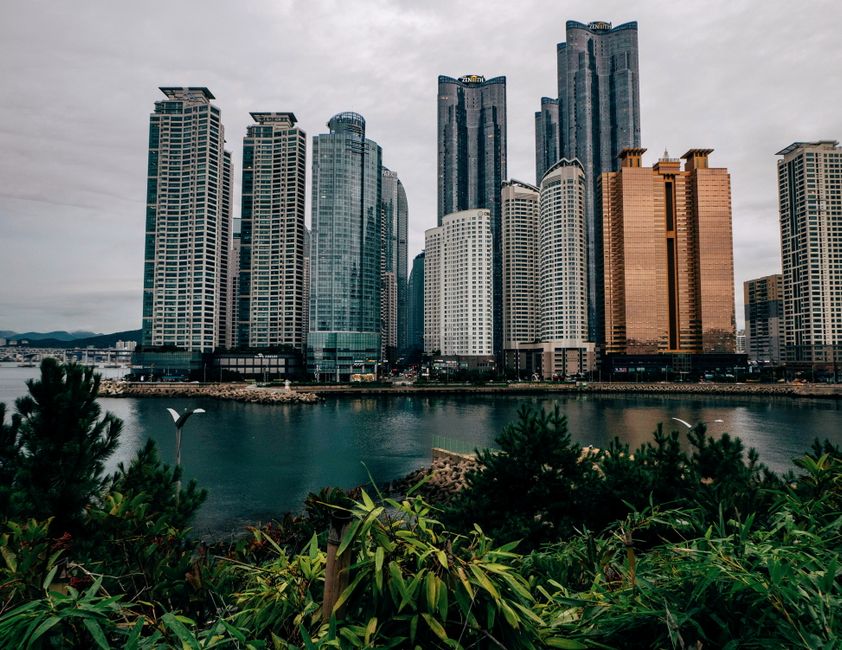
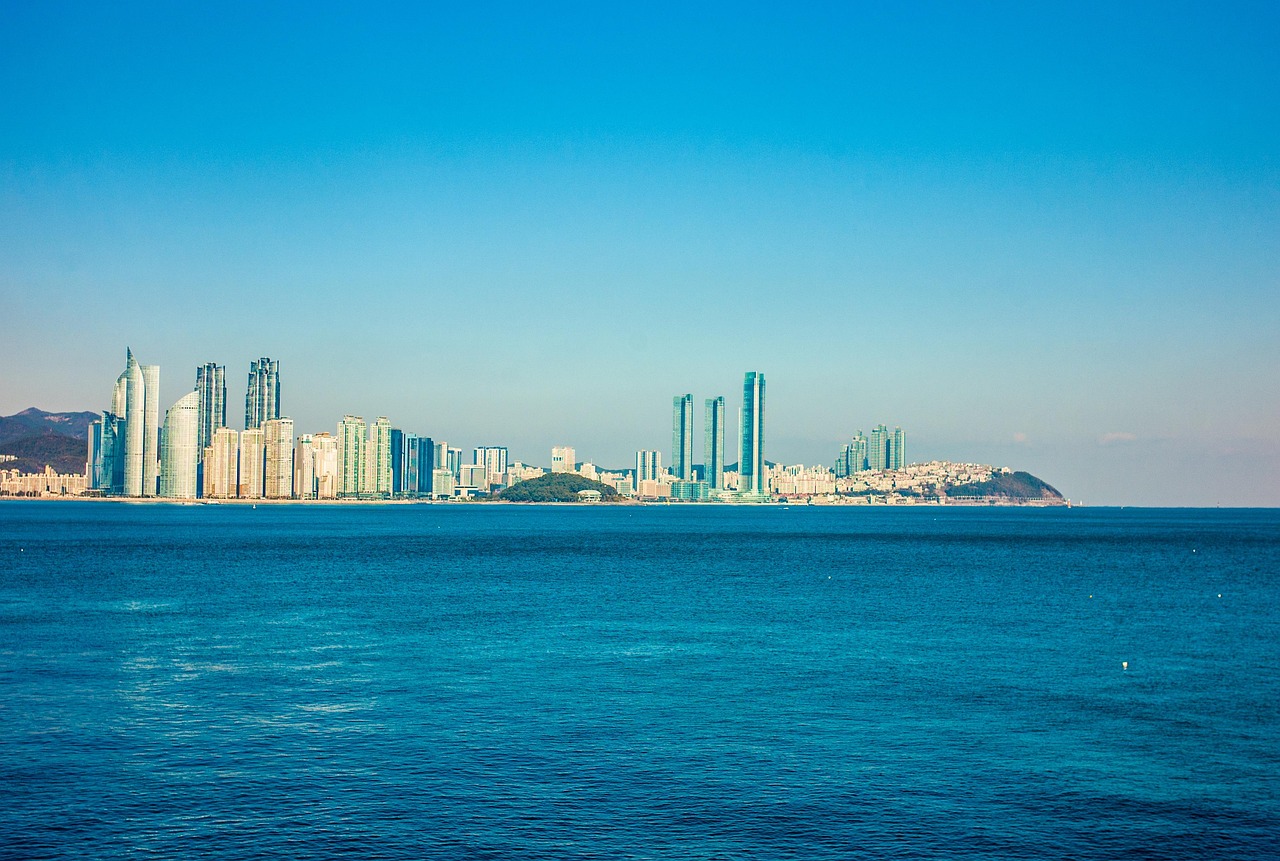
Busan, South Korea’s second city and its biggest port, wraps around a coast of beaches, rocky headlands and harbor bays at the southeastern tip of the peninsula. It mixes big-city energy with the sea: high-rise Haeundae and its long beach, the bridge lights over Gwangalli, the Jagalchi fish market, a Buddhist temple on the rocks at Haedong Yonggungsa, the pastel hillside houses of Gamcheon Culture Village and cliff walks at Taejongdae. Busan is milder than Seoul, with warmer winters and a long beach season, and it is the gateway to Gyeongju, the south coast and, by ferry, Japan. The best months are May, June, September and October; July and August are hot, humid and crowded on the beaches, with the jangma rains and the chance of typhoons.
Right now in Busan
- Wed 12–24°C 53–75°F Clear
- Thu 14–24°C 58–75°F Clear
- Fri 16–24°C 60–76°F 1 mm Clear
- Fri 9 Oct Hangul Day (한글날)
Weather: MET Norway (CC BY 4.0) · Sea temperature: NOAA CoastWatch · Air quality: OpenAQ · Rates: ECB · Holidays: Nager.Date
Top tours in Busan
See all tours for Busan →
From local operators, with prices and reviews; you check availability and book on Viator, our partner. We may earn a commission at no extra cost to you. How we earn money
Busan at a glance
- Best for: city beaches, seafood and markets, coastal walks, temples, hillside villages, the film festival and a relaxed pace after Seoul.
- How long: 2–3 days for the city; 4 or more with Gyeongju or the south coast.
- Best time: May to June and September to October, with highs of about 22–26 °C (72–80 °F); beach season from June to early September.
- Getting there: about 2.5 hours from Seoul by KTX or SRT; Gimhae International Airport has flights across Asia; ferries sail to Fukuoka in Japan.
- Getting around: four metro lines plus a light rail to the airport, buses, taxis and walking; pay with a T-money card.
- Good to know: Gamcheon Culture Village is a residential area where tourist visits are limited to 9 a.m. to 6 p.m.
- Before you go: the K-ETA (and the exemption for 22 countries until December 31, 2026), the e-Arrival card, money and general safety are in our South Korea travel guide; see also our Gyeongju guide.
Busan’s areas and where to stay
Busan stretches for about 40 km (25 miles) along the coast and up the valleys between steep hills, so the city feels like a string of separate towns linked by the metro. Most visitors base themselves by the beaches or in the old downtown near the port.
Haeundae
Busan’s famous beach district, with a 1.5 km (1-mile) sand beach backed by towers, Dongbaekseom island’s coastal path, the fish market and many hotels; next door, Marine City’s skyscrapers and The Bay 101 glitter at night. Haeundae is lively and convenient for the beaches and the east coast, a 40-minute metro ride from downtown.
Gwangalli and Suyeong
A smaller beach facing the illuminated Gwangan Bridge, with a promenade of cafés, bars and seafood restaurants and the free drone light show. Good value and more relaxed than Haeundae.
Nampo, Jung-gu and the old port
The historic downtown around the old harbor: Jagalchi fish market, Gukje Market, BIFF Square’s street food, Yongdusan Park and Busan Tower, with Gamcheon and Yeongdo a short ride away. Close to Busan Station and the international ferry terminal.
Seomyeon and Busan Station
Seomyeon, where metro lines 1 and 2 cross, is the shopping and nightlife center, with food alleys and the huge Lotte Department Store; the area around Busan Station suits short stays and early trains.
Gijang and the east coast
North of Haeundae, Songjeong Beach (Busan’s surf beach), Haedong Yonggungsa temple and resort hotels around Osiria, with the Lotte World Adventure theme park.
Top things to see in Busan
Haeundae Beach and the coastal walks
Haeundae is Korea’s best-known beach, busy with swimmers in summer and walkers all year. Walk around Dongbaekseom island to the Nurimaru APEC House, and east along the Green Railway, a 9.8 km (6-mile) walking trail on the former coastal railway line toward Songjeong, according to the Korea Tourism Organization (KTO). Beside it, the Haeundae Blueline Park runs small “sky capsules” and a beach train along the old tracks (book ahead in high season). BUSAN X the Sky, on the 98th to 100th floors of the LCT Landmark Tower, Busan’s tallest building, is the city’s highest observatory.
Gwangalli Beach and Gwangan Bridge
The 7.4 km (4.6-mile) Gwangan Bridge lights up every night across the bay. According to the KTO, Gwangalli hosts a permanent drone light show (usually on Saturday evenings; check the schedule), and the beach has a stand-up paddleboard zone with lessons. The promenade is lined with seafood restaurants and rooftop bars.
Haedong Yonggungsa Temple
A Buddhist temple founded in the 14th century on rocks above the waves, on the coast north of Haeundae. Entry is free; go early in the morning or at sunrise to avoid the tour groups, and be ready for steps.
Gamcheon Culture Village
Built by refugees during the Korean War, this hillside neighborhood of brightly painted houses, murals and art installations is one of Busan’s most photographed sights. According to the KTO, Busan has made the village a special management area: tourists may visit the residential lanes only between 9 a.m. and 6 p.m., groups of 10 or more must buy a group map, tourist cars and taxis are restricted inside the village, and you should keep your voice down and not photograph residents or look into houses. Buy the village map at the information center for a self-guided route.
Jagalchi Market and Nampo
Korea’s biggest fish market, on the waterfront in Nampo: choose fish, octopus or shellfish on the ground floor and have it prepared as hoe (sashimi), grilled or in a spicy stew upstairs. Nearby, Gukje Market and the covered arcades sell everything, BIFF Square has street food such as ssiat hotteok (seed-filled pancakes), and Yongdusan Park’s Busan Tower gives a harbor view.
Taejongdae and Yeongdo
On Yeongdo island, the cliffs and pine forest of Taejongdae, a scenic site and part of a national geopark, can be explored on foot or on the Danubi tourist train, with an observatory, Taejongsa temple and Yeongdo Lighthouse. Yeongdo’s Huinnyeoul Culture Village, a cliff-top lane of cafés above the sea, is a lovely walk.
More classic sights
- Songdo: Korea’s first public beach, with a sea cable car and a clifftop skywalk.
- Igidae Coastal Walk: a cliff trail with views of Gwangan Bridge and the Oryukdo Skywalk.
- Beomeosa: a mountain temple founded in 678 on the slopes of Geumjeongsan, now Korea’s newest national park.
- UN Memorial Cemetery: the world’s only United Nations cemetery, for soldiers who died in the Korean War.
- Busan Cinema Center: the home of the Busan International Film Festival, in Centum City next to the giant Shinsegae department store.
Beaches
- Gwangalli Beach
- Haeundae Beach
Other sights
- Gwangan Bridge
- Jagalchi Market
Parks and gardens
- Taejongdae
- United Nations Memorial Cemetery
Nature
- Dongbaek Island
Historic centres
- Gamcheon Culture Village
Churches and cathedrals
- Beomeosa
- Haedong Yonggungsa
Other things to do in Busan
Food and drink
Busan is a seafood city. Try hoe (raw fish) at Jagalchi or the Millak raw fish center near Gwangalli, grilled clams on the beach, eomuk (fish cakes, a Busan specialty), and the local soups: dwaeji gukbap (pork and rice soup), milmyeon (cold wheat noodles, born in wartime Busan) and daegu-tang (cod soup). Haeundae and Seomyeon have Korean barbecue and fried chicken; Jeonpo Café Street near Seomyeon is the coffee district. The local soju brands are C1 and Daesun.
Beaches and water sports
Busan has seven city beaches. Haeundae and Gwangalli are the busiest, Songjeong is the surf beach (best in fall and winter swells), and Dadaepo, in the west, has wide tidal flats and sunsets. Beaches are officially open with lifeguards in summer, roughly from June or July to August; swim only between the flags. See our beaches and surfing guides.
Boat trips and the harbor
Yacht and cruise tours leave from The Bay 101 in Haeundae and from Suyeongman, especially at sunset to see the bridge lights; harbor cruises sail from Nampo. See our boat trips guide.
Festivals
The Busan International Film Festival, Asia’s biggest, takes over the city in early October; the Busan Fireworks Festival lights up Gwangalli in the fall; the Haeundae Sand Festival is held in early summer; and the Busan Sea Festival runs in August. Hotels fill up for all of them.
Activities and best months
- Beaches and swimmingThe KTO lists Haeundae and Songjeong beaches and Gwangalli, with its permanent drone light show and a stand-up paddle zone, among Korea's 100 must-visit spots. · source
Day trips from Busan
- Gyeongju: the old Silla capital, with Bulguksa, Seokguram and the royal tombs, about 30 minutes by KTX to Singyeongju or an hour by the KTX-Eum from Bujeon to Gyeongju Station. See our Gyeongju guide.
- Tongdosa: one of Korea’s three jewel temples, in Yangsan, under an hour by bus.
- Tongyeong and Geoje: south-coast harbors and islands, with a cable car and island cruises, about 1.5–2 hours by bus.
- Ulsan: the Daewangam cliffs and the Bangudae petroglyphs, added to the UNESCO World Heritage list in 2025.
- Fukuoka, Japan: overnight or fast ferries cross the Korea Strait from Busan’s international ferry terminal; more an overnight trip than a day out. See our Fukuoka guide.
Getting there and getting around
By air
Gimhae International Airport (PUS), west of the city, has domestic flights (Seoul’s Gimpo, Jeju) and international flights across Asia, with new routes added in 2026 to Taichung, Phu Quoc, Kuala Lumpur and several Japanese cities, according to the KTO. From the airport, the Busan–Gimhae light rail runs to Sasang, where you change to metro line 2: about 30 minutes to Seomyeon and 70 minutes to Haeundae. Airport limousine buses go to Seomyeon and Haeundae (buy tickets at the counter near gate 4), and a taxi takes about 40 minutes to Seomyeon and 70 minutes to Haeundae.
By train and bus
KTX trains from Seoul Station and SRT trains from Suseo, in Gangnam, run to Busan Station in about 2.5 hours; according to the KTO, the Gyeongbu line between Seoul and Busan is 447 km (278 miles) long. Some trains also stop at Gupo in the west. Since December 30, 2025, the KTX-Eum on the Donghae Line has linked Bujeon Station with Gyeongju, Pohang and Gangneung along the east coast. Express buses leave from Nopo (Busan Central Bus Terminal) and Haeundae for most cities.
By ferry
The international ferry terminal near Busan Station has ferries to Fukuoka, Shimonoseki, Osaka and Tsushima in Japan; ferries to Jeju also sail from Busan.
Metro, buses and taxis
Busan’s metro has four main lines plus the Busan–Gimhae light rail and the Donghae Line commuter trains; line 2 runs along the coast to Gwangalli and Haeundae. Pay with a T-money card, which also works on buses. Taxis start at 4,800 won (about US$3.50) for the first 2 km (1.2 miles); book with k.ride or Uber. Use Naver Map or Kakao Map for directions. The hills are steep, so allow extra time and take taxis up to Gamcheon and Huinnyeoul if you want to save your legs.
When to go and how long to stay
Busan has the mildest climate of Korea’s big mainland cities, with sea breezes in summer and few freezing days in winter. The table uses the 1991–2020 normals of the Korea Meteorological Administration (KMA) for its Busan station, as submitted to the World Meteorological Organization: average daily highs and lows, total rain and days with at least 1 mm of rain.
| Month | Average high / low | Rain (days with 1 mm or more) | What to expect |
|---|---|---|---|
| January | 8 °C (47 °F) / 0 °C (32 °F) | 34 mm (1.4 in), 4 days | Cold, dry and sunny; quiet beaches |
| February | 10 °C (50 °F) / 2 °C (35 °F) | 50 mm (2.0 in), 4 days | Plum blossoms; still cool |
| March | 14 °C (57 °F) / 5 °C (42 °F) | 90 mm (3.5 in), 6 days | Cherry blossoms from the last week of the month |
| April | 18 °C (65 °F) / 10 °C (50 °F) | 141 mm (5.5 in), 8 days | Mild and pleasant; spring flowers |
| May | 22 °C (72 °F) / 15 °C (58 °F) | 156 mm (6.1 in), 7 days | Warm and fresh; great walking weather |
| June | 25 °C (76 °F) / 18 °C (65 °F) | 188 mm (7.4 in), 8 days | Warm and humid; jangma rains usually start around June 23 |
| July | 28 °C (82 °F) / 22 °C (72 °F) | 327 mm (12.9 in), 10 days | The wettest month; beach season begins |
| August | 30 °C (85 °F) / 24 °C (75 °F) | 266 mm (10.5 in), 10 days | Hot and humid; beaches at their busiest; typhoons possible |
| September | 26 °C (80 °F) / 20 °C (68 °F) | 161 mm (6.3 in), 7 days | Warm sea; typhoons possible; quieter beaches |
| October | 22 °C (72 °F) / 14 °C (58 °F) | 80 mm (3.1 in), 4 days | Clear and mild; Busan International Film Festival |
| November | 17 °C (62 °F) / 8 °C (47 °F) | 50 mm (2.0 in), 4 days | Cool and sunny; fireworks festival |
| December | 10 °C (51 °F) / 2 °C (36 °F) | 34 mm (1.3 in), 3 days | Cool and dry; seafood season |
Busan gets about 1,580 mm (62 in) of rain a year, more than a third of it in July and August. According to the KMA, the jangma monsoon normally reaches the southern regions around June 23 and lasts about a month, and typhoons, most likely from July to September, can bring storms, high waves and canceled ferries to Busan. Winter nights rarely drop much below freezing.
Weather month by month
Averages from KMA normals 1991–2020, Busan · Last reviewed 5 Oct 2026
Cherry blossoms and beaches: in 2026, the KTO’s forecast (from Weather i) put Busan’s first cherry blossoms on March 25, among the earliest on the mainland; Dalmaji-gil above Haeundae and the Oncheoncheon stream are favorite spots. The sea is warm enough for swimming from July to September.
2 days in Busan
Day one, Gamcheon Culture Village in the morning, then Jagalchi Market, BIFF Square and Gukje Market for lunch, and Taejongdae in the afternoon; dinner in Nampo. Day two, sunrise at Haedong Yonggungsa, the Green Railway and Haeundae Beach, BUSAN X the Sky at sunset, and Gwangalli for the bridge lights.
4 days with day trips
Add a day in Gyeongju and a slower day for Beomeosa, the Igidae coastal walk and a sunset cruise.
Where to stay in Busan
- Haeundae: beach hotels and resorts, the widest choice of restaurants; the best summer base.
- Gwangalli: bridge views and bars, good value.
- Nampo and Jung-gu: the old port, markets and Gamcheon; convenient for ferries.
- Seomyeon: central, with nightlife and good metro links.
- Busan Station: practical business hotels for train travelers.
Hotel prices rise sharply in July and August and during the film festival; book early.
What a trip to Busan costs
Prices are approximate, for October 2026, converted at about 1,365 won to the US dollar.
| Item | Typical cost |
|---|---|
| Metro or bus ride with T-money | about 1,600 won (about US$1.20) |
| KTX, Seoul to Busan, standard class | about 60,000 won (about US$44) |
| Taxi, base fare (first 2 km, 1.2 miles) | 4,800 won (about US$3.50) |
| Dwaeji gukbap or milmyeon | 9,000–12,000 won (about US$6.60–9) |
| Raw fish platter for two at Jagalchi | 50,000–100,000 won (about US$37–73) |
| Haedong Yonggungsa, Gamcheon village | free |
| Mid-range hotel double, per night | 100,000–200,000 won (about US$73–147) |
| Beach hotel in Haeundae, summer | 250,000 won and up (about US$183 and up) |
Practical tips for Busan
- Hills: Gamcheon, Huinnyeoul and Taejongdae involve steep slopes and steps; wear good shoes.
- Respect residents: keep to Gamcheon’s 9 a.m. to 6 p.m. visiting hours and stay quiet in the lanes.
- Markets: confirm prices by weight before choosing fish at Jagalchi.
- Book festivals early: rooms near Haeundae and Gwangalli sell out for the film and fireworks festivals.
- Help in English: call the 1330 Korea Travel Helpline.
Safety
Busan is safe and easygoing. The main risks come from the sea and the weather. Typhoons, most likely from July to September, can bring high waves, strong winds and flooding to the coast; stay away from seawalls and rocky coastal paths when warnings are issued, and follow the emergency text alerts. Swim only on official beaches during the lifeguard season and between the flags, as rip currents form at Haeundae and Songjeong. Coastal trails such as Igidae and Taejongdae have steep drops; keep to the paths. In an emergency, call 112 for the police or 119 for an ambulance or fire.
What to pack for Busan
Swimwear and sandals in summer, comfortable shoes for the hills and coastal walks, a light rain jacket for the jangma and typhoon season, and a warm jacket from December to February, when the sea wind is cold. Korea uses 220 V and round two-pin plugs.
What to pack
- Day packs and anti-theft bagsCarries water, towel and sunscreen down the long stairways to Algarve coves.
- Dry bags and phone pouchesProtects phones and cameras from sand and spray on beaches reached by ferry or steep paths.
- Quick-dry beach towelsA sand-shedding quick-dry towel packs small for beach days and lido visits.
- Reef-friendly sunscreenSummer UV is strong on Portuguese beaches and there is little shade below the cliffs.
- Water shoesRocky coves, lava pools and weever fish in shallow sand make water shoes useful.
- WetsuitsOn the west and north coasts the sea stays around 16–18 °C even in summer, so a thin suit helps for long swims.
Busan travel FAQ
How many days do I need in Busan?
Two to three days for the main sights; four or more with a day trip to Gyeongju.
How do I get from Seoul to Busan?
By KTX from Seoul Station or SRT from Suseo, in about 2.5 hours, or by a one-hour domestic flight from Gimpo to Gimhae.
What are Gamcheon Culture Village’s opening hours?
Tourist visits to the residential lanes are allowed from 9 a.m. to 6 p.m. Groups of 10 or more must buy a group map, and tourist cars and taxis are restricted inside the village.
Is Haeundae or Gwangalli better to stay?
Haeundae has the bigger beach and more hotels; Gwangalli is smaller, cheaper and has the bridge views and nightlife.
When can you swim in Busan?
The beaches have lifeguards in the summer season, roughly from June or July to August, and the sea stays warm into September.
When is the Busan International Film Festival?
Every year in early October, mainly at the Busan Cinema Center in Centum City and in Haeundae.
How do I get from Gimhae Airport to Haeundae?
Take the light rail to Sasang and metro line 2 (about 70 minutes), an airport limousine bus, or a taxi (about 70 minutes).
Can I take a ferry from Busan to Japan?
Yes. Ferries leave the international terminal near Busan Station for Fukuoka, Shimonoseki, Osaka and Tsushima.
When is typhoon season in Busan?
Typhoons can affect Busan from July to September; flights, ferries and beaches may close for a day or two.
Is Busan worth visiting after Seoul?
Yes. It adds beaches, seafood and coastal scenery, and it is the best base for Gyeongju and the south coast.
Sources
- © OpenStreetMap contributors · ODbL · fetched 5 Oct 2026
- Wikidata · CC0 · fetched 5 Oct 2026
Sources and last review
Researched and last reviewed on 4 October 2026. Gamcheon’s special management area rules, the Green Railway, BUSAN X the Sky, the Gwangalli drone show, airport transportation, new routes from Gimhae, taxi fares, the KTX-Eum, the Gyeongbu line and the 2026 cherry blossom forecast (from Weather i): the Korea Tourism Organization (KTO); climate normals and jangma dates: the Korea Meteorological Administration (KMA), via the World Meteorological Organization; Geumjeongsan National Park: the Korea National Park Service; exchange rate: the US Federal Reserve. Journey times, ferry routes, beach seasons, festival dates, the drone show schedule and typical prices are general references or estimates, flagged for checking. Prices and hours change, so check the official sites before you go. For entry rules, money and general safety, see our South Korea travel guide.
Plan your trip
Partner links: TravelerCenter may earn a commission if you book, at no extra cost to you.
🇰🇷 Useful Korean phrases for Busan
All 38 Korean phrases: restaurant, hotel, emergencies, romance (printable) →