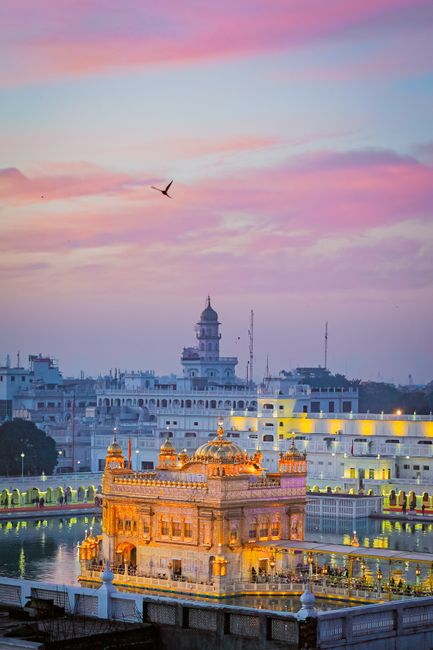
Amritsar, in the state of Punjab near the border with Pakistan, is the spiritual center of the Sikh faith and home to its holiest shrine, Sri Harmandir Sahib, known to the world as the Golden Temple. According to Incredible India, the city grew from a settlement founded in 1574 by Guru Ram Das, the fourth Sikh Guru, around a sacred pool, the Amrit Sarovar, that gave Amritsar its name; the temple at its center, its upper story covered in gold leaf, welcomes everyone, regardless of religion, around the clock, and its community kitchen serves free meals to tens of thousands of people a day. Amritsar is also a city of history and memory: the memorial garden of Jallianwala Bagh recalls the massacre of 1919, the Partition Museum tells the story of the division of India and Pakistan in 1947, and the evening flag-lowering ceremony at the Attari–Wagah border, about 30 km (19 miles) west, draws large, patriotic crowds. Add Punjab’s famously generous food, from stuffed kulchas to creamy lassi, and the city easily rewards two or three days. The most pleasant months are October to March.
Right now in Amritsar
- Wed 22–31°C 71–87°F Mostly clear
- Thu 23–31°C 73–87°F 2 mm Showers
- Fri 23–30°C 73–85°F 1 mm Mostly clear
Weather: MET Norway (CC BY 4.0)
Top tours in Amritsar
See all tours for Amritsar →
From local operators, with prices and reviews; you check availability and book on Viator, our partner. We may earn a commission at no extra cost to you. How we earn money
Amritsar at a glance
- Best for: the Golden Temple by day and night, the langar, Sikh heritage, Jallianwala Bagh, the Partition Museum, the Attari–Wagah ceremony and Punjabi food.
- How long: 2 days covers the main sights; 3 for a slower pace.
- Best time: October to March; winter nights can be cold and foggy, and May and June are very hot.
- Getting there: Sri Guru Ram Dass Jee International Airport (ATQ), about 13 km (8 miles) from the Golden Temple, and fast trains from Delhi.
- Getting around: on foot in the walled city, by e-rickshaw, auto-rickshaw or app cab elsewhere.
- Good to know: entry to the Golden Temple is free; cover your head, remove your shoes and wash your feet before entering.
- Before you go: the e-Visa, money, trains and general safety are in our India travel guide.
Amritsar’s areas and where to stay
The old walled city, with the Golden Temple at its heart, lies south of the railway station; the modern city spreads beyond it.
The Golden Temple and Heritage Street
The area around the temple has been pedestrianized as a heritage street, lined with hotels, guesthouses, sweet shops and dhabas, all within a few minutes’ walk of the entrance. Staying here lets you visit the temple at dawn and late at night, the most atmospheric times. The temple’s own pilgrim lodges, run by the Shiromani Gurdwara Parbandhak Committee (SGPC), also take visitors.
The walled city
Beyond the temple, the old city is a maze of bazaars selling textiles, steel utensils, pickles and sweets, with Jallianwala Bagh and the Town Hall close by. Few hotels lie deeper inside.
Lawrence Road and Ranjit Avenue
North of the station, the newer parts of the city have mid-range and international hotels, shopping malls and restaurants, about 15 to 20 minutes by road from the temple.
Top things to see in Amritsar
The Golden Temple (Sri Harmandir Sahib)
The Golden Temple stands in the middle of the Amrit Sarovar, reached by a marble causeway. According to the district administration, the foundation of the temple was laid in 1588 under the fifth Guru, Guru Arjan Dev, who gave it four doors to show that it was open to all, and the Sikh scripture, the Guru Granth Sahib, was installed there in 1604. The temple was rebuilt in the 18th century, and in the early 19th century Maharaja Ranjit Singh covered its upper floors in gilded copper; Incredible India puts the gold leaf at almost 400 kg. Inside, musicians sing hymns from the scripture from before dawn until late at night, and pilgrims walk the marble parikrama around the pool and bathe in its waters.
Visiting. Entry is free and open around the clock. All visitors must cover their heads (scarves are available at the entrances), leave their shoes at the free shoe deposit, and wash their feet in the shallow channels at the gates. Dress modestly, do not bring tobacco or alcohol, and sit cross-legged on the floor, not with your feet pointing toward the scripture. Photography is allowed around the pool but not inside the main shrine. Come at least twice: early in the morning, when the scripture is carried in procession from the Akal Takht to the temple, and after dark, when the gold glows in floodlight on the water.
The langar
According to the district administration, the temple’s multistory langar hall is open 24 hours a day, serving a simple vegetarian meal of roti, dal, vegetables and kheer to everyone who comes, seated in rows on the floor, regardless of faith or status. Volunteers, many of them visitors, help to chop vegetables, roll chapatis and wash the dishes; you are welcome to join in. A donation is appreciated but never required.
Jallianwala Bagh
A short walk from the temple, this walled garden is a memorial to the hundreds of people killed and wounded on April 13, 1919, when British troops under General Reginald Dyer opened fire without warning on a peaceful gathering; the district administration describes it as one of the major incidents of India’s freedom struggle. Bullet marks are preserved in a section of wall, along with the well into which some people jumped to escape, and a gallery tells the story. Entry is free.
Partition Museum
In the restored red-brick Town Hall near the temple, the Partition Museum tells the story of the 1947 division of British India into India and Pakistan, one of the largest migrations in human history, through oral histories, photographs, letters and objects donated by survivors and their families. Allow two hours.
The Attari–Wagah border ceremony
Every evening before sunset, the Border Security Force of India and the Pakistan Rangers perform a choreographed flag-lowering ceremony at the Attari–Wagah border post, about 32 km (20 miles) west of the city bus stand. The district administration describes the soldiers marching in perfect drill as their national flags come down, amid cheering crowds and patriotic music. Seating on the Indian side is free, but stands fill early; arrive at least 1½ to 2 hours before sunset, bring your passport (foreigners sometimes have a separate seating area), and leave bags in the car, as they are not allowed. Since 2025 the ceremony has been held in a scaled-down form, without the traditional handshake and with the gates kept closed, and the land crossing itself has been closed to most travelers; check locally before you go.
More classic sights
- Gobindgarh Fort: an 18th-century fort, opened to the public with museums and evening shows on Punjab’s history.
- Durgiana Temple: a Hindu temple with a gilded dome set in its own sacred pool, modeled on the Golden Temple.
- Maharaja Ranjit Singh Museum: in the summer palace of the Sikh ruler in the Ram Bagh gardens.
- Punjab State War Heroes’ Memorial and Museum: a sword-shaped memorial and military museum on the road to Attari.
- Akal Takht: the seat of Sikh temporal authority, facing the Golden Temple across the parikrama.
- Gurudwara Baba Atal Sahib: a nine-story tower near the temple with views over the old city.
Other things to do in Amritsar
Food and drink
Amritsar is one of India’s best food cities. Its signature dish is the Amritsari kulcha, a crisp, buttery bread stuffed with spiced potato and cauliflower, baked in a tandoor and served with chole (chickpea curry). Try poori chole or satpura for breakfast, Amritsari fish fried in spiced batter, mutton chaap and tandoori chicken, and the city’s famously thick lassi, topped with a layer of cream. The dhabas, family-run eateries that grew up after Partition, serve kali dal, sarson ka saag with makki di roti in winter, and kadhi. Finish with phirni, kulfi or pinni. Restaurants near the Golden Temple are vegetarian and alcohol-free. Drink bottled or filtered water.
Shopping
The bazaars of the old city sell phulkari, the bright embroidered shawls of Punjab, juttis (embroidered leather slippers), woolen shawls, papad and wadiyan (sun-dried lentil dumplings), pickles and spice mixes. Katra Jaimal Singh is the place for textiles.
Festivals
Baisakhi, around April 13 or 14, the harvest festival and the anniversary of the founding of the Khalsa in 1699, fills the temple with pilgrims. On Diwali, celebrated by Sikhs as Bandi Chhor Divas, the Golden Temple and the pool are lit with thousands of lamps and fireworks. The birthday of Guru Nanak, in November, and the other Gurpurabs are marked by processions called nagar kirtans. See our city sightseeing guide.
Day trips from Amritsar
- Attari–Wagah border: the evening ceremony, about 45 minutes to an hour by road; combine it with the War Heroes’ Memorial.
- Tarn Taran and Goindwal Sahib: important Sikh gurdwaras south of the city, Tarn Taran with one of the largest sacred pools.
- Harike wetland: a bird sanctuary at the confluence of the Beas and Sutlej rivers, best from November to February, about 60 km (37 miles) south.
- Dharamshala and McLeod Ganj: the home of the Tibetan government-in-exile in the Himalayan foothills, about 5 to 6 hours by road; best on an overnight trip.
- Delhi: about 6 hours by fast train. See our Delhi travel guide.
Getting there and getting around
By air
Sri Guru Ram Dass Jee International Airport (ATQ), which the district administration places 13 km (8 miles) from the Golden Temple, is a designated e-Visa entry airport, with domestic flights across India and international flights to the Gulf, Central Asia and Southeast Asia. Taxis and app cabs take 30 to 40 minutes to the temple.
By train
Amritsar Junction, about 2 km (1 mile) from the Golden Temple, has fast trains to Delhi, including the Shatabdi Express and the Vande Bharat Express, which take about 5½ to 6 hours, and services to Jammu, Haridwar, Kolkata and Mumbai. The nearest station to the Wagah border is Attari, 6 km (4 miles) away.
By road
The bus stand is about 1.7 km (1 mile) from the temple. Punjab’s roads are good by Indian standards; Delhi is about 7 to 8 hours by road.
Around the city
The streets around the Golden Temple are pedestrianized; e-rickshaws and cycle-rickshaws shuttle visitors from the edge of the zone. Auto-rickshaws and app cabs cover the rest of the city, and shared taxis and tour vehicles run to the Wagah border every afternoon.
When to go and how long to stay
Amritsar has a semi-arid climate with very hot summers and cool, foggy winters. October to March is the best time to visit, with warm, dry days from October to November and February to March; in December and January, highs are around 19 to 21 °C (66 to 70 °F), nights near freezing, around 4 °C (39 °F), and dense fog can delay trains and flights. April to June is hot, with highs near 40 °C (104 °F) in June. The monsoon, from July to September, brings humid heat and heavy showers. The World Meteorological Organization’s 1991–2020 archive does not include Amritsar’s station, so the table shows the India Meteorological Department’s (IMD) older long-term averages for Amritsar, as published on the WMO World Weather Information Service; they are a good guide to the seasons, but recent decades have been slightly warmer.
| Month | Average high / low | Rain | What to expect |
|---|---|---|---|
| January | 19 °C (67 °F) / 4 °C (39 °F) | 28 mm (1.1 in) | Cold nights; dense fog |
| February | 22 °C (71 °F) / 6 °C (43 °F) | 29 mm (1.1 in) | Cool and fresh; occasional showers |
| March | 27 °C (80 °F) / 11 °C (52 °F) | 35 mm (1.4 in) | Pleasant; spring |
| April | 34 °C (93 °F) / 16 °C (61 °F) | 19 mm (0.8 in) | Warm to hot; Baisakhi |
| May | 39 °C (102 °F) / 21 °C (70 °F) | 20 mm (0.8 in) | Hot and dry |
| June | 40 °C (104 °F) / 25 °C (77 °F) | 52 mm (2.0 in) | Hottest month |
| July | 35 °C (96 °F) / 26 °C (78 °F) | 225 mm (8.8 in) | Monsoon; wettest month |
| August | 34 °C (94 °F) / 25 °C (77 °F) | 175 mm (6.9 in) | Humid; heavy showers |
| September | 34 °C (94 °F) / 23 °C (73 °F) | 95 mm (3.7 in) | Rains ending |
| October | 32 °C (90 °F) / 16 °C (60 °F) | 21 mm (0.8 in) | Warm days, cooler nights; Diwali in some years |
| November | 27 °C (81 °F) / 9 °C (48 °F) | 6 mm (0.2 in) | Clear and pleasant; Guru Nanak’s birthday |
| December | 21 °C (70 °F) / 4 °C (40 °F) | 15 mm (0.6 in) | Cold nights; fog begins |
These averages give Amritsar about 720 mm (28 in) of rain a year, more than half of it in July and August.
Two days in Amritsar
Day one: the Golden Temple at dawn, breakfast of kulcha and lassi, Jallianwala Bagh and the Partition Museum, then the Attari–Wagah ceremony in the afternoon and the temple again by night. Day two: help out in the langar, explore the old bazaars, visit Gobindgarh Fort and the Durgiana Temple, and end with a dhaba dinner.
Three days
Add the War Heroes’ Memorial, the Ranjit Singh Museum and a trip to Tarn Taran, or continue to Dharamshala.
Where to stay in Amritsar
- Heritage Street and the Golden Temple area: hotels and guesthouses steps from the temple, ideal for dawn and night visits.
- SGPC pilgrim lodges: simple rooms near the temple, run by the committee that manages it.
- Lawrence Road and Ranjit Avenue: mid-range and international hotels in the modern city.
Rooms near the temple fill up around Baisakhi, Diwali and the Gurpurabs; book ahead.
What a trip to Amritsar costs
Prices are approximate, for October 2026, converted at about 96 rupees (₹) to the US dollar.
| Item | Typical cost |
|---|---|
| Golden Temple and langar | Free (donations welcome) |
| Jallianwala Bagh | Free |
| Attari–Wagah ceremony seating | Free |
| Shared taxi or tour to the Wagah border, return | ₹200–500 (about US$2–5) |
| Amritsari kulcha with chole | ₹80–200 (about US$0.80–2) |
| Lassi | ₹50–120 (about US$0.50–1.25) |
| Dinner in a mid-range restaurant | ₹500–1,500 (about US$5–16) per person |
| Mid-range hotel double near the temple, per night | ₹3,500–9,000 (about US$36–94) |
Practical tips for Amritsar
- Carry a scarf: you need a head covering at the Golden Temple and other gurdwaras.
- Use the shoe deposit: it is free; leave socks with your shoes, too.
- Visit twice: the temple is quietest and most beautiful before dawn and late at night.
- Get to the border early: seats fill well before the ceremony, especially at weekends and on holidays.
- Travel light to Wagah: bags are not allowed in the seating area; bring only your passport, phone and water.
Safety
Amritsar is generally safe and welcoming, and the Golden Temple area is well policed. Crowds at the temple on festival days and at the Attari–Wagah ceremony are very dense, so keep your passport and phone secure and stay with your group. Border area: the ceremony takes place in a security zone; follow the instructions of the Border Security Force, carry your passport and do not photograph military installations other than the ceremony itself. Heat from May to June and fog from December to January call for planning: take water and sun protection in summer, and allow extra time for winter travel. Food and water: the food is rich, so pace yourself, and drink bottled or filtered water. Road safety: Punjab’s highways are fast and busy; avoid driving in dense fog. Women travelers generally find the temple area comfortable; dress modestly and use app cabs at night. In an emergency, call 112.
What to pack for Amritsar
A scarf or bandana for covering your head, modest clothes that cover shoulders and knees, easy slip-on shoes, warm layers and a jacket for winter nights and early mornings, and light clothes and a hat for summer. India uses 230 V, with round-pin plugs of types C, D and M. See our travel adapters guide.
Amritsar travel FAQ
Is there an entry fee for the Golden Temple?
No. The Golden Temple and its langar are free and open to everyone, day and night. Donations are welcome but not required.
What are the rules for visiting the Golden Temple?
Cover your head, remove your shoes and socks at the free shoe deposit, wash your feet, dress modestly, and do not bring tobacco or alcohol. Photography is not allowed inside the main shrine.
Can non-Sikhs eat at the Golden Temple langar?
Yes. The langar serves free vegetarian meals to everyone, of any faith, around the clock, and visitors are welcome to volunteer in the kitchen.
What time is the Wagah border ceremony?
It takes place every evening shortly before sunset, so the time changes through the year. Arrive at least 1½ to 2 hours early to get a seat.
Can I cross the border to Pakistan at Wagah?
Not usually. The land crossing at Attari has been closed to most travelers since 2025; check the current situation locally before planning a crossing.
How many days do I need in Amritsar?
Two days covers the Golden Temple by day and night, the langar, Jallianwala Bagh, the Partition Museum and the border ceremony.
What is the best time to visit Amritsar?
October to March, for pleasant weather. December and January are cold and foggy, and May and June are very hot.
How do I get from Delhi to Amritsar?
By fast train, such as the Shatabdi or Vande Bharat Express, in about 5½ to 6 hours, by a one-hour flight, or by road in about 7 to 8 hours.
What food is Amritsar famous for?
Amritsari kulcha with chole, lassi, Amritsari fish, mutton chaap, dhaba dal and saag, and phirni.
Can I stay at the Golden Temple?
The SGPC runs pilgrim lodges near the temple, which also take visitors, and there are many hotels and guesthouses along Heritage Street.
Sources and last review
Researched and last reviewed on 4 October 2026. The Golden Temple’s history, the 24-hour langar, Jallianwala Bagh, the Wagah ceremony and distances to the airport, station and border: the Amritsar district administration; the founding of the city, the gold leaf and other sights: Incredible India (Ministry of Tourism); the designated e-Visa airport: the Bureau of Immigration; Amritsar’s long-term climate averages: the India Meteorological Department via the WMO World Weather Information Service (older normals, as the station is not in the 1991–2020 archive); the exchange rate: the Reserve Bank of India (FBIL reference rate). Temple etiquette, the scaled-down ceremony and border crossing status since 2025, Partition Museum details, train times, festival dates and typical prices are general references or estimates, flagged for checking. Rules and times change, so check locally before you go. For the e-Visa, money and trains, see our India travel guide.
Plan your trip
Partner links: TravelerCenter may earn a commission if you book, at no extra cost to you.
🇮🇳 Useful Hindi phrases for Amritsar
All 38 Hindi phrases: restaurant, hotel, emergencies, romance (printable) →