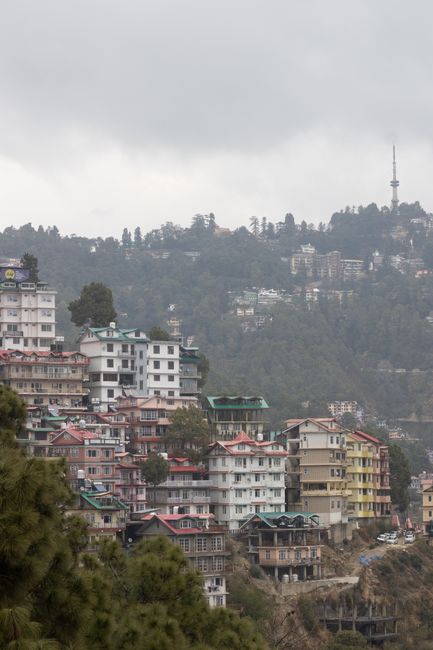
Shimla, the capital of Himachal Pradesh, spreads along a forested ridge at about 2,200 m (7,200 ft) in the outer Himalayas, its houses stacked down steep slopes of deodar cedar and oak. Once the summer capital of British India, when the government moved up from the plains each year to escape the heat, it still has the look of a Victorian hill station: a neo-Gothic church on an open ridge, a pedestrian Mall lined with shops, a half-timbered theater, and the stone Viceregal Lodge, where conferences that shaped the partition of India were held. Known as the “Queen of the Hills,” Shimla is today a busy city of about 200,000 people and one of India’s most popular holiday spots, especially in May and June and around Christmas, when Indian families come for cool air and, sometimes, snow. Getting there is part of the fun: the narrow-gauge Kalka–Shimla Railway, a UNESCO World Heritage Site, climbs through 102 tunnels from the plains. The best times to visit are March to June and September to November; winter is cold and can bring snow, while the July and August monsoon brings heavy rain and landslides.
Right now in Shimla
- Wed 10–20°C 51–69°F 9 mm Showers
- Thu 10–20°C 50–68°F 1 mm Mostly clear
- Fri 10–19°C 50–66°F 3 mm Showers
Weather: MET Norway (CC BY 4.0)
Top tours in Shimla
See all tours for Shimla →
From local operators, with prices and reviews; you check availability and book on Viator, our partner. We may earn a commission at no extra cost to you. How we earn money
Shimla at a glance
- Best for: colonial architecture, mountain views, the toy train, walks in cedar forests, temples, and a cool escape from the plains.
- How long: 2 days for the town; 3 or 4 with Kufri, Mashobra, Naldehra or Narkanda.
- Best time: March to June and September to November; December to February for a chance of snow.
- Getting there: the Kalka–Shimla toy train from Kalka; roads from Chandigarh (about 3½ to 4 hours); a small airport at Jubbarhatti with flights from Delhi.
- Getting around: on foot in the car-free center around the Mall and the Ridge, with lifts and steep lanes; taxis outside the center.
- Good to know: Chandigarh airport is a designated e-Visa entry airport, about 115 km (70 miles) away by road.
- Before you go: the e-Visa, the online e-Arrival card, money, trains and general safety are in our India travel guide.
Shimla’s areas and where to stay
Shimla is long and thin, stretching for several kilometers along its ridge. The center is closed to most traffic, so where you stay determines how much you walk.
The Mall and the Ridge
The heart of Shimla is the Ridge, a wide open space with views of snow peaks to the north, and the Mall, the main shopping street just below it, where the two meet at Scandal Point. Hotels here range from heritage properties to modest guesthouses; it is the most convenient base, though luggage has to be carried or taken up by lift from the roads below.
Lakkar Bazaar and the Jakhu slopes
Just east of the Ridge, Lakkar Bazaar, known for wooden crafts, leads uphill toward Jakhu temple. Budget hotels and guesthouses cluster on the slopes here, with good views but steep climbs.
Chhota Shimla and the Circular Road
The southern and eastern districts along Circular Road, including Chhota Shimla and Kasumpti, are home to government offices and mid-range hotels with road access, a short taxi ride from the center.
Summer Hill and Chaura Maidan
West of the center, toward the Viceregal Lodge and Summer Hill, the city becomes quieter and greener, with heritage hotels, colonial bungalows and forest walks.
Mashobra, Kufri and the outskirts
Resorts and boutique lodges in apple orchards and forests at Mashobra, Naldehra, Kufri and along the road to Chail offer quieter, scenic stays 12 to 25 km (7 to 15 miles) out of town.
Top things to see in Shimla
The Ridge and Christ Church
The Ridge is Shimla’s open-air living room, where families stroll, festivals and concerts are held, and on clear days the snow peaks of the Himalayas line the northern horizon. At its eastern end stands Christ Church, a yellow neo-Gothic church that is Shimla’s best-known landmark and one of the oldest churches in northern India, with fine stained-glass windows representing virtues such as faith, hope and charity. Nearby are the State Library in a Tudor-style building, a statue of Mahatma Gandhi and the Town Hall.
The Mall Road and the Gaiety Theatre
Running below and parallel to the Ridge, the Mall is a pedestrian promenade of shops, cafés, restaurants, the Himachal Emporium for local crafts, and the famous Indian Coffee House, a favorite of writers and politicians for decades. The Gaiety Heritage Cultural Complex, a five-story Victorian theater more than 120 years old, still stages plays and exhibitions; its stage hosted performers such as Prithviraj Kapoor and K. L. Saigal.
Viceregal Lodge (Indian Institute of Advanced Study)
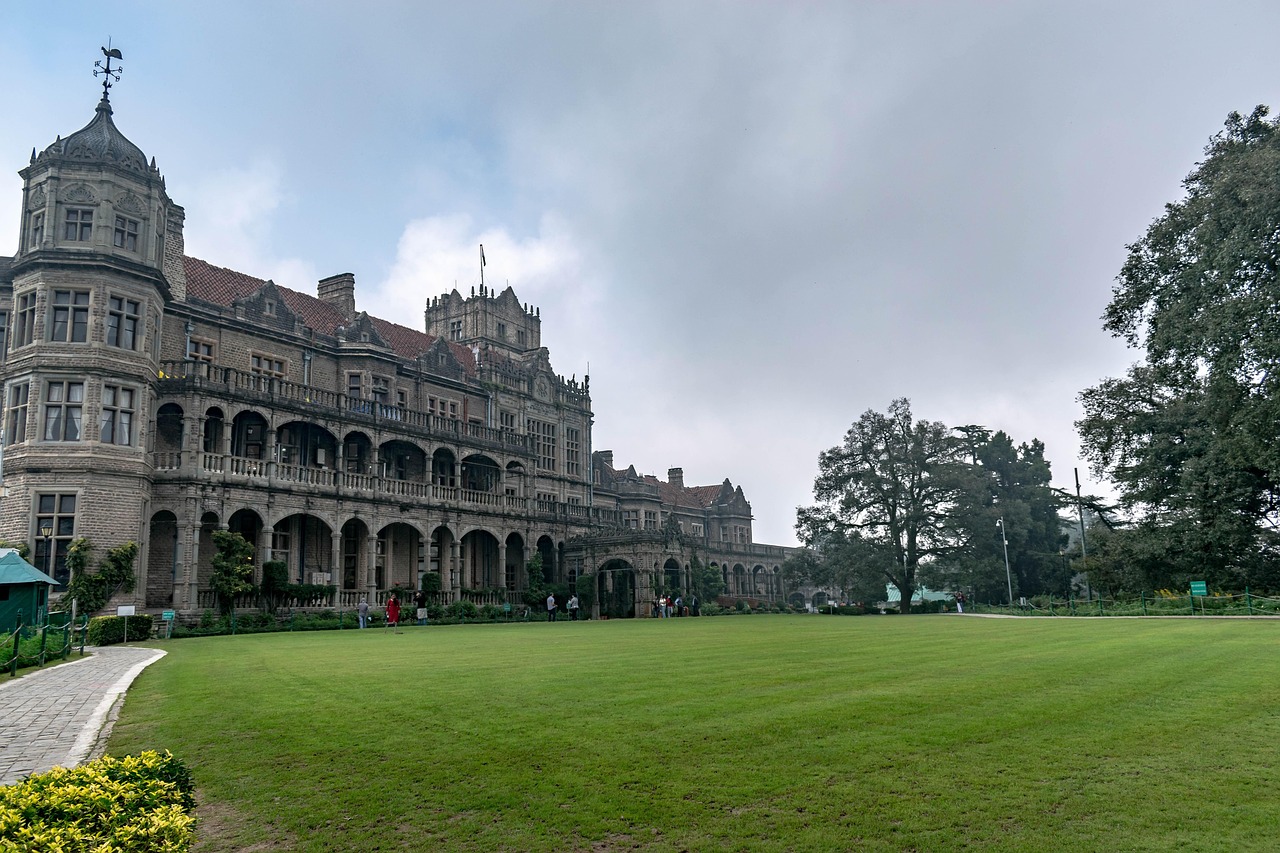
Completed in 1888 to designs by architect Henry Irwin, the Viceregal Lodge on Observatory Hill looks like a Scottish castle in gray stone, and was one of the first buildings in India to have electric light. The Viceroys of India lived here in summer, and in 1945 it hosted the Simla Conference, part of the negotiations that led to independence and partition. After independence it was donated for higher education and now houses the Indian Institute of Advanced Study; guided tours visit parts of the building and its lawns and botanical garden.
Jakhu Temple
Shimla’s highest point, Jakhu Hill, rises to about 2,450 m (8,040 ft) above the Ridge. Its temple is dedicated to Hanuman, who is said to have rested here while searching for a healing herb, and a 33 m (108 ft) orange statue of Hanuman towers over the city. The walk up from the Ridge takes about 30 to 45 minutes on a steep path; a ropeway offers an easier ride. Monkeys are numerous and bold, so carry nothing loose.
The Kalka–Shimla Railway
The narrow-gauge railway from Kalka, at the foot of the hills, to Shimla was built between 1898 and 1903 and is part of the Mountain Railways of India UNESCO World Heritage Site. According to Incredible India, it covers 96 km (60 miles) through 102 tunnels and over 864 bridges, with 919 curves. The journey takes about 5 to 6 hours each way at a gentle pace, passing pine forests, small stations such as Barog, with its long tunnel, and views over the plains. Even if you arrive by road, a short ride from Shimla to Tara Devi or Shoghi gives a taste of the line. Tickets are sold by Indian Railways and should be booked early in the high season.
More classic sights
- Himachal State Museum: sculptures, coins, Pahari miniature paintings, textiles and a doll gallery, about 3 km (2 miles) west of the center.
- Kali Bari Temple: a temple built in 1845 to the goddess Kali, also known as Shyamala, from whom Shimla is said to take its name.
- Annandale: the largest stretch of flat ground in Shimla, where the Durand Football Tournament began in 1888, now with a golf course and the Army Heritage Museum.
- Tara Devi Temple: a hilltop temple of wood and stone with panoramic views, about 11 km (7 miles) southwest.
- Gorton Castle and the colonial buildings: Gothic-style government buildings, Bantony Castle and old bungalows, best seen on a heritage walk.
- Ice-skating rink: India’s oldest natural ice-skating rink, open from about December to February when the ice holds.
Other things to do in Shimla
Heritage walks
Shimla’s colonial history is best explored on foot. Guided heritage walks link the Ridge, Christ Church, the Gaiety Theatre, the old post office, the Town Hall and Gorton Castle, ending at the Viceregal Lodge. Early mornings are clearest for mountain views. See our city sightseeing guide.
Forest and ridge walks
Walks through deodar and oak forests lead from Summer Hill to Chadwick Falls, which cascades about 100 m (330 ft) in the rainy season, around Glen Forest, and through the Craignano Nature Park near Mashobra. In winter, the slopes around Kufri, about 16 km (10 miles) east, offer sledding and some skiing when there is enough snow. See our hiking guide.
Food and drink
Shimla’s Mall and the lanes off it have every kind of food, from momos and thukpa to North Indian curries, South Indian dosas at the Indian Coffee House, bakeries and cafés. Try Himachali dishes when you can: sidu (a steamed bread stuffed with spiced filling and served with ghee), chana madra (chickpeas in a yogurt gravy), babru (a fried bread), and sweet patande pancakes. A traditional festive meal, the dham, is served on leaf plates at weddings and some restaurants. Apples from the surrounding orchards are excellent in the autumn.
Shopping
Look for woolen shawls, caps and scarves, wooden crafts in Lakkar Bazaar, Tibetan carpets and singing bowls in the Tibetan Market, and Himachali handloom products at the state emporium on the Mall.
Festivals
The Summer Festival in May or June brings music, dance and food to the Ridge. In winter, a carnival is held on the ice-skating rink around Christmas and New Year, and Christmas on the Ridge, often with snow, is a big draw. Nearby village fairs, such as the Sipi Fair at Mashobra in May and the Lavi trade fair at Rampur in November, show the region’s rural culture.
Day trips from Shimla
- Kufri: a small hill resort at about 2,500 m (8,200 ft), 16 km (10 miles) east, with pony rides, viewpoints, the Himalayan Nature Park and winter snow.
- Mashobra and Naldehra: orchard villages and a golf course in deodar forest, 12 and 23 km (7 and 14 miles) north.
- Narkanda: apple country and the Hatu Peak viewpoint, about 65 km (40 miles) northeast, with winter skiing.
- Chail: a former royal summer retreat with a palace hotel and a high-altitude cricket ground, about 45 km (28 miles) southeast.
- Kasauli: a quiet colonial cantonment town with forest walks, about 2 hours south, near the Kalka–Shimla line.
- Tattapani: hot springs on the banks of the Sutlej River, about 53 km (33 miles) north.
- Manali: about 250 km (155 miles) and 7 to 8 hours north by road. See our Manali travel guide.
Getting there and getting around
By train
The classic way to reach Shimla is by the Kalka–Shimla Railway. Fast trains from Delhi, including Shatabdi services, reach Kalka in about 4 hours and connect with the toy train for the 5-to-6-hour climb. Book both legs together in the high season. The broad-gauge railhead at Chandigarh is the alternative, followed by a road transfer.
By air
Shimla Airport at Jubbarhatti, about 23 km (14 miles) from the city, has a few flights from Delhi and other cities in Himachal Pradesh; weather can cause cancellations. Himachal Pradesh Tourism also lists helicopter services from Chandigarh. Chandigarh airport, a designated e-Visa entry airport about 115 km (70 miles) away, has many more flights.
By road
Shimla is about 3½ to 4 hours from Chandigarh and 7 to 9 hours from Delhi on the four-lane highway via Kalka and Solan. State-run Himachal Road Transport Corporation (HRTC) buses, including air-conditioned coaches, run from Delhi and Chandigarh to the main bus terminal at Tutikandi.
Around town
The center around the Mall and the Ridge is largely closed to private cars, so you walk. A public elevator links the Cart Road below with the Mall, and steep lanes and steps connect the levels. Taxis wait at stands on the roads below the center; parking is limited and expensive in season.
When to go and how long to stay
Shimla has a mild mountain climate. March to June is warm and sunny, with highs of 17 to 25 °C (62 to 77 °F), and it is the peak Indian holiday season. The monsoon, from late June to September, brings very heavy rain in July and August, mist, and landslides that can block roads and the railway. September to November is clear and crisp, with the best mountain views. December to February is cold, with lows around 3 °C (37 °F), and snow falls in some years, most often in January. The table shows 1991–2020 normals for the Shimla station from the India Meteorological Department (IMD), as published by the World Meteorological Organization (WMO); rainy days are days with at least 2.5 mm of rain.
| Month | Average high / low | Rain (rainy days) | What to expect |
|---|---|---|---|
| January | 11 °C (53 °F) / 3 °C (37 °F) | 80 mm (3.1 in), 5 days | Coldest month; snow in some years |
| February | 13 °C (55 °F) / 4 °C (40 °F) | 83 mm (3.3 in), 6 days | Cold; winter rain and snow possible |
| March | 17 °C (62 °F) / 8 °C (46 °F) | 79 mm (3.1 in), 6 days | Spring; rhododendrons in bloom |
| April | 21 °C (71 °F) / 12 °C (53 °F) | 58 mm (2.3 in), 4 days | Warm and pleasant |
| May | 25 °C (77 °F) / 15 °C (59 °F) | 82 mm (3.2 in), 7 days | Sunny; peak holiday season |
| June | 25 °C (77 °F) / 16 °C (62 °F) | 192 mm (7.6 in), 10 days | Warm; monsoon arrives late in the month |
| July | 23 °C (74 °F) / 16 °C (62 °F) | 328 mm (12.9 in), 16 days | Monsoon; mist and heavy rain |
| August | 22 °C (72 °F) / 16 °C (61 °F) | 351 mm (13.8 in), 16 days | Wettest month; landslide risk |
| September | 23 °C (73 °F) / 15 °C (58 °F) | 164 mm (6.5 in), 8 days | Rains easing |
| October | 21 °C (70 °F) / 12 °C (53 °F) | 30 mm (1.2 in), 2 days | Clear skies; best views |
| November | 18 °C (64 °F) / 8 °C (47 °F) | 14 mm (0.5 in), 1 day | Crisp and dry |
| December | 14 °C (58 °F) / 6 °C (42 °F) | 26 mm (1.0 in), 2 days | Cold; Christmas crowds, skating rink opens |
The station gets about 1,490 mm (59 in) of rain a year, about half of it in July and August.
Two days in Shimla
Day one: the Ridge, Christ Church and the Mall in the morning, the Gaiety Theatre, lunch at the Indian Coffee House, then up to Jakhu Temple for sunset views. Day two: the Viceregal Lodge and the State Museum, a walk through Summer Hill to Chadwick Falls, and an evening stroll on the Mall.
Four days with the hills
Add a day to Kufri and Mashobra, a day to Narkanda or Chail, and travel up or down on the Kalka–Shimla Railway.
Where to stay in Shimla
- The Mall and the Ridge: heritage hotels and guesthouses in the car-free center, the most convenient.
- Lakkar Bazaar and Jakhu: budget options with views and steep climbs.
- Circular Road and Chhota Shimla: mid-range hotels with road access.
- Summer Hill and Chaura Maidan: quieter heritage stays near forests.
- Mashobra, Naldehra and Chail: resorts and boutique lodges in orchards and forests.
Shimla is extremely busy in May and June, on long weekends and over Christmas and New Year; book well ahead and expect higher prices.
What a trip to Shimla costs
Prices are approximate, for October 2026, converted at about 96 rupees (₹) to the US dollar. They are estimates, as no official price lists could be checked.
| Item | Typical cost |
|---|---|
| Kalka–Shimla toy train, second-class seat to first class | ₹50–600 (about US$0.50–6.30) |
| Viceregal Lodge guided tour | ₹100–300 (about US$1–3) |
| Jakhu ropeway, return | ₹200–500 (about US$2–5) |
| Coffee and dosa at the Indian Coffee House | ₹150–300 (about US$1.60–3) |
| Dinner at a mid-range restaurant | ₹500–1,200 (about US$5–12.50) |
| Taxi for a day trip to Kufri and Mashobra | ₹2,000–3,500 (about US$21–36) |
| Mid-range hotel double, per night (high season) | ₹4,000–10,000 (about US$42–104) |
Practical tips for Shimla
- Travel light: the center is car-free and steep; porters are available but small bags make life easier.
- Book the toy train early: seats sell out in summer and at Christmas.
- Go early for views: mornings are clearest; clouds often build by midday.
- Avoid peak weekends: traffic jams on the highway and in town can be long.
- Guard against monkeys: especially at Jakhu, where they snatch glasses, phones and food.
Safety
Shimla is a safe, family-friendly city. Mountain roads are the main risk: the highway from Kalka and the roads to Kufri and Narkanda are winding, busy and prone to landslides during the monsoon, from July to September, when roads and the railway can close for hours or days. Travel by day and check road conditions with your hotel. Snow and ice in winter make lanes slippery and can close roads to Kufri and Narkanda; carry good shoes and allow extra time. Himachal Pradesh Tourism warns visitors not to stand at cliff edges or on boulders near river banks for photographs, as rivers in the state are strong and deceptive. Monkeys are aggressive at Jakhu and elsewhere; do not feed them. Crowds on the Mall and the Ridge in season attract pickpockets; keep valuables close. In an emergency, call 112.
What to pack for Shimla
Layers: a warm sweater or fleece even in summer evenings, a heavy jacket, hat and gloves from November to February, a rain jacket and waterproof shoes for the monsoon, comfortable walking shoes with good grip for steep lanes, and sunscreen for the strong mountain sun. India uses 230 V, with round-pin plugs of types C, D and M. See our rain jackets, hiking shoes and travel adapters guides.
Shimla travel FAQ
How many days do I need in Shimla?
Two days covers the Ridge, the Mall, Jakhu, the Viceregal Lodge and the museum. Allow three or four with Kufri, Mashobra, Narkanda or Chail.
How long does the Kalka–Shimla toy train take?
About 5 to 6 hours for the 96 km (60 miles) from Kalka, through 102 tunnels and over more than 800 bridges.
Is the Kalka–Shimla Railway a UNESCO site?
Yes. It is part of the Mountain Railways of India World Heritage Site, together with the Darjeeling Himalayan Railway and the Nilgiri Mountain Railway.
When does it snow in Shimla?
Snow falls in some years between December and February, most often in January. It is never guaranteed; Kufri and Narkanda get more.
What is the best time to visit Shimla?
March to June for warm, sunny weather, and September to November for clear views. Avoid July and August if you dislike heavy rain.
How do I get from Delhi to Shimla?
By train to Kalka and then the toy train, by road in 7 to 9 hours, or by flight to Shimla or Chandigarh.
Can I fly into Shimla on an e-Visa?
No. Shimla’s airport is domestic only. The nearest designated e-Visa entry airport is Chandigarh; Delhi is the other common entry point.
Is the center of Shimla car-free?
Mostly. The Mall and the Ridge are closed to most private vehicles, so you walk or use the public elevator from the road below.
Is Shimla or Manali better?
Shimla suits colonial history, easy walks and the toy train; Manali is better for adventure, high mountains and the road to Lahaul and Ladakh. Many trips combine both.
Is Shimla safe for tourists?
Yes. Take care on mountain roads during the monsoon and in winter, and watch out for monkeys.
Sources and last review
Researched and last reviewed on 4 October 2026. Shimla’s history as summer capital, the Ridge, the Mall, Christ Church, the Viceregal Lodge, Annandale, Jakhu Temple’s altitude, Kali Bari, Tara Devi, the Kalka–Shimla Railway’s construction dates and UNESCO listing, the airport at Jubbarhatti, distances to nearby places, festivals and the river safety warning: Himachal Pradesh Tourism; the Kalka–Shimla Railway’s length, tunnels, bridges and curves, the Gaiety Theatre, the Hanuman statue, Himachali dishes, the ice-skating rink and Kufri: Incredible India (Ministry of Tourism); the list of designated e-Visa airports (which includes Chandigarh): the Bureau of Immigration; climate normals for the Shimla station: the India Meteorological Department, via the World Meteorological Organization (1991–2020 normals archived by NOAA’s National Centers for Environmental Information); altitude and population: Wikidata; the exchange rate: the Reserve Bank of India (FBIL reference rate). Train times and fares, road times, the Simla Conference date and typical prices are general references or estimates, flagged for checking. Prices and hours change, so check locally before you go. For the e-Visa, money and trains, see our India travel guide.
Plan your trip
Partner links: TravelerCenter may earn a commission if you book, at no extra cost to you.
🇮🇳 Useful Hindi phrases for Shimla
All 38 Hindi phrases: restaurant, hotel, emergencies, romance (printable) →