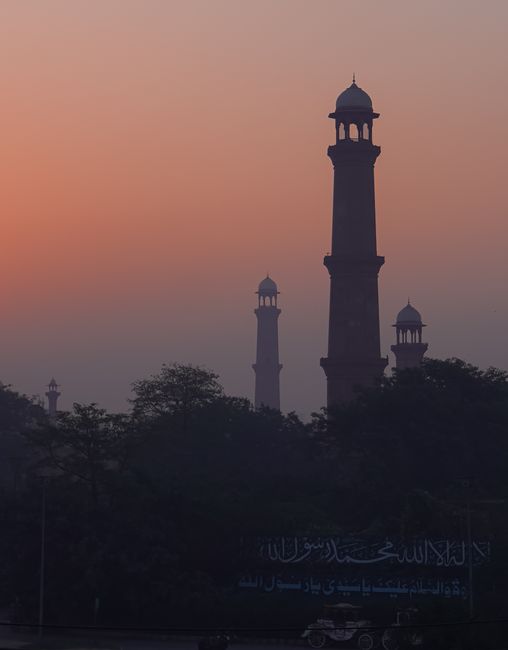
Lahore, the capital of Punjab and Pakistan’s second-largest city, is the country’s cultural heart: a city of Mughal monuments, Sufi shrines, colonial avenues, bazaars and food that Pakistanis consider the best in the land. Its greatest sights cluster around the old Walled City, where the vast red-sandstone Badshahi Mosque, built by the emperor Aurangzeb in 1673, faces the Lahore Fort, a UNESCO World Heritage Site with palaces, mirrored halls and a 450 m (1,480 ft) long wall of tile pictures. Inside the walls, lanes lead past the exquisitely tiled Wazir Khan Mosque, the restored royal bathhouse and havelis, and across the city, the terraced Shalimar Gardens, laid out by Shah Jahan, the builder of the Taj Mahal, show Mughal garden design at its finest. Lahore is also a modern city of some 13 million people, with leafy Gulberg, wide boulevards, a metro line, universities, galleries and a passion for food, from breakfast nihari to late-night barbecue on Fort Road. Near the Indian border, the daily flag-lowering ceremony at Wagah is a spectacle of marching and crowds. The best months are October to March; May and June are fiercely hot, and smog can blanket the city from November to January.
Right now in Lahore
- Wed 22–30°C 72–86°F Clear
- Thu 23–31°C 74–87°F Mostly clear
- Fri 23–30°C 74–86°F Mostly clear
Weather: MET Norway (CC BY 4.0)
Top tours in Lahore
See all tours for Lahore →
From local operators, with prices and reviews; you check availability and book on Viator, our partner. We may earn a commission at no extra cost to you. How we earn money
Lahore at a glance
- Best for: Mughal architecture, mosques and shrines, bazaars, food streets, museums, colonial buildings and the Wagah border ceremony.
- How long: 2–3 days.
- Best time: October to early November and February to March; December and January are cool but often smoggy and foggy, and May to June is extremely hot.
- Getting there: Allama Iqbal International Airport is about 15 km (9 miles) east of the center; coaches run on the M2 motorway to Islamabad in about 4.5–5 hours.
- Getting around: by ride-hailing app, the Orange Line metro and Metrobus, rickshaws and on foot in the Walled City.
- Good to know: dress modestly, and carry a scarf for mosques and shrines.
- Before you go: the e-visa, permissions, money and general safety are in our Pakistan travel guide.
Lahore’s areas and where to stay
Lahore spreads south and east from the Ravi River. The Walled City and the Fort lie in the north, the colonial Mall Road runs southeast through the center, and the newer districts of Gulberg, Model Town and the Defence Housing Authority (DHA) extend south.
The Walled City
The old city, once enclosed by walls and 13 gates, of which several survive, including the restored Delhi Gate, is a maze of bazaars, mosques, shrines and havelis. A few boutique guesthouses in restored houses are the only places to stay inside; it is noisy, crowded and fascinating.
Mall Road and the colonial center
Mall Road (Shahrah-e-Quaid-e-Azam), laid out by the British, is lined with colonial buildings: the Lahore Museum, Government College, the High Court, the General Post Office, Tollinton Market and the Punjab Assembly, with Anarkali Bazaar nearby. Several large hotels stand along it and around Shimla Hill.
Gulberg and the south
Gulberg, with its main boulevard and MM Alam Road, is the city’s modern center for hotels, restaurants, cafés and shopping, while DHA and Model Town are leafy residential areas with malls and upscale dining.
Where to stay in Lahore
- Mall Road and the center: heritage and international hotels, about 15–20 minutes from the Walled City.
- Gulberg: international and business hotels, the best area for restaurants and nightlife.
- The Walled City: a few boutique guesthouses in restored havelis, for atmosphere.
- DHA and near the airport: quieter business hotels.
Choose hotels with good security, which is standard at larger properties, and book ahead around Eid and major events.
Top things to see in Lahore
Badshahi Mosque
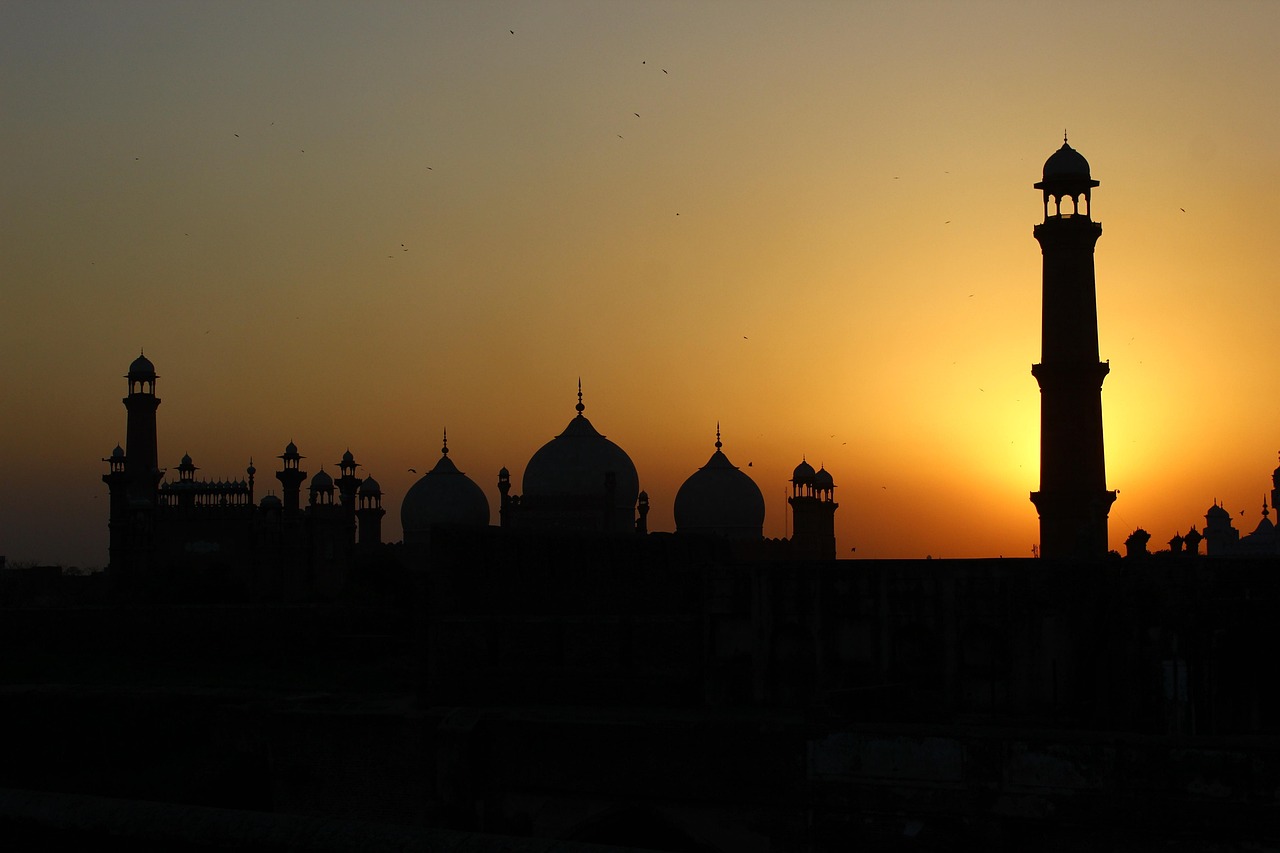
Built by the Mughal emperor Aurangzeb in 1673, the Badshahi Mosque was for centuries one of the largest mosques in the world, with a courtyard that holds tens of thousands of worshippers, four tall minarets and three marble domes. Its red sandstone facade is inlaid with white marble, and the prayer hall is decorated with fine fresco and stucco work. A small museum holds relics said to belong to the Prophet. Dress modestly, remove shoes at the entrance and cover your head (women); avoid visiting during Friday prayers.
Lahore Fort
The Lahore Fort (Shahi Qila), facing the mosque across the Hazuri Bagh garden, was rebuilt by Akbar in the 16th century and embellished by Jahangir, Shah Jahan and Aurangzeb. Highlights include the Sheesh Mahal, the Palace of Mirrors, whose ceilings are covered in convex mirror mosaics; the marble Naulakha Pavilion; the Diwan-e-Aam and Diwan-e-Khas audience halls; and the Picture Wall, about 450 m (1,480 ft) of glazed tile and fresco panels showing elephant fights, hunts and angels. With the Shalimar Gardens, it was inscribed as a UNESCO World Heritage Site in 1981. Allow two to three hours.
The Walled City and the Wazir Khan Mosque
Enter through the restored Delhi Gate and follow the Royal Trail through the old city to the Shahi Hammam, a restored 17th-century bathhouse with frescoed domes, and the Wazir Khan Mosque, built in 1641 by the governor of Lahore and covered inside and out in some of the finest kashi (glazed tile) and fresco work in South Asia. Nearby, the gilded domes of the Sunehri Mosque rise above a busy bazaar. The Walled City of Lahore Authority runs guided walks and rickshaw tours.
Shalimar Gardens
Laid out by Shah Jahan in 1641–1642, the Shalimar Gardens descend in three terraces with marble pavilions, canals, cascades and hundreds of fountains, following the Persian char bagh design. They lie about 8 km (5 miles) east of the Walled City.
Minar-e-Pakistan and Greater Iqbal Park
The Minar-e-Pakistan, a 62 m (203 ft) tower in Greater Iqbal Park, marks the place where the Lahore Resolution calling for a separate Muslim homeland was passed in 1940. The surrounding park, next to the Badshahi Mosque, is busy with families in the evening.
Lahore Museum
On Mall Road, the red-brick Lahore Museum, opened in 1894, holds the country’s finest collection of Gandharan Buddhist sculpture, including the emaciated Fasting Buddha, along with Mughal miniatures, coins and textiles. Outside stands the Zamzama cannon, “Kim’s gun” from Rudyard Kipling’s novel; Kipling’s father was the museum’s first curator.
More classic sights
- Tomb of Jahangir: the elegant mausoleum of the Mughal emperor in Shahdara, across the Ravi, with inlaid minarets and gardens.
- Data Darbar: the shrine of the 11th-century Sufi saint Data Ganj Bakhsh, one of the most visited shrines in South Asia; security is tight, and visits are best with a local guide.
- Anarkali Bazaar: one of the oldest markets in South Asia, for textiles, shoes and street food.
- Samadhi of Ranjit Singh and Gurdwara Dera Sahib: Sikh monuments beside the Fort; entry may be restricted.
- Lahore’s colonial buildings: the High Court, Government College, Tollinton Market and Aitchison College along and around Mall Road.
- Bagh-e-Jinnah: colonial-era gardens with the Quaid-e-Azam Library.
Other things to do in Lahore
Food and drink
Lahore lives to eat. Start the day with nihari, slow-cooked beef stew with naan, or halwa puri with chickpeas on a weekend morning; at lunch try chicken karahi, lahori fried fish in winter, and paye (trotters); and in the evening join the crowds for barbecue, seekh kebabs and tikka at the food streets of Fort Road, facing the Badshahi Mosque from rooftop restaurants, and Gawalmandi. Finish with kulfi, falooda or sweet lassi. Gulberg and MM Alam Road have cafés and international restaurants. Alcohol is not served in restaurants.
Shopping and crafts
Shop for embroidered textiles, lawn cotton, shawls, khussa (embroidered leather slippers), brass and carpets in Anarkali Bazaar, Liberty Market and the bazaars of the Walled City.
Sufi music and culture
Lahore has a strong tradition of qawwali and Sufi devotion: Thursday evenings at some shrines bring music and dhamaal (ecstatic dancing). Go with a local guide, and dress and behave respectfully. The city also has galleries, the Alhamra Arts Council and literary festivals. See our city sightseeing guide.
The Wagah border ceremony
Every evening before sunset, Pakistani and Indian border guards perform the flag-lowering ceremony at Wagah, about 25–30 km (16–19 miles) east of the center, with high-kicking marches, patriotic chants and crowds on both sides. The border crossing itself is closed to travelers, but the ceremony continues; arrive at least an hour early with your passport, and expect security checks. Foreigners usually have a separate seating area.
Day trips from Lahore
- Wagah: the evening flag-lowering ceremony, about 45–60 minutes by road.
- Kartarpur: the Gurdwara Darbar Sahib, where Guru Nanak spent his final years, near Narowal, about 2.5 hours north; the corridor for Indian pilgrims is currently not in use.
- Nankana Sahib: the birthplace of Guru Nanak and an important Sikh pilgrimage site, about 2 hours west.
- Rohtas Fort: Sher Shah Suri’s huge 16th-century fortress near Jhelum, a UNESCO site, about 3.5 hours north on the way to Islamabad.
- Harappa: one of the main cities of the Indus Valley civilization, with a museum, about 3 hours southwest.
- Islamabad: about 4.5–5 hours by coach on the M2 motorway. See our Islamabad guide.
Getting there and getting around
By air
Allama Iqbal International Airport (LHE), about 15 km (9 miles) east of the center, has flights from the Gulf hubs, Istanbul, Europe, China and Southeast Asia, and domestic flights to Karachi, Islamabad, Skardu and other cities. Ride-hailing cars and hotel transfers take about 30–45 minutes to Gulberg or Mall Road.
By road
The M2 motorway links Lahore with Islamabad, with comfortable air-conditioned coaches run by companies such as Daewoo Express and Faisal Movers taking about 4.5–5 hours from their own terminals; the M3 and M4 continue south toward Multan and Karachi. The Grand Trunk Road runs east to Wagah.
By train
Lahore Junction, a fortress-like station from 1860, has trains to Rawalpindi, Karachi and Peshawar. Trains are slow, and attacks have targeted the railway in some provinces, so many visitors prefer coaches or flights.
Around the city
Use ride-hailing apps such as Careem, inDrive or Yango, or taxis booked through your hotel, rather than street taxis. The Orange Line, Pakistan’s first metro, opened in 2020 and runs about 27 km (17 miles) across the city, and the Metrobus follows Ferozepur Road; both are cheap and air-conditioned. Auto-rickshaws and chingchi motorbike rickshaws work for short hops; agree on the fare first. Explore the Walled City on foot or by rickshaw.
When to go and how long to stay
Lahore has a hot semi-arid climate with a monsoon. October to March is the best time: October and November are warm and dry, though smog often settles over Punjab from November to January, with very poor air quality and fog that can disrupt flights and roads; February and March bring spring and the best weather. April to June is the hot season, with highs near 39 °C (102 °F) in May and June and heat waves above 45 °C (113 °F). The monsoon, from July to September, brings humid heat and heavy downpours that flood streets. The table uses the 1991–2020 climate normals for Lahore from the Pakistan Meteorological Department, as submitted to the World Meteorological Organization (WMO): average daily highs and lows, total rain, and days with at least 1 mm of rain.
| Month | Average high / low | Rain (days with 1 mm or more) | What to expect |
|---|---|---|---|
| January | 18 °C (65 °F) / 8 °C (46 °F) | 22 mm (0.9 in), 3 days | Cool; foggy mornings and smog |
| February | 22 °C (72 °F) / 11 °C (51 °F) | 32 mm (1.2 in), 4 days | Mild; spring begins |
| March | 28 °C (82 °F) / 16 °C (60 °F) | 32 mm (1.2 in), 4 days | Warm and pleasant |
| April | 34 °C (94 °F) / 21 °C (70 °F) | 20 mm (0.8 in), 3 days | Hot |
| May | 39 °C (102 °F) / 26 °C (78 °F) | 18 mm (0.7 in), 3 days | Very hot |
| June | 39 °C (102 °F) / 27 °C (81 °F) | 74 mm (2.9 in), 5 days | Very hot; heat waves |
| July | 36 °C (96 °F) / 27 °C (81 °F) | 189 mm (7.4 in), 9 days | Monsoon; humid |
| August | 35 °C (94 °F) / 27 °C (80 °F) | 177 mm (7.0 in), 9 days | Monsoon; Independence Day on August 14 |
| September | 34 °C (94 °F) / 25 °C (78 °F) | 89 mm (3.5 in), 5 days | Monsoon ending |
| October | 32 °C (90 °F) / 20 °C (68 °F) | 10 mm (0.4 in), 1 day | Dry and warm; good for sightseeing |
| November | 27 °C (81 °F) / 14 °C (57 °F) | 7 mm (0.3 in), 1 day | Pleasant days; smog season begins |
| December | 21 °C (71 °F) / 9 °C (48 °F) | 7 mm (0.3 in), 1 day | Cool; fog and smog |
Lahore receives about 670 mm (27 in) of rain a year, mostly in July and August.
One day in Lahore
Morning at the Lahore Fort and the Badshahi Mosque, a walk through the Walled City to the Wazir Khan Mosque and the Shahi Hammam, a late lunch, then the Wagah ceremony, and dinner on Fort Road facing the illuminated mosque.
Two or three days
Add the Lahore Museum and Mall Road, the Shalimar Gardens and Jahangir’s Tomb, Anarkali Bazaar, an evening of qawwali, or a day trip to Rohtas Fort.
What a trip to Lahore costs
Prices are approximate, for October 2026, converted at about 277 rupees to the US dollar.
| Item | Typical cost |
|---|---|
| Lahore Fort entry for foreigners | about 1,000 PKR (about US$3.60) |
| Badshahi Mosque | free (donation and shoe-keeping tip) |
| Lahore Museum entry for foreigners | about 500 PKR (about US$1.80) |
| Nihari or karahi at a local restaurant | 500–1,500 PKR (about US$1.80–5.40) |
| Dinner at a rooftop restaurant on Fort Road | 3,000–6,000 PKR (about US$11–22) per person |
| Orange Line or Metrobus ride | 40–100 PKR (about US$0.15–0.35) |
| Ride-hailing car across the city | 500–1,200 PKR (about US$1.80–4.30) |
| Coach to Islamabad | 2,500–4,000 PKR (about US$9–14) |
| Mid-range hotel double, per night | 12,000–25,000 PKR (about US$43–90) |
Practical tips for Lahore
- Visit monuments early: mornings are cooler and quieter, especially from April to September.
- Carry a scarf: for mosques and shrines; women should cover their heads.
- Use ride-hailing apps: they avoid haggling and are traceable.
- Check air quality in winter: smog peaks from November to January.
- Bring your passport to Wagah: it is needed at the security checks.
- Avoid Friday midday at mosques: when prayers take place.
Safety
Lahore attracts many visitors and has a strong police presence, but there have been terrorist attacks in the city, targeting public places, religious sites and security forces. Be cautious at large religious gatherings, shrines on busy days, political rallies and public events; keep a low profile and follow local news. Street crime, including phone and bag snatching by motorbike thieves, occurs in crowded areas; be careful on foot at night, and use ride-hailing apps or hotel taxis. Women may face staring and harassment in crowded places; dress conservatively and sit in family sections. Heat is dangerous from May to July, and winter smog is a health risk for people with breathing problems. Traffic is chaotic, so take care crossing roads. In an emergency, call 15 for police and 1122 for rescue and ambulance.
What to pack for Lahore
Loose, light clothes that cover shoulders and legs, a scarf for mosques and shrines (essential for women), comfortable walking shoes that slip off easily, a hat and sunscreen, a warm layer from December to February, a mask for smog season, and an adapter for round two-pin or British-style plugs. See our travel adapters guide.
Lahore travel FAQ
Is Lahore worth visiting?
Yes. The Badshahi Mosque, the Lahore Fort, the Walled City and the Shalimar Gardens are among the finest Mughal monuments anywhere, and the food is outstanding.
How many days do I need in Lahore?
Two to three days for the main monuments, the museum, food streets and Wagah.
Can I cross from Lahore to India at Wagah?
Not currently. The crossing is closed to travelers, but the daily flag-lowering ceremony still takes place.
What time is the Wagah border ceremony?
It takes place every evening before sunset, so the time changes with the season; arrive at least an hour early.
What is the best time to visit Lahore?
October to early November and February to March. May and June are extremely hot, and smog is common from November to January.
How much is the Lahore Fort entry fee?
About 1,000 rupees for foreigners; check at the ticket office, as fees change.
How do I get from Lahore to Islamabad?
By coach on the M2 motorway in about 4.5–5 hours, by train, or by a short flight.
What should I eat in Lahore?
Nihari, halwa puri, karahi, seekh kebabs, tikka, lahori fish in winter, and kulfi or falooda for dessert.
Is there a metro in Lahore?
Yes. The Orange Line metro crosses the city, and the Metrobus runs along Ferozepur Road.
Is Lahore safe for tourists?
Many visitors travel there, but there have been terrorist attacks, so be cautious at large gatherings, watch for street crime and follow local news.
Sources and last review
Researched and last reviewed on 5 October 2026. Climate normals: the Pakistan Meteorological Department via the World Meteorological Organization’s 1991–2020 normals; UNESCO inscription of the Fort and Shalimar Gardens: UNESCO. The Wagah crossing closure and ceremony, the Kartarpur Corridor, terrorism and crime in Lahore, rail risks, taxis and women’s safety: the UK government’s factual entry and safety pages. Exchange rate: a cross rate from the Central Bank of Myanmar’s published rates. Monument dates and dimensions, the Orange Line, the city’s population, journey times, entry fees, emergency numbers and typical prices are general references or estimates, flagged for checking. Prices and rules change, so check locally before you go. For entry rules, money and general safety, see our Pakistan travel guide.
Plan your trip
Partner links: TravelerCenter may earn a commission if you book, at no extra cost to you.
🇵🇰 Useful Urdu phrases for Lahore
All 38 Urdu phrases: restaurant, hotel, emergencies, romance (printable) →