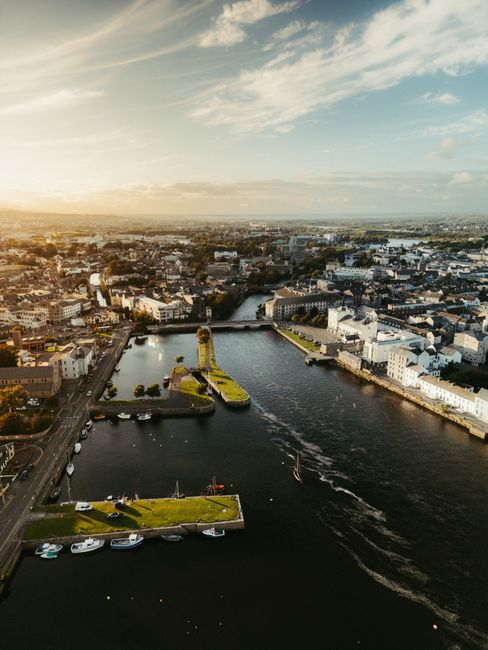
Galway is the lively, creative little city of the west of Ireland, where the River Corrib rushes into Galway Bay. Its medieval streets are painted in bright colours and full of buskers, bookshops and pubs where traditional music plays every night, and you hear the Irish language in the shops and on the radio, because the Connemara Gaeltacht begins just outside the city. You come for the atmosphere of the Latin Quarter, a walk along the Salthill promenade, oysters and seafood, and the summer festivals; and you stay to explore the Aran Islands, the Cliffs of Moher, the Burren and Connemara, all within a day’s reach. Give it two days for the city and three or four more for the trips around it.
Right now in Galway
- Wed 8–13°C 47–56°F 1 mm Partly cloudy
- Thu 8–15°C 46–59°F 10 mm Rain
- Fri 12–15°C 53–59°F 5 mm Mostly clear
Weather: MET Norway (CC BY 4.0) · Sea temperature: NOAA CoastWatch · Rates: ECB
Top tours in Galway
See all tours for Galway →
From local operators, with prices and reviews; you check availability and book on Viator, our partner. We may earn a commission at no extra cost to you. How we earn money
Galway at a glance
- Best for: traditional music and pubs, street life and festivals, seafood, and day trips to the Aran Islands, the Cliffs of Moher, the Burren and Connemara.
- How long: 1–2 days for the city; 4–5 days to add the Aran Islands, the Cliffs of Moher and Connemara.
- Best time: May to September for long days and island ferries; July for the Galway International Arts Festival and the Galway Races; September for oysters.
- Getting in: trains and coaches from Dublin take about 2 hours 30 minutes; Shannon Airport is about 1 hour 15 minutes away and Dublin Airport about 2 hours 30 minutes by direct coach.
- Getting around: the centre is small and mostly pedestrian; walk everywhere, and use buses or a tour to reach the coast and islands.
- Before you go: Ireland uses the euro, is outside the Schengen area and uses type G (British-style) plugs; see our travel adapter guide.
Galway, area by area
Galway’s centre fits between Eyre Square, the railway and coach stations to the east, and the River Corrib to the west. From the square, one long pedestrian street, changing its name from William Street to Shop Street, High Street and Quay Street, runs down to the river and the Spanish Arch in about ten minutes’ walk.
The Latin Quarter
The old heart of the city, from Shop Street to the river, is a web of narrow lanes, medieval merchants’ houses and colourful shopfronts. It has the best pubs, restaurants and street performers, the Saturday market around St Nicholas’ Collegiate Church, Kirwan’s Lane, the remains of the Hall of the Red Earl, and the Spanish Arch at the bottom of Quay Street. Best for: atmosphere, music and food; it can be noisy at night.
Eyre Square and the station area
Eyre Square, officially John F. Kennedy Memorial Park, is a green square with the railway station, the coach station and the bus to the Aran ferry close by. Hotels here are convenient for arrivals and day tours, and the Latin Quarter is five minutes away. Best for: travellers without a car.
The West End, the Claddagh and Salthill
Across the Corrib, the West End around Dominick Street has some of the best small restaurants and bars. South of it, the Claddagh, once a fishing village with its own king, gave its name to the Claddagh ring, with its hands, heart and crown. Further west, the seaside suburb of Salthill has the promenade, beaches and family hotels, about 30 minutes’ walk from the centre. Best for: food lovers, sea views and quieter nights.
Top things to see in Galway
Galway’s charm lies more in its streets than in big-ticket sights, and much of it is free. Prices and hours below were checked in October 2026 where they apply; check before you go.
The Spanish Arch and the Long Walk
The Spanish Arch is a surviving piece of the 16th-century town walls, built in 1584 to protect the quays where ships from Spain and France unloaded wine and goods. Today the grassy bank beside it is where Galway sits in the sun, listens to buskers and watches the Corrib meet the sea. Across the water, the Long Walk is the row of colourful houses that appears on every postcard of Galway. The free Galway City Museum, next to the arch, covers the city’s history, the Claddagh and the sea, and has a full-sized Galway hooker, the traditional brown-sailed fishing boat of the bay.
Shop Street, Quay Street and Lynch’s Castle
Galway was ruled for centuries by fourteen merchant families, the “Tribes of Galway”, which is why the city is still called the City of the Tribes. Their legacy is visible on Shop Street in Lynch’s Castle, a 15th-century fortified town house with carved stone gargoyles and coats of arms, now a bank. Nearby, the Lynch Memorial Window marks the legend of a mayor who hanged his own son for murder. St Nicholas’ Collegiate Church (1320) is the largest medieval parish church in Ireland still in use; Christopher Columbus is said to have prayed here in 1477. On Saturdays and in summer at weekends, the Galway Market around the church sells crafts, cheese and street food.
Eyre Square
The city’s main square is a park lined with hotels and shops, with the Browne Doorway, the carved entrance of a 17th-century merchant’s mansion, standing alone at its northern edge, and the rusty sails of the Quincentennial Fountain, which recall the hooker boats. President John F. Kennedy spoke here in 1963, shortly before his death.
Galway Cathedral
Across the Salmon Weir Bridge, where you can watch salmon swimming upriver in early summer, the Cathedral of Our Lady Assumed into Heaven and St Nicholas was the last great stone cathedral built in Europe, consecrated in 1965. Its green copper dome is a city landmark, and inside it mixes Renaissance and Celtic styles, with fine rose windows and modern mosaics. Entry is free; a donation is welcome. Respect services and weddings.
Salthill promenade
The Prom runs for about 2 km along the shore of Galway Bay from the Claddagh to Blackrock, with views across the bay to the hills of the Burren in County Clare. It is the city’s favourite walk at any time of year: tradition says you finish by “kicking the wall” at Blackrock, where hardy locals dive into the sea from the diving tower all year round. On a clear summer evening, the sunset over the bay is one of the finest sights in Ireland. The beaches at Salthill are popular for swimming in summer, with lifeguards in the main season; see our beaches guide.
Parks and gardens
- Eyre Square
Castles and forts
- Lynch's Castle
Museums
- Galway City Museum
Other sights
- The Spanish Arch
Churches and cathedrals
- Galway Cathedral
Nature
- Cliffs of Moher
Music, pubs and festivals
Galway has the best traditional music scene of any Irish city. Sessions, where musicians gather around a table with fiddles, flutes, bodhráns and uilleann pipes, start most evenings around 21:00 in pubs such as Tigh Neachtain and Tig Cóilí in the Latin Quarter, The Crane Bar in the West End and many others. Arrive early for a seat, buy your drinks at the bar and keep conversation quiet while a slow air is played. Galway is also proud of its food: oysters from Clarinbridge and the bay, smoked salmon, mussels and some of Ireland’s most interesting restaurants.
- Galway International Arts Festival: Ireland’s biggest arts festival, with theatre, visual art, music in a Big Top, talks and free street spectacle. The 2027 festival runs from 12 to 25 July 2027.
- Galway Races: the week-long Summer Festival at Ballybrit racecourse, east of the city, is the high point of the Irish racing and social calendar, traditionally at the end of July and into the August bank holiday. As of October 2026 the 2027 dates have not been published. The October festival runs over the bank holiday weekend, 24–26 October 2026.
- Other events: the Galway Film Fleadh in July, the Galway International Oyster and Seafood Festival in September, and the Christmas market on Eyre Square from November; check the dates each year.
During the arts festival and race week, hotels fill up and prices rise sharply; book months ahead.
Activities and best months
- Boat tripsAran Island Ferries sails all year from Rossaveel, 23 miles west of Galway (shuttle bus from Victoria Place in the city), to all three Aran Islands; the shortest crossing, to Inis Mór, takes 40 minutes. A seasonal sailing from Galway City Docks at 9.30 am goes to Inis Mór and along the Cliffs of Moher. · source
Day trips from Galway
The Aran Islands
The three Aran Islands, Inis Mór (Inishmore), Inis Meáin (Inishmaan) and Inis Oírr (Inisheer), lie across the mouth of Galway Bay: low limestone islands of stone walls, tiny fields, Irish-speaking villages and some of the most dramatic prehistoric forts in Europe. On Inis Mór, Dún Aonghasa is a stone fort of three rings on the edge of a sheer 90-metre cliff; reaching it takes a walk of about 20 minutes uphill from the visitor centre at Kilmurvey, and there are no rails at the edge. Hire a bike at the pier (the island is about 14 km long), take a minibus tour or a pony and trap. See our cycling guide.
- From Rossaveel (Connemara): Aran Island Ferries sail to all three islands all year; the crossing to Inis Mór takes about 40 minutes. As of October 2026, an adult return costs €34, and a connecting shuttle bus from Victoria Place, just off Eyre Square, costs €10 return (book at least 12 hours ahead); Rossaveel is about 1 hour’s drive west of the city.
- From Galway city docks: in season, Aran Island Ferries also sail direct from the city to Inis Mór in about 90 minutes, returning past the Cliffs of Moher.
- From Doolin (County Clare): Doolin Ferry serves all three islands, with crossings of 15 to 35 minutes, and runs separate cruises under the Cliffs of Moher; it is a seasonal service, so check the timetable.
- By air: Aer Arann Islands flies from Connemara Airport at Inverin, west of the city, in about ten minutes, with a bus from Galway; good when the sea is rough.
Atlantic weather can cancel sailings, especially from October to March; keep your plans flexible and check on the morning of travel. Stay a night on Inis Mór to see the island after the day-trippers leave. More boat trips are in our boat trips guide.
The Cliffs of Moher and the Burren
The Cliffs of Moher, 214 metres high at their highest point and about 8 km long, are Ireland’s most visited natural sight, about 1 hour 30 minutes south of Galway by car through the Burren. At the visitor centre, built into the hillside, there are paved, safe paths along the cliffs to O’Brien’s Tower, an exhibition and cafés. As of October 2026, adult tickets cost from €8 when booked online for a set time (prices vary by slot and are higher on the day), and children under 12 go free with an adult; the ticket includes parking. The site opens daily, 8:00–19:00 at the time of checking. The longer Cliffs of Moher Coastal Walk runs to Doolin and Hags Head; keep well back from the unfenced edge.
On the way, the Burren is a strange, beautiful plateau of bare grey limestone pavement, where Arctic, Alpine and Mediterranean flowers grow side by side in May and June. Stop at the Poulnabrone dolmen, a portal tomb more than 5,000 years old, the village of Ballyvaughan and the Burren Perfumery, or walk a looped trail in the Burren National Park; our hiking guide has more walks. Without a car, many companies run full-day tours from Galway that combine the Burren and the cliffs, and Bus Éireann runs a bus from Galway to the cliffs and Doolin; check the current timetable.
Connemara
West of the city, Connemara is a wild land of mountains, bogs, lakes and white-sand beaches, with Kylemore Abbey, Connemara National Park, Clifden and the Sky Road. It is about 1 hour 30 minutes to Clifden by car or 2 hours by Citylink coach; see our Connemara travel guide. A loop by car via Oughterard and Maam Cross, returning along the coast through the Irish-speaking villages of Carraroe and Spiddal, makes a full day.
Nearby destinations
- Connemara53 km
- Killarney138 km
- Dingle Peninsula139 km
- Cork157 km
- Dublin185 km
- Belfast252 km
- Causeway Coast271 km
Getting to Galway
By train. Irish Rail runs InterCity trains from Dublin Heuston to Galway Ceannt station, next to Eyre Square, taking about 2 hours 20 minutes to 2 hours 45 minutes, roughly every two hours. Book online for the cheapest fares and a reserved seat. Trains from Limerick also reach Galway via Ennis and Athenry.
By coach. Citylink, which has taken over the GoBus brand, runs frequent express coaches from Dublin city (Bachelor’s Walk, with a stop near Heuston) and Dublin Airport to Galway Coach Station near Eyre Square, taking about 2 hours 30 minutes on the fastest services; it also runs Galway to Limerick and Cork. Bus Éireann runs a parallel service and routes along the west coast. Coaches are usually cheaper than the train and stop at the airport.
By air. Galway has no scheduled airport. Shannon Airport, about 90 km south, has flights from Britain, Europe and North America (with US preclearance), and coaches to Galway; Dublin Airport has the most flights and direct coaches. Ireland West Airport Knock, in County Mayo, is another option.
By car. The M6 motorway links Dublin and Galway in about 2 hours 15 minutes. Inside the city, traffic is heavy at rush hour; leave the car at your hotel or a car park and walk. A car is the best way to explore Connemara and the Burren, but roads are narrow and twisty, so allow plenty of time.
When to go and how long to stay
Galway faces the Atlantic, so its weather is mild, windy and changeable: rarely hot or freezing, often showery, and sometimes four seasons in a day. Met Éireann does not publish 1991–2020 normals for a station in Galway itself, so the table uses its normals for Shannon Airport, about 90 km south on the Shannon estuary; Galway city and Connemara are, if anything, a little wetter and windier. May and June are often the sunniest months, and long evenings, with light until after 22:30 around midsummer, make summer the best time for the islands.
| Season | Average high / low | Rain per month | Sunshine per month | What it’s like |
|---|---|---|---|---|
| Winter (Dec–Feb) | 8.9–9.4 °C / 3.3–3.7 °C | 87–115 mm | 46–69 hours | Mild but wet and windy, short days; storms can stop the ferries |
| Spring (Mar–May) | 10.9 °C rising to 16.0 °C / 4.0–8.1 °C | 62–76 mm | 111–183 hours | Drier and brighter; Burren flowers in May |
| Summer (Jun–Aug) | 18.3–19.5 °C / 10.8–12.6 °C | 70–88 mm | 135–165 hours | Mild, long evenings, festivals and races; busiest season |
| Autumn (Sep–Nov) | 17.5 °C falling to 11.1 °C / 10.7–5.5 °C | 77–107 mm | 118 falling to 62 hours | September often settled; oyster festival; wetter later |
Shannon Airport gets about 1,020 mm of rain a year, with at least 1 mm on about 168 days, and about 1,340 hours of sunshine, with an average temperature of 10.7 °C. Pack a good waterproof whatever the month; our rain jacket guide can help.
Galway in 2 days
Day 1: Eyre Square, Shop Street and Lynch’s Castle, St Nicholas’ Church and the market, the Spanish Arch and the City Museum, then dinner in the Latin Quarter and a music session. Day 2: the cathedral and the Salmon Weir Bridge, a walk through the West End and the Claddagh, and the Salthill promenade to Blackrock at sunset.
Galway in 5 days
Add a day on Inis Mór (or stay the night), a day for the Burren and the Cliffs of Moher, and a day touring Connemara and Kylemore Abbey.
Weather month by month
Averages from Met Éireann normals 1991–2020, Shannon Airport · Last reviewed 4 Oct 2026
Where to stay in Galway
- Latin Quarter: boutique hotels and guesthouses in the thick of the action; ask for a quiet room.
- Eyre Square: larger hotels next to the train and coach stations, handy for tours and the Aran ferry bus.
- West End and Claddagh: smaller guesthouses across the river, five to ten minutes’ walk from the centre.
- Salthill: seaside hotels and B&Bs with bay views and free parking, about 30 minutes’ walk or a short bus ride from the centre.
Practical tips for Galway
- Book festival weeks early: the arts festival (12–25 July 2027) and race week fill every bed in the city.
- Watch the weather for the islands: check sailings on the morning of travel, and take a seasickness remedy if you are prone to it.
- Book Cliffs of Moher tickets online: it is cheaper than paying on the day, and early or late slots are quieter.
- Learn a word or two of Irish: Dia duit (hello) and go raibh maith agat (thank you) are warmly received, especially in Connemara and on the islands.
- Drive on the left: roads west of Galway are narrow, with stone walls, sheep and cyclists; take your time.
What to pack for Galway
A waterproof jacket with a hood and waterproof trousers if you plan to cycle Inis Mór or walk the Burren, warm layers and a hat for windy clifftops even in summer, and comfortable walking shoes with a good grip for wet limestone and cliff paths. A swimsuit is optional, but locals swim at Blackrock all year. Bring a type G plug adapter.
What to pack
- Dry bags and phone pouchesSpray soaks phones and cameras on open boats to the Algarve caves and on whale-watching trips.
- Fleeces and warm layersIt is cooler at sea than on land, especially on morning whale-watching trips.
- Rain jacketsA windproof, waterproof shell keeps you warm on open boats, where wind and spray cool you quickly.
- Reef-friendly sunscreenSun reflects off the water on cruises and cave tours.
- Water shoesKayak and small-boat trips to the Algarve grottoes land on rock and wet sand.
Galway travel FAQ
How do I get from Galway to the Aran Islands?
Take the Aran Island Ferries shuttle bus from Victoria Place, off Eyre Square, to Rossaveel and the 40-minute ferry to Inis Mór; as of October 2026, an adult return costs €34 plus €10 for the bus. In season there are also direct sailings from Galway city docks, ferries from Doolin and flights from Connemara Airport.
Which Aran Island should I visit?
Inis Mór for Dún Aonghasa and the most to see; Inis Oírr, the smallest, for a gentle day of walking and beaches; Inis Meáin for the quietest and most traditional island.
Can I visit the Cliffs of Moher as a day trip from Galway?
Yes. It takes about 1 hour 30 minutes by car through the Burren, and many tours go daily. As of October 2026, adult tickets cost from €8 online, including parking; under-12s are free.
When is the Galway International Arts Festival in 2027?
From 12 to 25 July 2027.
When are the Galway Races in 2027?
The Summer Festival traditionally runs for a week at the end of July into the August bank holiday weekend, but the 2027 dates had not been published as of October 2026. The October festival in 2026 runs from 24 to 26 October.
Is it better to take the train or the coach from Dublin to Galway?
Both take about 2 hours 30 minutes. The train is more comfortable; Citylink coaches run more often, are usually cheaper and also leave from Dublin Airport.
Where is the best traditional music in Galway?
Sessions run nightly in the Latin Quarter and the West End, for example at Tigh Neachtain, Tig Cóilí and The Crane Bar. They usually start around 21:00; arrive early for a seat.
Do I need a car in Galway?
Not in the city, which is easy to walk. A car helps for Connemara and the Burren, but buses and day tours reach the main sights, and the Aran ferry has its own shuttle bus.
How many days do you need in Galway?
One or two days for the city; four or five to add the Aran Islands, the Cliffs of Moher and Connemara.
When is the best time to visit Galway?
May to September for long days and calm crossings to the islands; July for the arts festival and races, if you book early; September for the oyster festival and fewer crowds.
Sources
- © OpenStreetMap contributors · ODbL · fetched 4 Oct 2026
- Wikidata · CC0 · fetched 4 Oct 2026
Sources and last review
Researched and last reviewed on 4 October 2026. Aran Islands ferries, fares and the shuttle bus: Aran Island Ferries; Doolin sailings: Doolin Ferry; island flights: Aer Arann Islands; Cliffs of Moher tickets and hours: Cliffs of Moher Experience (Clare County Council); arts festival dates: Galway International Arts Festival; race dates: Galway Racecourse; coaches: Citylink; climate: Met Éireann 1991–2020 normals for Shannon Airport. Train times, the Bus Éireann service to the cliffs, Dún Aonghasa and cathedral admission come from general knowledge and are flagged for checking. Prices, timetables and rules change, so check the official links before you go. For Northern Ireland and Britain, see our United Kingdom travel guide.
Plan your trip
Partner links: TravelerCenter may earn a commission if you book, at no extra cost to you.