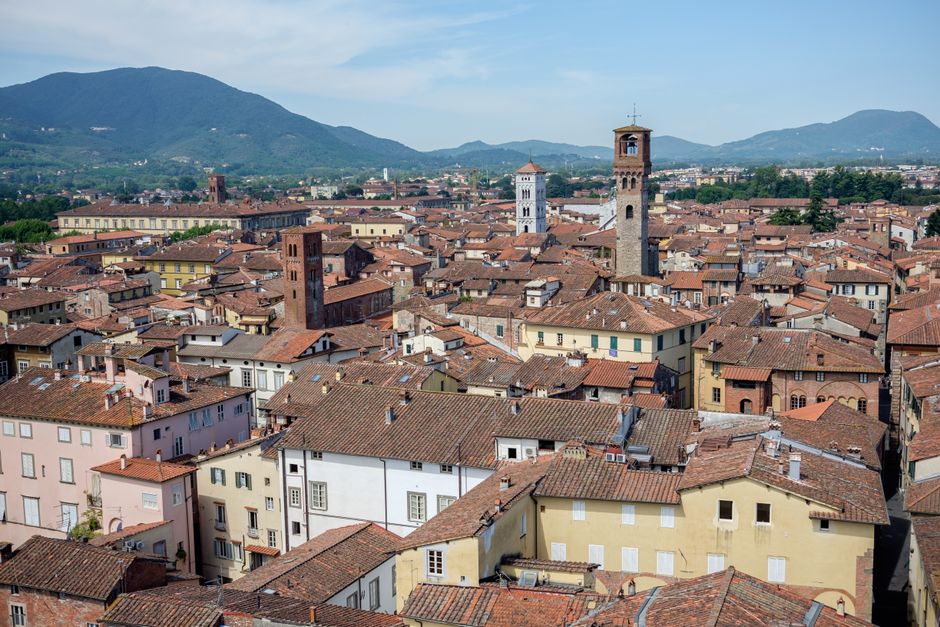
Lucca is the Tuscan city that kept its walls. A complete ring of Renaissance ramparts, 4.2 km long and planted with plane and lime trees, wraps around a flat, compact old town of Romanesque churches, medieval towers and narrow lanes, and on top of the walls everyone walks, runs and cycles. Inside, you find the oval Piazza dell’Anfiteatro, built over a Roman amphitheatre, the white marble façades of San Michele in Foro and San Martino cathedral, a tower with oak trees growing on its roof, and the house where Giacomo Puccini was born. Lucca is quieter and more relaxed than Florence or Pisa, only 30 minutes away by train, and it makes a lovely base for northern Tuscany: hilltop villas, the Garfagnana valley, the Versilia beaches and even the Cinque Terre. Spring and autumn are the best seasons, and at the end of October the city fills for Lucca Comics & Games.
Right now in Lucca
- Wed 13–25°C 56–77°F 15 mm Cloudy
- Thu 16–20°C 62–67°F 82 mm Heavy rain
- Fri 14–19°C 57–66°F Partly cloudy
Weather: MET Norway (CC BY 4.0) · Rates: ECB
Top tours in Lucca
See all tours for Lucca →
From local operators, with prices and reviews; you check availability and book on Viator, our partner. We may earn a commission at no extra cost to you. How we earn money
Lucca at a glance
- Best for: cycling and walking on the walls, Romanesque churches, Puccini and opera, a slower pace than Florence, and day trips into northern Tuscany.
- How long: a day covers the highlights; 2–3 days let you relax and add the villas, the Garfagnana or a day at the sea.
- Best time: April–June and September–October. July and August are hot; Lucca Comics & Games (28 October–1 November 2026) fills every bed.
- Book ahead: rooms for Comics & Games and summer concert dates months ahead; the Guinigi tower and the Torre delle Ore on weekends.
- Getting in: trains from Pisa (about 30 minutes) and Florence (about 1 hour 20), and Autolinee Toscane buses from Florence. Pisa airport is the nearest.
- Before you go: entry rules, money, trains and general safety are on our Italy travel guide.
Lucca’s neighbourhoods and who each one suits
The walled centre is only about 1.5 km across and almost entirely closed to traffic, so you can walk everywhere. Areas blend into each other, but each has its own feel.
Via Fillungo and the Piazza dell’Anfiteatro
Via Fillungo, the long, narrow main street, runs through the northern half of the old town past old shop fronts, cafés and the Torre delle Ore. Just off it, the Piazza dell’Anfiteatro is an oval of houses built into the ruins of the Roman amphitheatre, now lined with café terraces. Lively and central, with plenty of rooms; it can be noisy on summer nights.
San Michele and Piazza Napoleone
The heart of the city: the Piazza San Michele, with its wedding-cake church façade, and the big tree-lined Piazza Napoleone, where the summer concerts take place. Puccini’s birthplace is around the corner. A good base for first-timers, close to the bus terminus at Piazzale Verdi.
The cathedral quarter
The south-east of the old town is calmer, with the cathedral of San Martino, the church of Santi Giovanni e Reparata, quiet lanes and the walls a few steps away. It is ten minutes’ walk from the railway station, which is just outside the southern walls, so it is handy if you arrive by train.
Outside the walls
Hotels and B&Bs outside the ramparts, especially near the station and the western Sant’Anna district, are often cheaper and easier if you have a car; you walk in through one of the gates in a few minutes.
Top things to see in Lucca
Prices and hours were checked on the official sites in October 2026, unless we say otherwise; check again before you go. The Lucca Visit Card, a combined ticket sold by the city, covers the main museums and attractions, including the towers, the cathedral complex and the Puccini Museum.
The walls
Built between the mid-16th and mid-17th centuries and never tested in battle, the walls are now a raised park, 4.2 km round, with eleven bastions and six gates. Walking the full loop takes just over an hour; cycling it, about 20 minutes, and bikes are for hire at several shops near the gates and Piazza Santa Maria. Go at sunset, when the light turns the towers gold, and look out for the information panels about how the ramparts worked. Access is free and open all day.
San Martino cathedral
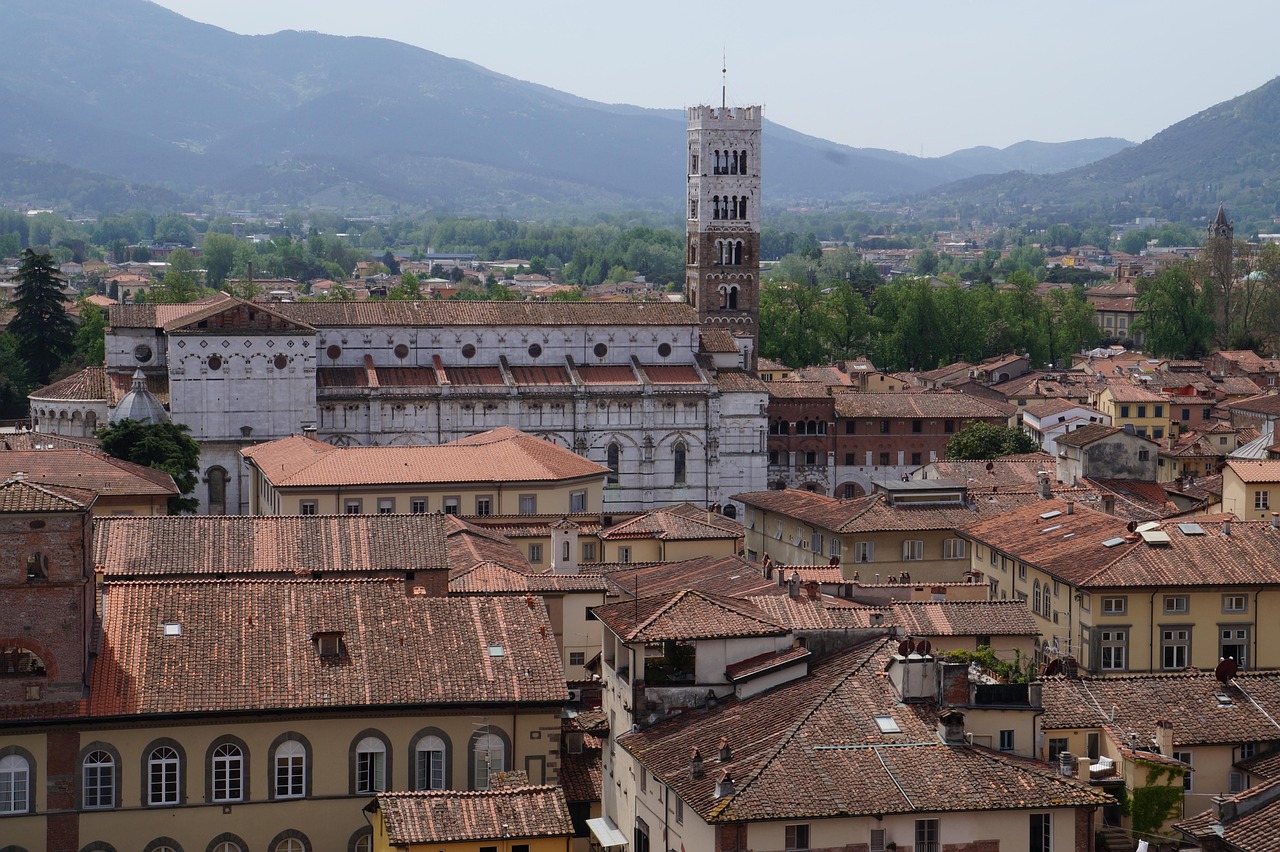
Lucca’s cathedral has an asymmetric Romanesque façade with arcades and inlaid marble, and inside it keeps two treasures: the Volto Santo, a much-venerated wooden crucifix, and Jacopo della Quercia’s tomb of Ilaria del Carretto, one of the finest Renaissance sculptures in Italy. According to the cathedral’s official site, the combined ticket for the cathedral, bell tower, cathedral museum and the church of Santi Giovanni e Reparata, with its baptistery and archaeological area, costs €10 (€8 reduced, €20 family); the cathedral with Ilaria’s tomb alone costs €5. Tickets are sold at each site and need no booking; cards are accepted. The cathedral opens Monday to Saturday 9:30–18:00 and Sunday 12:00–18:00, and the bell tower, museum and Santi Giovanni e Reparata daily 10:00–18:00, with last entry 30 minutes before closing.
San Michele in Foro and San Frediano
San Michele in Foro stands on the old Roman forum, its tall façade of tiered marble arcades topped by a statue of the Archangel Michael. In the north of town, San Frediano has a huge golden 13th-century mosaic on its façade and, inside, a carved Romanesque font and the preserved body of Saint Zita. Both are free to look at from the outside and among the best Romanesque churches in Tuscany.
The Guinigi Tower and the Torre delle Ore
Lucca once had around 130 towers; only two survive intact. The Torre Guinigi, 45 m high, is famous for the holm oaks growing in the roof garden at the top, reached by 230 steps. The Torre delle Ore on Via Fillungo, 50 m and the city’s tallest, has a working 18th-century clock mechanism you pass on the way up its 207 wooden steps. The city’s tourism site says booking is recommended on weekdays and required at weekends and on public holidays; tickets are sold online and at the entrance, and neither tower has a lift. Secondary sources give €8 per tower, with a combined ticket for both towers and the botanical garden; hours change by season and the Torre delle Ore closes in winter.
Puccini Museum
Giacomo Puccini was born on 22 December 1858 in a flat in Corte San Lorenzo, now a museum with his furniture, letters, scores and the Steinway piano on which he composed Turandot. According to the museum, tickets cost €9 (€7 reduced, free up to age 8, €17 family) and are sold at the ticket office in Piazza Cittadella 5, a few metres away. From 5 October to 1 November 2026 it opens daily 9:30–17:30 (last entry 17:00), and from 20 October it closes on Tuesdays.
More to see
- Piazza dell’Anfiteatro: the oval square on the footprint of the Roman arena, best early in the morning.
- Palazzo Pfanner: a 17th-century palace with a Baroque garden of statues and lemon trees, seen in many films.
- Palazzo Mansi and Villa Guinigi: the two national museums, one a grand merchant’s palace with tapestries and paintings, the other the city’s history and art museum in a late-Gothic villa.
- Botanical garden: a 19th-century garden inside the walls, with a pond, greenhouses and great old trees.
Other things to do in Lucca
Cycling
Lucca is Tuscany’s most bike-friendly city: the centre and the walls are flat, and many locals get around by bike. Rent a city bike, tandem or family bike for an hour or a day. For longer rides, the cycle path along the Serchio river heads north towards the Garfagnana, and quiet roads lead to the villas in the hills. See our cycling guide.
Puccini and music
Lucca keeps Puccini’s music alive: short concerts of his arias are given most evenings in a church in the centre, and in July the Lucca Summer Festival brings international pop and rock stars to Piazza Napoleone. The Puccini Festival at Torre del Lago, his lakeside home near Viareggio, stages his operas in an open-air theatre each summer.
Food and wine
Lucca’s cooking is rustic and generous: zuppa di farro (spelt soup), tordelli lucchesi (meat-filled pasta with a rich ragù), and buccellato, a sweet aniseed and raisin bread. The olive oil of the Lucca hills is excellent, and the wineries of the Colline Lucchesi and Montecarlo make reds and whites you can taste a short drive away. See our wine tasting guide.
Day trips from Lucca
Pisa
The Leaning Tower is 30 minutes away by train. Get off at Pisa San Rossore, a short walk from the Piazza dei Miracoli, and book the tower climb on the official site. See our Pisa guide.
Florence
About 1 hour 20 minutes by regional train or about the same by bus, Florence is an easy but busy day out; one day is only enough for a taste. See our Florence guide.
The villas, the Garfagnana and the coast
In the hills north of Lucca, grand villas such as the Villa Reale di Marlia and Villa Torrigiani open their gardens to visitors. Further up the Serchio valley, the medieval Ponte della Maddalena, or Devil’s Bridge, at Borgo a Mozzano, and the mountain villages of the Garfagnana make a good day by car. Viareggio and the Versilia beaches are about 30 minutes away, and the Cinque Terre can be reached by train via Viareggio and La Spezia, a long but feasible day trip.
Nearby destinations
- Pisa18 km
- Florence60 km
- San Gimignano60 km
- Tuscany71 km
- Cinque Terre72 km
- Siena88 km
- Bologna97 km
- Portofino116 km
Getting there and getting around
By train and bus
Lucca station is in Piazza Ricasoli, just outside the southern walls and a few minutes’ walk from the centre. Regional trains run from Florence Santa Maria Novella in about 1 hour 20 minutes, from Pisa Centrale and Pisa San Rossore in about 30 minutes, and from Viareggio. Autolinee Toscane buses run from Florence (Porta al Prato–Leopolda) and Viareggio to the bus station at Piazzale Verdi, inside the walls.
Airports
Pisa airport is the closest, about 30 km away: take the PisaMover shuttle to Pisa Centrale and change for Lucca. Florence airport is the alternative, about an hour away by road.
Walking and cycling
The walled centre is flat and small enough to walk, and most visitors never need a bus. A bike makes it even easier; just keep to walking pace in crowded lanes.
Driving, the ZTL and parking
Almost the whole old town is a limited-traffic zone (ZTL), and driving through a camera gate without a permit means a fine. If your hotel is inside the walls, ask it to register your number plate before you arrive. Otherwise, use one of the car parks outside the walls, such as those near Porta Elisa, Porta Sant’Anna or the station, and walk in. The city’s tourism site lists all car and coach parks.
When to go and how long to stay
Lucca has a mild, fairly wet climate, shaded by the Apuan Alps and the Apennines to the north. The table uses the WMO 1991–2020 climate normals for the Pisa San Giusto station, about 20 km away, the same station as our Pisa guide: long-term average daily highs and lows, and days with at least 1 mm of rain. Lucca, a little further inland, is often slightly hotter on summer afternoons and cooler on winter nights.
| Season | Average high / low | Rainy days per month | What it’s like | Good for |
|---|---|---|---|---|
| Winter (Dec–Feb) | 12–13 °C / 3–4 °C | 7–9 | Mild days, chilly nights, some fog | Museums, quiet walls, low prices |
| Spring (Mar–May) | 16–23 °C / 5–11 °C | 6–8 | Fresh and green, busy at Easter | Cycling, villa gardens, day trips |
| Summer (Jun–Aug) | 27–30 °C / 15–18 °C | 2–4 | Hot and sunny; concert season | Evening walks on the walls, the Summer Festival |
| Autumn (Sep–Nov) | 26 °C falling to 16 °C / 15 °C falling to 8 °C | 7 in September, 10 in November | Golden leaves on the walls, then the wettest months | Comics & Games, food, wine harvest |
October and November are the rainiest months, with around 130 mm of rain each, so pack an umbrella; the plane trees on the walls turn gold in late October.
Events worth planning around
- 13 September: the Luminara di Santa Croce, an evening procession by candlelight in honour of the Volto Santo, part of the Holy Cross festivities.
- July: the Lucca Summer Festival in Piazza Napoleone, with big-name concerts.
- July–August: the Puccini Festival at Torre del Lago, near Viareggio.
- 28 October–1 November 2026: Lucca Comics & Games, one of Europe’s largest comics and gaming festivals, which takes over the whole old town; book months ahead or avoid these dates.
How long to stay: 1, 2 and 3 days
1 day: cycle the walls in the morning, then the cathedral, San Michele, the Piazza dell’Anfiteatro and Via Fillungo, a climb up the Guinigi tower and the Puccini Museum.
2 days: add San Frediano, Palazzo Pfanner’s garden, an evening Puccini concert and a half-day in Pisa. 3 days: add a villa garden and the Devil’s Bridge, or a day at the beach in Viareggio.
Where to stay in Lucca and the tourist tax
- Inside the walls: the most atmospheric choice, with everything on foot; near Via Fillungo for life, the cathedral quarter for quiet.
- By the station: just outside the southern walls, practical for day trips by train.
- Outside the walls: cheaper hotels with parking, a few minutes’ walk from the gates.
- In the hills: villas and farm stays among olive groves, best with a car.
The City of Lucca charges a tourist tax (imposta di soggiorno) per person per night to non-residents, for up to three consecutive nights in the same property, at rates that depend on the type and category of accommodation; secondary summaries of the rates in force since April 2025 give about €1.50 to €5. It is paid at your hotel; check the current rate when you book.
Practical tips for Lucca
- Ride, don’t drive: rent a bike for the walls and leave the car outside the ZTL.
- Book the towers at weekends: booking is required on Saturdays, Sundays and holidays.
- Check the Comics & Games dates: at the end of October the old town is packed and some sites close or change hours.
- Mind Tuesdays in late autumn: from 20 October 2026 the Puccini Museum closes on Tuesdays.
- Combine with Pisa: trains every half hour or so make it easy to see both in one day.
- Emergencies: call 112.
What to pack for Lucca
Pack comfortable walking shoes for the stone lanes and the steps of the towers, and clothes you can cycle in. In spring and autumn bring layers and a compact umbrella or rain jacket, as October and November are wet. In summer a sun hat, sunglasses and a refillable bottle help on the walls, where shade comes and goes. Cover your shoulders and knees for the cathedral and churches, and pack a smarter outfit if you plan an evening concert.
Lucca travel FAQ
Is Lucca worth visiting?
Yes. It is one of Tuscany’s most pleasant towns, with complete walls you can cycle around, beautiful Romanesque churches and a relaxed atmosphere, and it is easy to combine with Pisa.
How many days do you need in Lucca?
One day covers the walls, the cathedral, the towers and the main squares. Two or three days let you add Pisa, the villas, the Garfagnana or the coast.
How do I get from Pisa to Lucca?
By regional train from Pisa Centrale or Pisa San Rossore, in about 30 minutes. From Pisa airport, take the PisaMover to Pisa Centrale first.
How do I get from Florence to Lucca?
By regional train from Santa Maria Novella in about 1 hour 20 minutes, or by Autolinee Toscane bus from Porta al Prato–Leopolda.
Can you walk or cycle on Lucca’s walls?
Yes. The walls are a 4.2 km tree-lined park, free and open all day. The full loop takes just over an hour on foot or about 20 minutes by bike, and bikes are easy to rent near the gates.
Can I drive into Lucca?
Not into the old town without a permit: almost all of it is a camera-controlled ZTL. Park outside the walls and walk in, or ask your hotel inside the walls to register your plate.
How much is Lucca Cathedral?
According to the cathedral’s official site, the combined ticket for the cathedral, bell tower, museum and Santi Giovanni e Reparata costs €10 (€8 reduced), and the cathedral with Ilaria del Carretto’s tomb €5. No booking is needed.
When is Lucca Comics & Games 2026?
From 28 October to 1 November 2026. The whole old town becomes a festival site, so book accommodation very early or visit on other dates.
Can you climb the Guinigi Tower?
Yes, 230 steps to a roof garden with holm oaks and views over the whole city. There is no lift, and booking is required at weekends and on holidays.
Is Lucca a good base for Tuscany?
Good for northern Tuscany: Pisa, the coast, the Garfagnana and even the Cinque Terre by train. For Siena, Chianti and the Val d’Orcia, Florence or Siena is a better base.
Sources and last review
Researched and last reviewed on 4 October 2026. Cathedral complex prices and hours: the Complesso Museale e Archeologico della Cattedrale di Lucca; Puccini Museum prices and autumn hours: the Fondazione Giacomo Puccini; walls, towers, the Visit Card, arrivals and parking: the City of Lucca’s official tourism site, turismo.lucca.it; tourist tax rules: the City of Lucca; Lucca Comics & Games dates: the festival’s official site; climate: WMO 1991–2020 normals for Pisa San Giusto (Italian Air Force station, archived by NOAA). Tower prices, the tourist tax amounts, concert and festival details and train times come from secondary or general sources and are flagged for checking. Prices, timetables and opening hours change, so check the official sites before you go. For entry rules, money and safety, see our Italy travel guide.
Plan your trip
Partner links: TravelerCenter may earn a commission if you book, at no extra cost to you.
🇮🇹 Useful Italian phrases for Lucca
All 38 Italian phrases: restaurant, hotel, emergencies, romance (printable) →