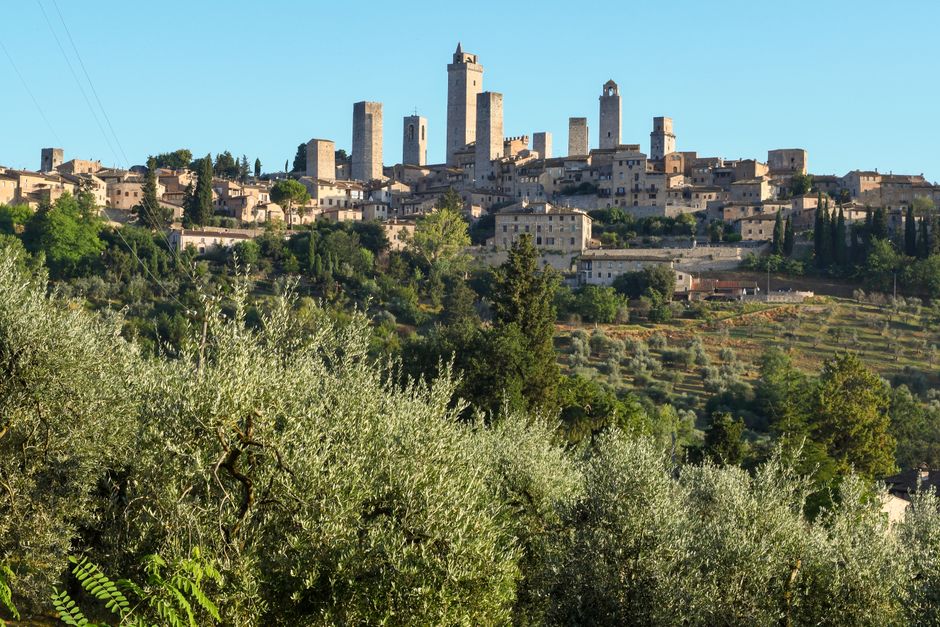
San Gimignano is the hill town of towers. In the Middle Ages its rich merchant families, grown wealthy on saffron and the pilgrim traffic of the Via Francigena, competed to build the tallest tower; about 70 once stood, and around 14 survive, giving this small walled town in central Tuscany a skyline you recognise from miles away. Inside the walls, two linked squares, frescoed churches and stone lanes have hardly changed since the plague of 1348 stopped the town’s growth, and the historic centre has been a UNESCO World Heritage Site since 1990. Around it, vineyards produce Vernaccia di San Gimignano, the white wine that became Italy’s first DOC. By day San Gimignano is one of Tuscany’s busiest stops for tour buses from Florence and Siena; stay the night and the streets are yours again. The best months are April to June and September to October.
Right now in San Gimignano
- Wed14–24°C56–76°F3 mm rain
- Thu15–22°C59–71°F29 mm rain
- Fri14–18°C57–65°FCloudy
Top tours in San Gimignano
See all tours for San Gimignano →
From local operators, with prices and reviews; you check availability and book on Viator, our partner. We may earn a commission at no extra cost to you. How we earn money
San Gimignano at a glance
- Best for: medieval towers and squares, frescoed churches, views over vineyards, Vernaccia wine and gelato, and a night in a Tuscan hill town.
- How long: half a day covers the highlights; one night lets you enjoy the evening and early-morning calm, two to three as a base for the countryside.
- Best time: April–June and September–October. Summer days are hot and crowded from mid-morning; in winter many shops close early.
- Book ahead: rooms inside the walls for weekends from spring to autumn; nothing else needs booking except guided tours.
- Getting in: about 1 hour from Siena or 1 hour 30 from Florence, by car or by train or bus to Poggibonsi and then a local bus. The walled centre is closed to cars.
- Before you go: entry rules, money, trains and general safety are on our Italy travel guide.
San Gimignano’s streets and who each one suits
The walled town is small: you can cross it in 15 minutes, from Porta San Giovanni in the south to Porta San Matteo in the north. It sits on a ridge 324 m up, so expect gentle slopes and a few steep lanes.
Piazza della Cisterna and Piazza del Duomo
The heart of town: two connected squares surrounded by towers and palaces. The triangular Piazza della Cisterna is named after its 13th-century well, while the Piazza del Duomo holds the Collegiata, the Palazzo Comunale with the Torre Grossa, and the tourist office. Hotels here have the best views and the most atmosphere.
Via San Giovanni and the south
The main street from Porta San Giovanni, where buses and the closest car parks are, climbs to the Piazza della Cisterna past shops selling ceramics, saffron, wild boar salami and Vernaccia. It is the busiest street by day; behind it, quiet lanes lead to the walls and viewpoints.
Via San Matteo and the north
The quieter half of town, with fine medieval houses along Via San Matteo, the church of Sant’Agostino with its frescoes, and views from the walls near Porta San Matteo. A good choice for a calmer stay.
The countryside
Farm stays, villas and wine estates surround the town, often with pools and views of the towers. You need a car, but you get space, quiet and prices lower than inside the walls.
Top things to see in San Gimignano
Prices and hours were checked on the official sites in October 2026, unless we say otherwise; check again before you go. Tickets for the Civic Museums are sold at the museum entrances and online.
The Torre Grossa and the Civic Museums
The Palazzo Comunale, the town hall on the Piazza del Duomo, houses the Civic Museum and Pinacoteca, with the frescoed Sala di Dante, where the poet spoke as Florence’s envoy in 1300, Lippo Memmi’s Maestà, paintings by Benozzo Gozzoli and Filippino Lippi, and a cycle of lively wedding frescoes in the Podestà’s room. From the courtyard you climb the Torre Grossa, at 54 m the tallest tower in town and the only one you can climb, for a view over the rooftops and the vineyards. According to the town’s tourist office, a Civic Museums ticket costs €10 (€8 reduced), valid for three consecutive days, and also covers the archaeological museum with the old Santa Fina pharmacy, the modern art gallery and the church of San Lorenzo in Ponte. A combined ticket with the Collegiata and its museum costs €15 (€12 for ages 6–17). The Civic Museums open daily 10:00–19:30 from 1 April to 31 October and 11:00–17:30 from 1 November to 31 March, with last entry 30 minutes before closing; they close on 25 December.
The Collegiata
From outside, the Collegiata (Basilica di Santa Maria Assunta) looks plain. Inside, its walls are covered in 14th-century frescoes: Old Testament scenes on one side, the life of Christ on the other, a terrifying Last Judgement by Taddeo di Bartolo, and, in the Chapel of Santa Fina, Domenico Ghirlandaio’s frescoes of the town’s young saint. According to the tourist office, entry costs €5 (€3 reduced), or €7 with the Museum of Sacred Art. The Collegiata’s own site gives its April–October hours as Monday to Friday 10:00–19:30, Saturday 10:00–17:00 and Sunday 12:30–19:30, with shorter hours from November to March, and it closes to visitors from 16 January to 15 February, on 12 March and on 25 December. Hours can change for church services.
Piazza della Cisterna and the towers
Stand by the old well in the Piazza della Cisterna at dusk, when the day-trippers have gone, and look up at the Torri Ardinghelli, the twin towers built by rival branches of the same family. From here, walk the lanes to spot the other towers, including the Torre Rognosa beside the Palazzo del Podestà and the Torre Chigi. The square is also home to some of Tuscany’s most famous gelato shops; expect a queue.
Sant’Agostino and the walls
At the northern end of town, the church of Sant’Agostino has a choir frescoed by Benozzo Gozzoli with the life of Saint Augustine, a peaceful contrast to the busy centre; entry is free. Nearby, climb up to the Rocca di Montestaffoli, the ruins of a 14th-century fortress whose garden and tower give one of the best views of the skyline.
More to see
- San Gimignano 1300: a private museum with a large ceramic model of the town as it looked in the Middle Ages.
- The Vernaccia wine centre: at the Rocca di Montestaffoli, for tastings of the local white wine.
- The walls and gates: Porta San Giovanni and Porta San Matteo, and short walks along the outside of the walls for views of the towers.
- Torture and medieval curiosities museums: several private museums on the main streets, popular with families.
Other things to do in San Gimignano
Wine tasting
Vernaccia di San Gimignano, a crisp, slightly bitter white, was Italy’s first wine to receive DOC status, in 1966, and is now a DOCG. Many estates on the hills around town open their cellars for tastings, often with olive oil and local saffron, and some offer lunch among the vines. Book estates directly, especially at weekends. See our wine tasting guide.
Walking and cycling
The Via Francigena, the medieval pilgrim route from Canterbury to Rome, passes through San Gimignano. Walk the stage south to Monteriggioni (about 30 km) or just a few kilometres of it among vineyards for the classic view back to the towers. The rolling roads are popular with road cyclists and e-bike tours. See our hiking and cycling guides.
Food
Try saffron, grown here since the Middle Ages and sold in tiny packets in town, pici pasta with wild boar ragù, and pecorino with honey. End the day with gelato on the Piazza della Cisterna and a glass of Vernaccia as the towers light up.
Day trips from San Gimignano
Siena and Monteriggioni
Siena is about 45 minutes away by car, or about an hour by public transport with a change at Poggibonsi; see our Siena guide. On the way, stop at Monteriggioni, a tiny village completely ringed by walls and 14 towers on the Via Francigena.
Volterra and Certaldo
Volterra, about 30 km west along a scenic road, is an Etruscan and medieval hill town famous for its alabaster workshops and Roman theatre. Certaldo Alto, the medieval upper town of Certaldo, where Boccaccio lived, is reached by a small funicular from the modern town below.
Florence, Chianti and Pisa
Florence is about an hour by car, and the wine villages of Chianti lie between the two; see our Tuscany guide. Pisa is about 1 hour 15 minutes by car, making it a possible stop on the way to or from Pisa airport.
Nearby destinations
Getting there and getting around
By train and bus
There is no station in San Gimignano. Take a regional train on the Empoli–Siena line to Poggibonsi, the station listed as Poggibonsi-San Gimignano, then an Autolinee Toscane bus up to the town, about 20–25 minutes. From Florence the trip usually takes about 1 hour 30 minutes to 2 hours with a change in Empoli or Poggibonsi; some buses from Florence and Siena connect at Poggibonsi too. The tourist office notes that from June to September local buses do not pass through the historic centre, so get off at Porta San Giovanni or Porta San Matteo. Check the last bus back, especially on Sundays.
By car and where to park
The walled centre is a limited-traffic zone, so park outside. According to the town’s tourist office, the 2026 car park rates are: P1 Giubileo, the largest and cheapest, at €2 an hour for the first two hours, €1.50 for each hour after and €7 maximum for the first day; P2 Montemaggio, closest to Porta San Giovanni, at €3 for the first hour, €2.50 for the second, €2 after and €15 maximum per day; and P3 and P4 Bagnaia, at €2.50 for each of the first two hours and €2 after, €15 maximum. Overnight rates (20:00–08:00) are €1 at Giubileo and €5 at the others, and pay machines take cash and cards. A local bus links Santa Lucia and Giubileo with Porta San Giovanni. If your hotel is inside the walls, ask whether it can register your plate to unload.
Airports
Florence airport is about 1 hour 15 minutes away by car and Pisa airport about 1 hour 30. Without a car, take the airport shuttle or tram into Florence, or the PisaMover to Pisa Centrale, and continue by train to Poggibonsi.
When to go and how long to stay
San Gimignano stands on a hilltop in inland Tuscany, with hot, dry summers and cold, sometimes foggy winters. The table uses the WMO 1991–2020 climate normals for Arezzo, the nearest inland Tuscan station in the official set, the same as our Siena guide: long-term average daily highs and lows, and days with at least 1 mm of rain. San Gimignano, a little higher and windier, has a very similar climate.
| Season | Average high / low | Rainy days per month | What it’s like | Good for |
|---|---|---|---|---|
| Winter (Dec–Feb) | 9–11 °C / 0–1 °C | 7–9 | Cold, often grey or foggy, frosty nights | Quiet streets, low prices, museums |
| Spring (Mar–May) | 15–23 °C / 3–10 °C | 7–9 | Mild days, cool nights, green vineyards | Walking, cycling, wine tastings |
| Summer (Jun–Aug) | 28–32 °C / 13–16 °C | 4–6 | Hot and sunny; very busy by day | Early mornings, evenings in the squares, festivals |
| Autumn (Sep–Nov) | 26 °C falling to 14 °C / 12 °C falling to 5 °C | 7 in September, 10 in November | Warm September, grape harvest, wetter November | Wine, food, fewer crowds |
The busiest hours are from about 10:00 to 17:00, when tour buses arrive from Florence and Siena. Come early, stay late, or sleep in town.
Events worth planning around
- 12 March and the first Sunday of August: the feasts of Santa Fina, the town’s young patron saint.
- June: the Ferie delle Messi, a medieval festival with costumes, crafts and jousting.
- Summer: open-air concerts and opera in the squares and at the Rocca di Montestaffoli.
- September–October: the grape harvest, with wineries busy and the vineyards turning gold.
How long to stay: half a day, 1 and 2 days
Half a day: the Collegiata, the Civic Museum and Torre Grossa, the Piazza della Cisterna and a gelato, then the view from the Rocca di Montestaffoli.
1 day with a night: add Sant’Agostino, a walk outside the walls and a wine tasting, then dinner in town and an evening stroll. 2 days: add Volterra or Monteriggioni and Siena, or a morning on the Via Francigena among the vineyards.
Where to stay in San Gimignano and the tourist tax
- Inside the walls: the most atmospheric choice, with quiet evenings and early mornings; rooms are small and parking is outside.
- Near Porta San Giovanni: practical for buses and car parks.
- Countryside farm stays: space, pools and views of the towers, best with a car.
- Siena or Florence: if you prefer a city base, San Gimignano works as a day trip.
The town charges a tourist tax (imposta di soggiorno) on every night all year, for up to five consecutive nights, with children under 14 exempt. According to the City of San Gimignano, the rates are €1.50 for campsites, €2 for 1-star hotels, €2.50 for 2-star hotels, agriturismi, B&Bs and holiday rentals, €3 for 3-star, €3.50 for 4-star and €4 for 5-star hotels, per person per night, paid at your accommodation.
Practical tips for San Gimignano
- Beat the buses: visit before 10:00 or after 17:00, or stay the night.
- Buy the combined ticket: the Civic Museums ticket lasts three days and includes the Torre Grossa.
- Park outside the walls: the centre is a ZTL; Giubileo is cheaper, Montemaggio closer.
- Check the last bus: connections to Poggibonsi thin out in the evening and on Sundays.
- Dress for churches: cover shoulders and knees for the Collegiata.
- Emergencies: call 112.
What to pack for San Gimignano
Comfortable shoes are a must for the stone lanes and the Torre Grossa’s stairs. In summer bring a sun hat, sunglasses and a refillable bottle; there are fountains in town, but little shade at midday. Spring and autumn evenings are cool on the hilltop, so pack a warm layer and a light rain jacket for October and November. A scarf or light layer to cover your shoulders in the Collegiata is useful, and if you plan to walk the Via Francigena, add proper trail shoes and a day pack.
San Gimignano travel FAQ
Is San Gimignano worth visiting?
Yes. Its towers, frescoed churches and squares are among the best-preserved medieval sights in Italy. It gets crowded by day, so come early or stay overnight to enjoy it at its best.
How do I get from Florence to San Gimignano?
By car in about an hour, or by train or bus to Poggibonsi and then a local Autolinee Toscane bus to the town, about 1 hour 30 minutes to 2 hours in total.
How do I get from Siena to San Gimignano?
About 45 minutes by car, or about an hour by public transport with a change at Poggibonsi.
How many towers are there in San Gimignano?
About 14 survive of the roughly 70 that stood in the Middle Ages. The tallest, the Torre Grossa at 54 m, is the only one you can climb.
Can you climb the Torre Grossa?
Yes, from the Palazzo Comunale, with the Civic Museums ticket (€10, €8 reduced, valid three days). It is open daily 10:00–19:30 from April to October and 11:00–17:30 from November to March.
How much is the Collegiata in San Gimignano?
According to the tourist office, €5 (€3 reduced), or €7 with the Museum of Sacred Art. A combined ticket with the Civic Museums costs €15. It closes to visitors from 16 January to 15 February.
Where do I park in San Gimignano?
In the car parks outside the walls: P2 Montemaggio is closest to Porta San Giovanni, P1 Giubileo is the cheapest (€7 maximum for the first day in 2026), and P3 and P4 Bagnaia are near the north side.
Is San Gimignano good for a day trip?
Half a day is enough for the highlights, so it pairs well with Siena, Volterra or Monteriggioni. An overnight stay is much more atmospheric.
What wine is San Gimignano famous for?
Vernaccia di San Gimignano, a crisp white that was Italy’s first DOC wine in 1966. Taste it at the wine centre in the Rocca di Montestaffoli or at the estates around town.
Is there a tourist tax in San Gimignano?
Yes, every night all year for up to five consecutive nights: from €1.50 for campsites to €4 for 5-star hotels per person per night. Children under 14 are exempt.
Plan your trip
Partner links: TravelerCenter may earn a commission if you book, at no extra cost to you.
🇮🇹 Useful Italian phrases for San Gimignano
All 38 Italian phrases: restaurant, hotel, emergencies, romance (printable) →
Sources · last reviewed 4 October 2026
Researched and last reviewed on 4 October 2026. Civic Museums and Collegiata prices, museum hours, car park rates and bus notes: the town’s tourist office, run by the Pro Loco of San Gimignano, using data from the City; Collegiata hours and closures: the Collegiata’s official site; tourist tax: the City of San Gimignano; climate: WMO 1991–2020 normals for Arezzo (Italian Air Force station, archived by NOAA). Bus and train times and event dates are general and should be checked with Trenitalia, Autolinee Toscane and the town. Prices, timetables and opening hours change, so check the official sites before you go. For entry rules, money and safety, see our Italy travel guide.
Data: Weather: MET Norway (CC BY 4.0) · Rates: ECB · Costs: World Bank ICP and price levels · Wikidata (CC0)