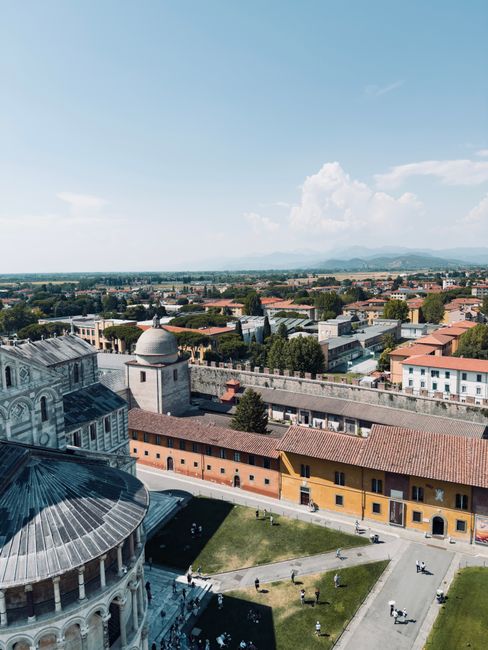
Pisa is far more than a leaning bell tower. Yes, the Piazza dei Miracoli is one of the most beautiful squares in Italy, with the tower, the cathedral, the baptistery and the cemetery standing like white marble sculptures on a green lawn. But walk ten minutes away and you find a lively university town of arcaded streets, riverside palaces along the Arno, tiny Gothic churches and some of the best-value food in Tuscany. Pisa has the region’s busiest airport, trains to Florence, Lucca and the Cinque Terre, and the sea a short bus ride away. It is great for city sightseeing on foot or by bike. Give it half a day for the square, a full day to enjoy the old town too, and two days if you use it as a base for Lucca and the coast.
Right now in Pisa
- Wed 14–26°C 57–78°F 15 mm Cloudy
- Thu 16–21°C 62–69°F 59 mm Heavy rain
- Fri 14–21°C 57–69°F Mostly clear
Weather: MET Norway (CC BY 4.0) · Rates: ECB
Top tours in Pisa
See all tours for Pisa →
From local operators, with prices and reviews; you check availability and book on Viator, our partner. We may earn a commission at no extra cost to you. How we earn money
Pisa at a glance
- Best for: the Leaning Tower and the Piazza dei Miracoli, a relaxed university-town atmosphere, riverside walks, and an easy base for Lucca, the coast and the Cinque Terre.
- How long: half a day for the square, one day for the old town as well, two days with Lucca or a beach afternoon.
- Best time: April to June and September to October. July and August are hot and the square is crowded; 16 June is the magical Luminara night.
- Book ahead: a timed slot to climb the Leaning Tower on opapisa.it, the only official seller; tickets go on sale 90 days ahead.
- Getting in: the PisaMover shuttle links the airport and Pisa Centrale in a few minutes; regional trains reach Florence in about an hour.
- Before you go: entry rules, money, trains and general safety are on our Italy travel guide.
Pisa’s neighbourhoods and who each one suits
Pisa’s historic centre is small and flat, spread along both banks of the Arno. The river divides it into the northern half, with the Piazza dei Miracoli, the university and the markets, and the quieter southern half, with the main station. You can walk from the station to the Leaning Tower in about 25 minutes.
Piazza dei Miracoli and Santa Maria
The north-west corner of the old town, around the cathedral square and Via Santa Maria. Convenient for an early start at the tower; busy with tour groups by day, quiet once they leave.
Borgo Stretto and the university quarter
The heart of everyday Pisa: the arcaded Borgo Stretto shopping street, the market square of Piazza delle Vettovaglie, the Piazza dei Cavalieri with its decorated palace, and the streets around the university, full of students, cheap trattorias and bars. The best area for atmosphere and evenings out.
The Lungarni
The riverside avenues on both banks of the Arno, lined with pastel palaces and lovely at dusk. Rooms with a river view are a treat.
Corso Italia and the station
South of the river, the pedestrian Corso Italia runs from the Ponte di Mezzo to Pisa Centrale station. Good for short stays, budget hotels, early trains and the airport.
Top things to see in Pisa
Prices and hours below were checked on the official sites in October 2026; check again before you go, as hours change with the seasons and for religious services.
The Leaning Tower and the Piazza dei Miracoli
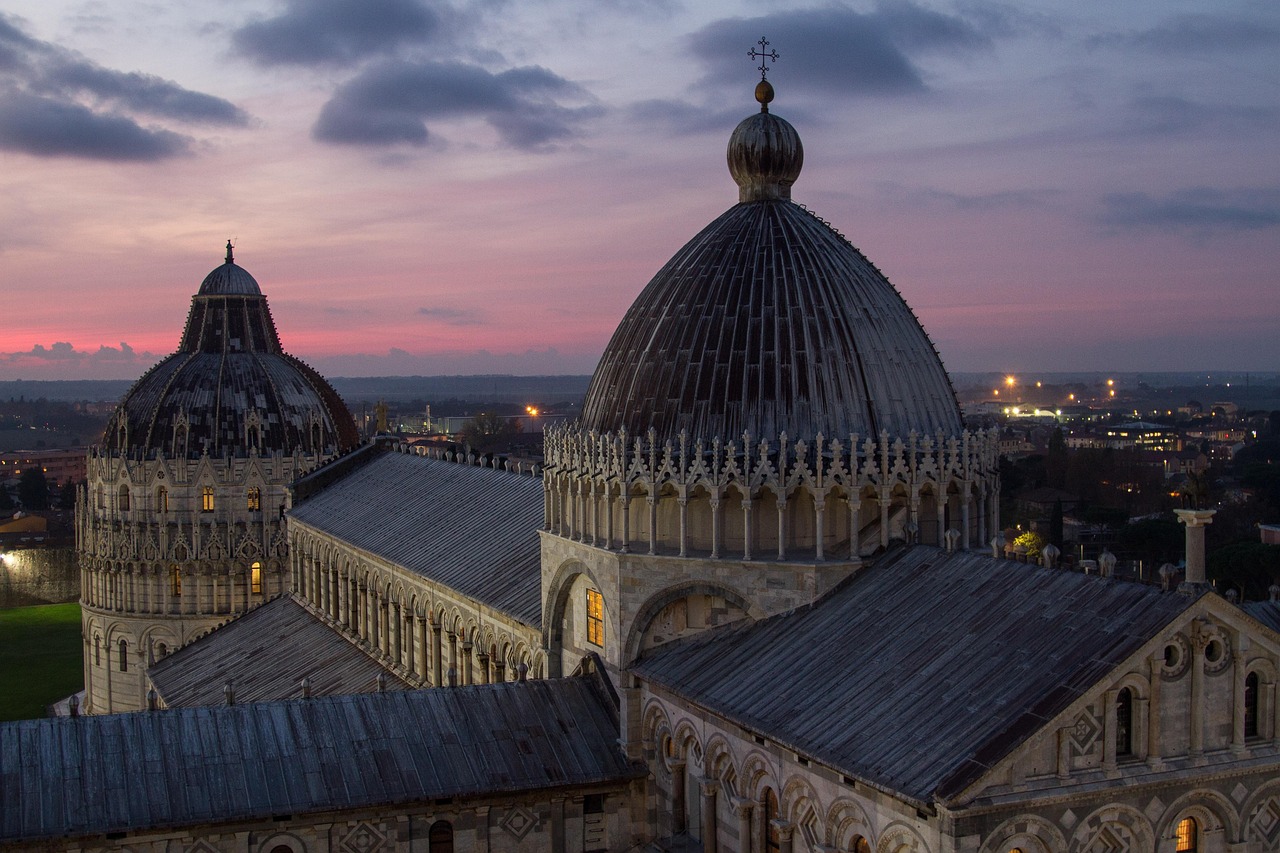
The Square of Miracles gathers four masterpieces of Pisan Romanesque on one lawn: the cathedral, begun in 1064, the round baptistery, the Camposanto cemetery and the famous bell tower, which began to lean as soon as building started in the 12th century. Together they are a UNESCO World Heritage Site. Looking is free; climbing the tower means a timed ticket from the Opera della Primaziale Pisana on its official site, opapisa.it. As of October 2026 a tower ticket costs €20, with no reduced prices. Children may climb only if they turn 8 during the current year, under-18s must be with an adult, and all bags go in the cloakroom. The climb is about 250 steps and takes around 30 minutes. Read our full Leaning Tower of Pisa guide for slots, age rules and tips.
The cathedral, baptistery and Camposanto
The cathedral is free: any paid ticket includes a cathedral pass, or you can pick up a free timed coupon at the ticket offices in the square. Inside, look for the gilded ceiling and Giovanni Pisano’s carved pulpit. The baptistery, the largest in Italy, is famous for its echo, and attendants often demonstrate it by singing a few notes. The Camposanto is a long cloistered cemetery with Roman sarcophagi and medieval frescoes, and the Opera del Duomo and Sinopie museums complete the set. Combined tickets for the other monuments are sold on opapisa.it; check the current combinations there. In autumn 2026 the monuments open at 9:00 and the cathedral at 10:00, closing at 20:00 until 18 October, 19:00 until 1 November and 18:00 from 2 November.
Piazza dei Cavalieri
Once the political heart of medieval Pisa, this square is dominated by the Palazzo della Carovana, covered in black-and-white sgraffito decoration. It houses the Scuola Normale Superiore, one of Italy’s most selective universities, so the square is full of students. Galileo studied at the university here.
Santa Maria della Spina and the Lungarni
A tiny Gothic jewel box of a church on the Lungarno Gambacorti, covered in spires, statues and marble lace. It was built to hold a thorn said to be from Christ’s crown and was moved stone by stone in the 19th century to save it from the river. Walk the Lungarni from here to the Ponte di Mezzo and on to the old Citadel for the city’s most elegant views, especially at sunset.
Palazzo Blu
A blue-painted palace on the river that is now Pisa’s main art centre, with a permanent collection of Pisan art and big temporary exhibitions. From 14 October 2026 to 7 March 2027 it hosts a major Edward Hopper exhibition with more than 150 works. It is open Tuesday to Friday from 10:00 to 19:00, and on weekends and holidays from 10:00 to 20:00, with last entry an hour before closing; see palazzoblu.it for exhibition prices.
More classic sights
- Borgo Stretto: the arcaded main street, with the Pasticceria Salza and the morning market just behind it in Piazza delle Vettovaglie.
- The city walls: a walkway along the medieval walls near the Piazza dei Miracoli gives a view over the square from above.
- Museum of the Ancient Ships: Roman ships found buried near San Rossore station, displayed in the old Medici arsenals.
- Keith Haring’s “Tuttomondo”: a huge, joyful mural painted in 1989 on a wall by Sant’Antonio church, near the station.
The Pisa Card: is it worth it?
Launched by the city in September 2026, the digital Pisa Card costs €24 and is valid for one week from the start date you choose. It gives one entry to each participating museum, including the Palazzo Blu permanent collection, the medieval walls, the Museum of the Ancient Ships, the national museums of San Matteo and Palazzo Reale, the Certosa di Calci, the university’s botanical garden and museum and other university collections, plus a free code for the CicloPi bike-share. Children under 8 go free. It does not include the Leaning Tower or the other Piazza dei Miracoli monuments, which are sold separately by the Opera della Primaziale. It is worth it if you plan three or four of the museums.
Other things to do in Pisa
Eating and drinking in Pisa
Pisa is a student city, which keeps prices down. Try cecina, a thin chickpea-flour pancake sold by the slice, often stuffed into focaccia; bavette sul pesce, pasta with seafood; and torta coi bischeri, a chocolate and rice tart. The Vettovaglie market square is full of simple trattorias and wine bars. The wines of the Pisan hills and nearby Bolgheri are a short drive away for wine tasting.
Cycling and the river
Pisa is flat and easy by bike: the CicloPi bike-share has stations around the centre, and bike lanes lead out through the San Rossore park towards the sea. See our cycling guide. In summer, boat trips run on the Arno from the city towards the river mouth.
The beaches
Pisa’s own coast, at Marina di Pisa and Tirrenia, is about 20–30 minutes away by city bus, with sandy beaches, beach clubs and a Blue Flag for the clean water. Further north, Viareggio and Forte dei Marmi are the classic Versilia resorts. See our beaches guide.
Day trips from Pisa: Lucca, Florence and the Cinque Terre
Lucca
Just 30 minutes away by train, Lucca is a relaxed, elegant town ringed by complete Renaissance walls, topped by a tree-lined path about 4 km around that is perfect by rented bike. Add the oval Piazza dell’Anfiteatro and the Guinigi Tower with oak trees on its roof. Pisa and Lucca make an easy pair; see our Tuscany guide.
Florence
Regional trains reach Florence Santa Maria Novella in about an hour, so a day trip is easy, though Florence deserves at least two days. Read our Florence guide for the Uffizi, the Duomo and where to stay.
The Cinque Terre
Regional trains run up the coast to La Spezia in about an hour, where the Cinque Terre train takes over. See our Cinque Terre guide for the villages, the trails and the Cinque Terre Card. Further on, Genoa is about two hours by train.
Nearby destinations
- Lucca18 km
- San Gimignano59 km
- Florence69 km
- Tuscany71 km
- Cinque Terre72 km
- Siena87 km
- Elba105 km
- Bologna115 km
Getting there and getting around
From Pisa airport
Pisa International Airport (PSA), the busiest in Tuscany, is right next to the city. The PisaMover automated shuttle runs from the terminal to Pisa Centrale station in a few minutes, with departures every 5 to 15 minutes; as of October 2026 a single journey costs €6.50, and it cannot be discounted. Trains from Pisa Centrale then reach Florence, Lucca and the coast. A taxi to the centre is quick but costs more.
By train
Pisa Centrale, south of the river, is on the main coastal line between Rome, Genoa and Turin and has frequent regional trains to Florence (about an hour), Lucca (about 30 minutes) and La Spezia (about an hour). High-speed connections to Rome and Milan usually go via Florence. Pisa San Rossore, a small station on the Lucca line, is a few minutes’ walk from the Leaning Tower. Validate paper regional tickets before boarding.
Walking, buses and bikes
The centre is flat and compact: walk, or ride a CicloPi bike-share bike. City buses link the station, the Piazza dei Miracoli and the coast at Marina di Pisa and Tirrenia; buy tickets before you board or in the app.
Driving and the ZTL
Don’t drive into the old town. Most of central Pisa is a ZTL limited-traffic zone, watched by cameras at every gate, and permits are issued only to residents and other authorised vehicles through Pisamo, the city’s mobility company. Fines arrive months later via your car-rental company. Since 2026 a separate ZTL also operates around the Arena Garibaldi football stadium, near the Piazza dei Miracoli, on match days. Use the car parks outside the walls, including the big park-and-ride by the PisaMover’s middle stop, and if your hotel is inside the zone ask it in advance about access.
When to go and how long to stay
Pisa lies on the coastal plain, so it is milder in winter than inland Tuscany, with frequent rain in autumn. The table uses the WMO 1991–2020 climate normals for the Pisa San Giusto station at the airport: long-term average daily highs and lows, and days with at least 1 mm of rain.
| Season | Average high / low | Rainy days per month | What it’s like | Good for |
|---|---|---|---|---|
| Winter (Dec–Feb) | 12–13 °C / 3–4 °C | 7–9 | Mild days, chilly nights, some rainy spells | The square without crowds, museums, low prices |
| Spring (Mar–May) | 16–23 °C / 5–11 °C | 6–8 | Pleasant and green, busy at Easter | Walking, cycling, day trips |
| Summer (Jun–Aug) | 27–30 °C / 15–18 °C | 2–4 | Hot, sunny and dry; crowds at the tower | Early starts, beaches, the June festivals |
| Autumn (Sep–Nov) | 26 °C falling to 16 °C / 15 °C falling to 8 °C | 7 in September, 10 in November | Warm September, then the wettest months | Fewer crowds, food, wine and museums |
These are long-term averages and recent summers have been hotter. October and November bring about 130 mm of rain a month, the most of the year, so pack an umbrella.
Events worth planning around
- Giugno Pisano (June): the city’s month of traditions, with the most famous events below.
- 16 June, the Luminara: on the eve of the patron saint’s day, about 100,000 small candle lamps outline the palaces along the Lungarni, and fireworks start at 23:00. It is magical and very crowded.
- 17 June, the Palio di San Ranieri: a historic rowing race on the Arno between the city’s districts.
- Last Saturday of June, the Gioco del Ponte: a costumed parade and a trial of strength on the Ponte di Mezzo between the two halves of the city, Tramontana and Mezzogiorno.
- Regatta of the Ancient Maritime Republics: Pisa, Genoa, Venice and Amalfi take turns to host this rowing race and historic pageant; Pisa hosted it on 2 June 2026.
How long to stay: half-day, 1-day and 2-day plans
Half a day: the Piazza dei Miracoli with an early or late tower slot, the cathedral and the baptistery, then a walk down Via Santa Maria to the river.
1 day: add the Camposanto in the morning, lunch around the Vettovaglie market, Piazza dei Cavalieri and Borgo Stretto, Santa Maria della Spina and sunset along the Lungarni, with Palazzo Blu if an exhibition appeals. 2 days: add a day in Lucca with a bike ride on the walls, or an afternoon at the beach at Marina di Pisa.
Where to stay in Pisa and the tourist tax
- Near the Piazza dei Miracoli: handy for the tower; quiet at night.
- Borgo Stretto and the university quarter: the liveliest area, with restaurants and bars.
- The Lungarni: river views and elegant palaces.
- Corso Italia and the station: good value and best for trains and the airport.
- The coast: Marina di Pisa or Tirrenia for a beach base in summer.
Pisa tourist tax (imposta di soggiorno): paid per person per night at your accommodation, usually at check-out. The latest rates the city has announced, from 2024, are about €2 a night in a 1-star hotel, €2.50 in a 2- or 3-star and €3 in a 4- or 5-star, with the same €1 rise applied to B&Bs, rentals, hostels and campsites, and different rates in high and low season. Check the current rates with your hotel or on comune.pisa.it before you travel.
Practical tips for Pisa
- Book your tower slot early and only on opapisa.it; arrive 15 minutes before your time, as latecomers are not admitted.
- Travel light: bags must go in the cloakroom before the climb, and large suitcases are not accepted, so leave luggage at your hotel or the station.
- Go early or late: tour buses arrive mid-morning; the square is calm and golden at the end of the day.
- Respect the lawns: walking or sitting on the grass of the Piazza dei Miracoli is not allowed.
- Watch your pockets in the crowds around the square, at the station and on buses.
- Don’t drive into the ZTL; park outside the walls.
- Emergencies: call 112.
What to pack for Pisa
Comfortable shoes with good grip for the tower’s worn marble steps. A small bag is easiest, since even handbags go in the cloakroom before the climb. In summer pack light clothes, a sun hat, sunscreen and a refillable bottle; there is little shade in the square. Bring a light layer in spring and autumn, an umbrella for October and November, clothes that cover shoulders and knees for the cathedral, and a swimsuit for the beach.
Pisa travel FAQ
Is Pisa worth visiting for more than the Leaning Tower?
Yes. The Piazza dei Miracoli is the star, but the riverside Lungarni, Piazza dei Cavalieri, Borgo Stretto and the tiny church of Santa Maria della Spina make a lovely day, with good-value food and far fewer crowds than the square.
How many days do you need in Pisa?
Half a day covers the square and the tower. One day lets you enjoy the old town too, and two days work well with a day trip to Lucca or an afternoon on the beach.
How much does it cost to climb the Leaning Tower in 2026?
€20 per person as of October 2026, with no reduced tickets. Book a timed slot on opapisa.it, the official site, up to 90 days ahead. Children must turn 8 during the current year, and under-18s must be with an adult.
Is Pisa Cathedral free?
Yes. Any monument ticket includes a cathedral pass, or you can collect a free timed coupon at the ticket offices in the square. The baptistery, Camposanto and museums need a paid ticket.
What is the Pisa Card?
A digital museum pass launched in September 2026: €24 for one week, with one entry to each participating museum, including Palazzo Blu, the city walls and the Museum of the Ancient Ships, plus a free bike-share code. It does not include the Leaning Tower.
How do I get from Pisa airport to the city centre?
Take the PisaMover shuttle to Pisa Centrale station, which takes a few minutes and costs €6.50 one way as of October 2026. From the station it is about 25 minutes on foot to the Leaning Tower, or a short bus ride.
How do I get from Pisa to Florence?
By regional train from Pisa Centrale to Florence Santa Maria Novella in about an hour, with frequent departures through the day. Direct coaches also run from Pisa airport to Florence.
Can you visit Pisa and Lucca in one day?
Yes. Lucca is about 30 minutes from Pisa by train. See the Leaning Tower in the morning and spend the afternoon cycling Lucca’s walls, or do it the other way round.
When is the Luminara in Pisa?
Every year on the evening of 16 June, the eve of the feast of San Ranieri. About 100,000 candle lamps light the palaces along the Arno, followed by fireworks at 23:00.
How much is the tourist tax in Pisa?
A few euros per person per night, depending on the type of accommodation and the season. The latest published hotel rates are about €2 to €3; check with your hotel or on comune.pisa.it.
Sources and last review
Researched and last reviewed on 4 October 2026. Leaning Tower prices, age rules, cathedral access and autumn hours come from the Opera della Primaziale Pisana (opapisa.it); the Pisa Card from Pisamo, the city’s mobility company; Palazzo Blu hours and exhibitions from palazzoblu.it; Luminara, Gioco del Ponte, regatta and ZTL news from the Comune di Pisa; the PisaMover fare from Trenitalia; climate from the WMO 1991–2020 normals for Pisa San Giusto (Italian Air Force station, archived by NOAA). The tourist tax rates are the city’s 2024 figures and are flagged for checking, and train times are typical. Prices, timetables and opening hours change, so check the official sites before you go. For entry rules, money and safety, see our Italy travel guide.
Plan your trip
Partner links: TravelerCenter may earn a commission if you book, at no extra cost to you.
🇮🇹 Useful Italian phrases for Pisa
All 38 Italian phrases: restaurant, hotel, emergencies, romance (printable) →