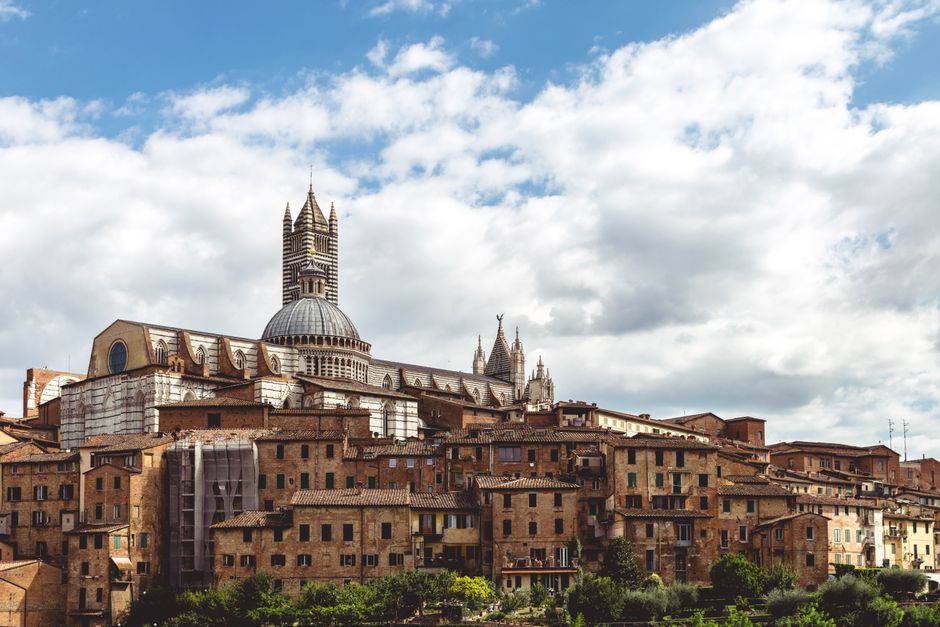
Siena is the medieval city Tuscany dreams of: a warren of red-brick lanes on three hilltops, all running down to the Piazza del Campo, a sloping, shell-shaped square under the slender Torre del Mangia. Its striped cathedral hides one of the great art treasures of Italy, a marble floor of 56 inlaid scenes, and twice a year the Campo hosts the Palio, a wild bareback horse race between the city’s districts. Siena’s historic centre is a UNESCO World Heritage Site, it is easy to reach by bus from Florence, and it sits at the edge of Chianti and the Val d’Orcia, perfect for wine tasting. One full day covers the highlights; stay two or three nights to enjoy the city after the day-trippers leave and explore the hills around it.
Right now in Siena
- Wed 15–24°C 59–76°F Partly cloudy
- Thu 15–21°C 60–71°F 11 mm Rain
- Fri 13–19°C 56–66°F 1 mm Partly cloudy
Weather: MET Norway (CC BY 4.0) · Rates: ECB
Top tours in Siena
See all tours for Siena →
From local operators, with prices and reviews; you check availability and book on Viator, our partner. We may earn a commission at no extra cost to you. How we earn money
Siena at a glance
- Best for: medieval streets and squares, Gothic art, the cathedral and its floor, the Palio, and a base for Chianti, San Gimignano and the Val d’Orcia.
- How long: 1 day for the Campo and the cathedral complex, 2–3 days with the museums and a trip into the countryside.
- Best time: April to June and September to October. The Palio on 2 July and 16 August is unforgettable but packed; in 2026 the cathedral floor is uncovered until 15 November.
- Book ahead: the cathedral’s OPA SI Pass or the Gate of Heaven roof tour; rooms months ahead for the Palio. Torre del Mangia tickets are sold only on the day.
- Getting in: express buses from Florence take about 1 hour 15 minutes; trains take about 1½ hours and arrive at the bottom of the hill.
- Before you go: entry rules, money, trains and general safety are on our Italy travel guide.
Siena’s neighbourhoods and who each one suits
Siena is divided into three terzi (thirds), each on its own ridge, and into 17 contrade, the districts that race in the Palio. Each contrada has its own church, museum, fountain and animal emblem, and you will see their flags and symbols on every street. The whole centre is walkable, but steep.
Il Campo and the city centre
The streets around the Piazza del Campo, including the main shopping streets of Banchi di Sopra and Banchi di Sotto. You can’t be more central, and it is magical at night, but rooms are pricey and it is busy by day.
Terzo di Città: the cathedral quarter
The oldest part of Siena, on the hill to the south-west, with the cathedral, Santa Maria della Scala and quiet lanes leading down to the Pinacoteca. Lovely for history lovers and early risers who want the cathedral before the crowds.
Terzo di San Martino
The eastern ridge, with the Logge del Papa, the church of Santa Maria dei Servi and its view back over the city. Residential and calm, with good local restaurants.
Terzo di Camollia and outside the walls
The northern third, around San Domenico and the sanctuary of St Catherine, close to the bus terminus at Piazza Gramsci and the Fortezza Medicea park. Handy for buses and drivers; hotels just outside the walls have parking and better prices.
Top things to see in Siena
Prices and hours were checked on the official sites in October 2026; check again before you go. Opening times can change for religious services and on Palio days.
The Piazza del Campo
One of the most beautiful squares in Europe, laid out in the 14th century in nine sections, a tribute to the city’s Government of the Nine, sloping down like a scallop shell to the Palazzo Pubblico. Sit on the warm brick, admire the Fonte Gaia fountain at the top, and come back after dark, when the square is at its best. It is free, open all day and the stage for the Palio.
Palazzo Pubblico: the Museo Civico and the Torre del Mangia
The Gothic town hall still houses the city council, and its upstairs rooms form the Museo Civico, with Simone Martini’s Maestà and Ambrogio Lorenzetti’s frescoes of Good and Bad Government, one of the most famous secular paintings of the Middle Ages. As of October 2026 a ticket costs €10, or €11 booked online, and the museum is open daily from 10:00 to 19:00 until 31 October, then 10:00 to 18:00 from 1 November.
The Torre del Mangia, about 400 steps up a narrow stair, has the best view in Siena. Tickets cost €10 and cannot be booked: buy them on the day at the Palazzo Pubblico ticket office or at the Dear Guests visitor centre on Via di Città. Climbs leave every 45 minutes for groups of up to 25, so they sell out on busy days; go early. The tower is open from 10:00 to 19:00 until 31 October and 10:00 to 16:00 from November. A combined Museo Civico and tower ticket costs €15, and adding Santa Maria della Scala makes it €20. Under-11s go free.
The cathedral complex and the OPA SI Pass
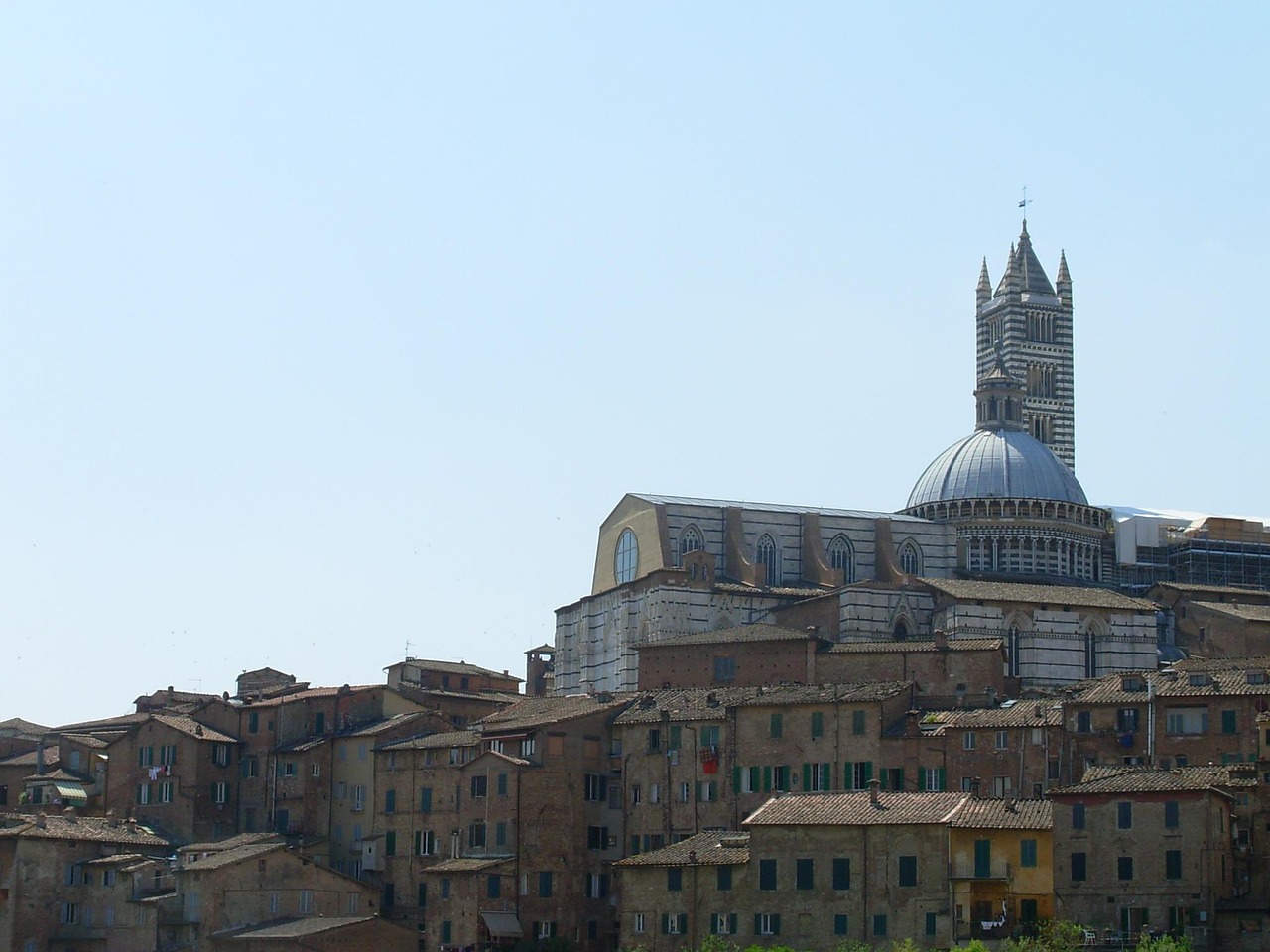
Siena Cathedral is a dazzling Gothic church of black and white marble stripes, with a pulpit by Nicola Pisano and statues by Donatello, Michelangelo and Bernini. Its greatest treasure is underfoot: a marble floor of 56 inlaid scenes, made over six centuries, normally covered to protect it. In 2026 it is uncovered from 27 June to 31 July and from 18 August to 15 November, for the Year of St Francis. Don’t miss the Piccolomini Library, bright with Pinturicchio’s frescoes, or the view from the top of the unfinished façade of the “New Cathedral”, which shows how vast Siena once planned its church to be.
Visits are sold by the Opera della Metropolitana (operaduomo.siena.it), as of October 2026:
- OPA SI Pass (€16 while the floor is uncovered, €14 at other times): the cathedral, the Piccolomini Library, the Museo dell’Opera with Duccio’s Maestà, the panorama from the New Cathedral façade, the crypt and the baptistery, valid for three consecutive days.
- Gate of Heaven Pass (€21): everything above plus the guided “Porta del Cielo” walk through the roof spaces and galleries of the cathedral, sold from 1 March to 6 January.
- Reduced tickets: €3 (OPA SI) or €6 (Gate of Heaven) for children aged 7 to 11; under-7s go free.
Until 31 October 2026 the complex is open from 10:00 to 19:00; from 1 November it closes at 17:30. The cathedral opens later on Sundays and holidays, and the last entry is 30 minutes before closing. Buy online, at the ticket office in Piazza Duomo or at the Dear Guests visitor centre.
Santa Maria della Scala
Opposite the cathedral, this was one of Europe’s first hospitals, caring for pilgrims and abandoned children for 800 years. Today it is a vast museum of frescoed wards, chapels, archaeology and underground passages. As of October 2026 a ticket costs €9 (€8 booked), and it is open daily from 10:00 to 19:00 until 31 October; from 1 November to 14 March it closes on Tuesdays and at 17:00 on weekdays.
More classic sights
- Pinacoteca Nazionale: the best collection of Sienese gold-ground painting, from Duccio to Beccafumi.
- San Domenico and St Catherine’s sanctuary: the saint’s head is kept in the great brick church; her family house is nearby.
- Fonte Branda: the largest of Siena’s medieval fountains, fed by underground aqueducts called bottini.
- The contrada museums: each district has a small museum of Palio banners and costumes, open on certain days or by appointment.
Other things to do in Siena
Food and wine
Sienese cooking is hearty and rustic: pici, thick hand-rolled pasta, with garlic and tomato or wild boar ragù; ribollita; grilled Cinta Senese pork; and pecorino cheese from nearby Pienza. For dessert, panforte, a dense spiced cake of nuts and candied fruit, ricciarelli almond biscuits and cavallucci. Chianti Classico vineyards begin just north of the walls, and Brunello di Montalcino and Vino Nobile di Montepulciano are an hour south.
Walks and views
Walk the lanes away from the centre, down to the Orto de’ Pecci garden below the Campo or out to the Fortezza Medicea, whose walls have a park and views. The city is also a stage on the Via Francigena pilgrim route from Canterbury to Rome, and many people walk part of it here; see our hiking guide.
Day trips from Siena: Chianti, San Gimignano and the Val d’Orcia
Siena is the best base for southern Tuscany. Buses reach the main towns, but a car, a tour or a bike opens up the countryside. See our Tuscany guide for more.
Chianti
The wine hills between Siena and Florence, with castles, villages such as Castellina, Radda and Gaiole, and estates offering tastings. Drive the scenic roads, book a guided tour, or ride an e-bike (see our cycling guide).
San Gimignano and Monteriggioni
San Gimignano’s medieval towers rise from a hilltop about an hour away; by public transport, change at Poggibonsi. On the way, Monteriggioni is a tiny village completely enclosed by walls and 14 towers, on the Via Francigena.
The Val d’Orcia
South of Siena, the UNESCO-listed Val d’Orcia is Tuscany’s postcard landscape of rolling hills and cypresses, with Pienza, Montalcino, Montepulciano and the hot springs of Bagno Vignoni. You really need a car, or a full-day tour.
Nearby destinations
Getting there and getting around
By bus and train from Florence
The fastest way from Florence is the express bus run by Autolinee Toscane, which takes about 1 hour 15 minutes and stops at Piazza Gramsci, a 10–15 minute walk from the Campo. Trains take about 1½ hours, sometimes with a change at Empoli, and arrive at Siena station at the bottom of the hill, about 2 km from the centre: take city bus line 520 up to Piazza Gramsci, or the long series of escalators from the shopping centre opposite the station up towards Porta Camollia. From Rome, take the train to Chiusi or Florence and change, or a direct coach.
Airports
The nearest big airports are Florence (FLR) and Pisa (PSA). From Florence airport, take the tram to Santa Maria Novella and then the bus or train; from Pisa, allow about 2½ to 3 hours by train via Empoli.
Walking
The centre is pedestrian-friendly but hilly, with steep lanes and steps. Wear good shoes and allow extra time between the Campo and the cathedral, which are only five minutes apart but on different hills.
Driving and the ZTL
Don’t drive into the centre. Inside the walls, Siena is a ZTL limited-traffic zone with camera-controlled gates, and some streets, including the Campo and Via di Città, are open to permitted vehicles only at set times in the early morning. Fines reach you months later through your rental company. Park in the car parks outside the walls, such as those by the Stadium and the Fortezza or at San Francesco, several of them linked to the centre by escalators; if your hotel is inside the ZTL, ask it to arrange a permit for unloading.
When to go and how long to stay
Siena stands about 320 metres up in inland Tuscany, with hot, dry summers and cold, sometimes foggy winters. The table uses the WMO 1991–2020 climate normals for Arezzo, the nearest inland Tuscan station in the official set (248 m), which has a very similar climate: long-term average daily highs and lows, and days with at least 1 mm of rain.
| Season | Average high / low | Rainy days per month | What it’s like | Good for |
|---|---|---|---|---|
| Winter (Dec–Feb) | 9–11 °C / 0–1 °C | 7–9 | Cold, often grey or foggy, frosty nights | Museums without queues, low prices, the December market |
| Spring (Mar–May) | 15–23 °C / 3–10 °C | 7–9 | Mild days, cool nights, green hills | Walking, day trips, Easter |
| Summer (Jun–Aug) | 28–32 °C / 13–16 °C | 4–6 | Hot and sunny; the Palio in July and August | Early starts, evenings in the Campo, countryside |
| Autumn (Sep–Nov) | 26 °C falling to 14 °C / 12 °C falling to 5 °C | 7 in September, 10 in November | Warm September, grape harvest, wetter November | Wine, food, the uncovered cathedral floor |
These are long-term averages; recent summers have been hotter. October and November are the wettest months, with about 110–120 mm of rain each. The figures match those on our Tuscany page.
Events worth planning around
- The Palio (2 July and 16 August): ten of the seventeen contrade race bareback three times around the Campo in about 90 seconds, after days of trial races, parades and contrada dinners. In 2027 the dates fall on a Friday and a Monday, and rain can push the race to the next day, as happened in July 2026. Standing in the centre of the square is free but very crowded and hot; seats on the stands are sold privately and cost a lot.
- Cathedral floor uncovering: usually late June to July and mid-August to October; in 2026 extended to 15 November.
- Early December: the Mercato nel Campo, a big market of Tuscan food and crafts in the square, held from 4 to 8 December in 2026.
How long to stay: 1-, 2- and 3-day plans
1 day: the Campo and the Torre del Mangia early, the Museo Civico, lunch, then the cathedral, the Piccolomini Library and the New Cathedral façade view in the afternoon.
2 days: add Santa Maria della Scala, the Pinacoteca, San Domenico and an evening in the Campo. 3 days: add a day in Chianti, San Gimignano and Monteriggioni, or the Val d’Orcia.
Where to stay in Siena and the tourist tax
- Around the Campo: the most atmospheric and central; book early.
- Terzo di Città: quiet lanes near the cathedral.
- San Martino: residential and calm, with local restaurants.
- Camollia and outside the walls: close to buses and parking, with better prices.
- The countryside: a farm stay in Chianti or on the hills around the city, with a car.
Siena tourist tax (imposta di soggiorno): charged per person per night at your accommodation and paid locally, with rates that depend on the type of property and are lower from November to February. Ask your hotel for the current amount or check comune.siena.it. For the Palio, book months ahead and expect higher prices and minimum stays.
Practical tips for Siena
- Climb the tower early: tickets are sold only on the day, in small timed groups, and can sell out.
- Plan around the floor: in 2026 it is uncovered until 15 November, a reason to visit in autumn.
- Dress for the cathedral: shoulders and knees covered.
- Check Palio days: museums close early and the Campo is fenced off on the race days and the days of the trials.
- Wear good shoes: the hills and steps are steep and the brick can be slippery when wet.
- Stay out of the ZTL with a car and use the car parks outside the walls.
- Emergencies: call 112.
What to pack for Siena
Comfortable shoes with grip for steep, sloping lanes and the Torre del Mangia’s narrow stairs. In summer, pack light clothes, a hat, sunscreen and a water bottle, plus a scarf or light layer to cover your shoulders in the cathedral. In spring and autumn bring layers and a compact umbrella, since evenings on the hilltop are cool and November is wet. In winter, a warm coat, hat and gloves: Siena’s stone streets hold the cold. If you come for the Palio, dress for heat and crowds and bring water.
Siena travel FAQ
Is Siena worth visiting?
Yes. It is one of the best-preserved medieval cities in Italy, with the Piazza del Campo, a superb cathedral and fine Gothic art, and it is calmer than Florence once the day-trippers leave.
How many days do you need in Siena?
One full day for the Campo, the tower and the cathedral complex. Two or three days let you add Santa Maria della Scala and a trip to Chianti, San Gimignano or the Val d’Orcia.
When is the Palio di Siena?
Every year on 2 July and 16 August in the Piazza del Campo, with trial races on the days before. Rain can move it to the next day. Standing in the centre is free but crowded; seats are sold privately.
When is the Siena Cathedral floor uncovered in 2026?
From 27 June to 31 July and from 18 August to 15 November 2026. During those dates the OPA SI Pass costs €16 instead of €14.
How much is the OPA SI Pass?
€16 while the floor is uncovered and €14 at other times, as of October 2026, valid for three days. It covers the cathedral, the Piccolomini Library, the museum and its panorama, the crypt and the baptistery. Children aged 7 to 11 pay €3.
Can you book the Torre del Mangia?
No. Tickets (€10) are sold only on the day at the Palazzo Pubblico or the Dear Guests visitor centre, for climbs every 45 minutes in groups of up to 25. Go early, especially at weekends.
How do I get from Florence to Siena?
The express bus takes about 1 hour 15 minutes and drops you near the centre at Piazza Gramsci. The train takes about 1½ hours and stops at the bottom of the hill, with a bus or escalators up to the old town.
Can I drive into Siena?
Not into the old town, which is a camera-controlled ZTL. Park outside the walls, at car parks such as the Stadium, the Fortezza or San Francesco, and walk or take the escalators up.
Is Siena a good base for exploring Tuscany?
Yes, for Chianti, San Gimignano, Monteriggioni and the Val d’Orcia. You will want a car or tours for the countryside, as buses are infrequent outside the main towns.
What food is Siena famous for?
Pici pasta, Cinta Senese pork, pecorino from Pienza, and sweets: panforte, ricciarelli almond biscuits and cavallucci. Chianti Classico and Brunello wines are grown nearby.
What is a contrada?
One of the 17 historic districts of Siena, each with its own emblem, church and museum. Ten of them race in each Palio, and the rivalry is fierce and very much alive.
Sources and last review
Researched and last reviewed on 4 October 2026. Cathedral passes, prices, hours and the 2026 floor uncovering come from the Opera della Metropolitana di Siena (operaduomo.siena.it); Museo Civico and Torre del Mangia prices and rules from the Comune di Siena’s museum site; Santa Maria della Scala from its official site; ZTL rules from comune.siena.it; climate from the WMO 1991–2020 normals for Arezzo (Italian Air Force station, archived by NOAA). Palio dates follow the City of Siena’s fixed calendar. The tourist tax rates were not confirmed on an official page, and bus and train times are typical; check the operators before you travel. Prices, timetables and opening hours change, so check the official sites before you go. For entry rules, money and safety, see our Italy travel guide.
Plan your trip
Partner links: TravelerCenter may earn a commission if you book, at no extra cost to you.
🇮🇹 Useful Italian phrases for Siena
All 38 Italian phrases: restaurant, hotel, emergencies, romance (printable) →