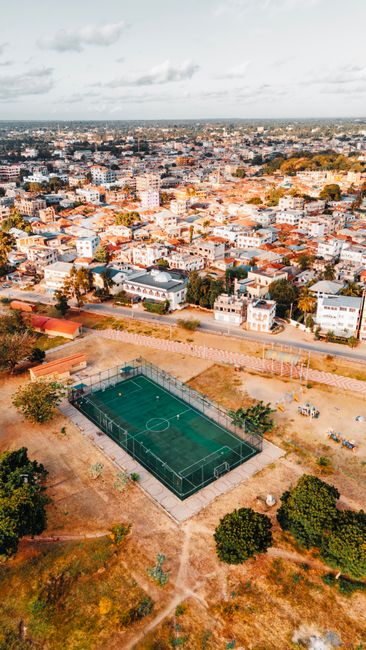
Malindi, on Kenya’s north coast in Kilifi County, is an old Swahili trading town turned beach resort, where the Sabaki River meets the Indian Ocean. It’s best known for the Vasco da Gama Pillar, raised by the Portuguese explorer in 1498 after the Sultan of Malindi gave him a pilot to guide his fleet to India, and for Malindi Marine National Park, which Kenya Wildlife Service (KWS) calls the country’s oldest marine protected area. Today Malindi has a relaxed, cosmopolitan feel, with a strong Italian influence: you’ll find gelato shops, pizzerias and Italian-run hotels alongside Swahili cafés, mosques and a busy market. A few kilometers south, the quieter village of Watamu has some of the most beautiful beaches in Kenya, coral lagoons protected as Watamu Marine National Park, the mangroves of Mida Creek and the ruins of the medieval Swahili town of Gede. Between them lies the Arabuko-Sokoke Forest, home to rare birds and butterflies. From Malindi, you can snorkel with turtles, watch humpback whales from July to October, fish for marlin and sailfish, and drive inland to Tsavo East through the Sala Gate. Malindi Airport has flights from Nairobi, and Mombasa is about two to three hours away by road.
Right now in Malindi
- Wed 24–29°C 74–85°F 2 mm Mostly clear
- Thu 24–30°C 76–86°F 4 mm Light showers
- Fri 24–27°C 75–81°F 38 mm Heavy rain
- Sat 10 Oct Mazingira Day
Weather: MET Norway (CC BY 4.0) · Sea temperature: NOAA CoastWatch · Holidays: Nager.Date
Top tours in Malindi
See all tours for Malindi →
From local operators, with prices and reviews; you check availability and book on Viator, our partner. We may earn a commission at no extra cost to you. How we earn money
Malindi at a glance
- Best for: beaches, snorkeling and diving, Swahili history, deep-sea fishing, Italian food and Watamu.
- How long: 3–4 nights for Malindi and Watamu; a week with Tsavo East.
- Best time: December to March and July to October; April to June is the main rainy season.
- Getting there: fly to Malindi Airport (MYD) from Nairobi, or drive about 2–3 hours from Mombasa.
- Getting around: tuk-tuks, boda-bodas and taxis; matatus run to Watamu and Mombasa.
- Good to know: the sea is muddy near the Sabaki River in the rains; Watamu’s water is often clearer.
- Before you go: the eTA, money and general safety are in our Kenya travel guide.
Malindi areas and who each one suits
Old Town and the seafront
Malindi’s Old Town, around the Jamia Mosque, the market and the old jetty, has whitewashed Swahili houses, small shops and cafés. The seafront road runs south past the Vasco da Gama Pillar and the Portuguese Chapel.
Silversands and the south beaches
South of the center, Silversands and Casuarina Point have beach hotels and villas facing the marine park, with the reef a short boat ride away.
Watamu
About 20 km (12 miles) south, Watamu is a village with a string of white-sand bays, including Turtle Bay, Garoda and Blue Lagoon, between coral rocks and islets. It has boutique hotels, villas and dive and kite centers, and a calmer, greener feel than Malindi.
Mida Creek
Behind Watamu, the tidal Mida Creek is lined with mangroves, with a boardwalk and suspended bridge, and huge flocks of waders at low tide.
Where to stay around Malindi
- Malindi town and seafront: for restaurants, nightlife and easy transport.
- Silversands and Casuarina: for beach hotels near the marine park.
- Watamu: for the best beaches, boutique stays and diving.
- Villas and guesthouses: good value for families and long stays.
Top things to see around Malindi
A short history of Malindi
Malindi was one of the wealthy Swahili city-states of the medieval coast, trading ivory, gold and mangrove poles with Arabia, Persia, India and even China; a Chinese fleet visited in the early 15th century. When Vasco da Gama arrived in 1498, Malindi’s sultan, a rival of Mombasa, welcomed him and helped him reach India, and the town stayed an ally of the Portuguese for a century. It later declined, was revived under the Omani sultans of Zanzibar as a plantation town, and grew into a beach resort from the mid-20th century. The Old Town’s mosques, pillar tombs and Swahili houses recall its long history.
The Vasco da Gama Pillar
The coral-stone pillar topped by a cross stands on a rocky point at the north end of the beach, near the entrance to the Malindi Marine National Park, according to KWS. Vasco da Gama erected it in 1498 as a sign of friendship with the Sultan of Malindi; it is one of the oldest European monuments in Africa. Nearby, the small thatched Portuguese Chapel is said to be among the oldest churches in East Africa.
Malindi Marine National Park and Reserve
KWS describes the park as Kenya’s first marine protected area, established in 1968 and designated a UNESCO Biosphere Reserve in 1979, stretching south of town from the Vasco da Gama Pillar, about 5 km (3 miles) from the center via Casuarina Road. Its fringing reefs, sheltered coral gardens, seagrass beds and mangroves are home to humpback dolphins, sea turtles, rays, reef sharks and many reef fish. Glass-bottom boats and snorkeling trips leave at low tide. The KWS 2025 fee for marine protected areas is US$25 for non-resident adults and US$15 for children. See our snorkeling guide.
Watamu Marine National Park and Reserve
According to KWS, Watamu Marine National Park and Reserve was gazetted on 26 March 1968 and protects coral gardens, lagoons and mangroves. It’s home to what KWS calls Kenya’s “Marine Big Five”: sea turtles, whale sharks, dolphins, whales and billfish. Between about July and October, humpback whales migrate along the coast, which KWS promotes as the marine half of Kenya’s “Twin Migration” alongside the wildebeest migration on land. The park fee is US$25 for non-resident adults.
Gede Ruins
In the coastal forest near Watamu, the ruins of Gede (Gedi), a Swahili town of the 13th to 17th centuries, include a palace, mosques, houses, tombs and wells, overgrown with baobabs and patrolled by monkeys. The site is managed by the National Museums of Kenya; go early when it’s cool, and with a guide.
Mida Creek and Whale Island
KWS lists Mida Creek and Whale Island among Watamu’s attractions. Explore the creek by canoe at high tide or walk the mangrove boardwalk, and visit Whale Island, a small islet with nesting seabirds in season, by boat.
Arabuko-Sokoke Forest
The largest surviving block of coastal dry forest in East Africa shelters rare birds such as the Sokoke scops owl and Clarke’s weaver, the golden-rumped elephant shrew, butterflies and forest elephants. Guided walks and drives start from the visitor center on the Malindi–Mombasa road near Gede.
Other things to do around Malindi
Diving and snorkeling
Dive centers in Malindi and Watamu visit coral reefs, drop-offs and the Watamu reef walls, with turtles, rays and occasionally whale sharks. Visibility is usually best from October to March. See our diving guide.
Deep-sea fishing
Malindi and Watamu are known for big-game fishing for sailfish, marlin, tuna and dorado, mainly from about November to March; many boats practice tag and release for billfish.
Kitesurfing and water sports
The steady winds from December to March and June to September make Watamu and Malindi good for kitesurfing; stand-up paddleboarding and kayaking are popular on calm mornings. See our surfing guide.
Turtle watching in Watamu
Green, hawksbill and olive ridley turtles nest on Watamu’s beaches, and a long-running local conservation group runs a rehabilitation center for injured turtles and releases hatchlings. If you see a nest or hatchlings on the beach, keep your distance and avoid flashlights. You can visit the center to learn about its work.
The Sabaki River estuary
North of town, the Sabaki estuary, where the river from Tsavo meets the sea, is one of Kenya’s best birding sites, with terns, gulls, flamingos and migrant waders from Europe and Asia from about October to April. Go at low tide with binoculars and a local guide.
Marafa Depression
About an hour inland, the Marafa Depression, nicknamed Hell’s Kitchen, is a canyon of eroded sandstone in red, orange and white, magical at sunset with a local guide.
Swahili culture and etiquette
Malindi’s Swahili community is mainly Muslim, and the call to prayer from the Jamia Mosque sets the rhythm of the Old Town. Women may wear the black buibui, men the white kanzu and embroidered kofia cap. Greet people with “jambo” or “habari”, shake hands with the right hand, cover shoulders and knees in town, and ask before photographing people or mosques. During Ramadan, many cafés open only after sunset, and the evening markets are at their liveliest.
Food and drink
Malindi is a great place to eat. Try Swahili coconut fish curry, biryani, pilau, mahamri with spiced tea, grilled octopus and prawns, and fresh tropical juices, and don’t miss the Italian side of town: wood-fired pizza, homemade pasta, espresso and gelato. Watamu’s beach restaurants serve the day’s catch, and the evening market in town has street food.
Day trips from Malindi
- Watamu, Gede and Mida Creek: an easy day combining the ruins, the creek and a beach lunch.
- Tsavo East National Park: KWS directs visitors from Malindi along the C103 road to the Sala Gate, about 2–3 hours inland, for a one- or two-night safari. See our Tsavo East National Park guide.
- Kilifi: a creek-side town with boutique hotels and sailing, about an hour south.
- Mombasa: Fort Jesus and the Old Town, about 2–3 hours by road. See our Mombasa guide.
- Lamu: the Swahili island town further north is usually reached by air from Malindi or Nairobi; check road conditions and status locally before driving north of Malindi.
Nearby destinations
- Mombasa105 km
- Diani Beach137 km
- Tsavo East National Park157 km
Getting there and getting around
By air
Malindi Airport (MYD), just south of the town center, has daily flights from Nairobi’s Jomo Kenyatta International and Wilson airports in about an hour, and some seasonal flights from Italy. Taxis reach central Malindi in 10 minutes and Watamu in about 30 minutes.
By road and rail
From Mombasa, the coast road north passes Mtwapa, Kilifi and Watamu; allow 2–3 hours, depending on traffic. KWS suggests the Madaraka Express from Nairobi to Mombasa Terminus (KES 1,500 economy, KES 4,500 first class one way, according to Kenya Railways), then onward by road. Buses and matatus link Malindi with Mombasa.
Getting around
Tuk-tuks are the easiest way to get around town and to Watamu (agree the fare first); boda-bodas are cheap but riskier. Taxis can be hired by the day for excursions, and some hotels rent bicycles.
When to go and how long to stay
Malindi is warm to hot all year, with highs of about 27–32 °C (81–90 °F). December to March is dry and sunny, the main beach and fishing season. The long rains from April to June are heaviest in May, with humid, cloudy days; some hotels close, and the Sabaki River can make the sea muddy near town. July to October is breezy and pleasant, with humpback whales offshore. The short rains in November are usually light. The table uses Kenya Meteorological Department (KMD) climate averages for Malindi, as published by the World Meteorological Organization (WMO): average daily highs and lows, total rainfall and days with at least 1 mm of rain.
| Month | Average high / low | Rain (days with 1 mm or more) | What to expect |
|---|---|---|---|
| January | 31 °C (87 °F) / 23 °C (74 °F) | 11 mm (0.4 in), 2 days | Hot, sunny and dry; peak season |
| February | 31 °C (88 °F) / 24 °C (74 °F) | 17 mm (0.7 in), 2 days | Hot and dry; calm seas; fishing season |
| March | 32 °C (89 °F) / 24 °C (75 °F) | 36 mm (1.4 in), 3 days | Hottest month; very humid |
| April | 31 °C (88 °F) / 24 °C (76 °F) | 163 mm (6.4 in), 11 days | Long rains begin; quieter |
| May | 29 °C (84 °F) / 23 °C (74 °F) | 298 mm (11.7 in), 17 days | Wettest month; some hotels close |
| June | 28 °C (82 °F) / 23 °C (73 °F) | 154 mm (6.1 in), 12 days | Showers; breezy kusi winds |
| July | 27 °C (81 °F) / 22 °C (72 °F) | 91 mm (3.6 in), 12 days | Cooler and breezy; whales offshore |
| August | 27 °C (81 °F) / 22 °C (71 °F) | 64 mm (2.5 in), 9 days | Pleasant; humpback whale season |
| September | 28 °C (83 °F) / 22 °C (71 °F) | 47 mm (1.9 in), 7 days | Mostly dry; good diving |
| October | 30 °C (85 °F) / 22 °C (72 °F) | 68 mm (2.7 in), 6 days | Warm and dry; excellent |
| November | 30 °C (87 °F) / 23 °C (73 °F) | 75 mm (3.0 in), 6 days | Short rains; brief showers |
| December | 31 °C (87 °F) / 23 °C (74 °F) | 35 mm (1.4 in), 3 days | Hot and sunny; busy holidays |
How long to stay: 3, 4 and 7 nights
- 3 nights: the marine park, Vasco da Gama Pillar, Old Town and Gede.
- 4 nights: add Mida Creek, Arabuko-Sokoke Forest and a beach day in Watamu.
- 7 nights: add a dive or fishing trip, Marafa, and a safari in Tsavo East.
Typical costs around Malindi
Prices are approximate, for October 2026, converted at about KES 129.8 to the US dollar (Central Bank of Kenya). Park fees are KWS’s 2025 non-resident rates.
| Item | Typical cost |
|---|---|
| Malindi or Watamu marine park fee, non-resident adult | US$25 (about KES 3,240) |
| Glass-bottom boat and snorkeling trip, park fee included | about US$40–70 |
| Tuk-tuk across Malindi | KES 150–400 (about US$1.2–3.1) |
| Tuk-tuk Malindi to Watamu | KES 1,000–1,800 (about US$7.7–14) |
| Swahili lunch | KES 400–900 (about US$3.1–6.9) |
| Pizza and drink in an Italian restaurant | KES 1,200–2,500 (about US$9.2–19) |
| Mid-range beach hotel double, per night | about US$70–180 |
Safety around Malindi
Malindi and Watamu are relaxed resorts, but take ordinary precautions. Don’t walk on empty beaches or roads after dark; take a tuk-tuk or taxi. Keep valuables in your hotel safe and carry only what you need. Beach boys selling excursions can be persistent; book trips through your hotel or established operators. At sea, swim inside the reef and at high tide, watch for currents at reef gaps and near the Sabaki River mouth, wear water shoes on coral and rocks, and make sure boats carry life jackets. During the kusi winds from about June to September, seas can be rough and seaweed piles up. Malaria and dengue occur on the coast; ask a travel-health professional about antimalarials and use repellent day and night. Dress modestly away from the beach, as the coast is mainly Muslim. If you’re heading north toward Lamu, fly rather than drive, and check the current road situation locally before you go. In an emergency, call 999 or 112.
Practical tips for Malindi
- Use the tides: snorkel at low tide on the reef; swim at high tide.
- Choose your beach by season: Watamu is usually clearer than Malindi in the rains.
- Carry cash and M-Pesa: smaller places prefer cash or mobile money.
- Book fishing early: boats fill up in the peak season from December to March.
- No plastic bags: plastic carrier bags are banned in Kenya.
What to pack for Malindi
Light, breathable clothes, modest outfits for town, swimwear, a sun hat, sunglasses, reef-safe sunscreen, insect repellent, water shoes for coral, a rash vest or light wetsuit for long snorkels, a light rain jacket from April to June, binoculars for birds and a power adapter for Kenya’s 240 V type G sockets. See our wetsuits and travel adapters guides.
Malindi travel FAQ
Is Malindi or Watamu better?
Malindi has more restaurants, nightlife and history; Watamu has clearer water, prettier bays and a quieter atmosphere. Many visitors stay in Watamu and visit Malindi.
How much is the Malindi marine park fee?
US$25 for non-resident adults and US$15 for children, under Kenya Wildlife Service’s 2025 fees.
How do I get to Malindi from Nairobi?
Fly to Malindi Airport in about an hour, or take the Madaraka Express to Mombasa and drive north for 2–3 hours.
When can you see whales in Malindi?
Humpback whales pass along the coast from about July to October, and boat trips leave from Malindi and Watamu.
What is the Vasco da Gama Pillar?
A coral-stone pillar erected by the Portuguese explorer in 1498, at the north end of Malindi’s marine park, one of the oldest European monuments in Africa.
Can I visit Tsavo East from Malindi?
Yes. Kenya Wildlife Service directs visitors along the C103 road to the Sala Gate, about 2–3 hours away.
Why is there an Italian community in Malindi?
Italians have holidayed and settled here for decades, partly linked to the Italian space center at Ngomeni nearby, and many hotels and restaurants are Italian-run.
When is the best time to visit Malindi?
December to March and July to October; avoid the heaviest rains in May.
Is Malindi safe for tourists?
Most visits are trouble-free. Take taxis after dark, keep valuables secure, and book trips with reputable operators.
Is there malaria in Malindi?
Yes, malaria is present on the Kenyan coast. Ask about antimalarials before you go and protect yourself from bites.
Sources and last review
Researched and last reviewed on 5 October 2026. Malindi Marine National Park history, UNESCO biosphere status, location, wildlife and access; Watamu’s gazettement, Marine Big Five, humpback whale migration and attractions; marine park fees; Sala Gate access to Tsavo East; SGR access: Kenya Wildlife Service and its 2025 conservation fees; Madaraka Express fares: Kenya Railways; the plastic bag ban: Kenya’s National Environment Management Authority; malaria and dengue: the US CDC; Lamu air access and emergency numbers: the UK government’s factual safety pages, used for practical facts only; climate averages: the Kenya Meteorological Department via the World Meteorological Organization (Malindi station); the exchange rate: the Central Bank of Kenya. Vasco da Gama history, the Portuguese Chapel, Gede, Arabuko-Sokoke, Marafa, fishing and wind seasons, the Italian community, flight and road times and typical prices are general references or estimates, flagged for checking. Prices and rules change, so check locally before you go. For the eTA, money and general safety, see our Kenya travel guide.
Plan your trip
Partner links: TravelerCenter may earn a commission if you book, at no extra cost to you.
🇹🇿 Useful Swahili phrases for Malindi
All 38 Swahili phrases: restaurant, hotel, emergencies, romance (printable) →