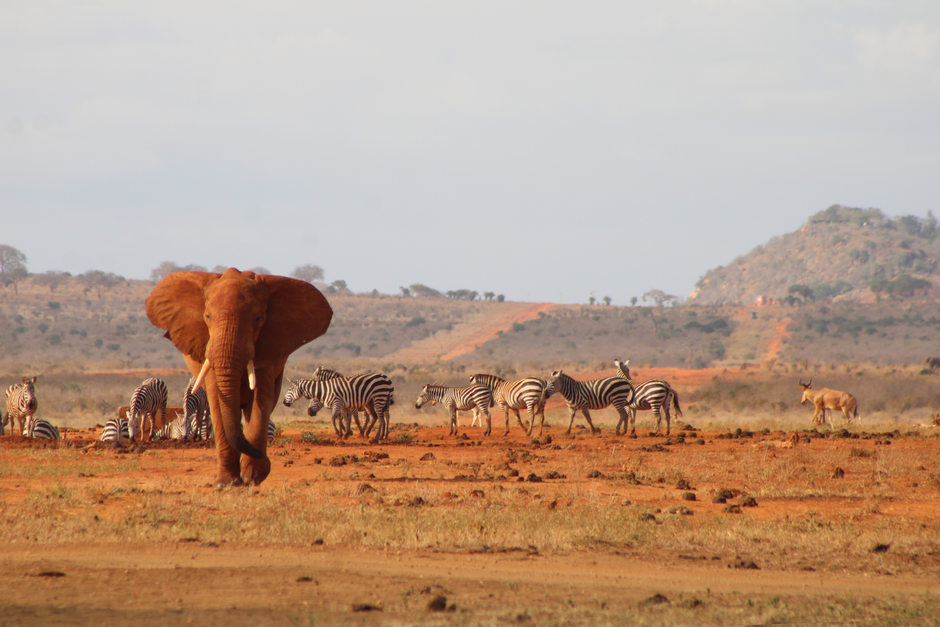
Tsavo East National Park is Kenya’s largest national park, a vast semi-arid wilderness of red earth, thorn bush, doum palms and baobabs between Nairobi and the coast. Kenya Wildlife Service (KWS), which manages it, gives its area as about 13,747 km² (5,308 square miles), larger than the state of Connecticut, and together with neighboring Tsavo West it forms the Tsavo Conservation Area of around 22,000 km². Tsavo is famous for its “red elephants”, which dust themselves with the iron-rich soil, for the maneless lions of Tsavo, and for wide horizons where you can drive for an hour without seeing another vehicle. The Galana River, formed where the Tsavo and Athi rivers meet, cuts through the park past Lugard’s Falls and Crocodile Point, and the Yatta Plateau, which KWS describes as the world’s longest lava flow, runs along its western edge. Only the southern part of the park, below the Galana, is regularly visited, with lodges near the Voi Gate, the Aruba Dam and the river. Tsavo East is the easiest big park to reach from the Kenyan coast and from the Madaraka Express train, which stops at Voi, so it’s perfect for a one- to three-night safari combined with a beach holiday in Mombasa, Diani or Malindi.
Right now in Tsavo East National Park (Tsavo East)
- Wed22–33°C71–91°F2 mm rain
- Thu22–33°C72–92°F3 mm rain
- Fri22–27°C72–80°F12 mm rain
- Sat 10 Oct Mazingira Day
Top tours in Tsavo East National Park
See all tours for Tsavo East National Park →
From local operators, with prices and reviews; you check availability and book on Viator, our partner. We may earn a commission at no extra cost to you. How we earn money
Tsavo East at a glance
- Best for: red elephants, lions, wide-open wilderness, the Galana River and a short safari from the coast.
- How long: 1–3 nights; a day trip is possible from the coast but long.
- Best time: June to October and January to February, when animals gather at water.
- Getting there: by road from Mombasa (Bachuma Gate, 110 km or 68 miles), Nairobi (Mtito Andei or Voi gates) or Malindi (Sala Gate); or by train to Voi or Miasenyi.
- Park fees: US$80 per non-resident adult per day, under KWS’s 2025 conservation fees.
- Good to know: it’s hot and dusty; bring water and a hat, and stay in the vehicle.
- Before you go: the eTA, money and general safety are in our Kenya travel guide.
Park fees, gates and rules
Tsavo East park fees
Tsavo East and Tsavo West are KWS wilderness parks. Under the KWS conservation fees for 2025, non-resident adults pay US$80 and children and students US$40 per day, valid for a single entry of up to 24 hours. KWS also sells a Tsavo East–Tsavo West–Amboseli package for US$215 for non-resident adults. Fees are paid online through KWSPay on Kenya’s eCitizen platform, by card or mobile money; your safari operator usually handles them. Vehicles pay a daily fee by seat count (KES 600 for fewer than 6 seats), and camping costs US$20 per adult at public campsites and US$35 at special campsites.
Gates
KWS lists these main road gates: Bachuma Gate, about 110 km (68 miles) from Mombasa; Voi Gate, about 156 km (97 miles) from Mombasa, near Voi town and the park headquarters; Manyani Gate, about 191 km (119 miles) from Mombasa, all on the Mombasa–Nairobi highway; Mtito Andei Gate, 233 km (145 miles) south of Nairobi; and Sala Gate in the east, reached from Malindi on the C103 road. Gates open at 6 a.m. and close at 6 p.m. unless you’re staying inside the park.
Park rules
Stay in your vehicle except at designated points, keep to the roads (off-road driving is prohibited), stay at least 20 m (65 ft) from animals, keep below 40 km/h (25 mph), don’t hoot or play loud music, never feed wildlife, and take all trash with you. Like all KWS parks, Tsavo East is a single-use-plastic-free zone.
Tsavo East’s areas and who each one suits
Voi and the southwest
The area around Voi Gate, the park headquarters and the Kanderi Swamp is the busiest part of the park, with lodges on rocky hills overlooking waterholes and the plains. It’s ideal for short visits and for travelers arriving by train at Voi.
Aruba Dam
About 30 km (19 miles) east of Voi Gate, Aruba Dam holds water through the dry season and attracts elephants, buffalo, zebras and predators; KWS lists it as a game viewing point.
The Galana River
The Galana River crosses the park from west to east, lined with doum palms. Along it you’ll find Lugard’s Falls, a series of rapids through water-sculpted rock, and Crocodile Point just downstream, where big crocodiles bask. Tented camps line the river.
Mudanda Rock and the Yatta Plateau
Mudanda Rock, a 1.6-km (1-mile) rock ridge near the Manyani Gate, acts as a water catchment; from its top, you can watch elephants drinking at the pool below. To the west, the long, flat-topped Yatta Plateau runs for about 290 km (180 miles) along the Athi River.
The north
North of the Galana, the park is remote and lightly visited, with few roads. The Ithumba area, in the far north, is reached by a long drive or by air.
Top things to see in Tsavo East
The red elephants
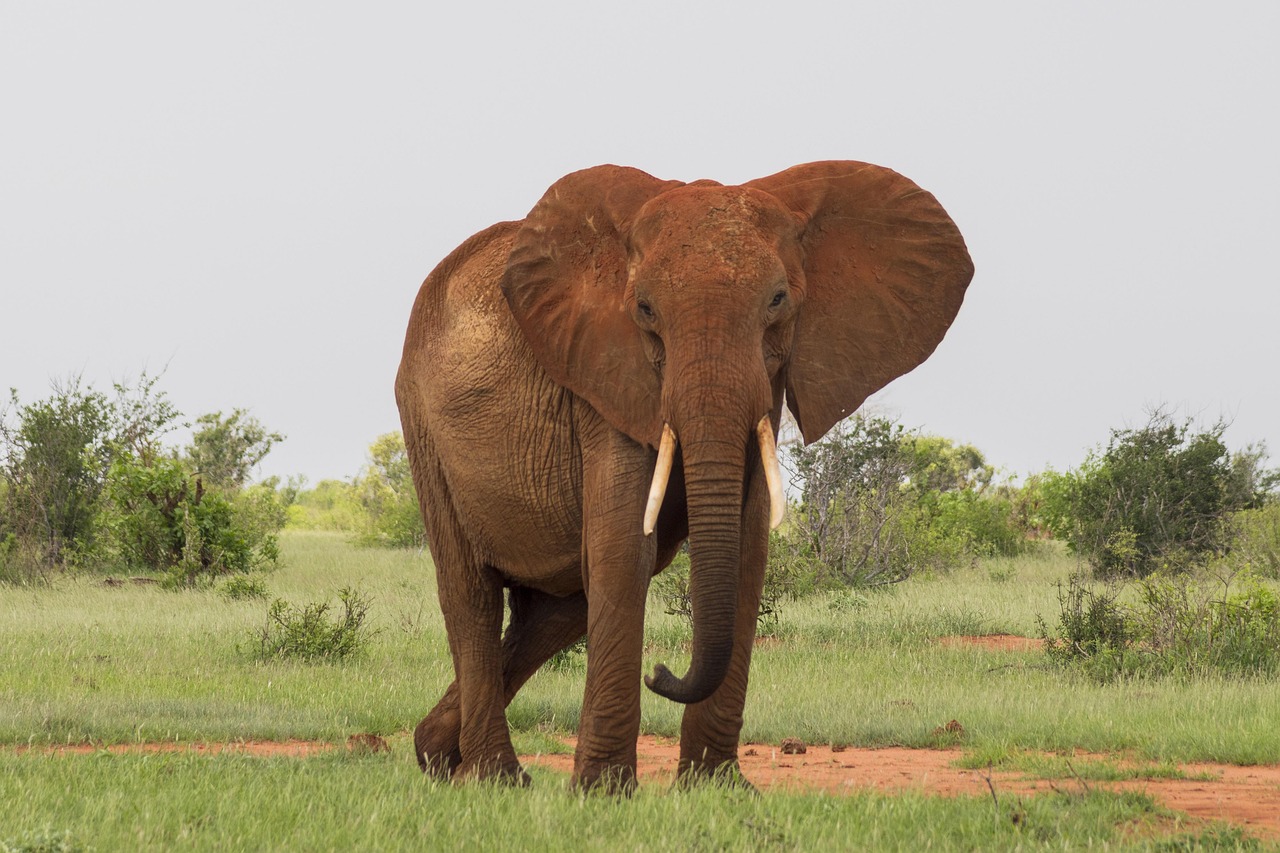
Tsavo’s elephants are often rust-red from dust bathing in the iron-rich soil, a striking sight against blue skies and green bush. Large herds come to Aruba Dam, Mudanda Rock and the river in the dry season, and KWS calls them one of the park’s signature attractions.
The lions of Tsavo
Tsavo’s lions, males of which often have little or no mane, are famous from the “man-eaters of Tsavo”, two lions that killed railway workers building the Uganda Railway across the Tsavo River in 1898. Today you’re most likely to see them resting near water or under shady trees.
Other wildlife
Buffalo, zebras, Maasai giraffes, lesser kudu, gerenuk, oryx, Grant’s gazelles, waterbucks, cheetahs, leopards and hyenas live here, and KWS notes the critically endangered hirola antelope. Hippos and crocodiles fill the Galana River, and KWS has recorded more than 500 bird species, including migratory birds from Europe and Asia from about October to April.
Lugard’s Falls
Named after Frederick Lugard, a British colonial administrator, the falls are more rapids than waterfall, but the swirling water and the eroded rock channels make a fine stop on a river drive. You can usually get out of the vehicle here at the designated area; stay away from the edge and the water.
Other things to do in Tsavo East
Walking safaris and night drives
KWS offers organized walking safaris in Tsavo East for groups of up to 10 people, at US$50 per non-resident per day plus park and security fees, and night game drives in selected parks at US$50 per person per trip. Some lodges and camps on the boundary arrange walks with armed rangers. See our hiking guide.
Elephant orphans returning to the wild
Many of the orphaned elephants raised at the Sheldrick Wildlife Trust nursery in Nairobi are moved to reintegration units in Tsavo, including at Voi and Ithumba, where they gradually rejoin wild herds over several years. Visits to the Ithumba unit are possible for those staying at the trust’s own lodge there, booked in advance through the trust; at Voi, you may see young orphans out with their keepers.
Driving yourself
Tsavo East is one of the easier Kenyan parks to self-drive, with signed main tracks in the south and long sight lines. You’ll need a high-clearance vehicle (a 4×4 after rain), a full tank, spare tire, offline maps and plenty of water, and you must leave the park or reach your lodge by 6 p.m. A guide from your lodge will still find far more animals.
Stargazing
KWS promotes Tsavo East’s minimal light pollution for astro-tourism; the night sky away from the lodges is spectacular.
Food and drink
Meals are included at nearly all lodges and camps, often served on terraces overlooking a waterhole. Expect buffets or set menus with Kenyan dishes such as nyama choma, pilau, sukuma wiki, chapati and ugali, plus international food, Kenyan tea and coffee, and sundowners. There are few shops inside the park, so carry water and snacks on drives.
Day trips and nearby
Tsavo West National Park
Across the highway, Tsavo West is hillier and greener, with Mzima Springs, the Shetani lava flow and the Ngulia rhino sanctuary; the non-resident adult fee is also US$80 (KWS, 2025).
Taita Hills and Lumo
West of Voi, the Taita Hills have cloud forest with rare birds, and private sanctuaries at Taita and Lumo offer game drives and lodges.
The coast
Tsavo East is 2–3 hours by road from Mombasa and combines easily with the beaches. See our Mombasa, Diani Beach and Malindi guides.
Amboseli
West of Tsavo West, Amboseli has elephants beneath Kilimanjaro. See our Amboseli National Park guide.
Nearby destinations
- Malindi157 km
- Kilimanjaro National Park159 km
- Amboseli National Park170 km
- Mombasa173 km
- Diani Beach193 km
- Arusha241 km
- Nairobi273 km
Getting there and getting around
By train
KWS lists the Madaraka Express (standard gauge railway) as a way to reach the park: get off at Voi from Nairobi, or at Voi or Miasenyi from Mombasa, and have your lodge or operator meet you. According to Kenya Railways, the 8 a.m. Inter-County train from Nairobi reaches Voi at about noon, and the one from Mombasa at about 9:50 a.m.; the 3 p.m. express trains also stop at Voi. One-way economy fares to Voi are KES 1,050 from Nairobi and KES 440 from Mombasa, with first class at KES 3,200 and KES 1,320.
By road
From Mombasa, the Bachuma Gate is about 110 km (68 miles) and the Voi Gate about 156 km (97 miles) up the busy Mombasa–Nairobi highway, about 2–3 hours. From Nairobi, the Mtito Andei Gate is 233 km (145 miles) south, about 4–5 hours. From Malindi, KWS directs visitors along the C103 road to the Sala Gate. Most visitors come with a tour operator; the highway carries heavy trucks, so avoid driving at night.
By air
According to KWS, the main airstrips are at Voi and Ithumba, with others at Aruba, Satao, Sala and Lugard’s Falls; charter flights serve them from the coast and Nairobi.
Getting around
You explore the park on game drives with a guide, usually in a pop-top minivan or 4×4. Distances are long, so take a full day with a picnic to reach the Galana River.
When to go and how long to stay
Tsavo East is hot and dry for most of the year, with highs of about 28–33 °C (82–91 °F) and warm nights. The dry seasons, from June to October and in January and February, are best for game viewing, as animals concentrate around the remaining water. The short rains fall in November and December and the long rains from about March to May, though rainfall here is low; the bush turns green, roads can become muddy, and animals disperse. The table uses Kenya Meteorological Department (KMD) climate averages for Voi, beside the park’s main gate, as published by the World Meteorological Organization (WMO): average daily highs and lows, total rainfall and days with at least 1 mm of rain.
| Month | Average high / low | Rain (days with 1 mm or more) | What to expect |
|---|---|---|---|
| January | 32 °C (89 °F) / 20 °C (68 °F) | 34 mm (1.3 in), 5 days | Hot and fairly dry; good game viewing |
| February | 33 °C (91 °F) / 20 °C (68 °F) | 29 mm (1.1 in), 3 days | Hot and dry; animals at waterholes |
| March | 33 °C (92 °F) / 21 °C (69 °F) | 79 mm (3.1 in), 8 days | Hottest month; rains may start |
| April | 32 °C (89 °F) / 20 °C (69 °F) | 100 mm (3.9 in), 7 days | Short spell of long rains; green |
| May | 30 °C (86 °F) / 20 °C (68 °F) | 30 mm (1.2 in), 5 days | Rain easing; very quiet |
| June | 29 °C (84 °F) / 18 °C (65 °F) | 6 mm (0.2 in), 2 days | Dry season begins; cooler |
| July | 28 °C (83 °F) / 18 °C (64 °F) | 3 mm (0.1 in), 1 day | Coolest month; dry and dusty |
| August | 28 °C (82 °F) / 17 °C (63 °F) | 8 mm (0.3 in), 2 days | Dry; elephants gather at water |
| September | 29 °C (85 °F) / 18 °C (64 °F) | 15 mm (0.6 in), 3 days | Dry and warming; excellent |
| October | 31 °C (88 °F) / 19 °C (66 °F) | 26 mm (1.0 in), 4 days | Hot and dry; busy with coast visitors |
| November | 31 °C (89 °F) / 20 °C (68 °F) | 106 mm (4.2 in), 10 days | Short rains; lush and quieter |
| December | 31 °C (87 °F) / 20 °C (69 °F) | 119 mm (4.7 in), 8 days | Rainy at times; busy at holidays |
How long to stay: 1, 2 and 3 nights
- 1 night: arrive at midday, drive in the afternoon, and do a dawn drive before leaving.
- 2 nights: add a full day to Aruba Dam, the Galana River and Lugard’s Falls.
- 3 nights: combine with Tsavo West or the Taita Hills.
Where to stay in Tsavo East
KWS lists the Ndololo public campsite, several special campsites and privately owned lodges and camps, including Voi Safari Lodge, Ashnil Aruba Lodge, Satao Camp and Galdessa, plus others near the boundary. Choose a lodge near Voi for short stays, a camp near Aruba or Satao for waterhole viewing, or a riverside camp on the Galana for a wilder experience. Budget hotels are found in Voi town.
Typical costs
Prices are approximate, for October 2026, converted at about KES 129.8 to the US dollar (Central Bank of Kenya). Park and train fares are official rates.
| Item | Typical cost |
|---|---|
| Tsavo East park fee, non-resident adult, per day | US$80 (about KES 10,380) |
| Child or student, per day | US$40 (about KES 5,190) |
| Tsavo East–Tsavo West–Amboseli package, non-resident adult | US$215 (about KES 27,900) |
| Madaraka Express Mombasa–Voi, economy / first class | KES 440 / 1,320 (about US$3.4 / 10) |
| Madaraka Express Nairobi–Voi, economy / first class | KES 1,050 / 3,200 (about US$8 / 25) |
| 2-day safari from Mombasa or Diani, per person | about US$300–600 |
| Mid-range lodge, per person per night, full board | about US$150–300 |
Safety in Tsavo East
Wildlife: stay in your vehicle except at designated points such as Lugard’s Falls and Mudanda Rock, keep a respectful distance from elephants and buffalo, and never approach the river banks, where crocodiles lie hidden. Lodges are unfenced; use an escort at night. Heat: temperatures often exceed 30 °C (86 °F), so drink plenty of water, wear a hat and use high-factor sunscreen. Malaria occurs in all parts of Kenya below 2,500 m (8,200 ft), including the game parks; ask a travel-health professional about antimalarials, and use repellent. The US CDC recommends yellow fever vaccination for Taita-Taveta County, where the park lies, unlike most of the coast. Roads: the Mombasa–Nairobi highway is busy with trucks; travel in daylight with an experienced driver. Buy safaris only from established operators. In an emergency, call 999 or 112.
Practical tips for Tsavo East
- Start early: the first and last hours of daylight are best for animals and cooler for you.
- Use the train: the Madaraka Express to Voi is cheap and avoids the highway.
- Combine parks: the KWS package covers Tsavo East, Tsavo West and Amboseli.
- Carry water: distances are long and facilities few.
- Pay online: KWS fees are paid through KWSPay on Kenya’s eCitizen platform, by card or mobile money.
What to pack for Tsavo East
Lightweight, neutral-colored clothes, a wide-brimmed hat, sunglasses, a buff or scarf for dust, high-factor sunscreen, insect repellent, binoculars, a camera with a zoom lens, a refillable water bottle, a light fleece for early mornings in June to August, and a power adapter for Kenya’s 240 V type G sockets. See our hiking shoes and travel adapters guides.
Tsavo East National Park travel FAQ
How much is the Tsavo East park fee?
US$80 per non-resident adult and US$40 per child or student, per day, under KWS’s 2025 conservation fees.
How do I get from Mombasa to Tsavo East?
By road to the Bachuma Gate (about 110 km, or 68 miles) or the Voi Gate (about 156 km, or 97 miles) in 2–3 hours, or by Madaraka Express to Voi or Miasenyi.
Can I take the train to Tsavo East?
Yes. The Madaraka Express stops at Voi, near the main gate; economy tickets cost KES 1,050 from Nairobi and KES 440 from Mombasa, according to Kenya Railways.
Why are Tsavo’s elephants red?
They cover themselves in the park’s red, iron-rich dust to protect their skin from sun and insects.
Is Tsavo East better than Tsavo West?
They’re different: Tsavo East is flatter and more open, good for big herds; Tsavo West is hillier and greener, with Mzima Springs. Many visitors see both.
Can I do a day trip to Tsavo East from Mombasa?
Yes, but it means about 5–6 hours on the road; one night in the park is much better.
What is the best time to visit Tsavo East?
June to October and January to February, when it’s dry and animals gather at waterholes.
Are there lions in Tsavo East?
Yes. Tsavo’s lions, many with little mane, are seen regularly, though less often than in the Maasai Mara.
How big is Tsavo East?
About 13,747 km² (5,308 square miles), Kenya’s largest national park, according to KWS.
Is there malaria in Tsavo East?
Yes, as in all Kenyan parks below 2,500 m. Ask about antimalarials and protect yourself from mosquito bites.
Plan your trip
Partner links: TravelerCenter may earn a commission if you book, at no extra cost to you.
🇹🇿 Useful Swahili phrases for Tsavo East National Park
All 38 Swahili phrases: restaurant, hotel, emergencies, romance (printable) →
Sources · last reviewed 5 October 2026
Researched and last reviewed on 5 October 2026. Park size, establishment, county, rivers, the Yatta Plateau, attractions, birds, hirola, gates and distances, airstrips, SGR access, gate hours, rules, plastic-free rules, accommodation, fees, packages, camping, walking safari and night drive fees: Kenya Wildlife Service and its 2025 conservation fees; Madaraka Express times and fares: Kenya Railways; malaria and yellow fever: the US CDC; emergency numbers: the UK government’s factual safety pages, used for practical facts only; climate averages: the Kenya Meteorological Department via the World Meteorological Organization (Voi station); the exchange rate: the Central Bank of Kenya. The man-eaters story, Lugard’s Falls naming, Mudanda Rock length, Yatta Plateau length, Aruba Dam distance, journey times and typical prices are general references or estimates, flagged for checking. Fees and rules change, so check with KWS or your operator before you go. For the eTA, money and general safety, see our Kenya travel guide.
Data: Weather: MET Norway (CC BY 4.0) · Rates: ECB · Holidays: Nager.Date · Costs: World Bank ICP and price levels · Wikidata (CC0)