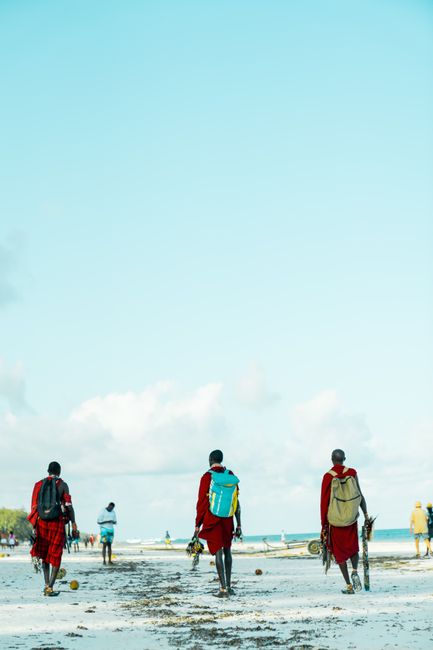
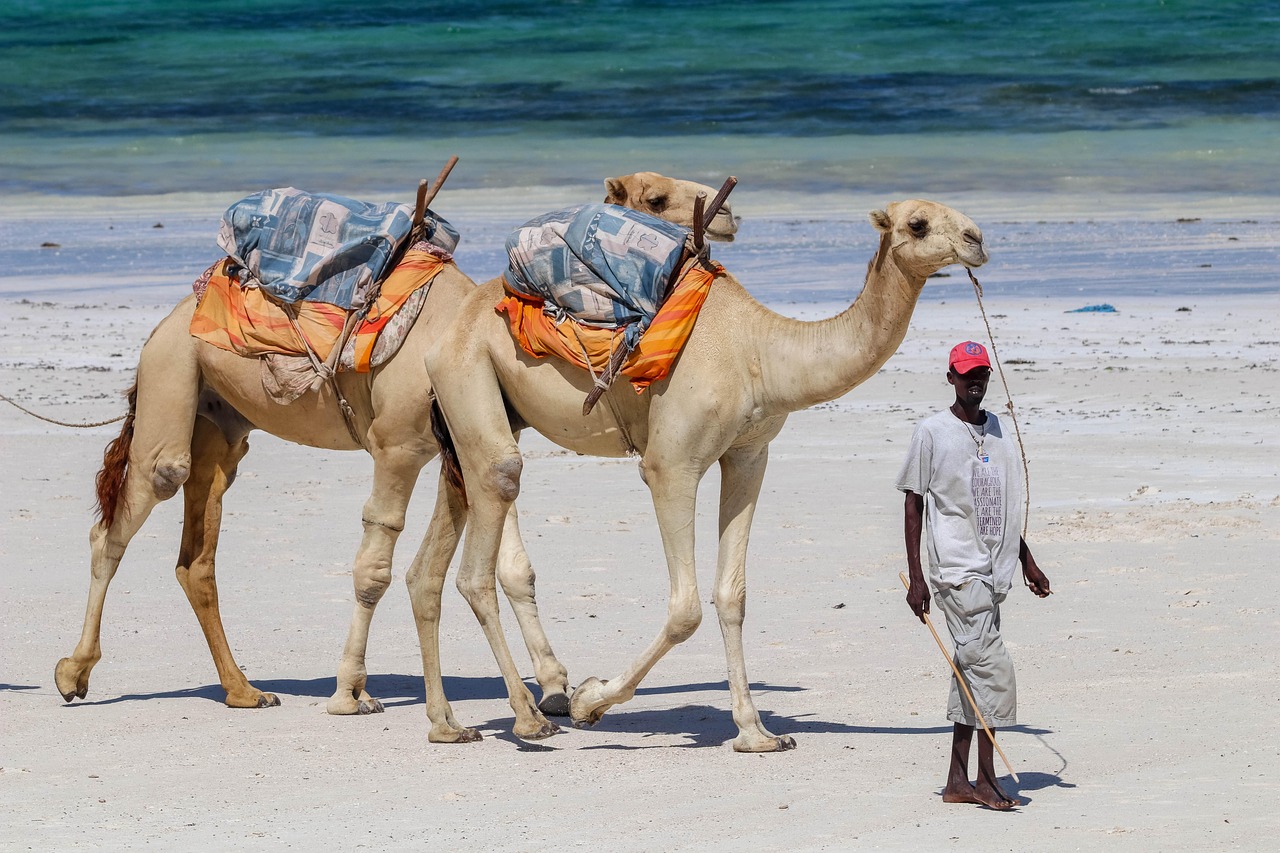
Diani Beach, on Kenya’s south coast about 35 km (22 miles) south of Mombasa in Kwale County, is the country’s favorite beach resort: a long, straight sweep of powder-white sand lined with palms and baobabs, protected by a coral reef that keeps the turquoise lagoon calm at low tide. Behind the beach, a single road runs past hotels, villas, beach bars, restaurants, dive centers and kitesurf schools, while troops of black-and-white Angolan colobus and cheeky monkeys swing through the coastal forest overhead. Diani is a place for slow days: swimming and snorkeling in the lagoon, kitesurfing when the trade winds blow, dhow trips to the coral islands of Kisite-Mpunguti Marine National Park to look for dolphins, and seafood dinners on the sand. It also combines easily with a safari: a light aircraft flies from the local airstrip at Ukunda to the Maasai Mara or Nairobi, and Tsavo East and the Shimba Hills are within reach by road. The beach is busiest over Christmas, New Year and European summer holidays, and quietest in the long rains of April to June, when some smaller hotels close. Diani is relaxed and family-friendly, with everything from simple guesthouses to luxury villas and all-inclusive resorts.
Right now in Diani Beach (Diani)
- Wed 23–30°C 73–85°F 2 mm Partly cloudy
- Thu 23–31°C 73–88°F 4 mm Partly cloudy
- Fri 24–28°C 75–82°F 39 mm Heavy rain
- Sat 10 Oct Mazingira Day
Weather: MET Norway (CC BY 4.0) · Sea temperature: NOAA CoastWatch · Holidays: Nager.Date
Top tours in Diani Beach
See all tours for Diani Beach →
From local operators, with prices and reviews; you check availability and book on Viator, our partner. We may earn a commission at no extra cost to you. How we earn money
Diani Beach at a glance
- Best for: white-sand beaches, snorkeling, kitesurfing, diving, dhow trips, primates and a beach stay after safari.
- How long: 4–7 nights; longer if you’re kitesurfing or diving.
- Best time: December to March and July to October; April to June is rainy.
- Getting there: fly to Ukunda airstrip, or take the Madaraka Express or a flight to Mombasa and drive about an hour south.
- Getting around: tuk-tuks, boda-bodas, taxis and bicycles along Diani Beach Road.
- Good to know: tides shape the day; snorkel at low tide and swim at high tide, and use water shoes on the reef.
- Before you go: the eTA, money and general safety are in our Kenya travel guide.
Diani’s areas and who each one suits
The resort stretches along Diani Beach Road for about 15 km (9 miles), from Tiwi in the north to Galu and Kinondo in the south, parallel to the main Mombasa–Lunga Lunga highway. The town of Ukunda, with banks, supermarkets, the matatu stage and the airstrip, is at the junction with the highway.
Tiwi
North of Diani, across the Kongo River, Tiwi Beach is quieter, with cottages and rock pools at low tide; it’s reached by a rough side road.
North Diani
The northern end, near the Kongo Mosque and the river mouth, has some of the oldest hotels, quiet stretches of sand and good kitesurfing.
Central Diani
The central section, near the main junction from Ukunda, has the most restaurants, beach bars, shopping centers and nightlife, along with dive and kite centers. It’s the most convenient area for first-timers.
Galu and Kinondo
At the southern end, Galu and Kinondo are peaceful, with boutique hotels, private villas and wide beaches near the Kaya Kinondo sacred forest and Chale Island.
Where to stay in Diani
- Central Diani: for walking to restaurants and beach bars.
- North Diani and Tiwi: for space, cottages and kitesurfing.
- Galu and Kinondo: for quiet boutique stays and villas.
- All-inclusive resorts: along the whole beach, good for families.
Top things to see in Diani
The beach and the lagoon
Diani’s beach is the main attraction: soft, white coral sand, warm water and a fringing reef a few hundred meters offshore. The tides are big, so at low tide you can walk out across seagrass and rock pools to look for starfish and sea cucumbers, while at high tide the lagoon is ideal for swimming. Beach walks at sunrise, when fishermen bring in their catch, are a highlight. See our beaches guide.
Kisite-Mpunguti Marine National Park and Wasini
The full-day trip to Kisite-Mpunguti, about 90 minutes south near the Tanzanian border, is Diani’s classic excursion. According to Kenya Wildlife Service (KWS), the protected area was established in 1973 and gazetted in 1978, with the fully protected Kisite Marine National Park (28 km², or 11 square miles) and the Mpunguti Marine National Reserve (11 km², or 4 square miles), where low-impact fishing and tourism are allowed. Dhows leave from Shimoni and sail past Wasini Island to the coral islands, where you snorkel over reefs with turtles and reef fish, often with dolphins nearby, before a seafood lunch on Wasini. The KWS 2025 fee for marine protected areas is US$25 for non-resident adults and US$15 for children, usually included in the trip price. See our snorkeling and boat trips guides.
Diani-Chale Marine National Reserve
The reef right off Diani and the waters around Chale Island are protected by the Diani-Chale Marine National Reserve, gazetted in 1995, according to KWS. It has coral gardens, seagrass beds, mangroves and nesting beaches for endangered sea turtles, and the same US$25 fee applies to excursions within the reserve.
Colobus monkeys
Diani’s coastal forest is home to the rare Angolan colobus, along with Sykes’ monkeys, vervets and baboons. A local conservation group runs guided forest walks and has built rope “colobridges” across the busy beach road to stop monkeys being hit by cars. Don’t feed the monkeys, and keep food and windows closed in your room.
Kaya Kinondo
The Kaya Kinondo sacred forest, near Galu, is one of the Mijikenda people’s sacred forests, the Kayas, which are listed together as a UNESCO World Heritage Site. Local guides lead walks, explaining the rules and plants; you’ll wrap a kanga cloth around your waist before entering.
The Kongo Mosque
At the northern end of the beach, where the Kongo River meets the sea, the small coral-stone Kongo Mosque, also called the Diani Persian Mosque, is believed to date from the 15th century and is still in use, shaded by huge baobab trees. Visitors can look from outside; dress modestly and avoid prayer times.
Turtles and the reef
Green and hawksbill turtles nest on Diani’s quieter beaches and feed in the lagoon, and local conservation groups monitor nests and rescue turtles caught in nets. If you see a nesting turtle or hatchlings, keep your distance, don’t use flashlights, and let them reach the sea on their own. On the reef, don’t stand on or touch coral, don’t buy shells or coral souvenirs, and use reef-safe sunscreen.
Shimba Hills National Reserve
Inland from Diani, the forested Shimba Hills have the only population of sable antelope in Kenya, plus elephants, buffalo, viewpoints over the coast and the Sheldrick Falls walk. KWS lists the 2025 fee at US$50 for non-resident adults. It’s an easy half- or full-day trip.
Other things to do in Diani
Kitesurfing and water sports
Diani is one of East Africa’s best kitesurfing spots. The northeast kaskazi winds blow from about December to March, and the stronger southeast kusi from about June to September, with flat water in the lagoon at low tide. Schools rent gear and run courses for beginners. Stand-up paddleboarding, kayaking and glass-bottom boats are available too. See our surfing guide.
Diving
Dive centers visit reefs, drop-offs and wrecks off Diani and around Kisite. From about July to October, humpback whales pass along the coast, and whale sharks are sometimes seen in the warmer months. The best visibility is usually from October to March. See our diving guide.
Skydiving and other adventures
Tandem skydives over the beach take off from Ukunda airstrip, weather permitting, and quad-bike and horse-riding trips explore the villages and bush inland.
Food and drink
Diani’s restaurants range from beach shacks to fine dining. Try fresh grilled fish, prawns and lobster, Swahili coconut curries, pilau and biryani, chapatis and samosas, tropical fruits such as mango and passion fruit, and madafu (fresh coconut water). Beach bars serve cocktails and Kenyan Tusker beer at sunset. Many villas can arrange a cook to prepare local dishes.
Day trips from Diani
- Wasini and Kisite: the full-day dhow trip for snorkeling, dolphins and a seafood lunch.
- Shimba Hills: sable antelope, elephants and forest walks, about 45 minutes by road.
- Mombasa: Fort Jesus, the Old Town and Swahili food, about an hour by road and the Likoni ferry. See our Mombasa guide.
- Tsavo East: an early start for a one- or two-night safari; Voi Gate is about 3–4 hours by road. See our Tsavo East National Park guide.
- Maasai Mara: light aircraft fly from Ukunda to the Mara for a short safari. See our Maasai Mara guide.
Nearby destinations
- Mombasa32 km
- Malindi137 km
- Tsavo East National Park193 km
- zanzibar209 km
- Dar es Salaam279 km
- Kilimanjaro National Park282 km
Getting there and getting around
By air
Ukunda Airstrip (UKA), right behind the beach, has daily flights from Nairobi (both Wilson Airport and Jomo Kenyatta International) and seasonal connections to the Maasai Mara and other parks. Kenya Wildlife Service puts the flight from Nairobi at about 1 hour 10 minutes. Alternatively, fly into Moi International Airport in Mombasa, about 1½–2 hours away by road.
By train and road
Take the Madaraka Express from Nairobi to Mombasa Terminus (KES 1,500 in economy and KES 4,500 in first class one way, according to Kenya Railways), then a taxi or transfer south. The fastest route crosses the harbor on the Likoni ferry, which can mean long queues at rush hour; a longer road via the Dongo Kundu bypass avoids the ferry. Allow 1–2 hours from the terminus to Diani.
Getting around
Diani Beach Road is long, so most people use tuk-tuks (agree the fare first), boda-bodas or taxis; ride-hailing apps operate here too. Cycling is pleasant early in the morning. At night, take a tuk-tuk or taxi rather than walking along the road or beach.
When to go and how long to stay
Diani is warm all year, with highs of about 28–33 °C (82–91 °F). December to March is hot, dry and sunny, with calm seas and the kaskazi winds, and is peak season. The long rains from April to June bring heavy showers, humidity and quieter, cheaper hotels. From July to October, it’s a little cooler and breezier with the kusi winds and some seaweed on the beach, a good time to combine with a safari. Short rains fall in November. The table uses Kenya Meteorological Department (KMD) climate averages for the Mombasa station, about 35 km (22 miles) north, as published by the World Meteorological Organization (WMO): average daily highs and lows, total rainfall and days with at least 1 mm of rain.
| Month | Average high / low | Rain (days with 1 mm or more) | What to expect |
|---|---|---|---|
| January | 32 °C (90 °F) / 23 °C (74 °F) | 33 mm (1.3 in), 4 days | Hot and sunny; calm seas; kaskazi winds |
| February | 32 °C (90 °F) / 24 °C (74 °F) | 15 mm (0.6 in), 2 days | Hottest month; great for the beach |
| March | 33 °C (91 °F) / 24 °C (76 °F) | 56 mm (2.2 in), 5 days | Very hot and humid; last of the dry season |
| April | 31 °C (88 °F) / 24 °C (75 °F) | 163 mm (6.4 in), 10 days | Long rains begin; quieter and cheaper |
| May | 29 °C (85 °F) / 23 °C (73 °F) | 240 mm (9.4 in), 14 days | Wettest month; some places close |
| June | 28 °C (83 °F) / 21 °C (70 °F) | 80 mm (3.1 in), 10 days | Showers easing; kusi winds pick up |
| July | 28 °C (82 °F) / 20 °C (69 °F) | 70 mm (2.8 in), 11 days | Cooler and breezy; whales offshore |
| August | 28 °C (82 °F) / 20 °C (69 °F) | 66 mm (2.6 in), 9 days | Breezy, mostly dry; kitesurfing season |
| September | 29 °C (84 °F) / 21 °C (69 °F) | 72 mm (2.8 in), 9 days | Pleasant; good for safari combinations |
| October | 30 °C (85 °F) / 22 °C (72 °F) | 97 mm (3.8 in), 10 days | Warm and calm; diving visibility improves |
| November | 31 °C (87 °F) / 23 °C (74 °F) | 92 mm (3.6 in), 9 days | Short rains; brief showers |
| December | 32 °C (89 °F) / 23 °C (74 °F) | 75 mm (3.0 in), 7 days | Hot and sunny; very busy at holidays |
How long to stay: 4 and 7 nights
- 4 nights: a day on the Kisite dhow trip, a forest walk with the colobus, and plenty of beach time.
- 7 nights: add the Shimba Hills, a dive or kite course, a day in Mombasa and a lazy day or two.
Typical costs in Diani
Prices are approximate, for October 2026, converted at about KES 129.8 to the US dollar (Central Bank of Kenya). Park fees are KWS’s non-resident rates.
| Item | Typical cost |
|---|---|
| Kisite-Mpunguti or Diani-Chale marine park fee, non-resident adult | US$25 (about KES 3,240) |
| Shimba Hills National Reserve, non-resident adult | US$50 (about KES 6,490) |
| Kisite dhow trip with lunch, park fee included | about US$80–130 |
| Kitesurfing beginner course (about 9–10 hours) | about US$400–600 |
| Tuk-tuk along Diani Beach Road | KES 200–500 (about US$1.5–3.9) |
| Seafood dinner in a mid-range restaurant | KES 2,000–5,000 (about US$15–39) |
| Mid-range beach hotel double, per night | about US$90–220 |
Safety in Diani
Diani is a relaxed resort, but take sensible precautions. At sea, swim inside the reef and near other swimmers; currents can be strong around reef channels, especially on an outgoing tide, and there are few lifeguards. Wear water shoes at low tide for sea urchins, coral and stonefish, and don’t touch or stand on coral. During the kusi season, from about June to September, the sea can be choppy and seaweed piles up on some beaches. Check that boat operators carry life jackets. On land, don’t walk along the beach or road after dark; take a tuk-tuk or taxi. Keep valuables in the hotel safe, as petty theft from rooms and beaches happens. Beach boys selling trips and souvenirs can be persistent; a polite “no, thank you” usually works, and it’s best to book excursions through your hotel or established operators. Don’t feed monkeys, which can bite. Malaria and dengue are present on the coast, so ask a travel-health professional about antimalarials and use repellent day and night. The sun is intense; use high-factor sunscreen and drink plenty of water. In an emergency, call 999 or 112.
Practical tips for Diani
- Check the tide tables: snorkel and walk the reef at low tide; swim at high tide.
- Book Kisite early in peak season: the best dhow trips fill up.
- Respect the coast’s culture: cover up away from the beach, especially in Ukunda.
- Bring cash and M-Pesa: small restaurants and tuk-tuks often prefer cash or mobile money.
- Leave plastic at home: plastic carrier bags are banned in Kenya, and marine parks are single-use-plastic-free.
What to pack for Diani
Swimwear and cover-ups, light cotton clothes, a sun hat, sunglasses, reef-safe high-factor sunscreen, insect repellent, a rash vest for snorkeling, water shoes for the reef, sandals, a light rain jacket for April to June, a dry bag for boat trips and a power adapter for Kenya’s 240 V type G sockets. See our wetsuits, water shoes and travel adapters guides.
Diani Beach travel FAQ
How do I get from Mombasa to Diani Beach?
By road, crossing the Likoni ferry or taking the longer bypass, in about 1–2 hours from the airport or the train terminus.
Can I fly directly to Diani?
Yes. Ukunda Airstrip, behind the beach, has flights from Nairobi in about 1 hour 10 minutes and seasonal connections to the safari parks.
What is the best time to visit Diani Beach?
December to March for hot, sunny weather and calm seas, and July to October for a safari combination; April to June is the rainy season.
How much is the Kisite marine park fee?
US$25 for non-resident adults and US$15 for children, under Kenya Wildlife Service’s 2025 fees; it’s usually included in dhow trip prices.
Is Diani good for kitesurfing?
Yes. The kaskazi blows from about December to March and the stronger kusi from about June to September, and schools offer courses for beginners.
Can you see dolphins at Diani?
Dolphins are often seen around Kisite-Mpunguti on the Wasini dhow trip, and humpback whales pass offshore from about July to October.
Is it safe to swim at Diani Beach?
Generally yes, inside the reef and at high tide; watch for currents near reef channels, wear water shoes on coral, and follow local guidance.
Is there malaria in Diani?
Yes, malaria is present on the Kenyan coast. Ask about antimalarials before you go and protect yourself from mosquito bites.
Can I combine Diani with a safari?
Easily. Fly from Ukunda to the Maasai Mara, or drive to Tsavo East or the Shimba Hills.
How many days should I spend in Diani?
Four nights for the highlights, or a week to slow down and add diving, kitesurfing or the Shimba Hills.
Sources and last review
Researched and last reviewed on 5 October 2026. Kisite-Mpunguti history, size and fees, Diani-Chale gazettement, habitats and fees, Shimba Hills fee, the Nairobi flight time and SGR access: Kenya Wildlife Service; Madaraka Express fares: Kenya Railways; the plastic bag ban: Kenya’s National Environment Management Authority; malaria and dengue: the US CDC; emergency numbers: the UK government’s factual safety pages, used for practical facts only; climate averages: the Kenya Meteorological Department via the World Meteorological Organization (Mombasa station); the exchange rate: the Central Bank of Kenya. Beach length, wind and whale seasons, colobus conservation, Kaya Kinondo, skydiving, transfer times and typical prices are general references or estimates, flagged for checking. Prices and rules change, so check locally before you go. For the eTA, money and general safety, see our Kenya travel guide.
Plan your trip
Partner links: TravelerCenter may earn a commission if you book, at no extra cost to you.
🇹🇿 Useful Swahili phrases for Diani Beach
All 38 Swahili phrases: restaurant, hotel, emergencies, romance (printable) →