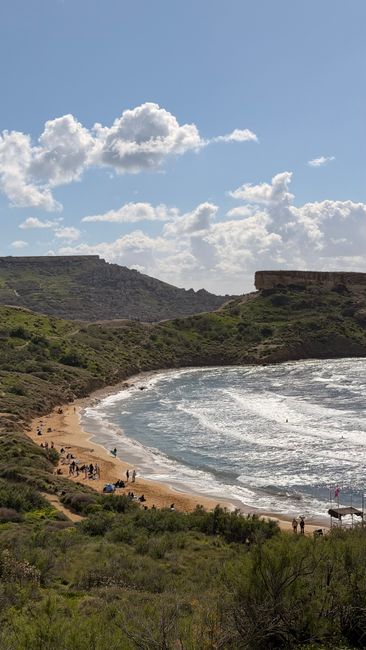
Gozo is Malta’s second island, a short ferry ride from the north-west tip of Malta and a world away in pace: green, terraced hills topped by village churches, cliffs dropping into deep blue water, red-sand Ramla Bay and some of the best diving in the Mediterranean. Its capital, Victoria (also called Rabat), sits below the Ċittadella, a fortified hilltop citadel, and near Xagħra stand the Ġgantija temples, among the oldest free-standing buildings on Earth. Gozo is where the Maltese go to relax: stay in a farmhouse with a pool, eat fresh ġbejniet cheese and Gozitan ftira, walk the cliffs at Dwejra and Ta’ Ċenċ, and take a morning boat to Comino’s Blue Lagoon. A day trip is possible from Valletta, but Gozo really rewards two or three nights. Late spring and early autumn are best.
Right now in Gozo (Victoria)
- Wed 25–26°C 77–78°F Mostly clear
- Thu 25–26°C 77–79°F Partly cloudy
- Fri 25–26°C 77–78°F Mostly clear
Weather: MET Norway (CC BY 4.0) · Sea temperature: NOAA CoastWatch · Air quality: OpenAQ
Top tours in Gozo
See all tours for Gozo →
From local operators, with prices and reviews; you check availability and book on Viator, our partner. We may earn a commission at no extra cost to you. How we earn money
Gozo at a glance
- Best months: April–June and September–October. Mean temperatures run from about 20 °C in May to 27–28 °C in August (1991–2020 averages for Malta’s main station at Luqa; Gozo is similar, slightly cooler at night). The sea is warmest from July to October.
- Days needed: 1 for a quick tour of the highlights; 2–3 to enjoy the beaches, walks and villages; 4–5 for a diving or walking holiday.
- Getting there: the Gozo Channel car ferry from Ċirkewwa to Mġarr takes about 25 minutes and runs around the clock; the Gozo Highspeed fast ferry from Valletta takes about 45 minutes.
- Getting around: buses from the hub in Victoria to every village; a hire car, a quad or an e-bike for the remote coves; hop-on hop-off tour buses in season.
- Budget level: usually cheaper and calmer than the main island; farmhouses with pools are good value for groups. See our Malta country guide for money, entry rules and costs.
Gozo’s towns and who each one suits
- Victoria (Rabat): the island’s small capital in the middle of Gozo, with the Ċittadella, shops, cafés on It-Tokk square and the bus hub. Practical for exploring by bus, but not by the sea.
- Marsalforn: the main resort on the north coast, with a small sandy beach, seafront restaurants, dive centres and the salt pans nearby. Good for first-timers and divers.
- Xlendi: a pretty, narrow bay on the south-west coast below high cliffs, with swimming from the rocks, sunset dinners and diving. Ideal for couples.
- Mġarr: the ferry harbour, with a marina, fish restaurants and the hilltop church of Our Lady of Lourdes above. Handy for the ferry and boats to Comino.
- Xagħra, Nadur, Għarb and the villages: hilltop villages of honey-coloured houses and big churches, where most farmhouse rentals are. Best for families and groups with a car.
Top things to see on Gozo
Victoria and the Ċittadella
The Ċittadella has crowned the hill above Victoria since the Bronze Age; the walls you see today were rebuilt by the Knights after an Ottoman raid in 1551 carried off almost the whole population of Gozo. Walk the ramparts for a view over the whole island, visit the Baroque cathedral, whose “dome” is a painted illusion on a flat ceiling, and explore the Old Prisons, with graffiti carved by prisoners over the centuries. Heritage Malta’s Ċittadella combo ticket (€5 for adults, valid 30 days) covers the Ċittadella sites. The Gozo Museum of Archaeology closed on 13 April 2026 to prepare a new Gozo Museum, but its shop stays open and still sells Hypogeum tickets. Below the walls, the old streets around It-Tokk square have a morning market and small cafés.
Ġgantija temples and Ta’ Kola Windmill
On the Xagħra plateau, the two temples of Ġgantija were built in the Late Neolithic, more than 5,000 years ago, from huge blocks of limestone, so big that Gozitans once believed giants had built them. They are part of the UNESCO-listed Megalithic Temples of Malta. Entry is through an interpretation centre displaying some of the finest Neolithic finds from Gozo. Adult tickets cost €10 (youths and seniors €8, children 6–11 €6), and a combined ticket includes Ta’ Kola Windmill, an 18th-century windmill with its miller’s house, in the village nearby. Go early or late on hot days: there is little shade among the stones.
Dwejra: the Inland Sea, the Blue Hole and Fungus Rock
Gozo’s wild west coast was home to the Azure Window, a famous natural arch that collapsed into the sea in a storm in March 2017. Dwejra is still spectacular: the Inland Sea is a lagoon linked to the open sea by a tunnel through the cliff, where fishermen take visitors out by boat when the sea is calm; the Blue Hole, a natural rock pool and chimney, is one of Malta’s most famous dive sites; and Fungus Rock, a nature reserve, stands just offshore. Wear sturdy shoes on the sharp rocks and keep away from the cliff edges. Swimming here is only for calm days and strong swimmers.
Churches, salt pans and the north coast
The Basilica of Ta’ Pinu, standing alone in the fields near Għarb, is Malta’s national shrine and a place of pilgrimage. The vast domed Rotunda of Xewkija is visible from much of the island. On the north coast, the salt pans between Marsalforn and Xwejni, cut into the rock and still worked in summer, make a striking chequerboard against the sea. Further west, Wied il-Għasri is a narrow gorge ending in a tiny inlet, good for snorkelling on calm days.
Comino and the Blue Lagoon from Gozo
Comino, the tiny island between Gozo and Malta, is a nature reserve with almost no residents and no cars. Its Blue Lagoon, a channel of shallow turquoise water over white sand, is Malta’s most famous swimming spot. Boats run from Mġarr in about 15–20 minutes, mostly from spring to autumn; many also circle Comino’s sea caves. Since May 2025, the Malta Tourism Authority has required a free online booking for one of three daily time slots (08:00–13:00, 13:30–17:30 and 18:00–22:00) if you go ashore at the lagoon, with a cap of 4,000 people at a time. Book at bluelagooncomino.mt and show the QR code on arrival. Come on the first boat of the morning, bring water and shade, and walk inland to Santa Marija Tower and the quieter bays once the lagoon fills up.
Beaches on Gozo
Gozo has a handful of sandy beaches and many rocky coves with crystal-clear water. Bring water shoes for the rocks and the urchins. See our beaches guide.
- Ramla Bay (Ir-Ramla l-Ħamra): Gozo’s biggest and best-known beach, a wide bay of reddish-golden sand in a green valley below Xagħra and Nadur. Snack bars and sunbeds in summer; a protected dune area behind. The Calypso Cave viewpoint above looks down on it.
- San Blas: a small, steep-sided cove of reddish sand near Nadur, reached by a very steep path. Quieter than Ramla.
- Hondoq ir-Rummien: a small beach with clear, shallow water near Qala, looking across to Comino. Busy on summer weekends with local families.
- Xlendi and Marsalforn: small town beaches with rock platforms and ladders, restaurants and dive centres.
- Mġarr ix-Xini: a narrow fjord-like inlet on the south coast, sheltered and great for snorkelling and kayaking.
Diving, walking and slow travel
Diving and snorkelling
Gozo is one of the Mediterranean’s top diving destinations, with visibility often above 30 metres, dramatic underwater cliffs, caves and arches, and sites suitable for beginners and technical divers alike. Highlights include the Blue Hole and the Inland Sea tunnel at Dwejra, the caves and tunnel at Xlendi, the walls of Ta’ Ċenċ, and wrecks scuttled as artificial reefs off Xatt l-Aħmar near Mġarr. Many dive centres in Marsalforn and Xlendi offer courses and shore diving with transport. See our diving guide and our snorkeling guide.
Walking and cycling
Gozo is excellent for walking from October to May, when the countryside is green and the air cool. Follow the cliff tops from Xlendi to Dwejra or along Ta’ Ċenċ; see Wied il-Mielaħ, a natural sea arch near Għarb that is still standing; walk from Ramla Bay to San Blas; or circle the island in sections on country lanes. Paths are often unmarked, rocky and unfenced near cliff edges, so bring good shoes and water, and avoid midday in summer. E-bikes help on the steep valleys. See our hiking guide.
Food and drink
Gozo is proud of its produce: small sheep’s-milk cheeses called ġbejniet, fresh, dried or peppered; Gozitan ftira, a pizza-like bread topped with potatoes, anchovies or cheese; honey, capers, sun-dried tomatoes and local wine. Fish restaurants line the harbours at Mġarr, Xlendi and Marsalforn. On summer evenings, village festas fill the squares with brass bands, food stalls and fireworks.
Nearby destinations
- St. Julian's25 km
- Valletta28 km
- Sicily174 km
- Catania178 km
- Taormina221 km
- Palermo244 km
- Aeolian Islands279 km
Getting there and getting around
The Gozo Channel ferry and the fast ferry
The Gozo Channel car ferry links Ċirkewwa, at the north-west tip of Malta, with Mġarr on Gozo in about 25 minutes, around the clock. You pay only when you leave Gozo: a return costs €4.65 for a foot passenger (€4.05 when leaving Mġarr after 20:00 from November to March), €1.15 for children aged 3–12 (bought at the Mġarr booths), and €15.70 for a car and driver, plus passengers. Tickets are scanned in Mġarr before the return trip. In summer and on public holidays, cars can queue for an hour or more at Ċirkewwa; foot passengers rarely wait long. From Valletta, the Airport and Sliema, buses run to Ċirkewwa.
The Gozo Highspeed fast ferry carries foot passengers from the Valletta waterfront to Mġarr in about 45 minutes, for about €7.50 one way for an adult; it is the easiest option from Valletta or Sliema, and the Airport Direct TD4 bus stops at its Valletta terminal. Malta Public Transport’s Explore Flex card can include a return trip. Rough seas, especially when the gregale blows in winter, occasionally cancel fast-ferry sailings; the car ferry keeps running in all but the worst weather.
On the island
Malta Public Transport’s buses meet the ferries at Mġarr and run to the bus hub in Victoria, from where routes fan out to every village and to Marsalforn, Xlendi, Ramla and Dwejra. Fares and cards are the same as on Malta (€2.50 a trip in summer, €2 in winter, Explore cards valid on both islands), but services to the coast can be hourly or less, so check the tallinja app. A hire car (they drive on the left) makes it much easier to reach remote coves, and Gozo’s roads are quieter than Malta’s; quads, jeep tours and seasonal hop-on hop-off buses are popular alternatives. Taxis are available at Mġarr and Victoria; agree the fare or use an app.
When to go and how long to stay
Gozo shares Malta’s hot, dry summers and mild winters. April to June is green and flowery, ideal for walking and sightseeing, with the sea warming up by June. July and August are hot and the busiest time, when Maltese families move to their Gozo summer homes and the ferries are full at weekends. September and October bring the warmest sea and calmer days, and the Victoria opera season in October. In winter Gozo is very quiet, with some restaurants closed, but walks are at their best.
| Season | Mean temperature | Days with rain a month | What it’s like |
|---|---|---|---|
| Spring (Mar–May) | 14–20 °C | 2–6 | Green fields and wildflowers; the best walking; sea cool until late May. |
| Summer (Jun–Aug) | 24–28 °C | 0–1 | Hot and dry; busy ferries and beaches; village festas; superb diving visibility. |
| Autumn (Sep–Nov) | 25 °C falling to 18 °C | 4–9 | Warmest sea, fewer visitors, occasional storms; opera season in October. |
| Winter (Dec–Feb) | 13–15 °C | 8–10 | Mild and windy; quiet; Carnival in Nadur in February. |
Figures are 1991–2020 monthly averages for Malta International Airport at Luqa, the archipelago’s main station, about 30 km from Victoria; Gozo is a little cooler at night and slightly wetter. They are mean temperatures over day and night: afternoon highs reach about 32 °C in August and about 16 °C in January.
Gozo in a day from Malta
Take an early ferry, then the Ċittadella and Victoria in the morning, lunch in Xlendi or Marsalforn, Ġgantija in the afternoon and Ramla Bay or the salt pans before the ferry back. A car, a tour or a hop-on hop-off bus makes this much easier.
3 days on Gozo
Day 1: Victoria and the Ċittadella, Ta’ Pinu and sunset at Dwejra. Day 2: an early boat from Mġarr to Comino and the Blue Lagoon, then a lazy afternoon at Hondoq or Mġarr ix-Xini. Day 3: Ġgantija and Ta’ Kola, a walk from Ramla Bay to San Blas, and dinner in Marsalforn. Add two days for diving or cliff walks.
Where to stay on Gozo
- Divers and first-timers without a car: Marsalforn, with dive centres, restaurants and buses to Victoria.
- Couples: Xlendi for sea views and sunsets, or a boutique hotel in the countryside.
- Families and groups: a converted farmhouse with a pool in Xagħra, Nadur, Għarb or another village, with a hire car.
- By bus: Victoria, the hub for every route.
- Early ferries and Comino: Mġarr.
Malta’s eco-contribution applies on Gozo too: from 1 July 2026 it is €1.50 per person aged 18 or over per night, up to €22.50 per visit, usually added by your host, according to the Malta Tourism Authority. Under-18s pay nothing.
Practical tips for Gozo
- Ferry queues: on summer weekends and public holidays, travel early or late with a car; foot passengers board easily.
- Pay on the way back: keep a card or some cash for your Gozo Channel ticket at Mġarr.
- Cliffs: there are few railings; stay well back from the edges at Dwejra, Ta’ Ċenċ and Wied il-Mielaħ, especially in wind.
- Sea conditions: on rough days, swim on the sheltered side of the island; check the forecast before the Blue Hole or Comino.
- Shops and Sundays: villages are quiet on Sunday afternoons; buy supplies in Victoria.
- Emergencies: call 112; Gozo General Hospital is in Victoria.
What to pack for Gozo
Swimwear, a snorkel mask, water shoes for rocky coves, a sun hat and high-factor sunscreen, a refillable water bottle, and sturdy walking shoes for the cliff paths. Add a light layer for windy ferry decks and evenings, a scarf or shirt for churches, and a type G (UK-style) plug adapter. In winter, bring a windproof jacket and a warm layer.
Gozo travel FAQ
How much is the ferry from Malta to Gozo?
On the Gozo Channel car ferry, a return is €4.65 for a foot passenger, €1.15 for children aged 3–12 and €15.70 for a car and driver, paid only when you leave Gozo. The fast ferry from Valletta costs about €7.50 one way.
How long is the ferry to Gozo?
About 25 minutes from Ċirkewwa to Mġarr on the car ferry, or about 45 minutes on the fast ferry from Valletta.
Can I visit Gozo in one day?
Yes, but it is a full day. Focus on the Ċittadella, Ġgantija, Dwejra and one beach. Two or three nights let you enjoy the island properly.
Is the Azure Window still there?
No. The arch at Dwejra collapsed into the sea in a storm in March 2017. Dwejra is still worth visiting for the Inland Sea, the Blue Hole and Fungus Rock.
What is the best beach on Gozo?
Ramla Bay, a wide bay of red-gold sand, is the best known. San Blas is smaller and quieter, and Hondoq ir-Rummien has clear shallow water facing Comino.
How much does Ġgantija cost?
As of October 2026, adult tickets are €10, youths and seniors €8 and children aged 6–11 €6. A combined ticket with Ta’ Kola Windmill is available, and the Heritage Malta Multisite Pass covers both.
Do I need a car on Gozo?
Not essential, but helpful. Buses link Victoria with every village and the main bays, but some coves are hard to reach and coastal routes can be infrequent.
Can I go to Comino from Gozo?
Yes. Boats leave Mġarr for the Blue Lagoon in about 15–20 minutes, mostly from spring to autumn. Book a free Blue Lagoon time slot online if you plan to go ashore.
Is Gozo good for diving?
Excellent. The water is clear and warm, with caves, arches, walls and wrecks close to shore. The Blue Hole at Dwejra and the Xlendi tunnel are classics, and dive centres offer beginner courses.
Is the Gozo Museum of Archaeology open?
No. Heritage Malta closed it on 13 April 2026 to prepare a new Gozo Museum. The other Ċittadella sites remain open on the Ċittadella combo ticket.
Sources and last review
Researched and last reviewed on 4 October 2026. Ferry fares and ticket rules come from Gozo Channel; museum and site prices and closures from Heritage Malta; the Blue Lagoon booking system and the eco-contribution from the Malta Tourism Authority; bus fares from Malta Public Transport. The fast ferry fare, the ferry crossing times and the climate averages come from secondary sources and are flagged for checking. Prices, timetables and rules change, so check the official sites before you travel.
Plan your trip
Partner links: TravelerCenter may earn a commission if you book, at no extra cost to you.