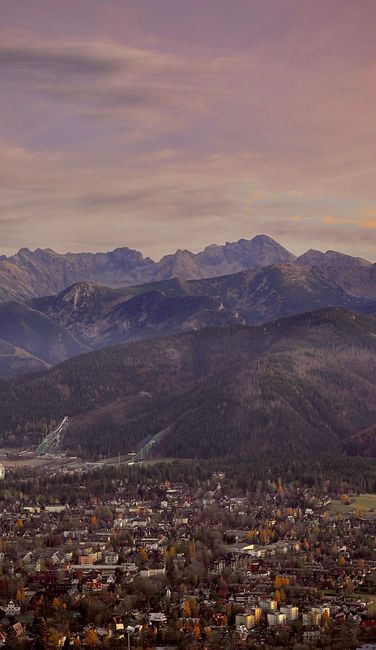
Zakopane is Poland’s mountain capital: a resort town at 800–1,000 m at the foot of the Tatras, the highest range between the Alps and the Caucasus, with granite peaks, glacial lakes and alpine meadows protected as Tatra National Park. It has its own highlander (góral) culture, with wooden villas in the Zakopane style, smoked sheep’s cheese, fiddle music and a dialect of its own, and it is busy all year: hikers in summer, skiers in winter and crowds of day-trippers on the Krupówki promenade. You come to walk to the lake of Morskie Oko, ride the cable car to Kasprowy Wierch, climb Giewont or simply sit on the Gubałówka hill with a view of the whole range. Give it two days for the classics, three or four to hike properly.
Right now in Zakopane
- Wed 9–18°C 49–64°F Mostly clear
- Thu 12–18°C 53–64°F 2 mm Cloudy
- Fri 5–12°C 42–53°F 8 mm Partly cloudy
Weather: MET Norway (CC BY 4.0) · Rates: ECB
Top tours in Zakopane
See all tours for Zakopane →
From local operators, with prices and reviews; you check availability and book on Viator, our partner. We may earn a commission at no extra cost to you. How we earn money
Zakopane at a glance
- Best for: mountain hiking, alpine lakes, cable cars, highland culture, skiing in winter.
- How long: 2 days for Morskie Oko and Kasprowy Wierch; 3–4 days to add Giewont and the valleys.
- Best time: June to early October for hiking; September is the sweet spot. December to March for snow and skiing.
- Getting in: trains from Kraków take about 2 hours to 2 hours 20 minutes; buses and minibuses also run.
- Key prices: as of October 2026, the Tatra National Park entry fee cost 11 zł, and a return ticket on the Kasprowy Wierch cable car 129 zł.
- Before you go: entry rules, money and trains are in our Poland travel guide.
Zakopane, area by area
Krupówki and the town centre
Krupówki, the pedestrian main street, is lined with restaurants, souvenir stalls, cheese sellers and crowds, especially at weekends. Around it are the market under Gubałówka, the old wooden church and cemetery on Kościeliska Street, and some of the finest villas in the Zakopane style. Best for: restaurants, shopping and nightlife.
Kuźnice
At the southern edge of town, Kuźnice is the gateway to the high mountains: the lower station of the Kasprowy Wierch cable car and the start of trails to Giewont, the Hala Gąsienicowa and the Morskie Oko side of the range. Private cars cannot drive there. Best for: early starts.
Gubałówka
The long hill north of town, reached by funicular, has the best panoramic view of the Tatras. Best for: views and easy walks.
Kościelisko and the western valleys
West of town, the villages of Kościelisko and Witów lead to the Kościeliska and Chochołowska valleys, with gentler walks, caves and crocuses in spring. Best for: quieter stays and family walks.
Tatra National Park: fees, tickets and rules
The Tatras are protected by Tatra National Park (Tatrzański Park Narodowy, TPN), which shares the range with the Slovak TANAP across the border. As of October 2026:
- Entry fee: 11 zł for adults and 5.50 zł reduced (pupils, students, pensioners and disabled visitors); a 7-day ticket costs 55 zł (27.50 zł reduced). Children under 7 go free. Buy at the ticket booths at trailheads, online on the park’s website (tpn.gov.pl) or by scanning the QR codes posted at the entrances.
- Night closure: from 1 March to 30 November, all trails in the park are closed from dusk to dawn to protect wildlife. Plan to be off the trails before dark.
- Dogs: are not allowed in the park.
- Stay on marked trails: off-trail walking is forbidden, and so are drones, fires and camping.
- Bears: brown bears live in the Tatras. Never feed them, keep food packed away, make noise on quiet trails and back away calmly if you meet one; the park publishes advice.
- Mountain rescue: TOPR on 985 or +48 601 100 300, or 112. In winter, check the avalanche bulletin on the park’s website; trails above the forest can be dangerous from November to May.
Top things to see in Zakopane
Morskie Oko
Morskie Oko (“Eye of the Sea”) is the largest lake in the Tatras, a deep, clear glacial lake at 1,395 m beneath the granite walls of the Mięguszowieckie peaks and Rysy, the highest mountain in Poland (2,499 m). It is the most visited place in the park, with a mountain hut by the shore, and on summer weekends tens of thousands of people make the trip.
Getting there. Cars and buses stop at Palenica Białczańska, about 25 km from Zakopane by road. From there, an asphalt road closed to private traffic climbs about 9 km to the lake; most walkers take 2 to 3 hours up. As of October 2026:
- Parking: the car parks at Palenica Białczańska and nearby cost 36–75 zł a day for a car, depending on the season and demand, and 10 zł more if paid on site. Booking online on the park’s website is strongly recommended, as the car parks fill early in summer. Sleeping in vehicles is not allowed.
- Buses to Palenica: private buses and minibuses run from Zakopane; pay the driver.
- Electric buses: the park runs electric buses on the road to Włosienica, about 1.5 km below the lake: in 2026, 89 zł from Zakopane or 69 zł from Palenica Białczańska, bought online or at the park’s information point. The e-bus season ran until 14 October 2026.
- Horse-drawn carriages: after years of controversy about the welfare of the horses hauling heavy carts up the road, the carriages have been cut back. Since 1 September 2026, in a pilot scheme, they run only from Palenica Białczańska to the Wodogrzmoty Mickiewicza waterfalls, about 2.9 km, carrying no more than ten adults per uphill trip, and they stop running in hot weather. From the waterfalls, it is about 6 km on foot to the lake.
Walk around the lake (about an hour) and, if you are fit, climb on to the higher lake of Czarny Staw, another steep hour. Start early, before 8:00 in summer, to avoid the crowds.
Kasprowy Wierch cable car
The cable car from Kuźnice climbs 936 m to the summit of Kasprowy Wierch (1,987 m) on the Polish–Slovak border, with views over the whole range, ski runs in winter and trails along the ridge in summer. As of October 2026, in the low season from 1 October to 18 December 2026, a return ticket costs 129 zł and a one-way ticket 119 zł (109 and 95 zł reduced); an “Express” ticket with a reserved time slot costs 159 zł return. In summer, online prices vary with the time slot and demand (99–165 zł return in 2026). Buy online on the operator’s website (pkl.pl) to choose your slot; queues at the cash desk can be long. The cable car closes for maintenance for some weeks in spring and in November, and in strong winds or ice.
Giewont
The rocky ridge of Giewont (1,894 m), shaped like a sleeping knight, dominates the town and is crowned by a 15 m iron cross. The classic route climbs from Kuźnice or the Strążyska Valley in about 3 to 3.5 hours; the final section has chains on steep rock and is dangerous in rain or storms, when lightning strikes are common. Start early and turn back if thunder is forecast.
Gubałówka
The Gubałówka funicular climbs from behind the market to the 1,120 m hill above town in a few minutes. As of October 2026, a return ticket costs 37 zł online (42 zł at the cash desk) in the low season. At the top are viewing points, restaurants, a summer toboggan run and easy ridge walks with views of the Tatras.
Zakopane-style architecture and culture
In the late 19th century, the painter Stanisław Witkiewicz created a “Zakopane style” based on highland wooden buildings. See it at the Villa Koliba (the Museum of the Zakopane Style), the Villa Atma (the Szymanowski Museum) and the Chapel of the Sacred Heart in Jaszczurówka. The Tatra Museum covers highland culture and nature, and the old cemetery on Pęksowy Brzyzek holds the graves of artists and mountaineers.
Museums
- Museum of Zakopane Style at Villa Koliba
- Tatra Museum in Zakopane
- Villa Atma
Peaks and mountains
- Gubałówka
- Kasprowy Wierch
- Rysy
Nature
- Morskie Oko
Things to do in Zakopane
Hiking
The Tatras have about 275 km of marked trails, from easy valley walks to exposed, chained routes on the highest peaks. Good choices for beginners are the Kościeliska and Chochołowska valleys, Dolina Strążyska and its waterfall, and the walk to Morskie Oko; more experienced hikers can tackle Giewont, the ridge from Kasprowy Wierch, the Valley of Five Polish Ponds or the infamous Orla Perć, the hardest marked trail in Poland. See our hiking guide.
Skiing
From December to March, Kasprowy Wierch has Poland’s highest ski runs, and smaller ski areas around Zakopane, Białka Tatrzańska and Bukowina suit beginners and families.
Thermal baths
Several thermal spas near Zakopane, such as those at Bukowina Tatrzańska, Białka Tatrzańska, Szaflary and Chochołów, have outdoor pools with Tatra views, perfect after a day’s hike.
Eat like a highlander
Try oscypek, smoked sheep’s cheese, grilled with cranberries; kwaśnica, sauerkraut soup; and lamb or trout, in a wooden inn (karczma) with live highland music. See our city sightseeing guide.
Activities and best months
- HikingThe Tatra National Park, on the Slovak border above Zakopane, has the highest Polish peaks and the deepest caves; its trails range from valley walks to high mountain routes. The most popular hike, to the lake of Morskie Oko, starts at Palenica Białczańska, over 20 km from Zakopane by car or public transport; the park advises buying parking tickets online days ahead in season, as the lake is very busy at weekends, in May and in summer. There are no litter bins in the park and dogs disturb wildlife. · source
Day trips from Zakopane
- Rafting through the Dunajec gorge: wooden rafts steered by highland boatmen through the Pieniny mountains, from April to October, about 1 hour 15 minutes away.
- The wooden churches of the Podhale: the 15th-century church at Dębno is UNESCO-listed.
- The Slovak Tatras: across the border, the resorts of Štrbské Pleso and Tatranská Lomnica.
- Kraków: about 2 hours away.
Nearby destinations
- High Tatras20 km
- Kraków85 km
- Banská Štiavnica121 km
- Eger159 km
- Budapest211 km
- Brno243 km
- Bratislava244 km
- Vienna289 km
Getting to Zakopane
By train. PKP Intercity and regional trains run from Kraków to Zakopane, taking about 2 hours to 2 hours 20 minutes on the fastest services; some through trains come from Warsaw and Gdańsk. A new timetable starts on 25 October 2026, so check times on intercity.pl. Zakopane station is a 10-minute walk from Krupówki.
By bus. Buses and minibuses run from Kraków’s bus station, often more frequently than trains, taking about 2 hours, longer on busy weekends.
By car. The Zakopianka road from Kraków is notorious for traffic jams on Friday and Sunday afternoons and holiday weekends. Parking in town is limited.
Getting around Zakopane
Walk in the centre. Minibuses (busy) leave from opposite the bus station for Kuźnice, Palenica Białczańska and the valleys; pay the driver in cash. Taxis are available, but private cars cannot drive to Kuźnice.
When to go and how long to stay
Zakopane, at 855 m, has a mountain climate: cool summers with frequent thunderstorms, cold, snowy winters and a lot of rain. Higher up, it is much colder and windier. The table uses the IMGW 1991–2020 averages for Zakopane.
| Season | Average high | Average low | Rain per month | What it’s like |
|---|---|---|---|---|
| Winter (Dec–Feb) | 1–2 °C | −7 to −6 °C | 45–51 mm | Snowy and cold; skiing, avalanche risk on high trails |
| Spring (Mar–May) | 5 °C rising to 16 °C | −4 °C rising to 6 °C | 61–142 mm | Snow lingers high up into May; crocuses in the valleys; cable car maintenance |
| Summer (Jun–Aug) | 20–21 °C | 9–11 °C | 125–192 mm | The main hiking season and the wettest months, with afternoon thunderstorms |
| Autumn (Sep–Nov) | 16 °C falling to 7 °C | 7 °C falling to −2 °C | 60–111 mm | September and early October are the most stable months for hiking; first snow on the peaks |
Zakopane gets about 1,150 mm of rain a year, twice as much as Kraków, with rain or snow on about 200 days. In summer, start hikes early, as thunderstorms often build in the afternoon. The “halny”, a warm, violent foehn wind, can blow in autumn and spring.
Zakopane in 2 days
Day 1: Morskie Oko and Czarny Staw, starting early. Day 2: the cable car to Kasprowy Wierch in the morning, walk down to Kuźnice via Hala Gąsienicowa, then Krupówki and dinner in a highland inn.
Zakopane in 4 days
Add Giewont, a walk in the Kościeliska or Chochołowska valley, an evening on Gubałówka and an afternoon in a thermal spa or on a Dunajec raft.
Weather month by month
Averages from IMGW-PIB normals 1991–2020, Zakopane · Last reviewed 4 Oct 2026
Where to stay in Zakopane
- Near Krupówki: central hotels and guesthouses, close to restaurants and the station, but busy.
- Towards Kuźnice: quieter villas and hotels near the trailheads.
- Kościelisko: wooden guesthouses for a quieter stay near the western valleys.
- Bukowina and Białka Tatrzańska: hotels with thermal spas, a short drive away.
Zakopane charges a local fee per person per night, added to the bill. Book early for summer, winter holidays and New Year.
Practical tips for Zakopane
- Start early: beat the crowds at Morskie Oko and the afternoon storms.
- Pay the park fee: at the trailhead booth, online or by QR code.
- Book ahead: parking at Palenica Białczańska and the Kasprowy Wierch cable car, especially in summer.
- Be off the trails by dark: they close from dusk to dawn between March and November.
- Save the rescue number: TOPR 985 or +48 601 100 300.
- Avoid weekends: the town and the road from Kraków are packed on summer and holiday weekends.
What to pack for Zakopane
Proper hiking boots with grip, a rain jacket, a warm layer and a hat even in August (it can snow on the peaks in any month), sunglasses and sunscreen, water and snacks, a charged phone and a paper or offline map. In winter, bring warm clothes and, for hiking, microspikes; for high trails, winter mountaineering gear and experience are essential. Cash is useful for minibuses and mountain huts.
What to pack
- Day packs and anti-theft bagsA 20–30 litre pack carries layers, water, a head torch and snacks on full-day levada walks.
- Fleeces and warm layersSummits like Pico do Areeiro averaged about 11 °C over 2024, so a fleece is needed even in summer.
- HeadlampsLevada routes such as PR1 and PR9 pass through long, dark, wet tunnels.
- Hiking shoes and bootsMadeira's levadas and the Azores' crater rims are wet, rocky and slippery, so grippy shoes matter more than anywhere else in Portugal.
- Rain jacketsMountain and island weather changes fast; a real shell beats an umbrella in the wind.
- Trekking polesLong stone staircases and steep descents on Madeira's peaks and the Azores' crater rims are easier on the knees with poles.
- Water bottles and hydration packsAlgarve and Alentejo trails are hot and exposed with few refill points.
Zakopane travel FAQ
How much is the Tatra National Park entry fee?
As of October 2026, 11 zł for adults and 5.50 zł reduced, or 55 zł for a 7-day ticket. Children under 7 go free. Pay at the trailhead booths, online on the park’s website or by QR code at the entrances.
Can you still take a horse carriage to Morskie Oko?
Only part of the way. Since 1 September 2026, in a pilot scheme, the carriages run only from Palenica Białczańska to the Wodogrzmoty Mickiewicza waterfalls, about 2.9 km; from there you walk about 6 km to the lake. The park also runs electric buses to Włosienica in season.
How long is the walk to Morskie Oko?
About 9 km on an asphalt road from Palenica Białczańska, roughly 2 to 3 hours up. Add an hour to walk around the lake.
Do I need to book parking for Morskie Oko?
It is strongly recommended in summer. As of October 2026, parking at Palenica Białczańska costs 36–75 zł a day, depending on demand, and 10 zł more on site.
How much is the Kasprowy Wierch cable car?
From 1 October to 18 December 2026, 129 zł return and 119 zł one way (109 and 95 zł reduced), or 159 zł for a timed Express ticket. Summer prices vary with the time slot. Buy online on pkl.pl.
Are the Tatra trails open at night?
No. From 1 March to 30 November, all trails in Tatra National Park are closed from dusk to dawn.
Can I bring my dog to the Tatras?
No. Dogs are not allowed in Tatra National Park.
How do I get from Kraków to Zakopane?
By train (about 2 hours to 2 hours 20 minutes) or by bus or minibus from Kraków’s bus station (about 2 hours, longer in traffic).
What is the emergency number in the Tatras?
Call TOPR, the Tatra mountain rescue service, on 985 or +48 601 100 300, or 112.
When is the best time to visit Zakopane?
June to early October for hiking, with September often the most stable month, and December to March for snow and skiing.
Sources
- © OpenStreetMap contributors · ODbL · fetched 4 Oct 2026
- Wikidata · CC0 · fetched 4 Oct 2026
Sources and last review
Researched and last reviewed on 4 October 2026. Park fees, night closure, dogs, rescue numbers, Morskie Oko parking, electric buses and horse-carriage changes: Tatra National Park (tpn.gov.pl); Kasprowy Wierch and Gubałówka prices: the operator, Polskie Koleje Linowe (pkl.pl); cable car details: Tatra National Park; climate: IMGW 1991–2020 averages for Zakopane via secondary sources. Train times, the carriage fares, the walking time to Morskie Oko and the local fee come partly from secondary sources and are flagged for checking. Prices, seasons and trail conditions change, so check the official links before you go. For entry rules and money, see our Poland travel guide; for the nearest city, our Kraków guide.
Plan your trip
Partner links: TravelerCenter may earn a commission if you book, at no extra cost to you.
🇵🇱 Useful Polish phrases for Zakopane
All 38 Polish phrases: restaurant, hotel, emergencies, romance (printable) →