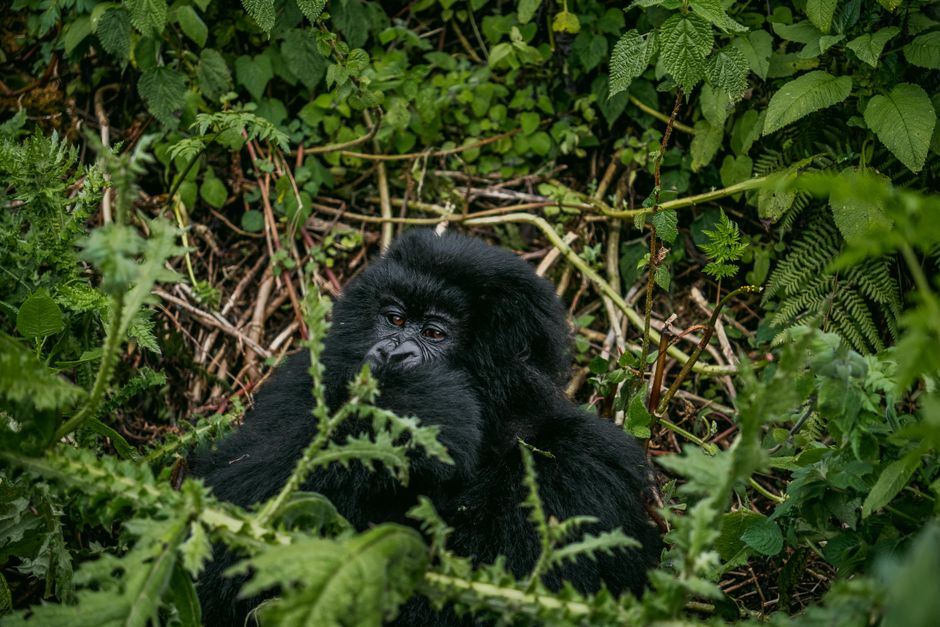
Volcanoes National Park, in the far northwest of Rwanda, protects the Rwandan slopes of the Virunga mountains, a chain of volcanoes shared with Uganda and the DR Congo, and it’s one of the best places in the world to see mountain gorillas. Five volcanoes rise inside the park, from Muhabura and Gahinga on the Ugandan border to Bisoke, with its crater lake, and Karisimbi, Rwanda’s highest point at 4,507 m (14,787 ft). Their lower slopes are covered in bamboo, hagenia woodland and giant lobelias, often wrapped in mist. The American primatologist Dian Fossey studied the gorillas here from the late 1960s, and her grave is a popular hike. Today the Rwanda Development Board (RDB) sells a limited number of permits each day to visit habituated gorilla families for one unforgettable hour, as well as permits to track the rare golden monkey, to climb the volcanoes and to explore caves. The park is only about two hours by road from Kigali, so you can fly in, trek and be back in the capital within two or three days. It’s not a cheap trip, and the hikes can be steep, muddy and high.
Right now in Volcanoes National Park (Volcanoes NP)
- Wed 8–13°C 47–56°F 15 mm Heavy rain
- Thu 9–13°C 47–55°F 19 mm Heavy rain
- Fri 9–13°C 48–56°F 6 mm Rain
Weather: MET Norway (CC BY 4.0)
Top tours in Volcanoes National Park
See all tours for Volcanoes National Park →
From local operators, with prices and reviews; you check availability and book on Viator, our partner. We may earn a commission at no extra cost to you. How we earn money
Volcanoes National Park at a glance
- Best for: mountain gorilla trekking, golden monkeys, volcano hikes, Dian Fossey’s grave and cool mountain scenery.
- How long: 2 nights for one gorilla trek; 3–4 nights to add golden monkeys or a volcano hike.
- Best time: June to mid-September and mid-December to mid-February are drier; gorillas can be seen all year.
- Getting there: about 90 minutes to two hours by road from Kigali to Musanze, according to the RDB, then 30 minutes to the park headquarters at Kinigi.
- Gorilla permit: US$1,500 per foreign visitor, sold by the RDB; minimum age 15.
- Good to know: book permits months ahead for June to September, report at 7 a.m. on the day, and don’t trek if you’re sick.
- Before you go: the visa, money and general safety are in our Rwanda travel guide.
Permits, fees and rules
Gorilla permits
The RDB sells gorilla permits on its official booking portal and through licensed tour operators. For foreign visitors, a permit costs US$1,500 per person per day (about RWF 2.2 million). Visit Rwanda says eight permits are issued per gorilla family per day, with 96 permits a day across the park, so the busiest dates sell out months ahead. The RDB offers lower promotional rates to Rwandan citizens, East African citizens and foreign residents of Rwanda and Africa, but its portal states that these rates don’t apply from June to October 2026. From November to May, foreign visitors can get a 30% discount on one gorilla permit if they also spend at least two nights in Akagera and/or Nyungwe national parks, with a hotel receipt and one paid activity. Applications need your passport details; the RDB checks documents at the park gate and warns that visitors with wrong or false details will be refused entry, even with a paid permit.
Other activity fees
| Activity | Foreign visitor fee (RDB) | Notes |
|---|---|---|
| Mountain gorilla trekking | US$1,500 (about RWF 2.2 million) | Minimum age 15; one hour with the gorillas |
| Golden monkey tracking | US$100 (about RWF 147,400) | Minimum age 12; report at 7 a.m. |
| Mount Bisoke hike | US$75 (about RWF 110,600) | Day hike to the crater lake |
| Dian Fossey’s grave | US$75 (about RWF 110,600) | Half-day forest hike |
| Mount Karisimbi | US$400 (about RWF 589,600) | Two-day climb with a night on the mountain |
| Musanze Caves | US$50 (about RWF 73,700) | Minimum age 12 |
Gorilla trekking rules
The RDB asks every visitor to follow its guidelines, which protect the gorillas from human diseases and keep encounters calm. Keep a distance of 7 m (about 22 feet) from the gorillas; groups are limited to eight visitors, and viewing time is limited to one hour. If you’re sick with a cold, flu or other contagious illness, don’t visit, as you may be refused entry. Don’t eat, drink or smoke near the gorillas, don’t spit in the park, and cover your mouth and turn away if you need to cough. Keep your voice low, avoid rapid movements, and if a gorilla charges or vocalizes, stand still, look away and follow your guide. Photography is allowed, but without flash. The minimum age is 15. If your group can’t find its gorilla family after a full day, the RDB offers another chance or a full refund; if you track all day and fail to make contact, it refunds 75%. There’s no refund for late arrival, missed flights or cancellations.
How a gorilla trekking day works
On the day, report at 7 a.m. to the RDB visitor center at Kinigi, the park headquarters, with your passport and permit. Guides assign visitors to the gorilla families, usually taking fitness into account, so tell your driver-guide if you’d like an easier or a more challenging trek. After a briefing on the rules, you drive to the trailhead for your family and set off with a guide, trackers who have gone ahead to find the gorillas, and park rangers. The RDB says hikes can last from 30 minutes to four hours or more each way, depending on where the family is feeding, at altitudes of 2,500 m to 4,000 m (8,200–13,100 ft). Trails cross farmland and a stone wall, then climb through bamboo and nettles. When the trackers find the family, you leave bags and sticks with the porters and spend your hour watching silverbacks, mothers and youngsters eat, play and rest, often just a few meters away. You’ll usually be back at your lodge by early afternoon.
The gorilla families
Visit Rwanda lists twelve gorilla families visited by tourists: Susa, Igisha, Karisimbi, Sabyinyo, Amahoro, Agashya, Kwitonda, Umubano, Hirwa, Bwenge, Ugyenda and Muhoza. Other groups are habituated only for research. The RDB says families tend to stick to a preferred area but change in size and composition over time. The large Susa family usually ranges high on Karisimbi and is one of the hardest treks, while groups such as Sabyinyo are often closer to the park edge. Each group is monitored and protected by rangers every day, and each meets tourists for a maximum of one hour a day.
Porters
Porters wait at each trailhead to carry your daypack and camera and to help you over steep and slippery ground. They charge a small set fee, and hiring one is a simple way to support families who live next to the park. The RDB says 10% of permit revenue goes to local communities for schools, health centers and roads, with a compensation fund for farmers whose crops are damaged by gorillas.
Where to stay near Volcanoes National Park
Kinigi and the park edge
Most visitors stay in the villages around Kinigi, close to the park headquarters, so they don’t need an early drive on the morning of the trek. Lodges here range from simple community guesthouses and mid-range lodges with fireplaces in the rooms to some of Africa’s most exclusive eco-lodges, with private villas looking up at the volcanoes. Nights are cold at about 2,300 m (7,500 ft), so look for a hot shower and a fire.
Musanze town
Musanze (formerly Ruhengeri), at about 1,700 m (5,600 ft), is the regional town, with banks, a market, restaurants and hotels at lower prices than Kinigi. The RDB notes that it’s generally quite cold in the evening, so bring warm clothes. From Musanze you’ll need a car or taxi to reach Kinigi for the 7 a.m. briefing, about 30 minutes away.
The twin lakes
East of Musanze, the “twin lakes” of Burera and Ruhondo sit between steep terraced hills with views of the volcanoes. A few lodges stand on their shores, and they make a peaceful base for an extra night, with boat trips and village walks.
Top things to see in Volcanoes National Park
Mountain gorillas
Mountain gorillas live only in the Virunga volcanoes and Uganda’s Bwindi forest, and the RDB calls Rwanda one of only three countries where they can be seen. Watching a silverback strip bamboo shoots, or young gorillas tumbling through the undergrowth, is the main reason to come. Visit Rwanda calls the encounter “life changing”, and the permit price funds the rangers, vets and community projects that have helped numbers recover.
Golden monkeys
Golden monkeys, a rare and endangered subspecies with orange-gold backs, live in the bamboo zone on the park’s lower slopes. Tracking them is usually an easier walk than a gorilla trek, and once found, the noisy groups leap through the bamboo close to visitors. Permits cost US$100, and children from age 12 can join, so it’s a good option for families.
Mount Bisoke and its crater lake
Bisoke (also spelled Visoke), on the border with the DR Congo, is the most popular volcano hike. A steep, often muddy trail climbs through bamboo and giant lobelias to a rim with a crater lake near the summit at about 3,700 m (12,100 ft). Allow most of a day for the round trip, and hope for a clear morning; the views over the Virungas can be superb. The fee is US$75.
Dian Fossey’s grave and Karisoke
Dian Fossey founded the Karisoke Research Center between Bisoke and Karisimbi in 1967 and spent nearly two decades studying and protecting the gorillas. She’s buried at the old research camp, next to a graveyard for gorillas, including her favorite, Digit. Visit Rwanda says the trail starts about 30 minutes’ drive from the park headquarters and takes two or three hours through the forest to above 3,000 m (9,800 ft). The hike costs US$75.
Musanze Caves and Buhanga Eco-Park
Visit Rwanda says the park’s boundaries include Buhanga Eco-Park, an ancient forest tied to Rwanda’s royal folklore, and the Musanze Caves, a long lava tube near Musanze town that you can explore with a guide for US$50. Both are good options for a half day before or after a trek, or on a rainy afternoon.
Other things to do around the park
Hiking, canoeing and cycling
Visit Rwanda lists hiking, canoeing, mountain biking and village experiences in the area. Guided walks follow farm tracks between the volcanoes, canoe trips explore the twin lakes and the Mukungwa River, and mountain-bike routes link villages around Musanze. See our hiking and cycling guides.
Kwita Izina
Each year, Rwanda holds Kwita Izina, a ceremony at the foot of the volcanoes where newborn gorillas are named. Visit Rwanda calls it a special time to visit, with guided tours, cultural evenings and a celebration in Musanze, plus music, dancing and talks on conservation. Check the date before you book, as lodges fill up.
Food and drink
Lodges serve hearty meals, often with Rwandan dishes such as grilled brochettes, stewed beans, sweet potatoes and cooked bananas, plus vegetables from local farms, and they pack lunches for long treks. In Musanze, local restaurants serve lunch buffets and grilled tilapia, with Rwandan coffee, tea or a cold Primus beer.
Day trips and nearby
- Lake Kivu at Rubavu: about an hour west of Musanze; beaches, lakeside hotels and boat trips. See our boat trips guide.
- Twin lakes Burera and Ruhondo: about 30–45 minutes east of Musanze; canoe trips and viewpoints.
- Gishwati-Mukura National Park: a small forest park west of Musanze, with chimpanzees and golden monkeys.
- Uganda’s gorilla parks: the Cyanika border is about 30 minutes north of Musanze, leading to Kisoro, Mgahinga and southern Bwindi. See our Bwindi Impenetrable National Park guide.
- Kigali: two hours by road, with the genocide memorial and markets. See our Kigali guide.
Nearby destinations
- Bwindi Impenetrable National Park53 km
- Kigali88 km
Getting there and getting around
By road from Kigali
The RDB says Musanze is a 90-minute drive from Kigali; allow two hours on the winding, busy road. You can hire a private car or take a public minibus, then hire a vehicle in Musanze to reach Kinigi for the 7 a.m. briefing. Most visitors book a car and driver-guide with a tour operator, who will also drive them to the trailhead, which can be up to an hour from Kinigi on rough tracks. Express buses run frequently between Kigali’s Nyabugogo bus station and Musanze.
By helicopter
Akagera Aviation runs helicopter transfers in Rwanda, and some luxury lodges near the park have helipads, cutting the transfer from Kigali International Airport to about half an hour.
Getting around
You’ll need a vehicle to reach the trailheads, as there’s no public transport to them, and a 4×4 is best for the last stretches in the rainy season. Don’t plan a gorilla trek on the day you arrive in Rwanda or on the day of an international flight, as delays on the mountain are common. Remember that on the last Saturday of each month, Umuganda community work restricts traffic in the morning.
When to go and how long to stay
Gorilla trekking runs all year. The drier months are June to mid-September and mid-December to mid-February, when trails are less slippery and permits are most in demand; the rainy seasons, from mid-February to May and from mid-September to mid-December, bring mud, mist and fewer visitors, and are when the low-season permit discount applies. It’s cool all year at this altitude, and frosty nights are possible on the high peaks. The table uses Rwanda Meteorology Agency (Meteo Rwanda) averages for 1961–1990 for Musanze, the nearest station, at about 1,700 m (5,600 ft), as published by the World Meteorological Organization (WMO): average daily highs and lows, rainfall and days with rain. The trekking areas higher up are several degrees cooler and wetter.
| Month | Average high / low | Rain (rainy days) | What to expect |
|---|---|---|---|
| January | 25 °C (77 °F) / 11 °C (52 °F) | 71 mm (2.8 in), 13 days | Short dry season; good trekking |
| February | 25 °C (77 °F) / 11 °C (52 °F) | 93 mm (3.7 in), 15 days | Mostly dry early; rain returns later |
| March | 24 °C (75 °F) / 11 °C (52 °F) | 142 mm (5.6 in), 20 days | Rainy season; muddy trails; discount on combined trips |
| April | 24 °C (75 °F) / 13 °C (55 °F) | 174 mm (6.8 in), 23 days | Wettest month; fewest visitors |
| May | 23 °C (73 °F) / 13 °C (55 °F) | 152 mm (6.0 in), 19 days | Rain easing late in the month |
| June | 23 °C (73 °F) / 12 °C (54 °F) | 39 mm (1.5 in), 7 days | Dry season begins; permits in demand |
| July | 24 °C (75 °F) / 11 °C (52 °F) | 17 mm (0.7 in), 3 days | Driest month; peak season |
| August | 24 °C (75 °F) / 12 °C (54 °F) | 49 mm (1.9 in), 8 days | Dry and busy; book well ahead |
| September | 24 °C (75 °F) / 11 °C (52 °F) | 124 mm (4.9 in), 18 days | Showers from mid-month; Kwita Izina is often around now |
| October | 24 °C (75 °F) / 11 °C (52 °F) | 162 mm (6.4 in), 22 days | Rainy; green and misty |
| November | 24 °C (75 °F) / 11 °C (52 °F) | 147 mm (5.8 in), 22 days | Rainy; low-season discount |
| December | 24 °C (75 °F) / 11 °C (52 °F) | 83 mm (3.3 in), 16 days | Drier from mid-month; holiday demand |
How long to stay: 2, 3 and 4 nights
- 2 nights: arrive in the afternoon, trek the next morning, rest, and leave the following day.
- 3 nights: one gorilla trek and golden monkey tracking, or a Bisoke or Dian Fossey hike.
- 4 nights: two gorilla treks with different families, plus golden monkeys and the twin lakes.
Typical costs
Prices are approximate, for October 2026, converted at about RWF 1,474 to the US dollar (National Bank of Rwanda). Permit fees are the RDB’s foreign-visitor rates.
| Item | Typical cost |
|---|---|
| Gorilla trekking permit | US$1,500 (about RWF 2.2 million) |
| Gorilla permit with the 30% low-season discount (November–May, conditions apply) | US$1,050 (about RWF 1.55 million) |
| Golden monkey permit | US$100 (about RWF 147,400) |
| Porter for a trek | about US$10–20 (about RWF 14,700–29,500), plus a tip |
| Bus Kigali–Musanze, one way | about RWF 3,000–4,000 (about US$2–3) |
| Car and driver from Kigali, per day | about US$100–180 |
| Guesthouse or hotel double in Musanze | about RWF 45,000–120,000 (about US$30–80) |
| Mid-range lodge near Kinigi, per person per night, full board | about US$150–500 |
| Luxury eco-lodge, per person per night, all-inclusive | about US$1,000–3,000 |
Safety in Volcanoes National Park
Gorilla health rules: because gorillas can catch human illnesses, the RDB may refuse entry to anyone with a cold, flu or other contagious illness, and visitors must keep 7 m from the animals, stay no longer than an hour, and cough away from them. Altitude: treks reach 2,500–4,000 m, and the RDB says altitude may cause difficulties for some visitors; walk slowly, drink plenty of water, and turn back if you feel unwell. Karisimbi, at 4,507 m, carries a real risk of altitude sickness. Terrain: trails are steep, muddy and lined with stinging nettles; wear long sleeves, gloves, gaiters and boots with good grip, and use a walking stick and a porter. Wildlife: follow your guide’s instructions at all times; buffalo and forest elephants also live in the park, and park rangers accompany every group. Malaria: the US CDC recommends antimalarial medicine for travelers to Rwanda; risk is lower in the cool highlands but present in the country. Roads: drive in daylight, and allow time for slow traffic on the Kigali road. Border: the park borders Uganda and the DR Congo; stay on guided routes and don’t approach the border on your own. In an emergency, call 112.
Practical tips for Volcanoes National Park
- Book early: permits for June to September sell out months ahead; confirm yours before you book flights.
- Use the official channel: buy permits on the RDB portal or through a licensed operator, with your passport details exactly as in your passport.
- Stay close: sleeping near Kinigi makes the 7 a.m. report time easy.
- Hire a porter: it helps you and supports local families.
- Bring cash for tips: small US dollar notes or Rwandan francs for porters, trackers and guides.
- No plastic bags: they’re banned in Rwanda and collected on arrival.
What to pack for Volcanoes National Park
Waterproof hiking boots with good grip, gaiters, long trousers and a long-sleeved shirt (the RDB recommends them against nettles), gardening or leather gloves, a waterproof jacket, a warm fleece and hat for early mornings and cold evenings, a small daypack with a rain cover, water and snacks (eating near the gorillas isn’t allowed), a camera without flash and spare batteries, binoculars for golden monkeys and birds, sunscreen, insect repellent, a headlamp, your passport and permit, and a power adapter for European two-pin sockets. See our hiking shoes, rain jackets and travel adapters guides.
Volcanoes National Park travel FAQ
How much is a gorilla permit in Volcanoes National Park?
US$1,500 per foreign visitor, sold by the Rwanda Development Board. From November to May, a 30% discount applies if you also stay two nights in Akagera or Nyungwe.
How many gorilla permits are there each day?
Visit Rwanda says eight permits per gorilla family per day, or 96 a day across the park.
How long is a gorilla trek?
From 30 minutes to four hours or more each way, depending on the family, plus one hour with the gorillas, according to the RDB.
What is the minimum age for gorilla trekking in Rwanda?
15 years. Golden monkey tracking and the Musanze Caves are open from age 12.
How close can you get to the gorillas?
The RDB asks visitors to keep 7 m (about 22 feet) away, although gorillas sometimes come closer on their own; stay still and follow your guide.
Can I trek if I have a cold?
No. The RDB says you may be denied access if you’re sick with a cold, flu or other contagious illness, because gorillas can catch human diseases.
What time does gorilla trekking start?
Report to the visitor center at Kinigi at 7 a.m. for registration, allocation to a family and the briefing.
How do I get from Kigali to Volcanoes National Park?
By road to Musanze in about 90 minutes to two hours, then 30 minutes to Kinigi; or by helicopter in about half an hour.
What is the best time for gorilla trekking in Rwanda?
June to mid-September and mid-December to mid-February are driest; treks run all year, and the rainy months are quieter.
Can I see golden monkeys in Volcanoes National Park?
Yes. Golden monkey tracking costs US$100, starts at 7 a.m. and is usually an easier walk than a gorilla trek.
Sources and last review
Researched and last reviewed on 5 October 2026. Gorilla, golden monkey, hiking, Karisimbi and cave fees, minimum ages, promotional rates, the low-season discount, the 7 a.m. report time, trekking rules, refunds, permit checks, altitude, porters and the route from Kigali: the Rwanda Development Board’s booking portal; permits per day, gorilla families, hike lengths, community revenue, Dian Fossey’s grave, Kwita Izina, Buhanga Eco-Park, Musanze Caves, activities, transport, health and what to wear: the RDB’s Visit Rwanda site; malaria: the US CDC; climate averages: the Rwanda Meteorology Agency via the World Meteorological Organization (Musanze station); the exchange rate: the National Bank of Rwanda. The park’s history, Karisoke dates, family trek difficulty, lodge locations and elevations, the twin lakes, cultural villages, Bisoke’s height, travel times, helicopter transfer times, the emergency number and typical prices are general references or estimates, flagged for checking. Fees and rules change, so check with the RDB or your operator before you go. For the visa, money and general safety, see our Rwanda travel guide.
Plan your trip
Partner links: TravelerCenter may earn a commission if you book, at no extra cost to you.