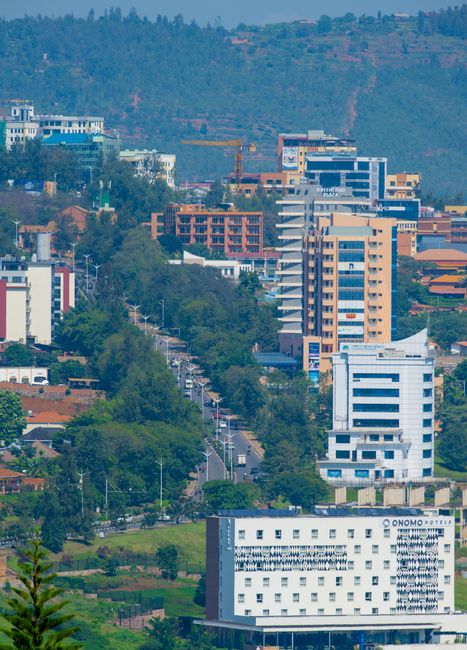
Kigali, Rwanda’s capital, spreads over a series of green hills and valleys in the center of the country, at about 1,500 m (4,900 ft) above sea level. It’s one of Africa’s cleanest and most orderly cities, with tidy streets, roundabouts planted with flowers, smooth roads and a skyline of glass towers around the Kigali Convention Centre. For most visitors, it’s the gateway to the gorillas of Volcanoes National Park, two hours away, but it deserves a day or two in its own right. The Kigali Genocide Memorial is a moving place of remembrance and learning, and the city’s art galleries, crafts cooperatives, busy markets and the lively Muslim quarter of Nyamirambo show a different side of Rwanda. The food scene has grown fast, from lunch buffets and grilled brochettes to specialty coffee shops and smart restaurants, and the mild climate makes walking pleasant almost all year. Getting around is easy by moto-taxi, taxi or the city’s card-operated buses, and the airport is only about 20 minutes from the center. Plan around Umuganda, the community-work morning on the last Saturday of each month, when much of the city pauses until about midday.
Right now in Kigali
- Wed 18–28°C 65–82°F 11 mm Rain
- Thu 18–27°C 64–80°F 9 mm Light showers
- Fri 18–27°C 64–81°F 7 mm Rain
Weather: MET Norway (CC BY 4.0) · Air quality: OpenAQ
Top tours in Kigali
See all tours for Kigali →
From local operators, with prices and reviews; you check availability and book on Viator, our partner. We may earn a commission at no extra cost to you. How we earn money
Kigali at a glance
- Best for: the Kigali Genocide Memorial, art galleries, markets, coffee, food and the start of a gorilla trip.
- How long: 1–2 full days, or an afternoon before heading to the parks.
- Best time: June to mid-September and mid-December to mid-February are driest; it’s mild all year.
- Getting there: Kigali International Airport (KGL), served by RwandAir and international airlines.
- Getting around: moto-taxis, taxis and ride-hailing, and buses that use the Tap&Go smart card.
- Good to know: plastic bags are banned, and on the last Saturday of each month the city pauses for Umuganda until about midday.
- Before you go: the visa, money and general safety are in our Rwanda travel guide.
Kigali’s areas and where to stay
Kigali is spread across hills, and each neighborhood has its own character. The city covers about 730 km² (280 square miles) and had about 1.7 million people at the 2022 census, but most visitors spend their time in a handful of central areas.
Kiyovu and the city center
The city center (Nyarugenge) holds banks, offices, the central bus stops and the car-free zone, while the leafy hill of Kiyovu just above it has some of the city’s best-known hotels and guesthouses. It’s a convenient base for a short stay, within walking distance of restaurants and a short ride from the memorial.
Kimihurura and Kacyiru
East of the center, Kimihurura is home to the Kigali Convention Centre, with its domed tower, plus many of the city’s restaurants and bars. Neighboring Kacyiru has government offices and the Kandt House Museum nearby. Both are good bases for business travelers and food lovers.
Nyarutarama and Remera
Nyarutarama, in the northeast, is the city’s upscale residential district, with large hotels, a golf course and quiet streets. Remera, toward the airport, is livelier and cheaper, with the Amahoro stadium and BK Arena, local bars and good-value guesthouses.
Nyamirambo
On a hill southwest of the center, Nyamirambo is Kigali’s most vibrant district and its traditional Muslim quarter, with the green-and-white Green Mosque, tailors, barbershops, colorful shopfronts and street food. It comes alive at night, and community walking tours led by local women explain daily life in the neighborhood.
Where to stay in Kigali
- Luxury: international hotels in Kiyovu, Kimihurura and Nyarutarama, with pools and spas.
- Mid-range: boutique hotels and guesthouses in Kiyovu, Kimihurura and Kacyiru, often with views over the hills.
- Budget: guesthouses and hostels in Remera, Kicukiro and Nyamirambo.
- Near the airport: Remera and Kanombe are handy for early flights.
Top things to see in Kigali
The Kigali Genocide Memorial
The Kigali Genocide Memorial, at Gisozi, about ten minutes’ drive north of the center, is a place of remembrance for the victims of the 1994 Genocide against the Tutsi and a center for peace education. Opened in 2004, it’s a burial site, and its exhibitions explain Rwanda’s history before 1994, the genocide and the country’s path of justice, reconciliation and renewal, with a section on other genocides of the 20th century. Visit Rwanda says the memorial gardens are a place for quiet reflection, and many visitors find it the most important stop in Rwanda. The memorial says entry is free; an optional package with an audio guide, a rose to lay at the graves and a pin costs US$30 (RWF 40,000), or US$20 without the pin, and guided tours can be booked. It’s open 9 a.m. to 5 p.m. daily (last entry 4 p.m.), and 1–5 p.m. on Umuganda Saturdays. Children under 12 aren’t permitted, photography isn’t allowed inside the exhibition, and visitors are asked to dress and behave respectfully. The memorial’s café is a social enterprise that supports its work.
Kandt House Museum
The Kandt House Museum occupies the former home of Richard Kandt, the German explorer and colonial official who founded Kigali in 1907. It tells the story of Rwanda’s natural history and the city’s early years, and its garden has views over the center. It’s one of several museums run by Rwanda’s national cultural heritage body, along with the Rwanda Art Museum in the former presidential palace at Kanombe, near the airport.
Kimironko Market
Kimironko Market, in the east of the city, is Kigali’s biggest and most colorful market. Stalls sell piles of fruit and vegetables, dried fish and spices, but visitors come for the bright African-print fabrics; tailors on site will make a shirt or dress within a day or two. You’ll also find baskets, woodcarvings and other crafts. Go in the morning, and bring cash in Rwandan francs.
Art galleries and crafts
Kigali has a lively contemporary art scene. The Inema Arts Center in Kacyiru exhibits and sells paintings and sculpture by Rwandan artists and hosts workshops, and several smaller galleries and studios are scattered around Kimihurura and Kiyovu. For crafts, look for the woven agaseke baskets with pointed lids, a symbol of Rwanda, and the geometric imigongo paintings, traditionally made with cow dung, from the east of the country. Cooperatives sell them at fair prices.
Kigali Convention Centre and the city views
The Kigali Convention Centre, with its dome lit up in changing colors at night, is the symbol of modern Kigali and a hub for conferences. For views of the city, head up Mount Kigali in the southwest, or to the rooftop bars of central hotels at sunset, when lights come on across the hills.
Kigali Cultural Village and Nyandungu
Visit Rwanda lists the Kigali Cultural Village among the city’s culture and heritage attractions, with performances, food and crafts. For nature in the city, the Nyandungu urban wetland eco-park in the east has walking and cycling paths, ponds and birdlife.
Other things to do in Kigali
Food and drink
At lunchtime, Rwandans eat at buffet restaurants, where a plate piled with rice, beans, cooked bananas, sweet potatoes, vegetables and a stew is good value. In the evening, the national favorite is brochettes, skewers of goat, beef or fish, with fries and a cold Primus or Mützig beer. Try isombe (stewed cassava leaves), grilled tilapia and sambaza, small fried fish from Lake Kivu. Kigali also has excellent Ethiopian, Indian and Italian restaurants and a growing number of modern African kitchens. Rwanda’s high-altitude coffee is some of Africa’s best, and the city has many specialty cafés that roast their own beans.
Nightlife and events
Nightlife centers on Kimihurura, Kacyiru and Nyamirambo, with rooftop bars, live music and clubs that get busy late on Fridays and Saturdays. Kigali hosts major conferences, basketball games at BK Arena, cycling races and music festivals, so check for events, which can fill hotels.
Walking and cycling
Kigali is hilly but safe and pleasant to walk by day. Guided walking tours of Nyamirambo, cycling tours of the outskirts and runs on the car-free mornings that the city holds on some Sundays are good ways to see local life. See our city sightseeing and cycling guides.
Day trips from Kigali
- Volcanoes National Park: about two hours northwest for gorillas and golden monkeys; better as an overnight trip because treks start at 7 a.m. See our Volcanoes National Park guide.
- Akagera National Park: about 2½ hours east; game drives and boat trips on Lake Ihema, possible as a long day trip.
- Nyanza: about two hours south, with the King’s Palace Museum, a reconstructed royal residence with long-horned Inyambo cattle. Visit Rwanda lists it among the country’s museums.
- Huye: about 2½–3 hours south, with the Ethnographic Museum, Rwanda’s finest collection of traditional objects.
- Bugesera: about an hour south, with the national memorial sites at Nyamata and Ntarama.
- Lake Muhazi: about an hour northeast, for a quiet lakeside lunch and boat rides. See our boat trips guide.
Nearby destinations
Getting there and getting around
By air
Kigali International Airport (KGL) is in Kanombe, east of the center. Visit Rwanda lists RwandAir, Kenya Airways, Ethiopian Airlines, Brussels Airlines, KLM, Qatar Airways and Turkish Airlines among its airlines, with connections via Nairobi, Addis Ababa, Doha, Istanbul, Amsterdam and Brussels; RwandAir also flies to Entebbe, Dar es Salaam, Johannesburg, Dubai and London. Visas are issued on arrival. The drive to the center normally takes 20–30 minutes, but Ethiopian Airlines warned in 2026 that roadworks between the city and the airport were causing heavy delays and asked passengers to arrive four hours before departure. Taxis wait outside arrivals, and most hotels arrange pickups.
By road
Intercity buses and minibuses leave from Nyabugogo bus station for Musanze, Rubavu, Huye, Rusizi and the borders, and international coaches run to Kampala and Nairobi. Rwanda drives on the right. Visit Rwanda says the main roads are well surfaced, and most travelers hire a car with a driver for park trips.
Getting around
Kigali’s public buses use a smart card called Tap&Go, sold at bus stops and stations. Moto-taxis are the quickest way to get around; riders are licensed, wear numbered vests and carry a helmet for the passenger, and fares are short and cheap, though Visit Rwanda warns that travel insurance may not cover motorbike taxis. Ride-hailing apps and regular taxis work well for evenings and airport runs. Remember that on Umuganda Saturdays, traffic is restricted in the morning and many shops stay closed.
When to go and how long to stay
Kigali is pleasant all year, with warm days and mild nights. The drier months are June to mid-September, the best time for gorilla trips, and mid-December to mid-February; the rainy seasons, from mid-February to May and mid-September to mid-December, bring afternoon downpours and greener hills. The table uses Rwanda Meteorology Agency (Meteo Rwanda) averages for 1961–1990 for Kigali, as published by the World Meteorological Organization (WMO): average daily highs and lows, monthly rainfall and days with rain. Visit Rwanda puts Kigali’s average daily temperature at 21 °C (70 °F).
| Month | Average high / low | Rain (rainy days) | What to expect |
|---|---|---|---|
| January | 27 °C (81 °F) / 16 °C (61 °F) | 77 mm (3.0 in), 11 days | Short dry season; warm and sunny |
| February | 27 °C (81 °F) / 16 °C (61 °F) | 91 mm (3.6 in), 11 days | Showers return late in the month |
| March | 27 °C (81 °F) / 16 °C (61 °F) | 114 mm (4.5 in), 15 days | Rainy season; afternoon storms |
| April | 26 °C (79 °F) / 16 °C (61 °F) | 154 mm (6.1 in), 18 days | Wettest month; Kwibuka from April 7 |
| May | 26 °C (79 °F) / 16 °C (61 °F) | 88 mm (3.5 in), 13 days | Rains easing |
| June | 26 °C (79 °F) / 15 °C (59 °F) | 19 mm (0.7 in), 2 days | Dry season begins |
| July | 27 °C (81 °F) / 15 °C (59 °F) | 11 mm (0.4 in), 1 day | Driest month; Independence and Liberation days |
| August | 28 °C (82 °F) / 16 °C (61 °F) | 31 mm (1.2 in), 4 days | Dry and dusty; busy for gorilla trips |
| September | 28 °C (82 °F) / 16 °C (61 °F) | 70 mm (2.7 in), 10 days | Warmest days; showers return |
| October | 27 °C (81 °F) / 16 °C (61 °F) | 106 mm (4.2 in), 17 days | Short rains |
| November | 26 °C (79 °F) / 16 °C (61 °F) | 113 mm (4.4 in), 17 days | Rainy; green hills |
| December | 26 °C (79 °F) / 16 °C (61 °F) | 77 mm (3.0 in), 14 days | Drier from mid-month; holiday season |
One or two days in Kigali
- One day: the Kigali Genocide Memorial in the morning, lunch at a buffet restaurant, Kimironko Market and an art gallery in the afternoon, and brochettes in Kimihurura in the evening.
- Two days: add the Kandt House Museum, a Nyamirambo walking tour and a sunset view from Mount Kigali or a rooftop bar.
What a trip to Kigali costs
Prices are approximate, for October 2026, converted at about RWF 1,474 to the US dollar (National Bank of Rwanda).
| Item | Typical cost |
|---|---|
| Kigali Genocide Memorial entry | Free |
| Memorial audio guide package | US$30 or RWF 40,000 (US$20 or RWF 30,000 without the pin) |
| Moto-taxi ride in the city | RWF 500–2,000 (about US$0.35–1.40) |
| Taxi from the airport to the center | about RWF 15,000–25,000 (about US$10–17) |
| Lunch buffet | RWF 3,000–7,000 (about US$2–5) |
| Brochettes and a beer | RWF 5,000–10,000 (about US$3.40–6.80) |
| Specialty coffee | RWF 2,000–4,000 (about US$1.40–2.70) |
| Mid-range restaurant dinner | RWF 15,000–35,000 (about US$10–24) |
| Mid-range hotel double, per night | about US$80–180 |
Practical tips for Kigali
- Plan around Umuganda: on the last Saturday of each month, avoid booking transfers or sightseeing before midday.
- No plastic bags: they’re banned in Rwanda and confiscated on arrival; bring a fabric shopping bag.
- Carry francs: markets, moto-taxis and small restaurants want Rwandan francs; Visa cards work in many hotels and restaurants.
- Respect the memorial: dress modestly, keep your voice low, don’t photograph inside, and leave young children with another adult.
- Leave time for the airport: traffic near the airport can be heavy; follow your airline’s advice on arrival times.
- Don’t litter: Kigali’s cleanliness is a point of pride.
Safety
Kigali is one of the safest capitals in Africa, with low levels of crime and a visible police presence. Use ordinary city precautions: keep phones and wallets secure in markets, at Nyabugogo bus station and in crowds, and take a moto-taxi, taxi or ride-hailing car at night rather than walking long distances in the dark. On moto-taxis, always wear the helmet and ask the rider to slow down if needed; road traffic is the most common risk. Sidewalks on the hills can be steep, so wear good shoes. The US CDC recommends antimalarial medicine for travelers to Rwanda, as malaria is present across the country, although the risk in the city is lower than around the lakes; use repellent in the evenings. Visit Rwanda advises drinking bottled water rather than tap water, and says King Faisal Hospital is the country’s most advanced. Don’t photograph government buildings, police or security installations. In an emergency, call 112.
What to pack for Kigali
Light layers for warm days and a sweater or light jacket for evenings, an umbrella or rain jacket for the rainy seasons, comfortable walking shoes for the hills, smart-casual clothes for restaurants, modest clothing for the memorial and Nyamirambo, sunscreen and sunglasses (the sun is strong at altitude), insect repellent, a fabric shopping bag, a refillable water bottle and a power adapter for European two-pin sockets (230 V). See our travel adapters and rain jackets guides.
Kigali travel FAQ
Is the Kigali Genocide Memorial free?
Yes. Entry is free; an optional audio guide package costs US$30 (or US$20 without the pin), and donations support the memorial’s work.
What are the Kigali Genocide Memorial’s opening hours?
9 a.m. to 5 p.m. daily, with last entry at 4 p.m., and 1–5 p.m. on the last Saturday of each month because of Umuganda.
Can children visit the Kigali Genocide Memorial?
The memorial says children under 12 are not permitted to visit.
How far is Kigali airport from the city center?
About 20–30 minutes by car in normal traffic, but allow extra time while roadworks continue near the airport.
How do I get around Kigali?
By moto-taxi, taxi, ride-hailing app or bus with a Tap&Go card; walking is pleasant by day in central areas.
What happens in Kigali during Umuganda?
On the last Saturday of each month, residents do community work in the morning; shops close and traffic is restricted until about midday.
Is Kigali safe for tourists?
Yes. Crime is low; take ordinary precautions with valuables, use the helmet on moto-taxis, and take a car at night.
How far is Kigali from the gorillas?
About two hours by road to Musanze and Volcanoes National Park; stay overnight near the park before your trek.
What should I buy in Kigali?
Agaseke baskets, imigongo paintings, African-print clothes made by tailors at Kimironko Market, and Rwandan coffee and tea.
How many days should I spend in Kigali?
One full day covers the memorial, a market and a gallery; two days let you add Nyamirambo, museums and a relaxed evening out.
Sources and last review
Researched and last reviewed on 5 October 2026. Memorial entry, audio guide prices, opening hours, Umuganda opening, age limit, photography rules, guided tours and location: the Kigali Genocide Memorial; the memorial’s purpose and Umuganda Saturday opening: the Rwanda Development Board’s Visit Rwanda site; airlines, transport, Tap&Go, moto-taxi insurance, health, water, dress, the plastic ban, the Kigali Cultural Village, museums and Kigali’s average temperature: Visit Rwanda; airport traffic: Ethiopian Airlines; malaria: the US CDC; climate averages: the Rwanda Meteorology Agency via the World Meteorological Organization (Kigali station); area and population: Wikidata; the exchange rate: the National Bank of Rwanda. Neighborhood descriptions, Kandt House and Rwanda Art Museum details, galleries, crafts, Nyandungu, nightlife, car-free days, travel times, RwandAir routes, the emergency number and typical prices are general references or estimates, flagged for checking. Hours and prices change, so check before you go. For the visa, money and general safety, see our Rwanda travel guide.
Plan your trip
Partner links: TravelerCenter may earn a commission if you book, at no extra cost to you.