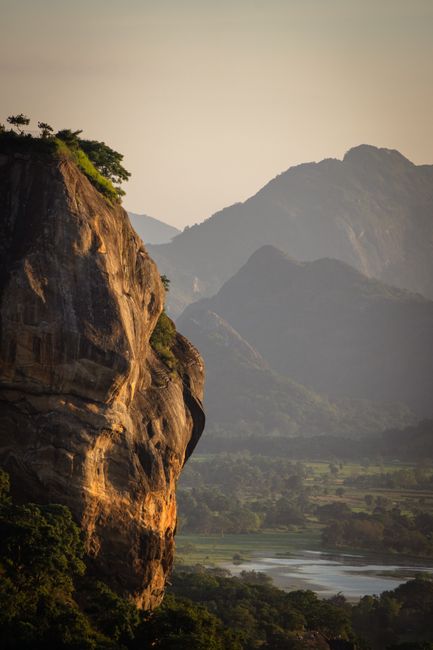
Sigiriya is a village in the dry plains of Sri Lanka’s Central Province, in the heart of the Cultural Triangle, and the site of the island’s most spectacular monument: Lion Rock, a sheer-sided column of granite rising about 180 m (590 ft) above the surrounding forest, with the ruins of a 5th-century royal palace on its summit. According to the Sri Lankan chronicles, King Kashyapa built his capital here after seizing the throne, surrounding the rock with water gardens, moats and ramparts, decorating its face with paintings of celestial maidens and guarding the final staircase with a gigantic lion, whose paws still flank the entrance. UNESCO inscribed the Ancient City of Sigiriya as a World Heritage Site in 1982. Today the village is a relaxed base of guesthouses, eco-lodges and paddy fields, ideally placed for the Dambulla cave temple, the ancient capitals of Polonnaruwa and Anuradhapura, and the elephant gatherings of Minneriya and Kaudulla national parks. The Cultural Triangle is driest from June to September and pleasant from January to April; the northeast monsoon and inter-monsoon rains fall mainly from October to December.
Right now in Sigiriya
- Wed23–32°C74–89°F6 mm rain
- Thu24–31°C75–89°F14 mm rain
- Fri23–31°C73–87°F19 mm rain
Top tours in Sigiriya
See all tours for Sigiriya →
From local operators, with prices and reviews; you check availability and book on Viator, our partner. We may earn a commission at no extra cost to you. How we earn money
Sigiriya at a glance
- Best for: Lion Rock and its frescoes, sunrise views from Pidurangala, the Cultural Triangle’s ancient cities and temples, and elephant safaris.
- How long: 2–3 days for Sigiriya, Dambulla and a safari; 4 with Polonnaruwa or Anuradhapura.
- Best time: January to September, with the driest weather from June to September; October to December is the rainy season here.
- Getting there: about 4–5 hours by car from Colombo or the airport, about 2.5–3 hours from Kandy; buses run via Dambulla.
- Getting around: by tuk-tuk, bicycle, car with driver and safari jeep.
- Fees to know: US$35 for foreign adults to climb Lion Rock, according to the Central Cultural Fund.
- Before you go: the ETA, the free-visa list, money and general safety are in our Sri Lanka travel guide.
Sigiriya’s areas and where to stay
Sigiriya is a small, spread-out village along the roads around the rock and its moats, with paddy fields, tanks (reservoirs) and scrub forest all around. Nearby towns offer more choice.
Sigiriya village
Guesthouses, homestays and small hotels line the road from the Inamaluwa junction to the rock and the lanes around the western entrance, many within walking or cycling distance of the ticket office. It is quiet at night, and a few simple restaurants serve rice and curry.
Around the tanks and forest
Eco-lodges and resorts set in the forest and beside the reservoirs around Sigiriya and nearby Kibissa offer pools, birdlife and views of the rock, best with a car or tuk-tuks.
Dambulla and Habarana
Dambulla, about 20 km (12 miles) southwest, is a market town on the main road, close to its cave temple, with more restaurants and banks. Habarana, about 25 km (15 miles) east, is a road junction near Minneriya and Kaudulla national parks, with several large resorts.
Where to stay in Sigiriya
- The village: guesthouses and homestays within reach of the rock, the budget choice.
- Forest and lake lodges: boutique eco-resorts with pools and wildlife.
- Dambulla: hotels in a town with more services.
- Habarana: resorts convenient for elephant safaris and Polonnaruwa.
Rooms are busiest from December to April and in August.
Top things to see in Sigiriya
Lion Rock (Sigiriya Rock Fortress)
The visit begins at the western entrance, crossing the moat into the symmetrical water gardens, with pools, fountains fed by underground channels that still flow after heavy rain, and island pavilions. Beyond them, the boulder gardens are scattered with caves and rock shelters once used by monks, and the terraced gardens climb to the foot of the rock. Stairs and metal walkways then lead up the rock face, past the frescoes and the Mirror Wall, to the Lion Terrace, where two giant paws carved from brick and plaster are all that remains of the lion gateway. The final steep staircase climbs to the summit, about 1.6 hectares (4 acres) of palace foundations, cisterns and terraces with views over the forest to the hills. There are about 1,200 steps in all; allow 2–3 hours and start early, as the rock is exposed and hot by mid-morning.
The frescoes and the Mirror Wall
Halfway up, a spiral staircase leads to a sheltered gallery where about 20 paintings of graceful, bare-shouldered women holding flowers, the famous Sigiriya maidens, survive from what may once have been hundreds. Photography of the frescoes is not allowed. Below them, the Mirror Wall, a gallery wall once polished to a shine, is covered with poems and comments scratched by visitors between about the 8th and 10th centuries, some of the earliest examples of Sinhala writing. On July 3, 2026, a section of later plaster on the outer face of the Mirror Wall’s northern end was found to be at risk of coming loose, and the Department of Archaeology and the Central Cultural Fund began urgent conservation work, according to the Central Cultural Fund; small sections may be roped off.
Lion Rock tickets and hours
According to the Central Cultural Fund’s price list, updated in September 2026, the ticket for foreign adults costs US$35 (11,690 rupees) and the half-price ticket for children US$20, including VAT; the fund also lists a separate Sigiriya Museum ticket at US$6. Tickets are sold at the site’s ticket office and on the fund’s eTicket website, and they are valid only on the day of issue. The site generally opens around 7 a.m., with last entry in the late afternoon; check the current hours locally.
Pidurangala Rock
About 1 km (0.6 miles) north, Pidurangala is a smaller rock with a Buddhist temple at its base and a reclining Buddha in a cave halfway up. A steep 30- to 45-minute climb, ending with a scramble over boulders, reaches a flat summit with the best view of Lion Rock, especially at sunrise. Wear proper shoes and cover shoulders and knees at the temple, which charges its own entry fee.
Sigiriya Museum
Near the ticket office, the site museum explains the history and engineering of Sigiriya, with models, finds from the excavations and reproductions of the frescoes. Visit it before the climb.
More classic sights
- Dambulla Cave Temple: five caves filled with Buddha statues and painted ceilings, a UNESCO World Heritage Site, about 30 minutes away.
- Sigiriya Wewa: the reservoir south of the rock, lovely for birdwatching and photos at sunset.
- Ritigala: forest monastery ruins on a jungle-covered mountain, about 1 hour north; foreign adults pay US$6, according to the Central Cultural Fund.
- Village tours: bullock-cart rides, canoe trips across village tanks and a home-cooked lunch, offered by many guesthouses.
Other things to do in Sigiriya
Elephant safaris
The national parks around Sigiriya are among the best places in Asia to see wild Asian elephants. At Minneriya and neighboring Kaudulla, about 30–45 minutes away, herds gather on the grasslands of the shrinking reservoirs in the dry season, peaking from about August to October in what is known as “the Gathering”. Hurulu Eco Park, near Habarana, is an alternative when the herds move. Jeeps, usually booked through hotels, take half-day afternoon trips; park permits are issued by the Department of Wildlife Conservation, which also sells them online.
Food and drink
Guesthouses and village restaurants serve some of Sri Lanka’s best home cooking: rice with a dozen curries of jackfruit, banana flower, pumpkin, lentils and freshwater fish, and buffalo curd with kithul treacle for dessert. Many offer cooking classes in their gardens. Restaurants are scattered, and alcohol is not sold on poya (full-moon) days.
Cycling, hot-air balloons and birdwatching
The flat lanes around Sigiriya are ideal for cycling between villages, tanks and the rock; most guesthouses rent bicycles. Hot-air balloon flights operate in the dry season. The forests and reservoirs are rich in birds, including the Sri Lanka junglefowl, hornbills, kingfishers and storks. See our cycling and hiking guides.
Day trips from Sigiriya
- Polonnaruwa: the medieval capital, with the Gal Vihara’s colossal rock-carved Buddhas, palaces and dagobas, about 1–1.5 hours east; foreign adults pay US$30, according to the Central Cultural Fund.
- Anuradhapura: the first great capital, with giant stupas and the sacred Bodhi tree, about 2–2.5 hours northwest; also US$30.
- Dambulla Cave Temple: the cave temple and its golden Buddha, 30 minutes away; often combined with Sigiriya in one day.
- Minneriya and Kaudulla national parks: afternoon jeep safaris for elephants.
- Kandy: the Temple of the Tooth, about 2.5–3 hours south. See our Kandy guide.
Nearby destinations
- Kandy75 km
- Nuwara Eliya110 km
- Ella124 km
- Colombo152 km
- Yala National Park176 km
- Galle222 km
- Mirissa226 km
Getting there and getting around
By car
Sigiriya is about 170 km (105 miles) from Colombo and the airport, a drive of 4–5 hours, partly on the Central Expressway, and about 2.5–3 hours from Kandy via Matale and Dambulla. Most visitors travel around the Cultural Triangle with a car and driver, which makes it easy to combine Sigiriya, Dambulla and Polonnaruwa.
By bus and train
Frequent buses run from Colombo and Kandy to Dambulla, where local buses and tuk-tuks continue to Sigiriya, about 30 minutes away. The nearest railway station is Habarana, on the line to Trincomalee and Batticaloa, about 30 minutes by tuk-tuk.
Around Sigiriya
Tuk-tuks are easy to hire for short trips and half-day tours; agree on the fare first. Bicycles suit the flat lanes near the rock. Safari jeeps collect you from your hotel.
When to go and how long to stay
The Cultural Triangle lies in Sri Lanka’s dry zone, hot all year with highs of 30–34 °C (85–93 °F). The main rains come from October to December, with the inter-monsoon storms and the northeast monsoon, and a shorter wet spell in April. June to September is driest, though hot and dusty, while January to March is green and pleasant. There is no long-term official weather station in Sigiriya itself, so the table uses the 1991–2020 climate normals for the Department of Meteorology’s station at Maha Illuppallama, about 35 km (22 miles) to the northwest, as submitted to the World Meteorological Organization (WMO): average daily highs and lows, total rain, and days with at least 1 mm of rain.
| Month | Average high / low | Rain (days with 1 mm or more) | What to expect |
|---|---|---|---|
| January | 30 °C (85 °F) / 21 °C (69 °F) | 92 mm (3.6 in), 7 days | Green and pleasant; occasional showers |
| February | 31 °C (89 °F) / 21 °C (70 °F) | 82 mm (3.2 in), 4 days | Mostly dry; busy season |
| March | 34 °C (93 °F) / 22 °C (72 °F) | 63 mm (2.5 in), 6 days | Hot and dry; climb early |
| April | 34 °C (93 °F) / 24 °C (75 °F) | 179 mm (7.0 in), 11 days | Afternoon storms; New Year holidays |
| May | 33 °C (91 °F) / 25 °C (77 °F) | 113 mm (4.5 in), 7 days | Hot; Vesak |
| June | 32 °C (90 °F) / 25 °C (77 °F) | 22 mm (0.9 in), 3 days | Dry, windy and dusty |
| July | 33 °C (91 °F) / 25 °C (76 °F) | 21 mm (0.8 in), 3 days | Dry; elephants begin to gather |
| August | 33 °C (91 °F) / 24 °C (76 °F) | 40 mm (1.6 in), 4 days | Dry; peak of the Gathering at Minneriya |
| September | 33 °C (92 °F) / 24 °C (76 °F) | 90 mm (3.5 in), 5 days | Dry; elephants at Minneriya and Kaudulla |
| October | 32 °C (89 °F) / 23 °C (74 °F) | 270 mm (10.6 in), 14 days | Rains return |
| November | 30 °C (87 °F) / 23 °C (73 °F) | 274 mm (10.8 in), 16 days | The wettest month |
| December | 29 °C (85 °F) / 22 °C (71 °F) | 209 mm (8.2 in), 12 days | Wet; quieter |
Maha Illuppallama receives about 1,450 mm (57 in) of rain a year, most of it from October to January.
Two days in Sigiriya
Day one, climb Lion Rock at opening time, visit the museum, rest through the heat and cycle to Sigiriya Wewa for sunset. Day two, sunrise on Pidurangala, then the Dambulla Cave Temple, and an afternoon elephant safari at Minneriya or Kaudulla.
Three to four days
Add a day trip to Polonnaruwa, or to Anuradhapura and Mihintale, and a village tour with a cooking class.
What a trip to Sigiriya costs
Prices are approximate, for October 2026, converted at about 330 rupees to the US dollar.
| Item | Typical cost |
|---|---|
| Lion Rock, foreign adult (child) | 11,690 LKR (US$35); child 6,680 LKR (US$20) |
| Polonnaruwa or Anuradhapura, foreign adult | 10,020 LKR (US$30) each |
| Pidurangala Rock entry | about 1,000–1,500 LKR (about US$3–4.50) |
| Jeep safari at Minneriya or Kaudulla, with park fees, per jeep | 20,000–35,000 LKR (about US$60–105) |
| Rice and curry at a guesthouse | 1,000–2,000 LKR (about US$3–6) |
| Bicycle rental, per day | 800–1,500 LKR (about US$2.40–4.50) |
| Tuk-tuk from Dambulla | 1,500–2,500 LKR (about US$4.50–7.50) |
| Guesthouse double | 6,000–15,000 LKR (about US$18–45) |
| Eco-lodge double | 30,000–80,000 LKR (about US$90–240) |
Practical tips for Sigiriya
- Climb early: be at the gate when it opens to beat the heat and the crowds.
- Bring water and a hat: there is little shade on the climb.
- Respect the frescoes: no photography in the fresco gallery, and do not touch the Mirror Wall.
- Mind the wasps: keep quiet near the rock face, where giant hornets nest, and follow staff instructions if the upper stairs are closed.
- Dress for temples: cover shoulders and knees at Pidurangala and Dambulla.
- Book safaris with your hotel: drivers know which park the elephants are using.
Safety
Sigiriya is peaceful and crime is rare. The main hazards are heat, heights and wildlife. The climb is steep, with metal stairways bolted to the rock; people with vertigo or heart conditions should consider stopping at the Lion Terrace. Giant hornets nest on the rock face and occasionally attack climbers when disturbed; staff may close the upper stairs, and visitors are asked to keep noise down. Wild elephants roam the forests and roads around Sigiriya, Habarana and Dambulla, especially at dusk and after dark: never approach or feed them, stay inside vehicles, keep a safe distance and avoid cycling or walking on forest roads at night. On safari, stay in the jeep and keep to the park’s rules. Heavy rain from October to December can flood roads and paths; follow Department of Meteorology forecasts. Snakes are present; watch your step in long grass. In an emergency, call 119 for police and 1990 for the Suwa Seriya ambulance.
What to pack for Sigiriya
Light, breathable clothes and shoes with grip for the rock, a hat, sunscreen and a refillable water bottle, clothes that cover shoulders and knees for temples, a flashlight for Pidurangala at sunrise, binoculars for safaris and birds, insect repellent, and a rain jacket from October to December. Sri Lanka uses 230 V, with British three-pin (type G) and round-pin (type D) sockets. See our hiking shoes and travel adapters guides.
Sigiriya travel FAQ
How much does it cost to climb Sigiriya?
US$35 (11,690 rupees) for foreign adults and US$20 for children, including VAT, according to the Central Cultural Fund’s September 2026 price list.
How long does it take to climb Sigiriya?
About 2–3 hours for the gardens, the climb of about 1,200 steps and the summit, at a steady pace with stops.
Is Sigiriya or Pidurangala better?
Do both if you can: Sigiriya for the history, frescoes and palace ruins, and Pidurangala for the view of Lion Rock itself, especially at sunrise.
What is the best time to visit Sigiriya?
January to September, and especially June to September, when it is driest. Arrive at opening time to avoid the heat.
Can I see elephants near Sigiriya?
Yes. Minneriya and Kaudulla national parks, 30–45 minutes away, are famous for elephant herds, especially from August to October.
Can you take photos of the Sigiriya frescoes?
No. Photography is not allowed in the fresco gallery; you can photograph the rest of the site.
How do I get from Kandy to Sigiriya?
By car in about 2.5–3 hours, or by bus to Dambulla and then by local bus or tuk-tuk to Sigiriya.
Is there a Cultural Triangle ticket that includes Sigiriya?
No. The Central Cultural Fund sells a separate ticket for each site, such as US$35 for Sigiriya and US$30 each for Polonnaruwa and Anuradhapura.
How many days do I need in Sigiriya?
Two days for Lion Rock, Pidurangala, Dambulla and a safari; three or four with Polonnaruwa or Anuradhapura.
Is the Sigiriya climb difficult?
It is steep but manageable for most people with reasonable fitness. The narrow metal stairways near the top can be hard for anyone afraid of heights.
Plan your trip
Partner links: TravelerCenter may earn a commission if you book, at no extra cost to you.
🇱🇰 Useful Sinhala phrases for Sigiriya
All 38 Sinhala phrases: restaurant, hotel, emergencies, romance (printable) →
Sources · last reviewed 4 October 2026
Researched and last reviewed on 4 October 2026. Ticket prices for Sigiriya, the museum, Polonnaruwa, Anuradhapura and Ritigala, ticketing rules and the July 2026 Mirror Wall conservation work: the Central Cultural Fund; national park permits: the Department of Wildlife Conservation; climate normals: Sri Lanka’s Department of Meteorology via the World Meteorological Organization’s 1991–2020 normals; exchange rate: the Central Bank of Sri Lanka. The history, the UNESCO inscription year, the rock’s height, the number of steps and frescoes, opening hours, Pidurangala’s fee, the elephant gathering season, travel times and typical prices are general references or estimates, flagged for checking. Prices and hours change, so check the official sites before you go. For entry rules, money and general safety, see our Sri Lanka travel guide.
Data: Weather: MET Norway (CC BY 4.0) · Rates: ECB · Costs: World Bank ICP and price levels · Wikidata (CC0)