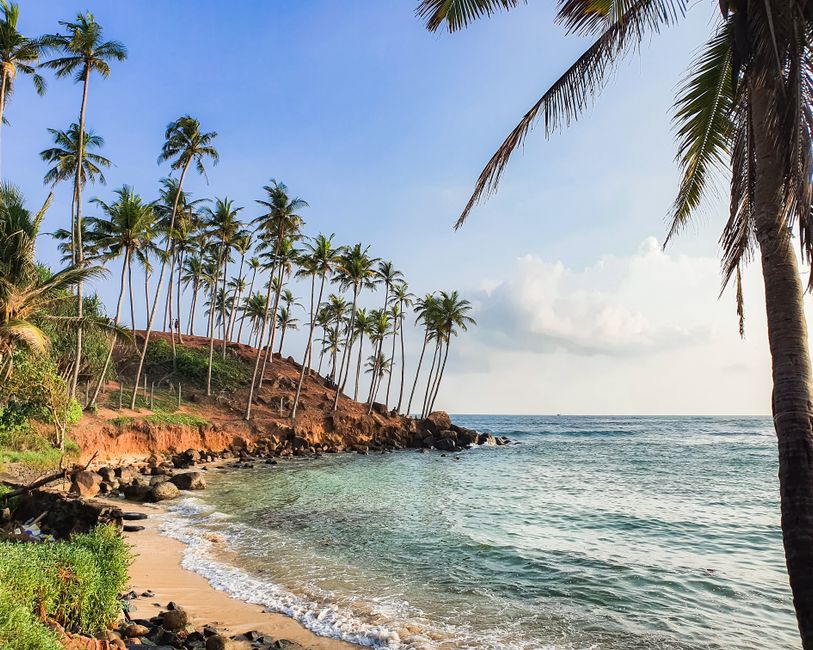
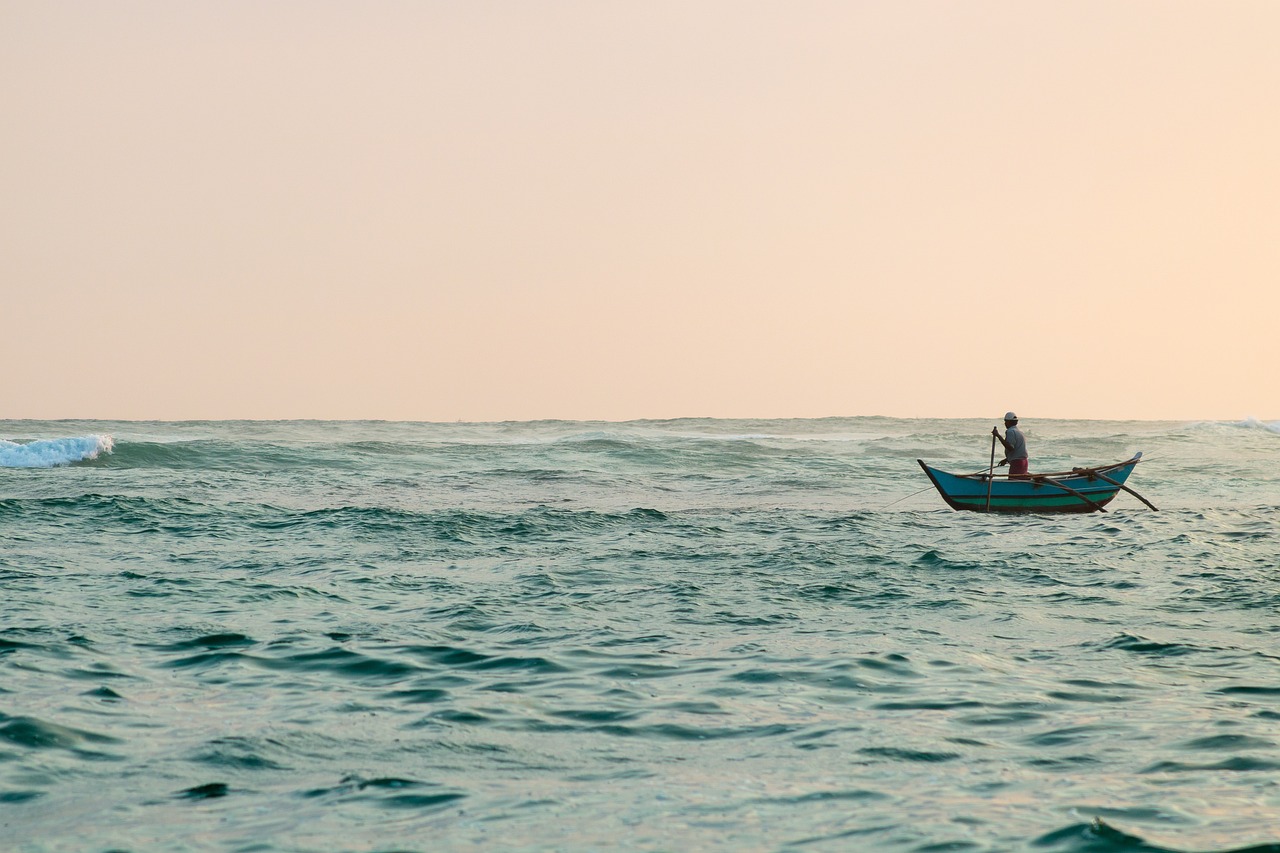
Mirissa is a small beach town on Sri Lanka’s south coast, about 35 km (22 miles) east of Galle, where a crescent of golden sand backed by palm trees curves between a rocky headland and a busy fishing harbor. It is best known as the island’s whale-watching capital: from the harbor, boats head out to the deep waters off Dondra Head, the southern tip of Sri Lanka, where blue whales, the largest animals on Earth, along with sperm whales and spinner dolphins, feed close to busy shipping lanes. The Sri Lanka Navy’s whale-watching project runs its south-coast season from November to April. Ashore, Mirissa is a laid-back mix of guesthouses, seafood restaurants and beach bars, with sunset views from Coconut Tree Hill and Parrot Rock, quiet coves nearby, and the surf breaks of Weligama next door. The beach is at its best from December to April; from May to September the southwest monsoon brings showers and big waves, when swimming is often unsafe and many boats stop running.
Right now in Mirissa
- Wed24–30°C75–86°F3 mm rain
- Thu24–29°C75–85°F9 mm rain
- Fri23–30°C74–86°F8 mm rain
Top tours in Mirissa
See all tours for Mirissa →
From local operators, with prices and reviews; you check availability and book on Viator, our partner. We may earn a commission at no extra cost to you. How we earn money
Mirissa at a glance
- Best for: whale and dolphin watching, beach days, surfing nearby, seafood dinners and sunsets.
- How long: 2–4 days, with a morning whale-watching trip.
- Best time: December to April, when the sea is calmer and whales are close; November is the start of the whale season; May to September brings rough seas.
- Getting there: about 2.5–3 hours from Colombo by the Southern Expressway, about 45 minutes from Galle, and about 4 hours from Ella; trains on the coastal line stop at Mirissa and nearby Weligama.
- Getting around: on foot along the beach, and by tuk-tuk, PickMe or bus along the coast road.
- Good to know: choose a whale-watching operator that follows Sri Lanka’s marine mammal regulations, and expect long hours at sea.
- Before you go: the ETA, the free-visa list, money and general safety are in our Sri Lanka travel guide.
Mirissa’s areas and where to stay
Mirissa is strung along the main coast road from Colombo to Matara, with the beach just below it and the harbor at its eastern end.
The beach
Guesthouses, small hotels and restaurants line the sand and the lanes leading down from the main road, with tables set out on the beach at night. It is the most convenient place to stay, but music from beach bars can carry late, especially on weekends.
The hillsides and inland lanes
On the slopes behind the coast road and around Coconut Tree Hill, villas and guesthouses offer quieter nights and views over the bay, a few minutes’ walk or a short tuk-tuk ride from the beach.
Weligama and Polhena
West of Mirissa, Weligama has a long, shallow bay with gentle waves for learning to surf, surf camps and larger hotels. East toward Matara, Polhena has a small reef lagoon popular for snorkeling.
Where to stay in Mirissa
- Beachfront: guesthouses and hotels on the sand, close to restaurants.
- Hillside: quieter villas and boutique guesthouses with sea views.
- Near the harbor: convenient for early whale-watching departures.
- Weligama: surf camps and resorts for surfers.
Rooms are scarce and prices high from mid-December to early January; book ahead.
Top things to see in Mirissa
Whale watching
The continental shelf drops away steeply off the south coast, so deep water rich in krill lies only a few kilometers offshore, and Dondra Head is one of the best places in the world to see blue whales. Sperm whales, Bryde’s whales and pods of spinner dolphins are also common, and occasionally orcas and false killer whales appear. The Sri Lanka Navy, which runs its own whale-watching cruises, schedules them from the south coast from November to April and from Trincomalee from May to October; Sri Lanka Tourism names Dondra Point, reached from Galle, Hikkaduwa and Mirissa, as an ideal location. Trips leave Mirissa harbor at about 6:30–7 a.m. and last 3–6 hours, depending on how far the whales are. Sightings are not guaranteed, and some operators offer a second trip free if you see none.
Whale-watching rules
Boats must follow Sri Lanka’s Sea Mammals Observation, Regulation and Control Regulations, which limit how close vessels may approach whales and dolphins and how they maneuver around them; the Sri Lanka Coast Guard monitors boats from the Mirissa harbor during the season, according to Sri Lanka Tourism. Choose an operator with life jackets for everyone, a sheltered deck and a crew that keeps its distance from the animals, and do not join trips that promise swimming with whales. Seasickness is common in the swell; take a tablet before you leave.
Coconut Tree Hill and Parrot Rock
At the eastern end of the bay, a grassy headland planted with a grove of coconut palms, Coconut Tree Hill, is one of the most photographed spots in Sri Lanka, best at sunrise or sunset. In the middle of the beach, Parrot Rock is a small rocky islet that you can wade to and climb at low tide for views back along the bay.
Secret Beach and the coves
A short tuk-tuk ride or a 20-minute walk west of the main beach, Secret Beach is a small cove with natural rock pools, calm in the dry season. Other small beaches lie along the coast toward Weligama.
More classic sights
- Mirissa fishing harbor: busy in the early morning, when the boats unload tuna and other fish.
- Dondra Head Lighthouse: Sri Lanka’s tallest lighthouse, at the island’s southern tip, about 20 minutes east.
- Matara Star Fort and Fort: small Dutch forts in the provincial town of Matara, about 20 minutes east.
- Turtle Beach: a stretch of shallow water where green turtles graze close to shore; watch from a distance and do not touch or feed them.
Other things to do in Mirissa
Food and drink
In the evening, restaurants along the beach display the day’s catch on ice, and you choose your fish, prawns or lobster to be grilled; ask the price per kilo first. Try a southern fish curry, kottu, and curd and treacle from roadside stalls, and fresh king coconuts during the day. Beach bars stay open late in the high season, though alcohol is not sold on poya (full-moon) days.
Surfing
Mirissa’s own reef breaks suit intermediate surfers, while Weligama bay, about 5 km (3 miles) west, has gentle, sandy-bottomed waves and many surf schools, making it one of the best places on the island to learn. The surf season on the south coast runs from about November to April. See our surfing guide.
Snorkeling and diving
In the calm months, snorkel around Parrot Rock and at Polhena’s reef lagoon, where turtles are common; dive centers in Mirissa and Weligama visit reefs and wrecks. See our snorkeling, diving and boat trips guides.
Turtle watching at Rekawa
About 1.5 hours east, near Tangalle, the beach at Rekawa is one of Sri Lanka’s most important nesting sites for sea turtles, and the Department of Wildlife Conservation lists it among its marine-tourism sites for turtle watching. Green turtles, olive ridleys and occasionally leatherbacks and hawksbills come ashore at night to lay their eggs, and a community conservation program takes small groups onto the beach with guides who keep visitors at a distance and ban flash photography. Nesting happens all year, peaking roughly from January to April. Avoid commercial “hatcheries” that keep turtles in tanks or let you handle them.
The low season
From May to September, Mirissa is much quieter: some restaurants close, prices fall and the beach is often too rough for swimming, but there are still plenty of sunny spells, the town is pleasantly uncrowded and surfers head for the sheltered corners. For whale watching in these months, travel to Trincomalee on the east coast instead.
Day trips from Mirissa
- Galle: the Dutch fort town and its ramparts, about 45 minutes west. See our Galle guide.
- Weligama and Ahangama: surf beaches and stilt fishermen, 10–30 minutes west.
- Tangalle and Hiriketiya: quieter beaches and a horseshoe surf bay, about 1 hour east.
- Mulkirigala Rock Temple: cave shrines on a rock outcrop inland, about 1.5 hours east.
- Yala National Park: leopards and elephants, about 2.5–3 hours east; better with a night. See our Yala guide.
Nearby destinations
- Galle29 km
- Nuwara Eliya118 km
- Ella122 km
- Colombo128 km
- Yala National Park133 km
- Kandy151 km
- Sigiriya226 km
Getting there and getting around
By road
Mirissa is about 150 km (95 miles) from Colombo. By car or expressway bus, the trip takes about 2.5–3 hours using the Southern Expressway, then a short drive down to the coast; from the airport, allow about 3.5 hours. Buses along the coastal Galle Road link Mirissa with Galle, Matara and Colombo, and many visitors arrive by car with driver from the hill country, via Ella and Wellawaya (about 4 hours), or from Yala.
By train
The coastal line from Colombo Fort to Matara has stations at Mirissa and Weligama; some express trains stop only at Weligama, about 10 minutes away by tuk-tuk. The journey from Colombo takes about 3–4 hours. Reserved seats are sold on Sri Lanka Railways’ seat-reservation website and at stations.
Around Mirissa
The beach is walkable from end to end. Tuk-tuks wait along the main road; agree on the fare first or use PickMe. Coast-road buses stop all along the bay. Scooters are easy to rent, but the coast road is fast and busy.
When to go and how long to stay
Mirissa is hot all year, with highs around 29–32 °C (84–89 °F). December to April is the main season, when the sea is calmer, the sun shines most days and the whale-watching boats run daily. November brings the first whales but still some rain. The southwest monsoon, from about May to September, brings showers, strong winds and big swells; many beaches are unsafe for swimming, and few whale-watching boats operate. October is usually the wettest month. There is no long-term official weather station in Mirissa itself, so the table uses the 1991–2020 climate normals for the Department of Meteorology’s Galle station, about 35 km (22 miles) to the west, as submitted to the World Meteorological Organization (WMO): average daily highs and lows, total rain, and days with at least 1 mm of rain.
| Month | Average high / low | Rain (days with 1 mm or more) | What to expect |
|---|---|---|---|
| January | 30 °C (86 °F) / 23 °C (74 °F) | 87 mm (3.4 in), 7 days | Dry and sunny; whales; peak season |
| February | 31 °C (87 °F) / 24 °C (75 °F) | 71 mm (2.8 in), 6 days | Calm seas; excellent whale watching |
| March | 32 °C (89 °F) / 25 °C (76 °F) | 90 mm (3.5 in), 7 days | Hot; blue whales still common |
| April | 31 °C (89 °F) / 25 °C (78 °F) | 202 mm (7.9 in), 12 days | End of whale season; afternoon storms |
| May | 30 °C (87 °F) / 26 °C (79 °F) | 316 mm (12.4 in), 17 days | Monsoon arrives; rough seas |
| June | 29 °C (85 °F) / 26 °C (78 °F) | 184 mm (7.2 in), 17 days | Windy and wet; strong currents |
| July | 29 °C (84 °F) / 25 °C (78 °F) | 173 mm (6.8 in), 15 days | Showers; big swells |
| August | 29 °C (84 °F) / 25 °C (78 °F) | 162 mm (6.4 in), 14 days | Similar to July |
| September | 29 °C (85 °F) / 25 °C (77 °F) | 261 mm (10.3 in), 17 days | Wet; quiet season |
| October | 29 °C (85 °F) / 25 °C (77 °F) | 344 mm (13.6 in), 18 days | The wettest month |
| November | 30 °C (86 °F) / 24 °C (76 °F) | 283 mm (11.1 in), 15 days | Whale season begins; showers easing |
| December | 30 °C (86 °F) / 24 °C (75 °F) | 176 mm (6.9 in), 11 days | Mostly dry; very busy at the holidays |
Galle records about 2,350 mm (92 in) of rain a year; Mirissa, a little farther east, is similar.
Three days in Mirissa
Day one, settle in, swim and climb Parrot Rock, then sunset at Coconut Tree Hill and a seafood dinner on the beach. Day two, an early whale-watching trip, an afternoon rest and Secret Beach. Day three, a surf lesson at Weligama or a trip to Galle Fort.
Four days or more
Add a day at Tangalle or Hiriketiya, or continue east to Yala for a safari.
What a trip to Mirissa costs
Prices are approximate, for October 2026, converted at about 330 rupees to the US dollar.
| Item | Typical cost |
|---|---|
| Whale-watching trip, per person | 15,000–30,000 LKR (about US$45–90) |
| Grilled fish dinner on the beach | 3,500–8,000 LKR (about US$10.50–24) per person |
| Rice and curry at a local restaurant | 800–1,500 LKR (about US$2.40–4.50) |
| Surf lesson with board, Weligama | 6,000–10,000 LKR (about US$18–30) |
| Surfboard rental, per day | 2,000–4,000 LKR (about US$6–12) |
| Tuk-tuk to Weligama | 800–1,500 LKR (about US$2.40–4.50) |
| Scooter rental, per day | 2,500–4,000 LKR (about US$7.50–12) |
| Guesthouse double | 7,000–18,000 LKR (about US$21–55) |
| Beach hotel double | 25,000–60,000 LKR (about US$76–180) |
Practical tips for Mirissa
- Pick a responsible whale-watching operator: look for life jackets, shade and crews that keep their distance from the whales.
- Go early and eat light: whale trips start around 7 a.m. and the swell can be big; take seasickness tablets beforehand.
- Swim between flags and where locals swim: currents can be strong even on calm-looking days.
- Ask fish prices first: beach restaurants price seafood by weight.
- Book ahead for the holidays: late December and early January are the busiest weeks.
- Respect the turtles: do not touch, feed or chase them.
Safety
Mirissa is relaxed and generally safe. The biggest danger is the sea: strong rip currents form along the beach, especially at the eastern end and during the southwest monsoon from May to September, when waves are large and swimming is often unsafe; drownings occur most years on Sri Lanka’s south coast. Swim only in calm conditions, near other people, and never after drinking. On whale-watching boats, wear the life jacket provided, stay seated in rough seas and protect yourself from the sun. The coast road is narrow and busy with fast buses; take care walking along it and on scooters, which should be ridden only by experienced, licensed riders with helmets. Keep valuables safe on the beach and in guesthouses. In case of a strong earthquake or sudden withdrawal of the sea, move inland or to high ground immediately, as the 2004 tsunami struck this coast. Dengue fever is present, so use insect repellent. In an emergency, call 119 for police and 1990 for the Suwa Seriya ambulance.
What to pack for Mirissa
Swimwear and a cover-up, reef-safe sunscreen, a hat and sunglasses, a light jacket and seasickness tablets for the whale-watching boat, water shoes for rocky coves, a rain jacket from April to November, and insect repellent. Sri Lanka uses 230 V, with British three-pin (type G) and round-pin (type D) sockets. See our water shoes, rain jackets and travel adapters guides.
Mirissa travel FAQ
When is the whale-watching season in Mirissa?
From November to April, according to the Sri Lanka Navy’s whale-watching project. From May to October, the whales are more often seen off Trincomalee on the east coast.
Can I see blue whales in Mirissa?
Yes. Blue whales are regularly seen off Dondra Head in season, along with sperm whales and spinner dolphins, though sightings are never guaranteed.
How long is a whale-watching trip in Mirissa?
About 3–6 hours, leaving the harbor around 6:30–7 a.m.
Is Mirissa beach safe for swimming?
In calm conditions from December to April, yes, with care. Rip currents are common, and the sea is often dangerous from May to September.
What is the best time to visit Mirissa?
December to April, for dry weather, calm seas and whale watching.
How do I get from Colombo to Mirissa?
By car or expressway bus in about 2.5–3 hours, or by the coastal train to Mirissa or Weligama in about 3–4 hours.
Is Mirissa good for surfing?
Mirissa has reef breaks for intermediate surfers; nearby Weligama is better for beginners. The season runs from about November to April.
How many days do I need in Mirissa?
Two to four days, including a whale-watching trip and time at the beach.
Is Coconut Tree Hill free?
It is a short walk from the east end of the beach and free to visit, although you may be asked for a small fee or donation by landowners.
Mirissa or Unawatuna?
Mirissa for whale watching, sunsets and nightlife; Unawatuna, near Galle, for a sheltered bay and easy trips to Galle Fort.
Plan your trip
Partner links: TravelerCenter may earn a commission if you book, at no extra cost to you.
🇱🇰 Useful Sinhala phrases for Mirissa
All 38 Sinhala phrases: restaurant, hotel, emergencies, romance (printable) →
Sources · last reviewed 4 October 2026
Researched and last reviewed on 4 October 2026. Whale-watching seasons and Navy cruises: the Sri Lanka Navy’s whale-watching project; Dondra Point and Coast Guard monitoring under the Sea Mammals Observation, Regulation and Control Regulations: Sri Lanka Tourism; Mirissa whale watching as a marine-tourism activity: the Department of Wildlife Conservation; climate normals for Galle: Sri Lanka’s Department of Meteorology via the World Meteorological Organization’s 1991–2020 normals; exchange rate: the Central Bank of Sri Lanka. Whale species, trip times, distances, surf season, travel times and typical prices are general references or estimates, flagged for checking. Prices and schedules change, so check the official sites before you go. For entry rules, money and general safety, see our Sri Lanka travel guide.
Data: Weather: MET Norway (CC BY 4.0) · Sea temperature: NOAA CoastWatch · Rates: ECB · Costs: World Bank ICP and price levels · Wikidata (CC0)