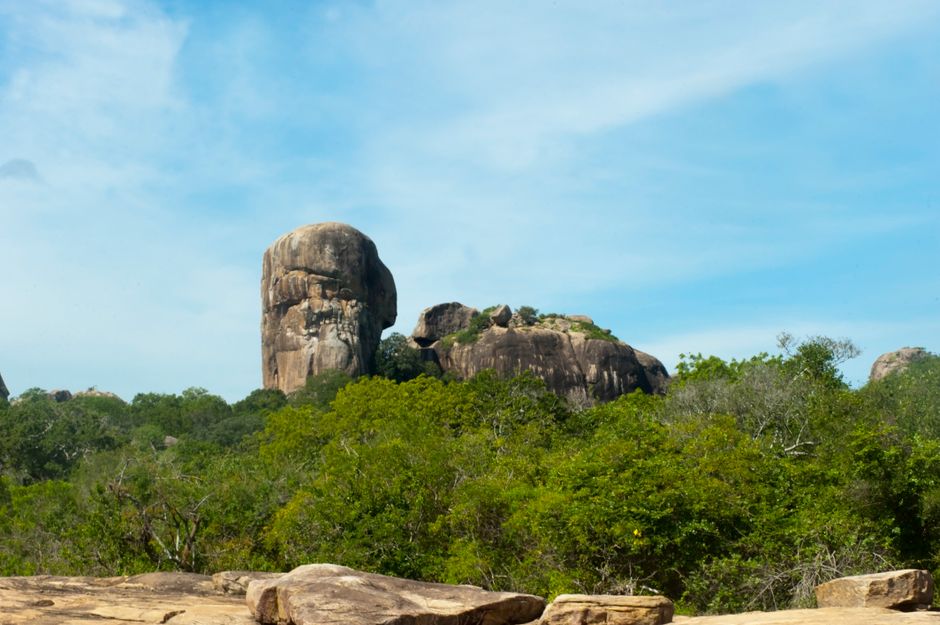
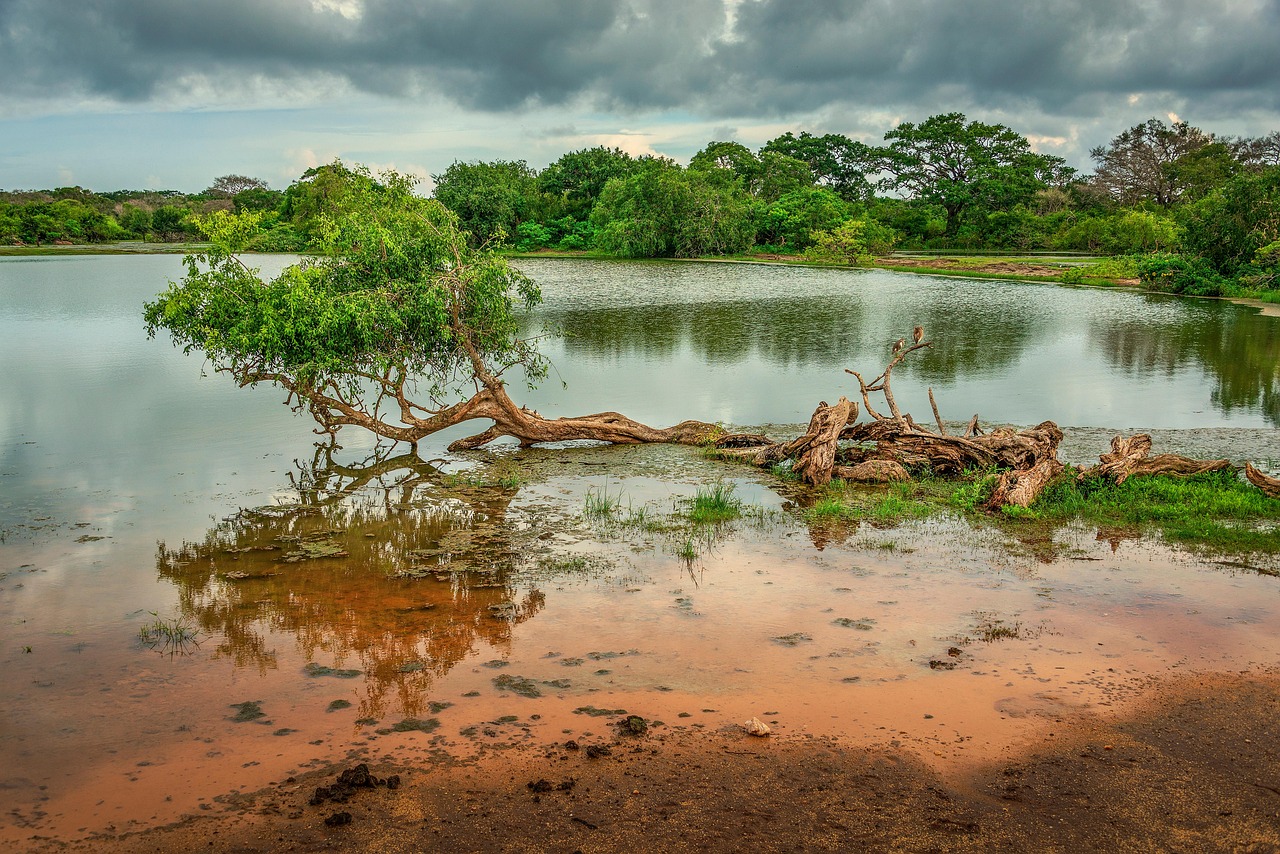
Yala National Park, in the dry southeast corner of Sri Lanka, is the island’s most visited national park and one of the best places in the world to see a wild leopard. Its scrub jungle, rocky outcrops, lagoons, grasslands and empty beaches stretch along the Indian Ocean between Hambantota and the east coast, covering, with the neighboring protected areas of the Yala complex, close to 1,000 km² (390 sq miles), divided into blocks. The most visited part is Block 1, near the town of Tissamaharama, where the Sri Lankan leopard is found at high densities alongside Asian elephants, sloth bears, mugger crocodiles, water buffalo, spotted deer, wild boar, jackals and peacocks; according to the Department of Wildlife Conservation, the park is home to 44 species of mammals and 215 species of birds. Visits are by jeep safari only, with a park tracker, at dawn and late afternoon. Yala is also a place of pilgrimage, with the ancient rock monastery of Sithulpawwa inside the park and the holy town of Kataragama nearby. Plan around the dry season: Blocks 1 and 2 were closed from September 14 to October 15, 2026, because of drought, and closures in the driest weeks are common.
Right now in Yala National Park (Palatupana)
- Thu25–30°C76–87°F5 mm rain
- Fri24–31°C75–89°F12 mm rain
- Sat23–31°C74–88°F11 mm rain
Top tours in Yala National Park
See all tours for Yala National Park →
From local operators, with prices and reviews; you check availability and book on Viator, our partner. We may earn a commission at no extra cost to you. How we earn money
Yala at a glance
- Best for: leopards, elephants, sloth bears and birdlife on jeep safaris, plus wild beaches, lagoons and the Sithulpawwa rock temple.
- How long: 1–2 nights, with two or three half-day safaris or a full day in the park.
- Best time: February to June and late October to December, when the animals are active and the park open; the driest months, August to October, are best for sightings but often bring closures of the main blocks.
- Getting there: Tissamaharama, the base town, is about 5–6 hours by road from Colombo, 2.5–3 hours from Ella and 2.5–3 hours from Mirissa; the main entrance, Palatupana, is about 20 km (12 miles) from Tissamaharama.
- Getting around: only by registered safari jeep, usually booked through your hotel, with a Department of Wildlife Conservation tracker.
- Fees: foreign visitors pay a per-person entry fee in US dollars, plus vehicle and service charges and VAT; see below.
- Before you go: the ETA, the free-visa list, money and general safety are in our Sri Lanka travel guide.
Fees, tickets and rules (as of October 2026)
Yala is managed by the Department of Wildlife Conservation (DWC). The main entrance to Block 1 is the Palatupana gate, about 20 km (12 miles) southeast of Tissamaharama, where the ticket office and a small visitor center are located; the Katagamuwa gate, north of Tissamaharama, also gives access to Block 1, and Block 5 is reached from the Lunugamvehera side.
Entry fees and permits
According to the Department of Wildlife Conservation, visitor fees in wildlife reserves were last revised by Extraordinary Gazette No. 2292/11 of August 2022, effective from September 2, 2022. Under that schedule, as widely reported, foreign adults pay US$25 per person per visit, with reduced rates for children, plus a vehicle charge, a service charge per group and 18% VAT; together these come to roughly US$40–50 per foreign adult for a half-day visit, before the cost of the jeep. Fees are charged in rupees at the official rate. Permits can be bought at the gate or in advance through the DWC’s online day-visitor permit system, which asks for your group, driver and vehicle details and issues a receipt with a QR code to show at the entrance. Most visitors leave it to their jeep driver, who pays at the gate and adds the fees to the bill; ask for an itemized receipt. The gazette itself could not be retrieved for this review, so check the current fee at the gate.
Opening hours
The park is generally open from about 6 a.m. to 6 p.m., and jeeps line up at the gate before dawn. Morning safaris usually run from about 5:30 or 6 a.m. to 10 or 11 a.m., and afternoon safaris from about 2:30 p.m. until closing; full-day safaris include a break at a designated rest area. All vehicles must be out by closing time.
Seasonal closures
The Department of Wildlife Conservation closes parts of Yala when drought leaves the animals short of water and food. In 2026, Blocks 1 and 2 were closed to visitors from September 14 to October 15, while Blocks 3, 4, 5 and 6 stayed open; local media quoted the department as saying that several water sources had dried up and that rangers were trucking about 200,000 liters of water a day into the park’s ponds. In earlier years, Block 1 has often closed for several weeks between September and October, so if you plan to visit then, check the latest notice and consider Block 5, Bundala or Udawalawe as alternatives.
The park’s key rules
- Stay in the vehicle at all times, except at designated rest areas and viewpoints.
- Keep to the tracks and the speed limit, and do not crowd or block animals; several jeeps converging on a leopard is a common problem, so ask your driver to keep a respectful distance.
- Do not feed animals, play music or shout, and take all your trash out with you.
- No pork products: in October 2024 the department banned raw pork and pork products in all national parks to protect wild boar from a disease outbreak in domestic pigs, until further notice.
- Leave before closing time and keep the tracker with you; drones need special permission.
The main areas of Yala
Block 1 (Ruhuna)
The original and most visited sector, with the highest density of leopards and the classic Yala landscapes: rocky outcrops where leopards rest, waterholes and tanks, open plains, lagoons with crocodiles and wading birds, and coastal dunes. It is also the busiest, with dozens of jeeps at peak times.
Patanangala and the coast
At Patanangala, a rock-strewn beach inside Block 1, a memorial recalls the visitors and staff killed when the Indian Ocean tsunami of December 26, 2004, swept away the park bungalow here. The rest area by the sea is a stop on many safaris.
Sithulpawwa Rock Temple
On the park’s northern edge, Sithulpawwa is a Buddhist monastery founded more than 2,000 years ago, with a stupa on a granite outcrop, cave shrines and ancient inscriptions; it is reached by road and remains an active place of pilgrimage. Dress modestly and remove your shoes.
Block 5 and the eastern blocks
Block 5, reached from Lunugamvehera, is quieter and greener, with good chances of elephants and sloth bears and fewer jeeps. The eastern blocks connect with Kumana National Park, sometimes called Yala East, famous for its bird colonies and reached from Arugam Bay.
Other stops in the park
- Leopard Rock and Elephant Rock: granite outcrops that make favorite lookouts for leopards.
- Buttuwa and Meynert’s tanks: waterholes where buffalo, elephants and birds gather.
- The Menik Ganga: the river along the park’s northern side, used by pilgrims walking to Kataragama.
Wildlife, safaris and seasons
Wildlife-watching
The Sri Lankan leopard, a subspecies found only on the island, is Yala’s star; with no tigers or lions, leopards are the top predator, and they are often seen resting on rocks or crossing tracks in the early morning and late afternoon. The department has used individual spot patterns to identify leopards in its research. Elephants are common, especially near water in the dry season; sloth bears are best seen from May to July, when the palu trees fruit; and the lagoons hold mugger and saltwater crocodiles, painted storks, pelicans, spoonbills and flamingos in some years. Peacocks, jungle fowl and hornbills are everywhere.
Choosing a safari
A half-day safari (morning or afternoon) is enough for most visitors; a full day allows a longer search for leopards and a visit to the coast. Book through your hotel or a reputable operator in Tissamaharama, and ask whether the jeep is shared or private, whether fees are included and whether the driver keeps to the rules. Smaller jeeps with fewer passengers give everyone a window seat. See our hiking guide for walks elsewhere in Sri Lanka; walking is not allowed in Yala.
Camping and park bungalows
The Department of Wildlife Conservation runs simple bungalows and campsites inside the park, bookable through its reservations system; demand is high, and the department issued a special notice on bungalow bookings in 2024. Private tented camps and lodges line the park boundary.
Around Yala
- Tissamaharama: the base town, with the large Tissa Wewa reservoir, birdlife at sunset and an ancient dagoba.
- Kataragama: a holy town sacred to Buddhists, Hindus and Muslims, about 20 km (12 miles) north, with evening ceremonies (pooja) and a festival in July or August.
- Kirinda: a fishing village with a temple on a rock above the beach, about 12 km (7.5 miles) south of Tissamaharama.
- Bundala National Park: a wetland of lagoons and salt pans west of Yala, known for wading birds and wintering flamingos.
- Udawalawe National Park: reliable elephant safaris, about 1.5–2 hours west.
- Mirissa and the south coast: beaches and whale watching, about 2.5–3 hours west. See our Mirissa and Galle guides.
Nearby destinations
Getting there
By car
From Colombo, the Southern Expressway runs to Hambantota, about 1.5 hours from Tissamaharama; the whole trip takes about 5–6 hours. From the hill country, the road from Ella drops through Wellawaya to Tissamaharama in about 2.5–3 hours, and from Mirissa or Galle the coast road takes about 2.5–3.5 hours. Most visitors come with a hired car and driver or by tuk-tuk from nearby towns.
By bus and air
Buses run to Tissamaharama from Colombo, Galle, Matara, Kataragama and Wellawaya, often with a change at Hambantota or Wellawaya. The nearest airport, Mattala Rajapaksa International (HRI), about 45 minutes away, has very few flights; most international visitors fly into Colombo.
Getting around: practical details
Inside the park, you must travel in a registered safari jeep; private cars are not allowed. Jeeps collect guests from hotels in Tissamaharama, Kirinda and the boundary camps about an hour before the gates open. The ride is bumpy and dusty, and the roofs are often open; bring a scarf or mask for the dust and sun protection. Tuk-tuks and buses link Tissamaharama with Kataragama and Kirinda.
When to go and how long to stay
Yala lies in Sri Lanka’s driest region, hot all year with highs around 30–32 °C (86–89 °F). Rain falls mainly with the inter-monsoon and northeast monsoon from October to January, peaking in November, with a smaller rise in April. From May to September, the southwest monsoon passes the park by and conditions become very dry, concentrating animals at waterholes; sightings are often best from August to early September, but this is also when drought closures of Blocks 1 and 2 are most likely. The park is green and lush after the rains, from December to March. There is no long-term official weather station in the park, so the table uses the 1991–2020 climate normals for the Department of Meteorology’s station at Hambantota, about 40 km (25 miles) west of Palatupana, as submitted to the World Meteorological Organization (WMO): average daily highs and lows, total rain, and days with at least 1 mm of rain.
| Month | Average high / low | Rain (days with 1 mm or more) | What to expect |
|---|---|---|---|
| January | 31 °C (88 °F) / 23 °C (74 °F) | 68 mm (2.7 in), 5 days | Green after the rains; busy season |
| February | 32 °C (89 °F) / 24 °C (74 °F) | 47 mm (1.9 in), 4 days | Dry and pleasant; good sightings |
| March | 32 °C (89 °F) / 24 °C (76 °F) | 47 mm (1.9 in), 4 days | Dry and hot; leopards active |
| April | 32 °C (89 °F) / 25 °C (78 °F) | 92 mm (3.6 in), 7 days | Some storms; New Year crowds |
| May | 31 °C (88 °F) / 26 °C (79 °F) | 73 mm (2.9 in), 7 days | Dry and windy; sloth bear season begins |
| June | 31 °C (88 °F) / 26 °C (78 °F) | 41 mm (1.6 in), 6 days | Dry; sloth bears and palu fruit |
| July | 32 °C (89 °F) / 25 °C (77 °F) | 31 mm (1.2 in), 4 days | Very dry; animals at waterholes |
| August | 31 °C (88 °F) / 25 °C (77 °F) | 59 mm (2.3 in), 6 days | Dry; excellent sightings; crowds |
| September | 30 °C (87 °F) / 25 °C (77 °F) | 100 mm (3.9 in), 8 days | Drought closures possible (in 2026 from September 14) |
| October | 31 °C (87 °F) / 25 °C (76 °F) | 128 mm (5.1 in), 10 days | Blocks 1–2 reopened October 16 in 2026; rains begin |
| November | 31 °C (87 °F) / 24 °C (75 °F) | 222 mm (8.7 in), 13 days | The wettest month; tracks can be muddy |
| December | 30 °C (87 °F) / 24 °C (75 °F) | 132 mm (5.2 in), 9 days | Green; holiday crowds |
Hambantota receives only about 1,040 mm (41 in) of rain a year, less than half as much as Colombo.
One day in Yala
Stay the night before in Tissamaharama, take a morning safari in Block 1 from dawn, rest through the heat, and visit Kataragama or Tissa Wewa in the late afternoon; or book a full-day safari with lunch in the park.
Two or three days
Add an afternoon safari, a visit to Block 5 or Bundala for birds, and the Sithulpawwa rock temple.
Where to stay
- Tissamaharama: guesthouses and hotels by the reservoir, with safari jeeps on call.
- Kirinda: a few guesthouses and boutique hotels near the coast.
- Park-boundary camps and lodges: tented camps and luxury lodges on the edge of Block 1, close to the gate.
- DWC bungalows and campsites: simple accommodation inside the park, booked through the department.
Rooms fill from December to April and in August; book ahead.
What a trip to Yala costs
Prices are approximate, for October 2026, converted at about 330 rupees to the US dollar.
| Item | Typical cost |
|---|---|
| Park entry, foreign adult, with service charge and VAT (2022 schedule) | about 13,000–16,500 LKR (about US$40–50) per visit |
| Half-day jeep hire (up to 6 people), excluding park fees | 12,000–20,000 LKR (about US$36–60) |
| Full-day jeep hire, excluding park fees | 25,000–40,000 LKR (about US$76–120) |
| Rice and curry in Tissamaharama | 800–1,500 LKR (about US$2.40–4.50) |
| Tuk-tuk from Tissamaharama to Kataragama | 2,000–3,500 LKR (about US$6–10.50) |
| Guesthouse double in Tissamaharama | 6,000–15,000 LKR (about US$18–45) |
| Tented camp or lodge, per night | 40,000–150,000 LKR (about US$120–455) |
Practical tips for Yala
- Check for closures: before booking in September and October, check the Department of Wildlife Conservation’s notices or ask your operator.
- Book a reputable jeep: ask about the vehicle, the number of passengers and whether fees are included.
- Start at dawn: the first hours after the gate opens give the best chance of leopards.
- Bring binoculars and a zoom lens: many animals are far from the tracks.
- Cover up against sun and dust: jeeps are open, and the park is hot.
- Be patient: leopards are never guaranteed; enjoy the elephants, birds and landscapes too.
Safety
Yala is safe for visitors who follow the rules. The key wildlife rules are simple: stay in the jeep, keep your arms and cameras inside near large animals, and never feed or provoke wildlife. Elephants, including bulls in musth, can charge vehicles; drivers should keep a safe distance and leave a clear escape route. Leopards and sloth bears are dangerous if surprised, which is why walking is not allowed. Jeeps sometimes speed and crowd around sightings, and accidents have happened; ask your driver to slow down if needed. Outside the park, wild elephants cross the roads around Tissamaharama and Kataragama, especially at dusk; drive slowly at night. Heat and dehydration are real risks, so carry water. Heavy rain from October to January can flood tracks and close parts of the park. The 2004 tsunami struck this coast; if you feel a strong earthquake on the coast, move inland. In an emergency, call 119 for police and 1990 for the Suwa Seriya ambulance.
What to pack for Yala
Neutral-colored, light clothes with long sleeves, a hat, sunglasses and sunscreen, a scarf or mask against the dust, binoculars and a camera with a zoom lens, a refillable water bottle, insect repellent and a light jacket for the early-morning drive. Sri Lanka uses 230 V, with British three-pin (type G) and round-pin (type D) sockets. See our travel adapters guide.
Yala travel FAQ
How much does it cost to enter Yala National Park?
Under the 2022 fee schedule, foreign adults pay US$25 per person plus vehicle and service charges and 18% VAT, roughly US$40–50 in total per visit, before the jeep hire. Check the current fee at the gate.
Is Yala National Park closed in September and October?
Parts of it often are. In 2026, Blocks 1 and 2 were closed from September 14 to October 15 because of drought, while Blocks 3 to 6 stayed open.
What is the best time to visit Yala?
February to July for good sightings with the park open; the driest months, August and September, are excellent for wildlife but bring a risk of closures.
Can I see leopards in Yala?
Yes. Block 1 has one of the highest leopard densities in the world, and sightings are common, though never guaranteed; early morning is best.
Morning or afternoon safari in Yala?
Both are good. Mornings are cooler and often best for leopards; afternoons give warm light. A full day maximizes your chances.
How do I book a Yala safari?
Through your hotel or a safari operator in Tissamaharama; the driver handles the park permit at the gate. You can also buy day permits through the Department of Wildlife Conservation’s online system.
Where should I stay for Yala?
Tissamaharama is the main base, about 20 km (12 miles) from the Palatupana gate; tented camps and lodges on the park boundary are closest.
Can I walk in Yala?
No. Visitors must stay in registered jeeps except at designated rest areas.
Can I bring food into Yala?
Yes, for full-day safaris, but take all trash out, never feed animals, and note that pork products are banned in national parks until further notice.
Is Yala or Udawalawe better?
Yala for leopards, sloth bears and varied landscapes; Udawalawe for almost guaranteed elephant sightings with fewer jeeps.
Plan your trip
Partner links: TravelerCenter may earn a commission if you book, at no extra cost to you.
🇱🇰 Useful Sinhala phrases for Yala National Park
All 38 Sinhala phrases: restaurant, hotel, emergencies, romance (printable) →
Sources · last reviewed 4 October 2026
Researched and last reviewed on 4 October 2026. The 2022 fee gazette, online day-visitor permits, the pork ban, bungalow reservations, Yala’s status as one of the most visited parks and the leopard identification research: the Department of Wildlife Conservation; the 2026 closure of Blocks 1 and 2, the water-trucking figure and species counts: local media quoting the Department of Wildlife Conservation; climate normals for Hambantota: Sri Lanka’s Department of Meteorology via the World Meteorological Organization’s 1991–2020 normals; exchange rate: the Central Bank of Sri Lanka. The foreign entry fee amount (the gazette could not be retrieved), park area, gate locations, opening and safari times, wildlife seasons, the tsunami memorial, distances, travel times and typical prices are general references or estimates, flagged for checking. Fees and rules change, so check the official sites before you go. For entry rules, money and general safety, see our Sri Lanka travel guide.
Data: Weather: MET Norway (CC BY 4.0) · Sea temperature: NOAA CoastWatch · Rates: ECB · Costs: World Bank ICP and price levels · Wikidata (CC0)