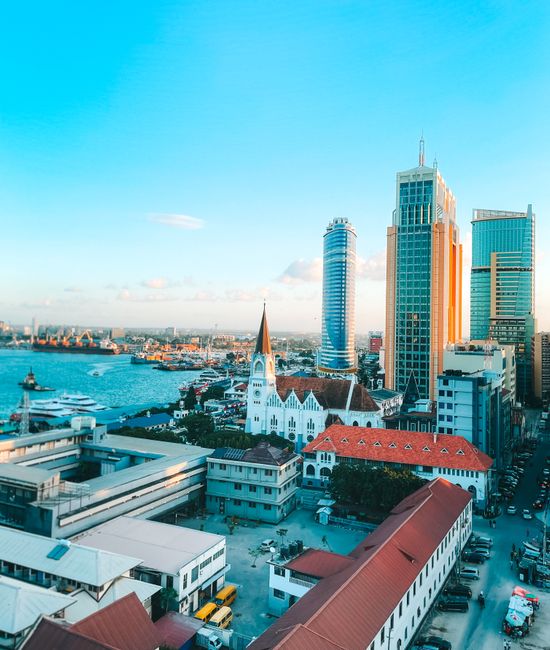
Dar es Salaam, Tanzania’s largest city and main port on the Indian Ocean, is a fast-growing metropolis of several million people, a former capital and the country’s commercial heart. Its name means “harbor of peace” in Arabic, and the city grew from a small 19th-century settlement founded by the Sultan of Zanzibar into a German and then British colonial capital, before the national government moved officially to Dodoma. For travelers, Dar is above all a gateway: its international airport is the busiest in Tanzania, fast ferries cross to Zanzibar in about two hours, the electric standard gauge railway heads inland toward Morogoro and Dodoma, and the city is the starting point for safaris in Mikumi and Nyerere national parks in the south. But it’s worth a day or two in its own right. Visit the National Museum, the chaotic Kariakoo Market, the morning fish auction at Kivukoni, colonial churches and the waterfront, and the colorful Tingatinga painters; eat Swahili street food and fresh seafood; and spend an afternoon on the beaches of the Msasani Peninsula, Kigamboni or the offshore islands of Bongoyo and Mbudya. Dar is hot and humid all year, so plan sightseeing for the mornings and evenings.
Right now in Dar es Salaam
- Wed 23–31°C 73–87°F 1 mm Mostly clear
- Thu 23–30°C 73–87°F 4 mm Light showers
- Fri 24–30°C 74–85°F 7 mm Rain
Weather: MET Norway (CC BY 4.0) · Sea temperature: NOAA CoastWatch
Top tours in Dar es Salaam
See all tours for Dar es Salaam →
From local operators, with prices and reviews; you check availability and book on Viator, our partner. We may earn a commission at no extra cost to you. How we earn money
Dar es Salaam at a glance
- Best for: connections to Zanzibar and southern safaris, markets, museums, Swahili food, island beaches and city life.
- How long: 1–2 days.
- Best time: June to October (drier and less humid) and January to February; March to May is the wettest.
- Getting there: Julius Nyerere International Airport (DAR), ferries from Zanzibar, the SGR train from Morogoro and Dodoma, and buses.
- Getting around: registered taxis, ride-hailing apps, bajaji and the rapid-transit buses.
- Good to know: buy ferry tickets only from official offices or operators’ websites, and use registered taxis.
- Before you go: the visa, insurance, money and general safety are in our Tanzania travel guide.
Dar es Salaam’s areas and where to stay
The city center and Kivukoni
The city center, along the harbor, has government buildings, banks, the ferry terminal, colonial churches, the National Museum and the Botanical Gardens. Kivukoni, at the harbor mouth, has the fish market and the old seafront. It’s busy by day and quiet at night.
Kariakoo
West of the center, Kariakoo is the market district, a maze of shops and stalls and the city’s commercial engine; it’s fascinating but very crowded.
Upanga and Masaki
Upanga, north of the center, is a residential area with Indian restaurants and the Aga Khan hospital. Masaki and Oyster Bay, on the Msasani Peninsula, are the upscale districts, with embassies, international hotels, restaurants, malls, the Slipway shopping center and sunset views over Msasani Bay.
Mikocheni, Mbezi Beach and the north
North along the coast, Mikocheni and Mbezi Beach have resort-style hotels and beaches, with boats to the islands of Mbudya and Bongoyo.
Kigamboni
Across the harbor mouth, reached by ferry or the Nyerere Bridge, Kigamboni has quiet beach hotels and long sandy beaches, a weekend escape from the city.
Where to stay in Dar es Salaam
- City center: for an early ferry to Zanzibar or business.
- Masaki and Oyster Bay: for restaurants, shopping and the safest-feeling streets.
- Mbezi Beach and Kigamboni: for beach hotels and a relaxed stay.
- Near the airport: for short stopovers.
A short history
Sultan Majid of Zanzibar founded Dar es Salaam in the 1860s as a mainland port and palace town, but it was the Germans who made it the capital of German East Africa in the 1890s, laying out the grid of streets, churches and offices you still see near the harbor. After the First World War, it became the capital of British-ruled Tanganyika, and in 1961 the capital of independent Tanganyika, which united with Zanzibar in 1964 to form Tanzania. The government decided in the 1970s to move the capital to Dodoma, a move completed in recent years, but Dar remains the country’s biggest city, port and business hub, and one of Africa’s fastest-growing cities.
Top things to see in Dar es Salaam
National Museum and House of Culture
The National Museum near the Botanical Gardens covers Tanzania’s history from early humans, including casts of hominid fossils from Olduvai Gorge, through the Swahili coast and colonial periods to independence, with ethnographic and art collections.
Kariakoo Market
The central market hall and the streets around it are packed with stalls selling fruit, spices, fabrics, household goods and everything else, in a whirl of handcarts and shouting traders. Go in the morning, with a local guide if you can, and keep your belongings secure.
Kivukoni Fish Market
At the harbor’s edge, the fish market is liveliest early in the morning, when catches are auctioned and cooked on the spot. It’s a great place for photos (ask first) and fried fish.
Colonial and religious architecture
Walk the center to see St. Joseph’s Cathedral, with its tall spire, the red-roofed Azania Front Lutheran Church facing the harbor, the Askari Monument, a bronze memorial to African soldiers of the First World War, and Indian and Arab-style houses with carved doors.
Village Museum
On the road to Bagamoyo, the open-air Village Museum displays traditional houses from Tanzania’s ethnic groups, with dance performances on some days.
Tingatinga art
Tingatinga, the bright, playful painting style of animals and village life founded by Edward Saidi Tingatinga in the 1960s, was born in Dar. The artists’ cooperative at Msasani sells paintings and lets you watch artists at work.
Other things to do in Dar es Salaam
Island beaches: Bongoyo and Mbudya
Small boats from the Msasani Peninsula and Mbezi Beach run to the uninhabited islands of Bongoyo and Mbudya, part of a marine reserve, with sandy beaches, snorkeling, grilled seafood shacks and walking trails. Go at high tide and check the return time. See our beaches and snorkeling guides.
Coco Beach and the waterfront
Coco Beach on the Msasani Peninsula is where locals come at weekends to eat grilled corn and cassava, play football and watch the sunset; the sea is rough and not great for swimming. Go in daylight with others.
Diving and boat trips
Dive centers on the Msasani Peninsula and in Kigamboni visit the reefs of the marine reserve, and sunset dhow cruises sail in Msasani Bay. See our diving and boat trips guides.
Food and drink
Dar is a great food city. On the street, look for mishkaki (grilled beef skewers), chipsi mayai (omelet with fries), mandazi and vitumbua (coconut rice cakes) for breakfast, roasted cassava and corn, and sugarcane juice. Restaurants serve Swahili pilau and biryani, coconut fish curries, ugali with fish or beans, and the city’s large Indian community has given it excellent curries, samosas and sweets. Seafood is fresh and cheap: try grilled octopus, prawns and kingfish at the waterfront. Wash it down with Tanzanian coffee, chai or a cold Safari or Kilimanjaro beer.
Day trips from Dar es Salaam
- Zanzibar: about 2 hours by fast ferry or 20–30 minutes by plane; better as a stay of several nights. See our Zanzibar guide.
- Bagamoyo: about 70 km (43 miles) north, a historic Swahili town and former caravan terminus with ruins, an old German boma, churches and the ruins of Kaole.
- Mikumi National Park: about 4–5 hours by road west, with elephants, lions and giraffes on open plains; TANAPA’s 2026/27 non-resident adult fee is TZS 76,650. Best with one or two nights.
- Nyerere National Park: Africa’s largest national park (formerly Selous), reached by road, light aircraft or train; TANAPA’s 2026/27 non-resident adult fee is TZS 178,850.
- Kigamboni beaches: across the harbor for a lazy day at a beach hotel.
Nearby destinations
- zanzibar73 km
- Diani Beach279 km
Getting there and getting around
By air
Julius Nyerere International Airport (DAR), about 12 km (7 miles) southwest of the center, has international flights from Europe, the Middle East (including via Dubai, Doha and Muscat), India and Africa, and domestic flights to Zanzibar, Kilimanjaro, Arusha, the southern parks and other cities. Use registered airport taxis or a hotel transfer; traffic into the city can be slow.
By ferry to Zanzibar
Fast catamarans to Zanzibar’s Stone Town leave from the ferry terminal on Sokoine Drive, in the center. The largest operator, Azam Marine (Kilimanjaro Fast Ferries), lists non-resident fares of US$35 in economy, US$40 in business, US$60 in VIP and US$100 in royal class, with child fares for ages 5 to 11; adults are 12 and over, and the luggage allowance is 25 kg (55 lb) per person. Book online or at the official ticket office, ignore touts at the port, and arrive early with your passport. The crossing takes about 2 hours, and seas can be rough. Remember that Zanzibar requires its own mandatory inbound travel insurance if it’s your first point of entry into Tanzania.
By train
The electric standard gauge railway (SGR) operated by Tanzania Railways Corporation (TRC) runs inland from Dar es Salaam to Morogoro and on to Dodoma, the capital, and is being extended west toward Tabora and Mwanza; buy tickets through TRC’s official channels. Morogoro is the jumping-off point for Mikumi.
By road
Long-distance buses leave from the Magufuli Bus Terminal at Mbezi for Arusha, Moshi, Mbeya and other cities. Roads are busy and long-distance buses have a poor safety record, so flights or the train are often better.
Getting around
The rapid-transit buses (DART) run on dedicated lanes between the center, Kariakoo and Kimara; they’re quick and cheap. Ride-hailing apps and registered taxis are the easiest option; agree fares with bajaji (tuk-tuks) before you get in. Traffic is heavy at rush hour.
When to go and how long to stay
Dar es Salaam is hot and humid all year, with highs of about 30–33 °C (86–91 °F) and warm nights. The long rains from about March to May are heavy, especially in April, and can cause local flooding. The short rains fall in November and December. June to October is the most comfortable time, slightly cooler and drier with a sea breeze; January and February are hot and fairly dry. The table uses Tanzania Meteorological Authority (TMA) climate normals for 1991–2020 for Dar es Salaam, as published by the World Meteorological Organization (WMO): average daily highs and lows, total precipitation and days with at least 1 mm of rain.
| Month | Average high / low | Rain (days with 1 mm or more) | What to expect |
|---|---|---|---|
| January | 32 °C (90 °F) / 25 °C (77 °F) | 54 mm (2.1 in), 4 days | Hot and humid; fairly dry; good beach weather |
| February | 33 °C (91 °F) / 24 °C (76 °F) | 71 mm (2.8 in), 4 days | Hottest month; mostly dry |
| March | 32 °C (90 °F) / 24 °C (75 °F) | 170 mm (6.7 in), 11 days | Long rains begin; very humid |
| April | 31 °C (88 °F) / 23 °C (74 °F) | 264 mm (10.4 in), 17 days | Wettest month; flooding possible |
| May | 30 °C (87 °F) / 22 °C (72 °F) | 172 mm (6.8 in), 11 days | Heavy showers easing |
| June | 30 °C (86 °F) / 20 °C (69 °F) | 31 mm (1.2 in), 4 days | Drier and less humid; pleasant |
| July | 30 °C (85 °F) / 19 °C (67 °F) | 16 mm (0.6 in), 3 days | Coolest month; breezy and dry |
| August | 30 °C (86 °F) / 19 °C (66 °F) | 18 mm (0.7 in), 3 days | Dry and comfortable; good for travel |
| September | 31 °C (87 °F) / 20 °C (67 °F) | 20 mm (0.8 in), 4 days | Dry and sunny; excellent |
| October | 32 °C (89 °F) / 21 °C (69 °F) | 77 mm (3.0 in), 5 days | Warming; short rains approach |
| November | 32 °C (89 °F) / 23 °C (73 °F) | 114 mm (4.5 in), 8 days | Short rains; showers |
| December | 32 °C (90 °F) / 24 °C (76 °F) | 110 mm (4.3 in), 8 days | Hot; showers; busy holidays |
One or two days in Dar es Salaam
With one day, visit the Kivukoni fish market early, walk past the churches and the Askari Monument, see the National Museum, have a Swahili lunch, and end with sunset at the Slipway in Masaki. With a second day, take a boat to Bongoyo or Mbudya island, or visit the Village Museum and the Tingatinga cooperative, with dinner at a seafood restaurant.
What a trip to Dar es Salaam costs
Prices are approximate, for October 2026, converted at about TZS 2,637 to the US dollar (Bank of Tanzania). Ferry fares are Azam Marine’s non-resident rates; park fees are TANAPA’s 2026/27 non-resident rates.
| Item | Typical cost |
|---|---|
| Fast ferry to Zanzibar, economy / business | US$35 / 40 (about TZS 92,300 / 105,500) |
| Mikumi National Park entry, adult per 24 hours | TZS 76,650 (about US$29) |
| Airport taxi to Masaki or the center | TZS 40,000–60,000 (about US$15–23) |
| Bajaji ride across town | TZS 3,000–8,000 (about US$1.1–3) |
| Street food (mishkaki, chipsi mayai) | TZS 3,000–8,000 (about US$1.1–3) |
| Seafood dinner in a mid-range restaurant | TZS 30,000–60,000 (about US$11–23) |
| Boat to Bongoyo Island, return | about US$20–40 including island fees |
| Mid-range hotel double, per night | about US$80–180 |
Practical tips for Dar es Salaam
- Book the ferry yourself: use the operator’s website or official office; ignore port touts.
- Use registered taxis: or ride-hailing apps, and check the driver and plate before you get in.
- Sightsee early: mornings are cooler and markets livelier.
- Carry shillings: small vendors and bajaji want cash or mobile money.
- Dress modestly: cover shoulders and knees away from hotels and beaches.
- No plastic bags: they’re banned in Tanzania.
Safety
Dar es Salaam has more street crime than the rest of Tanzania, so take city precautions. Bag snatching, sometimes from cars or motorbikes, and robbery have targeted visitors in the city center and on the Msasani Peninsula, including around Coco Beach and Toure Drive: walk against the traffic, keep bags away from the road and phones out of sight, don’t carry large amounts of cash or wear expensive jewelry, and avoid walking alone or at night. Use only registered taxis or ride-hailing apps; don’t accept lifts from strangers or people offering to find you a taxi, and be wary of new acquaintances who suggest going somewhere together. Keep car doors locked and windows up in traffic. At the ferry port, aggressive touts sell tickets; buy only from the official offices, and don’t board a vessel that looks overloaded. Avoid demonstrations and crowds, and don’t photograph police, military sites, government buildings or protests. Malaria and dengue are present in Dar; use repellent day and night and ask about antimalarials. Swim only at beaches where locals do, and watch for currents. In an emergency, call 112.
What to pack for Dar es Salaam
Light, breathable cotton or linen clothes that cover shoulders and knees, a sun hat, sunglasses, high-factor sunscreen, insect repellent, comfortable sandals and walking shoes, swimwear for the islands, a light rain jacket from March to May, a crossbody bag that closes securely, and a power adapter: Tanzania uses 230 V with type D and G sockets. See our travel adapters and water shoes guides.
Dar es Salaam travel FAQ
How do I get from Dar es Salaam to Zanzibar?
By fast ferry from the terminal on Sokoine Drive in about 2 hours, or by a 20–30 minute flight.
How much is the ferry to Zanzibar?
Azam Marine lists non-resident fares of US$35 in economy, US$40 in business, US$60 in VIP and US$100 in royal class.
Do I need insurance to go to Zanzibar from Dar?
Tanzania’s compulsory inbound insurance is bought for your first point of entry; if you entered the mainland first, you buy the mainland policy, not a second one for Zanzibar.
Is Dar es Salaam the capital of Tanzania?
No. Dodoma is the official capital; Dar is the largest city and the commercial center.
Is Dar es Salaam worth visiting?
For a day or two, yes: markets, museums, food and island beaches make a good stopover between safari and Zanzibar.
Is Dar es Salaam safe?
Most visits are trouble-free with city precautions: use registered taxis, don’t walk at night, and keep valuables hidden.
Where should I stay in Dar es Salaam?
Masaki and Oyster Bay for restaurants and comfort, the center for an early ferry, or Mbezi Beach and Kigamboni for the beach.
Can I take a train from Dar es Salaam?
Yes. The electric SGR runs to Morogoro and Dodoma, operated by Tanzania Railways Corporation.
What is the best time to visit Dar es Salaam?
June to October, when it’s drier and less humid; avoid April, the wettest month.
Can I go on safari from Dar es Salaam?
Yes. Mikumi is 4–5 hours by road, and Nyerere National Park is reached by road, air or train.
Sources and last review
Researched and last reviewed on 5 October 2026. Ferry fares, child ages, luggage allowance and booking channels: Azam Marine; Mikumi and Nyerere fees: Tanzania National Parks (TANAPA) 2026/27 tariff data; Zanzibar’s inbound insurance: the Zanzibar Insurance Corporation; the SGR routes and extensions: Tanzania Railways Corporation; crime hotspots and precautions, taxis, ferry touts and safety, protests and photography, plastic bags, the first-port-of-entry insurance rule and emergency numbers: the UK government’s factual entry and safety pages, used for practical facts only; malaria and dengue: the US CDC; climate normals: the Tanzania Meteorological Authority via the World Meteorological Organization’s 1991–2020 normals (Dar es Salaam station); the exchange rate: the Bank of Tanzania. City history, neighborhoods, museums, markets, Tingatinga, islands, airport distance, ferry and road journey times, bus terminal, DART and typical prices are general references or estimates, flagged for checking. Prices and rules change, so check locally before you go. For the visa, insurance, money and general safety, see our Tanzania travel guide.
Plan your trip
Partner links: TravelerCenter may earn a commission if you book, at no extra cost to you.
🇹🇿 Useful Swahili phrases for Dar es Salaam
All 38 Swahili phrases: restaurant, hotel, emergencies, romance (printable) →