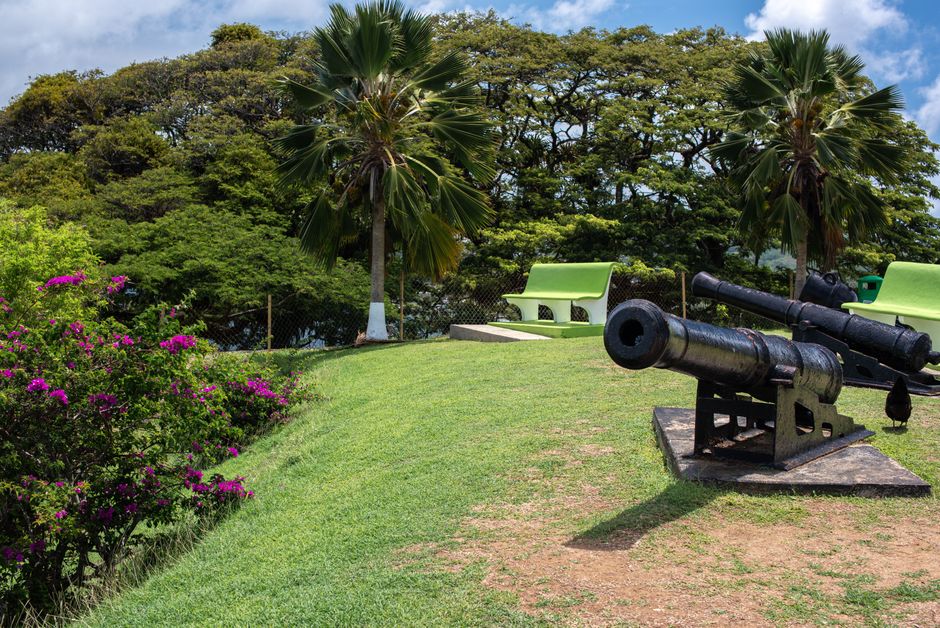
Trinidad and Tobago is the southernmost nation in the Caribbean, a two-island republic just off the coast of Venezuela, with about 1.37 million people. The two islands could hardly be more different. Trinidad, the large one, is busy, multicultural and energetic: it is the home of Carnival, of the steelpan, the national instrument, and of calypso and soca music, and its capital, Port of Spain, wraps around the huge green Queen’s Park Savannah. Beyond the city are the rainforested hills of the Northern Range, the surf beach of Maracas Bay, the scarlet ibis of the Caroni Swamp, the hummingbirds of the Asa Wright Nature Centre and the bubbling asphalt of the Pitch Lake. Tobago, the small island to the northeast, is calm and green, with the famous thatched jetty of Pigeon Point, the snorkeling of Buccoo Reef and the Nylon Pool, fishing villages such as Castara and Speyside, and the Main Ridge Forest Reserve, established in 1776 and described by UNESCO as the world’s oldest tropical rainforest reserve. English is the official language, the currency is the Trinidad and Tobago dollar (TT$), and everyone arriving completes an online arrival card before travel. Carnival 2027 falls on February 8 and 9, and the dry season runs from January to May.

Right now in Trinidad and Tobago
- Wed25–31°C77–88°F2 mm rain
- Thu24–31°C75–88°F1 mm rain
- Fri24–27°C76–81°F7 mm rain
Multi-day tours of Trinidad and Tobago
Multi-day tours from local operators. You check dates and book on Viator, our partner; we may earn a commission at no extra cost to you. How we earn money
Trinidad and Tobago at a glance
Trinidad and Tobago covers about 5,128 km² (1,980 square miles), almost all of it on Trinidad; Tobago is about 300 km² (116 square miles) and lies roughly 20 miles (about 32 km) to the northeast. Trinidad sits on the continental shelf of South America, separated from Venezuela by the Gulf of Paria, so its wildlife is partly South American, with far more bird and butterfly species than most Caribbean islands. The country became independent from Britain in August 1962, when the Union Flag was lowered outside the Red House in Port of Spain for the last time. Tobago has its own regional government, the Tobago House of Assembly, which runs much of the island’s tourism through the Tobago Tourism Agency.
Trinidad’s people descend from Africans, Indians, Europeans, Chinese, Syrians and Lebanese, Venezuelans and the islands’ First Peoples, and the calendar shows it: Carnival, Emancipation Day, Indian Arrival Day, Divali, Eid and Phagwa are all celebrated widely. English is the official language, alongside a lively Trinidadian and Tobagonian Creole. The currency is the Trinidad and Tobago dollar (TTD, written TT$). The islands keep Atlantic Standard Time, UTC−4, all year, with no daylight saving time. Cars drive on the left. Sockets are the North American type, at about 115 V and 60 Hz, so most North American plugs fit without an adapter. The international dialing code is +1 868.
Trinidad and Tobago’s regions
- Port of Spain and the northwest: the capital on the Gulf of Paria, with the Savannah, the Magnificent Seven mansions, the Royal Botanic Gardens and Fort George, and, to the west, the Chaguaramas peninsula with its marinas, boardwalk and boat trips “down the islands.”
- The north coast and the Northern Range: the forested mountains behind the capital, with Maracas Bay, Las Cuevas and the waterfalls and birding lodges of the Arima Valley, including the Asa Wright Nature Centre.
- Central Trinidad: the Caroni Swamp and its scarlet ibis, the old sugar lands, the Temple in the Sea at Waterloo and the 85-foot Hanuman statue at Carapichaima, and Chaguanas, the biggest market town.
- The south and east: San Fernando, the La Brea Pitch Lake, the long Atlantic beaches of Manzanilla and Mayaro on the east coast, and turtle-nesting beaches at Matura and Grande Riviere in the northeast.
- Tobago: the resort and beach area of Crown Point in the southwest, around the airport, Pigeon Point and Store Bay; Scarborough, the capital, with Fort King George; the quiet Caribbean-coast villages of the north; and Speyside and Charlotteville in the far northeast, with Little Tobago island.
Where to go: Carnival city, rainforest and island beaches
Most visitors split their time between Trinidad, for Carnival, culture, food and nature, and Tobago, for beaches, reefs and rainforest; a 25-minute flight or a ferry crossing links the two. See our guides:
- Port of Spain: the capital and the heart of Carnival, with the Queen’s Park Savannah, the Magnificent Seven, the Red House, the Royal Botanic Gardens, Fort George, street food, and day trips to Maracas Bay, the Caroni Swamp and the Northern Range.
- Tobago: the smaller island, with Pigeon Point and Store Bay, Buccoo Reef and the Nylon Pool, Fort King George in Scarborough, the Main Ridge rainforest, Argyle Falls, Castara, Englishman’s Bay, Speyside and Little Tobago.
Other highlights on Trinidad include the Asa Wright Nature Centre, a former cocoa and coffee estate in the Arima Valley, famous among birders; the Caroni Swamp, where flocks of scarlet ibis, the national bird, fly in to roost at dusk; the La Brea Pitch Lake, about 40 hectares (100 acres) of natural asphalt; the Temple in the Sea at Waterloo; the Hanuman statue at Carapichaima; Mount St. Benedict, the oldest monastery in the region, founded in 1912, above St. Augustine; and the east-coast beaches of Manzanilla and Mayaro.
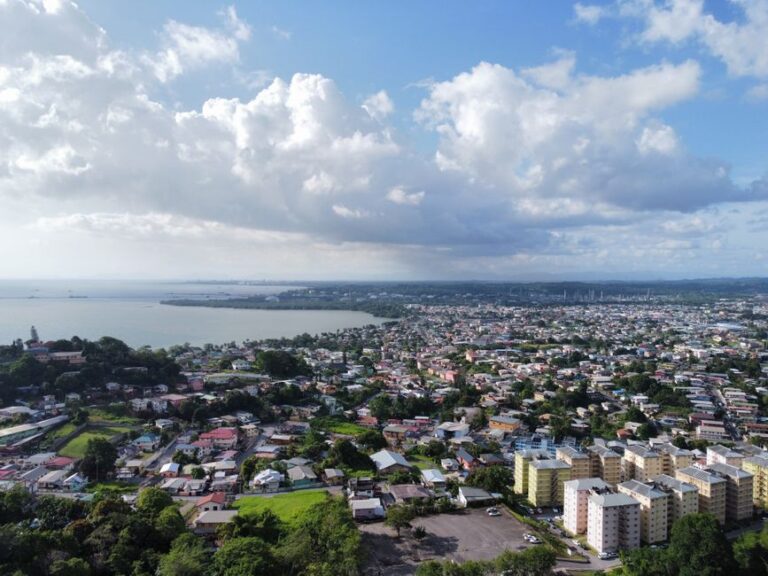
Port of Spain Travel Guide
Plan a visit to Port of Spain, Trinidad's capital and Carnival city: the Queen's Park Savannah, the Magnificent Seven mansions, the Red House, the…
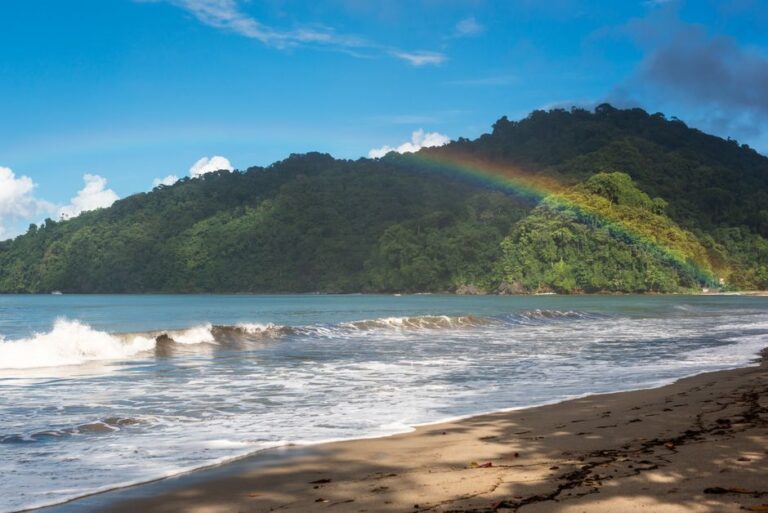
Tobago Travel Guide
Plan a trip to Tobago: Pigeon Point and Store Bay, Buccoo Reef and the Nylon Pool, Fort King George in Scarborough, the Main Ridge…
Beyond Port of Spain and Tobago’s beaches
Maracas Bay and the north coast
The North Coast Road climbs over the Northern Range from Port of Spain, with lookouts over the Caribbean, and drops to Maracas Bay, possibly the most popular beach in Trinidad, according to Tourism Trinidad, about 30 minutes from the capital. It is a wide, palm-fringed bay with energetic waves, lifeguards, paid parking and the stalls selling bake and shark, fried shark in a fluffy fried bread, with a choice of sauces and salads. A little farther east, Las Cuevas is calmer and quieter. Waves on the north coast can be strong, so swim where lifeguards are on duty and follow their advice.
The Arima Valley and the Asa Wright Nature Centre
The Asa Wright Nature Centre, in the hills above Arima, is one of the Caribbean’s best-known birding lodges, with a veranda overlooking feeders visited by hummingbirds, honeycreepers, toucans and motmots, guided trails through the rainforest and, nearby, a cave where oilbirds roost. Day visits and overnight stays are possible. The surrounding Northern Range has hiking trails and waterfalls, among them the falls in the Aripo valley, and is best explored with a local guide.
The Caroni Swamp and central Trinidad
Just south of Port of Spain, licensed operators run late-afternoon boat tours through the mangrove channels of the Caroni Swamp Bird Sanctuary, managed by the Forestry Division, to watch the scarlet ibis fly in to roost on the islands of the lagoon, alongside herons and egrets; you may also see tree boas and caimans. Farther south, on the Gulf of Paria at Waterloo, the Temple in the Sea stands on a causeway, built by an indentured laborer, Siewdass Sadhu, and nearby at Carapichaima the 85-foot (26 m) statue of Lord Hanuman, described by Tourism Trinidad as the largest Hanuman murti outside India, rises over the Dattatreya temple. Both are free to visit; dress modestly.
The south: San Fernando and the Pitch Lake
At La Brea, in the southwest, the Pitch Lake covers about 40 hectares of natural bitumen that rises to the surface and cools into asphalt, the largest natural deposit of its kind in the world, according to Tourism Trinidad. Guided walks from the visitor center, open Monday to Friday, explain its history and show the small pools of water on its surface. San Fernando, Trinidad’s second city, is the gateway to the south.
Chaguaramas and down the islands
West of Port of Spain, the Chaguaramas peninsula has a seaside boardwalk, a military history museum, marinas full of yachts, hiking trails, a golf course and boat trips to the small islands of the Bocas, between Trinidad and Venezuela, collectively known as “down the islands.” It is a popular weekend escape for Port of Spain residents.
Best time to visit Trinidad and Tobago
Trinidad and Tobago is hot all year, with highs of 31–33 °C (88–91 °F) and warm nights. According to the Trinidad and Tobago Meteorological Service, there are two seasons: the dry season, from January to May, with strong trade winds, warm days and cooler nights, and the wet season, from June to December, hot and humid, with heavier showers and thunderstorms; late May and December are transition months. Even in the wet season, mornings are often sunny, with showers in the afternoon. The hurricane season runs from June to November, peaking from August to October, within the wet season; Trinidad lies on the southern edge of the Atlantic hurricane belt and is affected directly less often than Tobago. Carnival, in February or early March, is the peak season on Trinidad, and Christmas, Easter and the July–August holidays are busy on Tobago.
The table shows averages for Piarco, the international airport about 25 km (16 miles) east of Port of Spain, from the World Meteorological Organization’s (WMO) climate normals for 1991–2020, rounded. Tobago is a little cooler by day and drier overall; see our Tobago guide.
| Month | Average high / low | Rain (days with 1 mm or more) | What to expect |
|---|---|---|---|
| January | 31 °C (88 °F) / 22 °C (72 °F) | 80 mm (3.1 in), 11 days | Dry season begins; Carnival fetes and calypso tents |
| February | 31 °C (88 °F) / 22 °C (72 °F) | 49 mm (1.9 in), 8 days | Dry and breezy; Carnival (February 8–9, 2027) |
| March | 32 °C (90 °F) / 23 °C (73 °F) | 41 mm (1.6 in), 6 days | Driest and sunniest month; Phagwa in some years |
| April | 33 °C (91 °F) / 24 °C (74 °F) | 52 mm (2.0 in), 6 days | Hot and dry; Easter goat and crab races on Tobago |
| May | 33 °C (91 °F) / 24 °C (76 °F) | 109 mm (4.3 in), 11 days | Hot; rains begin late in the month; Indian Arrival Day (May 30) |
| June | 32 °C (89 °F) / 24 °C (76 °F) | 243 mm (9.6 in), 19 days | Wet season begins; hurricane season starts |
| July | 32 °C (90 °F) / 24 °C (75 °F) | 229 mm (9.0 in), 19 days | Showers and sunshine; Tobago Heritage Festival |
| August | 33 °C (91 °F) / 24 °C (75 °F) | 255 mm (10.1 in), 18 days | Wettest month on Trinidad; Emancipation Day (August 1); Independence Day (August 31) |
| September | 33 °C (91 °F) / 24 °C (75 °F) | 179 mm (7.1 in), 14 days | Hottest days; often a short dry spell; storm risk at its peak |
| October | 33 °C (91 °F) / 24 °C (75 °F) | 193 mm (7.6 in), 15 days | Hot and humid; Tobago’s October Carnival and Blue Food Festival |
| November | 32 °C (89 °F) / 24 °C (74 °F) | 223 mm (8.8 in), 17 days | Wet; Divali in some years; wettest month on Tobago |
| December | 31 °C (88 °F) / 23 °C (73 °F) | 149 mm (5.9 in), 15 days | Transition to the dry season; parang music and Christmas |
The rainfall at Piarco totals about 1,800 mm (71 in) a year; March is the driest month and August the wettest. According to Tourism Trinidad, the sea stays between 24 and 29 °C (75–84 °F) all year. The Meteorological Service issues heat alerts in the hottest spells, mostly in April–May and August–October, and notes that hot days are now far more common than in the 1990s, so plan outdoor activities for the morning and late afternoon.
Carnival 2027
Trinidad’s Carnival is one of the biggest and best-loved in the world. According to Tourism Trinidad, the 2027 Carnival days are Monday, February 8, and Tuesday, February 9, ending on Ash Wednesday, February 10. The season begins just after Christmas, with fetes (parties), calypso tents, steelpan rehearsals in the panyards, stick-fighting and band launches, and it builds to a long weekend of events, centered on the stage at the Queen’s Park Savannah:
- Panorama: the steelpan competition, with the finals on the Saturday before Carnival; according to Tourism Trinidad, 60 to 80 bands take part, each with 75 to 200 players.
- Dimanche Gras: on the Sunday night, with the finals of the Kings and Queens of Carnival costume competition and the Calypso Monarch.
- J’Ouvert: from 4 a.m. on Carnival Monday, when revelers dance through the streets covered in paint, mud and oil.
- Playing mas: on Monday and Tuesday, thousands of masqueraders in costume parade through Port of Spain with their bands, crossing the stage at the Savannah.
To take part, you join a mas band and buy a costume, usually months in advance; hotels and guesthouses in Port of Spain fill early and raise their prices, and many require minimum stays. See our Port of Spain guide for practical tips.
Other festivals and events
- Buccoo Goat and Crab Race Festival: on Tobago on Easter Tuesday (April 7 in 2026), with goats racing down a track with their jockeys and crabs coaxed to the finish line.
- Tobago Jazz, Music and Golf Weekend: in early May (May 1–3 in 2026).
- Indian Arrival Day: May 30, marking the arrival of the first indentured workers from India in 1845.
- Tobago Heritage Festival: from mid-July to August 1 (July 16 to August 1 in 2026), with storytelling, folk music and re-enactments such as the Ole Time Wedding in Tobago’s villages, ending with the Emancipation Day parade.
- Emancipation Day: August 1, and Independence Day: August 31.
- Great Race: in August (August 15 in 2026), a powerboat race from Trinidad to Tobago, with beach parties at the finish.
- Tobago Blue Food Festival: in October (October 18, 2026) at Bloody Bay, celebrating dasheen and other root crops.
- Tobago Carnival: the island’s own October carnival, from October 30 to November 1, 2026, according to the Tobago Tourism Agency.
- Divali, Eid and Phagwa: Hindu and Muslim festivals whose dates follow the lunar calendars; Divali, the festival of lights, usually falls in October or November.
How long to stay: sample itineraries
- A cruise day in Port of Spain: the Savannah and the Magnificent Seven, the Royal Botanic Gardens and the view from Fort George or the Lady Young Lookout, then lunch on bake and shark at Maracas Bay.
- 4 days: two days in Port of Spain, with a city tour, Maracas Bay and a sunset boat trip in the Caroni Swamp; a day at the Asa Wright Nature Centre; and a day in Chaguaramas or on the Temple in the Sea and Hanuman statue circuit.
- 7 days: three days on Trinidad as above, then fly to Tobago for four days: Pigeon Point and a glass-bottom boat trip to Buccoo Reef and the Nylon Pool, a guided hike in the Main Ridge, Argyle Falls and Fort King George, and a drive along the Caribbean coast to Castara and Englishman’s Bay.
- 10 days or more: add the Pitch Lake and the south, the east-coast beaches, a night or two in Speyside or Charlotteville for diving and Little Tobago, and, from March to September, a guided night watch for nesting leatherback turtles.
Entry, money and costs
The online arrival card (as of October 2026)
Since March 17, 2026, according to the Ministry of Homeland Security, everyone arriving in or leaving Trinidad and Tobago by air or sea, citizens and visitors alike, must complete an online Arrival and Departure (AD) card at travel.gov.tt, the government’s platform, which replaced the paper forms. You create an account, fill in the form, upload a photo of your passport’s data page and enter your flight details, up to 72 hours before travel; you then receive a receipt with a QR code to show to immigration officers, on your phone or printed. It is worth printing a copy in case of technical problems. The platform is available in several languages, and staff at the airports and airlines can help travelers who have difficulty using it. You need a separate card for your departure.
Passports and visas
According to Tourism Trinidad, you need a passport valid for six months after your date of departure and a return or onward ticket, and visas are not required for most nationalities for stays of up to 90 days. US citizens do not need a visa for visits of up to 90 days, according to the Tobago Tourism Agency; most other nationalities can also visit for up to 90 days without a visa, but check your own nationality on the official immigration site. Some nationalities need a visa, which is applied for online through the Immigration Division’s eVisa service; stays can be extended at the Immigration Division. According to the Tobago Tourism Agency, a yellow fever vaccination certificate is required only if you arrive from, or spend more than 12 hours in transit in, a country with a risk of yellow fever. Rules change, so check the Immigration Division and your own government’s information before you travel.
Money and cards
The currency is the Trinidad and Tobago dollar (TTD, TT$), divided into 100 cents. It trades at about TT$6.80 to US$1, the figure used by Tourism Trinidad and the Tobago Tourism Agency (the Central Bank of Trinidad and Tobago’s selling rate was about 6.79 in early October 2026). US dollars are widely accepted, at around that rate, though change usually comes in TT dollars; euros and pounds are much less widely accepted. International credit cards (Visa and Mastercard) are accepted at most hotels, restaurants and malls, and ATMs are common, though bank fees apply; carry cash for street food, small shops, maxi taxis and beach facilities. Traveler’s checks are not accepted. On Tobago, banks generally open from 8 a.m. to 2 p.m. Monday to Thursday and 8 a.m. to 5 p.m. on Friday, according to the Tobago Tourism Agency; branches in shopping malls keep longer hours. Use banks and licensed exchange bureaus (cambios) to change money.
Taxes, service charges and tipping
According to Tourism Trinidad, prices are subject to 12.5% value-added tax (VAT), hotels add a 10% hotel tax, and a 10% service charge is often added in hotels and restaurants, so read your bill. Where no service charge is included, a tip of 10–15% in restaurants is customary, and taxi drivers, tour guides and boat crews appreciate a tip for good service.
What a trip costs
Prices are approximate, for October 2026, in Trinidad and Tobago dollars, with US dollar equivalents at about TT$6.80 to US$1. Carnival prices are much higher.
| Item | Typical cost |
|---|---|
| Inter-island ferry, adult, economy, one way | TT$75 (about US$11) |
| Inter-island ferry, adult, premium, one way | TT$150 (about US$22) |
| Bus ride on Tobago | TT$3–8 |
| Bake and shark at Maracas Bay | TT$40–70 (US$6–10) |
| Doubles (street breakfast), each | TT$7–10 |
| Dinner for two at a mid-range restaurant, without wine | TT$500–900 (US$75–130) |
| Caroni Swamp boat tour | TT$150–250 (US$22–37) |
| Rental car, per day | US$45–80 |
| Mid-range hotel double, per night | US$120–220 |
| Beach resort double on Tobago, high season, per night | US$200–450 |
A comfortable trip with a mid-range hotel, a rental car or taxis, tours and meals out costs roughly US$150–250 per person per day for two people sharing, outside Carnival. Street food, maxi taxis and guesthouses make Trinidad good value for budget travelers.
Getting there and getting around
Flights
Piarco International Airport (POS), about 25 km (16 miles) east of Port of Spain, is the main gateway. Caribbean Airlines, the national airline, flies there from North America and around the Caribbean, and, according to the Tobago Tourism Agency, the airport is also served by American Airlines, JetBlue, United, Frontier, Air Canada, British Airways, KLM and Copa Airlines. Tobago’s A.N.R. Robinson International Airport (TAB), at Crown Point, has a few direct international flights, including British Airways from London Gatwick and Caribbean Airlines from New York JFK and Barbados, and seasonal winter flights from Germany have been offered by Condor. Authorized airport taxis charge set fares, displayed in the arrivals hall at Piarco.
Between Trinidad and Tobago
Two ways connect the islands, about 20 miles apart. The air bridge: Caribbean Airlines flies between Piarco and Tobago many times a day, in about 25 minutes, according to the Tobago Tourism Agency; book early for weekends, holidays and Carnival. The inter-island ferry, run by the Trinidad and Tobago Inter-Island Transportation Company (TTIT), sails between Port of Spain and Scarborough every day on fast passenger ferries; Tourism Trinidad gives a crossing time of about 3 to 7 hours, depending on the vessel and the sea. The earliest sailings leave both ports at 6:30 a.m. on most weekdays and the last passenger sailings at 4 p.m., according to TTIT, with fewer on Wednesdays. Adult fares are TT$75 one way in economy and TT$150 in premium class. Check in at the terminal at least two hours before departure (the counter closes 45 minutes before sailing), with your original ticket and your physical passport; tickets bought online are valid only for the date booked.
Cruise ships and yachts
Cruise ships dock at the cruise ship complex in the Port of Port of Spain, a short walk from downtown, and at Scarborough on Tobago; Tourism Trinidad advises cruise visitors to book tours with registered operators and guides. Chaguaramas is one of the Caribbean’s main yachting centers, and yachts also anchor at Store Bay and Charlotteville on Tobago. Everyone arriving by sea also completes the online arrival card.
Getting around
Driving is on the left. Visitors with a valid foreign license can drive for up to three months, according to Tourism Trinidad; reserve a rental car early for Christmas and Carnival. Roads in rural areas and on Tobago are narrow and winding, with hairpin bends and potholes, seatbelts are compulsory, and using a hand-held phone while driving is against the law. Traffic around Port of Spain is heavy at rush hours. Licensed taxis have license plates beginning with “H” (for hire); fares are not metered, so agree on the price before you set off. Maxi taxis, minibuses color-coded by route, run fixed routes at set fares, and route taxis (shared cars) pick up along main roads; the Public Transport Service Corporation (PTSC) runs the public buses. Ride-hailing apps operate on Trinidad. On Tobago, taxis, rental cars, scooters and island-wide buses (TT$3–8) are available.
Beaches, rainforest and wildlife
Tobago has the classic Caribbean beaches: Pigeon Point, with its thatched jetty, managed as a heritage park with an entrance fee; Store Bay, with food stalls and boats to Buccoo Reef; the calm bays of Mount Irvine, Castara, Englishman’s Bay and Parlatuvier on the Caribbean coast; and Pirate’s Bay near Charlotteville. Trinidad’s beaches face the open sea: Maracas and Las Cuevas on the north coast, and the long, wild Atlantic beaches of Manzanilla and Mayaro in the east. Swim where there are lifeguards, especially on the Atlantic coast, where currents can be strong.
Under water, Tobago’s reefs, washed by nutrient-rich currents, are rich in sponges and corals, including what the Tobago Tourism Agency calls the world’s largest known brain coral, off Speyside, with turtles, rays, nurse sharks and big schools of fish; dive sites include London Bridge, Kelleston Drain, Mount Irvine Wall and the wreck of the MV Maverick, and Tobago has a hyperbaric chamber. On land, Tobago has more than 260 bird species, according to the Tobago Tourism Agency, and the Main Ridge Forest Reserve, protected since 1776, is the heart of the North-East Tobago Biosphere Reserve, designated by UNESCO in 2020. Trinidad, with its South American wildlife, has even more birds, from the scarlet ibis of Caroni to the oilbirds and hummingbirds of the Northern Range. From March to September, giant leatherback turtles nest on the beaches of both islands; Tobago’s nesting population is the third largest in the world, according to the Tobago Tourism Agency. Watch only with a licensed guide or permit, without flashlights or flash photography. See our beaches, snorkeling, diving, hiking and boat trips guides.
Culture, food and everyday etiquette
A short history
The islands were home to Amerindian peoples when Columbus sighted Trinidad in 1498. Spain held Trinidad for three centuries, inviting French Catholic planters and their enslaved Africans from the 1780s, before Britain took it in 1797; Tobago changed hands between the Dutch, French, British and others many times before becoming British in the early 19th century. The two islands were joined as one colony in 1889. After slavery was abolished in the 1830s, indentured workers came from India, beginning in 1845, and from China and elsewhere, creating today’s mix of cultures. Oil and natural gas, found in the south in the early 20th century, made Trinidad one of the wealthiest countries in the Caribbean. Trinidad and Tobago became independent on August 31, 1962, and a republic in 1976.
Music
The steelpan, the national instrument, was born in Port of Spain’s neighborhoods in the 1930s and 1940s from oil drums; visit a panyard in the weeks before Carnival to hear the big steel orchestras rehearse. Calypso, with its witty lyrics, and soca, its faster dance-floor descendant, are the soundtrack of Carnival, while parang, sung in Spanish with guitars and cuatros, fills the Christmas season, and chutney music blends Indian and Caribbean rhythms.
Food and drink
Trinidad is one of the Caribbean’s great food destinations, with street food on every corner. Try doubles, two soft fried flatbreads with curried chickpeas and pepper sauce, the classic breakfast; bake and shark at Maracas Bay; roti, a flatbread wrapped around curried goat, chicken, shrimp or vegetables; pelau, rice cooked with pigeon peas and caramelized chicken; callaloo, a soup of dasheen leaves and okra; pholourie (fried split-pea dough balls) with tamarind sauce; and corn soup from the stalls around the Savannah at night. On Tobago, the signature dish is curried crab and dumplings, and bread and cakes are still baked in clay ovens. Drink fresh coconut water, sorrel at Christmas, mauby (a bitter bark drink), local beers and Trinidad’s rums; the House of Angostura, maker of the famous bitters, is in Laventille. Pepper sauces can be very hot, so ask for “slight pepper.”
Etiquette
Greet people with a “good morning” or “good afternoon” before asking a question. “Liming” means hanging out, and you will be invited to plenty of limes. According to Tourism Trinidad, wearing camouflage clothing of any kind is illegal, as it is reserved for the military, and public nudity is prohibited; keep swimwear for the beach. Evening dress in restaurants is “elegantly casual,” and some government buildings, such as the Red House, do not admit visitors in shorts, sleeveless tops or flip-flops. Dress modestly and remove your shoes when visiting temples and mosques, and ask before photographing people.
Health, practical tips and connectivity
A few practical points:
- Everyday precautions: Tourism Trinidad advises visitors not to leave bags, cameras or valuables unattended or in view in cars, to avoid carrying large amounts of cash or flashy jewelry, to use hotel safes and licensed “H” taxis, to avoid isolated areas after dark, and to use official tour guides; ask your hotel for advice about the area you are staying in.
- At Carnival: travel with your band or in a group, carry only what you need, and drink plenty of water.
- Driving: drive on the left and take care on narrow, winding roads, especially at night and on Tobago, where taxis stop without warning.
- Sun and heat: the UV index can reach 12, according to the Tobago Tourism Agency; use SPF 50 sunscreen, a hat and sunglasses, and drink water.
- Mosquitoes: dengue occurs in the Caribbean, so use insect repellent; Tourism Trinidad recommends long sleeves and trousers on mangrove and rainforest tours.
- The sea: follow the advice of lifeguards, and watch for strong currents on Atlantic-facing beaches.
- Storms: from June to November, follow forecasts from the Trinidad and Tobago Meteorological Service and the instructions of your hotel and local authorities, and have travel insurance that covers disruption and medical evacuation.
- Emergencies: call 999 for the police, 990 for the fire service and 811 for an ambulance; on Tobago, emergency relief is also on 211, according to the Tobago Tourism Agency.
The two mobile networks, bmobile and Digicel, both offer 4G and roaming; check your plan’s roaming rates, or buy a local SIM or eSIM. Wi-Fi is widely available in hotels, restaurants and malls, and bmobile’s free bzone Wi-Fi hotspots require registration. North American plugs fit the 115 V sockets; others will need a travel adapter, and Tourism Trinidad suggests bringing one in any case, as some outlets supply 220–230 V.
Things to do: Carnival, steelpan, birds and beaches
Play mas or watch the bands cross the stage at Carnival; hear the steel orchestras at Panorama or in a panyard; walk around the Queen’s Park Savannah and its Magnificent Seven mansions; eat doubles for breakfast and bake and shark at Maracas Bay; watch the scarlet ibis fly in to roost in the Caroni Swamp; spot hummingbirds at the Asa Wright Nature Centre; walk on the Pitch Lake; visit the Temple in the Sea; snorkel Buccoo Reef and swim in the Nylon Pool; relax at Pigeon Point; hike the Main Ridge rainforest and bathe in the pools of Argyle Falls; dive the reefs off Speyside; and watch leatherback turtles nesting on a moonlit beach. See our city sightseeing, beaches, snorkeling, diving, hiking and surfing guides.
What to pack
Light cotton clothes, swimwear and a cover-up, a sun hat, sunglasses and reef-safe sunscreen, sandals and water shoes for rocky beaches and river pools, sturdy hiking shoes for the rainforest trails, a light rain jacket in the wet season, long sleeves and insect repellent for mangrove and forest tours, and something smarter for dinner. Leave anything camouflage-patterned at home. For Carnival, bring comfortable shoes for the road, old clothes for J’Ouvert and a waterproof pouch for your phone.
Trinidad and Tobago travel FAQ
When is Trinidad Carnival 2027?
Carnival Monday and Tuesday are February 8 and 9, 2027, according to Tourism Trinidad, with J’Ouvert in the early hours of Monday, Dimanche Gras on Sunday, February 7, and the Panorama steelpan finals on the Saturday before.
Do I need to fill in an arrival card for Trinidad and Tobago?
Yes. Since March 17, 2026, all passengers arriving or departing by air or sea must complete the online Arrival and Departure card at travel.gov.tt, up to 72 hours before travel, and show the QR code receipt at immigration.
Do I need a visa for Trinidad and Tobago?
Most nationalities, including US, Canadian, UK and EU citizens, do not need a visa for stays of up to 90 days; you need a passport valid for six months beyond your departure and a return or onward ticket. Other nationalities apply online for an eVisa.
How do I get from Trinidad to Tobago?
Fly with Caribbean Airlines on the air bridge, about 25 minutes, or take the TTIT ferry from Port of Spain to Scarborough, which takes about 3 hours or more; adult ferry fares start at TT$75 one way.
What is the best time to visit Trinidad and Tobago?
The dry season, January to May, has the most sunshine and includes Carnival. The wet season, June to December, brings afternoon showers, lower prices outside holidays, the turtle-nesting season (until September) and Tobago’s festivals.
Is Trinidad and Tobago in the hurricane belt?
It lies on the southern edge of the Atlantic hurricane basin. According to the Meteorological Service, Trinidad is affected directly less often than Tobago, but tropical storms passing nearby bring heavy rain to both islands between June and November.
What currency is used in Trinidad and Tobago?
The Trinidad and Tobago dollar (TT$), about TT$6.80 to US$1. US dollars are widely accepted, but change is given in TT dollars, and cards are accepted at most hotels, restaurants and malls.
Which island is better for beaches, Trinidad or Tobago?
Tobago, with its calm Caribbean bays, Pigeon Point and reefs. Trinidad’s beaches, such as Maracas, are wilder and wavier, and the island is best for Carnival, culture, food and birdwatching. Most visitors combine the two.
Where can I see the scarlet ibis?
On a late-afternoon boat tour of the Caroni Swamp Bird Sanctuary, about 30 minutes south of Port of Spain, when the birds fly in to roost. Tours are run by licensed operators.
What side of the road do they drive on in Trinidad and Tobago?
The left. Visitors can drive with a valid foreign license for up to three months.
What are the emergency numbers in Trinidad and Tobago?
999 for the police, 990 for the fire service and 811 for an ambulance; on Tobago, 211 for emergency relief.
What plugs are used in Trinidad and Tobago?
North American type A and B sockets, at about 115 V and 60 Hz; some outlets supply 220–230 V, so check before plugging in high-power appliances.
Plugs and power in Trinidad and Tobago
Trinidad and Tobago uses 115 V, 60 Hz and these plugs (left) and wall sockets (right):
Supply is 115/230 V; some outlets provide 220–230 V, so check before plugging in high-power appliances.
All plug types and voltages by country → · Check what you need to pack →
Plan your trip
Partner links: TravelerCenter may earn a commission if you book, at no extra cost to you.
Sources · last reviewed 6 October 2026
Researched and last reviewed on 6 October 2026. The online arrival and departure card: the Ministry of Homeland Security and Tourism Trinidad; passports, visas, the exchange rate, VAT, hotel tax and service charge, electricity, telecommunications, time, language, dress rules, driving, taxis, buses, the air bridge and ferry crossing times, visitor safety tips and attractions in Trinidad: Tourism Trinidad (visittrinbago.tt); Carnival 2027 dates and events: Tourism Trinidad; entry for US citizens, yellow fever, banking hours, emergency numbers, driving, UV index, flights to Tobago, festivals, beaches, diving, birds, turtles and waterfalls on Tobago: the Tobago Tourism Agency (visittobago.gov.tt); ferry fares, schedules and check-in rules: the Trinidad and Tobago Inter-Island Transportation Company; the exchange rate: the Central Bank of Trinidad and Tobago; supply voltage: the Trinidad and Tobago Electricity Commission; seasons, hurricane season and heat: the Trinidad and Tobago Meteorological Service; climate averages: the WMO 1991–2020 normals for Piarco (NOAA archive); the North-East Tobago Biosphere Reserve: UNESCO; area and population: Wikidata. History, music, food, the air bridge fare, festival details not listed above, and taxi, food, tour and hotel prices are general references or estimates, flagged for checking. Rules and prices change, so check the official sites before you go.
Data: Weather: MET Norway (CC BY 4.0) · Rates: ECB · Wikidata (CC0)