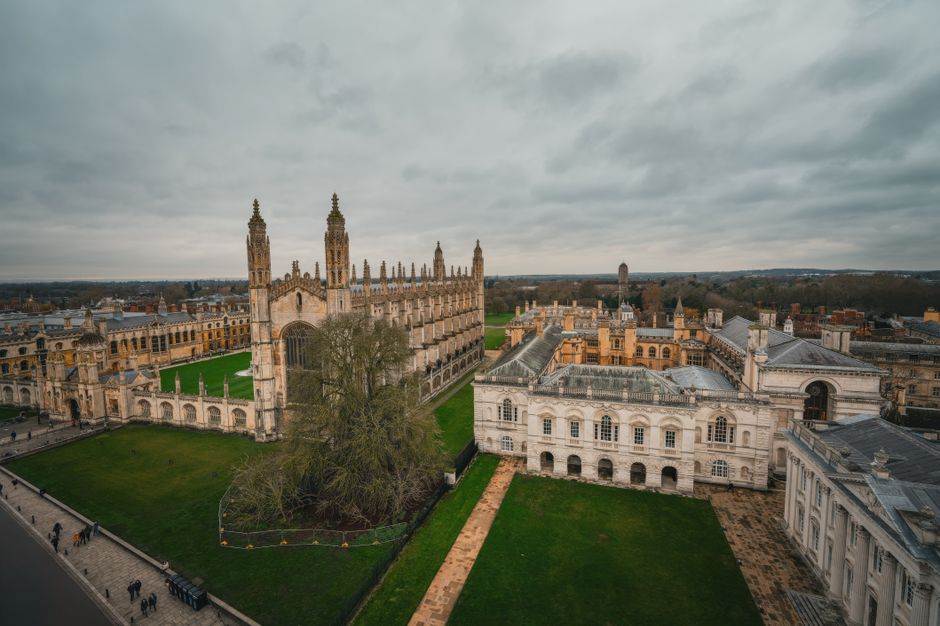
Cambridge is a small, green and gloriously old university city on the River Cam, where the most memorable view is from the water: gliding in a punt past the lawns, willows and college bridges of the Backs, with King’s College Chapel rising above the meadows. On land there are medieval courts, Isaac Newton’s college, the Fitzwilliam’s free treasures, bikes leaning against every railing and pubs where scientists once announced the structure of DNA. It is ideal for slow city sightseeing and less than an hour from London by train. Give it a day for King’s, a punt and a couple of colleges, two days to add the museums and a walk to Grantchester, and three to add Ely or Duxford.
Right now in Cambridge
- Wed 10–15°C 49–59°F 17 mm Rain
- Thu 7–14°C 44–57°F Clear
- Fri 10–19°C 51–65°F 2 mm Cloudy
Weather: MET Norway (CC BY 4.0) · Rates: ECB
Top tours in Cambridge
See all tours for Cambridge →
From local operators, with prices and reviews; you check availability and book on Viator, our partner. We may earn a commission at no extra cost to you. How we earn money
Cambridge at a glance
- Best for: college architecture, punting on the Backs, choral music, free museums, riverside walks and cycling.
- How long: 1 day for the highlights, 2 days with the museums and Grantchester, 3 with a day trip to Ely or Duxford.
- Best time: May, June and September. Many colleges close to visitors during exams from about April to June, and the river is busiest on summer weekends.
- Book ahead: King’s College Chapel (numbers are limited) and, on summer weekends, a punt.
- Getting in: fast trains from London King’s Cross in about 50 minutes, or from Liverpool Street; direct trains from Stansted airport.
- Before you go: the £20 ETA, money, trains and railcards are on our United Kingdom travel guide.
How Cambridge works: the colleges and the Backs
The University of Cambridge, founded in 1209, is made up of 31 independent colleges plus university departments and museums. Each college is a self-contained world of courts (Cambridge’s word for quadrangles), chapel, hall and library, and each decides whether, when and for how much visitors can come in. Many close to tourists during the exam term (roughly April to June), at the start of the academic year in late September and early October, over Christmas and for private events. Check the college website on the day, follow the signs to the visitors’ entrance and keep off the grass, which is strictly for fellows.
The centre is compact and flat. King’s Parade and Trinity Street run north–south past the grandest colleges; behind them, the colleges’ gardens and lawns sweep down to the Cam, a stretch known as the Backs. Cross the river and walk along Queen’s Road for the classic view back across the meadows to King’s College Chapel, free and open to all.
Top things to see in Cambridge
Prices and hours were checked on the official sites in October 2026; check again before you go, as colleges close at short notice.
King’s College and King’s College Chapel
The chapel, begun by Henry VI in 1446 and finished under Henry VIII, has the largest fan-vaulted ceiling in the world, 16th-century stained glass and Rubens’ Adoration of the Magi behind the altar. A self-guided visit includes the chapel and the front court and lawns of King’s. As of October 2026, adult tickets cost:
| Ticket | Weekday, online in advance | Weekday, in person | Weekend, online in advance | Weekend, in person |
|---|---|---|---|---|
| Adult (18+) | £15.75 | £17.00 | £16.75 | £18.00 |
| Student or child (5–17) | £13.25 | £14.50 | £14.25 | £15.50 |
| Family (2 adults + 2–3 children) | £55.00 | £60.00 | £59.00 | £64.00 |
Numbers are limited and King’s can’t guarantee tickets on the day, so book online. Opening hours change with services, rehearsals and events, so check the college website for the day you plan to go. The best way to experience the chapel is free: choral Evensong, sung by the famous King’s College Choir in term time, open to anyone who queues. On Christmas Eve, the Festival of Nine Lessons and Carols is broadcast around the world; a few places are given to people queuing from early morning.
Trinity College and the Wren Library
The largest and richest college, founded by Henry VIII, where Isaac Newton studied and an apple tree by the Great Gate is said to descend from his. Its Great Court is the largest enclosed court in Europe. As of October 2026, Trinity’s grounds on the Backs are usually open to the public from about 9:00 to 17:00, and guided tours run daily at 10:00 and 14:00 for £10 (under-12s free), meeting at the Great Gate on Trinity Street. Christopher Wren’s library, with manuscripts by Newton and A.A. Milne’s Winnie-the-Pooh, is free to visit during term from 12:00 to 14:00 on weekdays and 10:30 to 12:30 on Saturdays, entered from Garrett Hostel Lane.
Queens’, St John’s and more colleges
- Queens’ College: medieval courts and the wooden Mathematical Bridge over the Cam. As of October 2026 entry costs £5 (under-12s free with an adult), 10:00–16:00, through the Visitors’ Gate on Queens’ Lane; it closes during exams, Freshers’ Week and over Christmas.
- St John’s College: home to the Bridge of Sighs and a striking Victorian chapel. As of October 2026 its grounds are closed to general tourism, with paid open days only on set dates (adults £17); you can still see the Bridge of Sighs from a punt, and anyone may attend services in the chapel.
- Others: Corpus Christi, with the Corpus Clock and its “time-eating” grasshopper on Trumpington Street; Clare, with the oldest surviving college bridge and lovely gardens; Emmanuel, with its Wren chapel and duck pond; and Magdalene, with the Pepys Library. Many smaller colleges are free to enter when open.
The Fitzwilliam Museum and other free museums
The Fitzwilliam, the university’s art and antiquities museum in a grand neoclassical building, holds Egyptian coffins, Greek vases, illuminated manuscripts and paintings by Titian, Rembrandt, Monet and Picasso. Entry to the collection is free, with no ticket needed for individuals; it opens Tuesday to Saturday 10:00–17:00 and Sunday 12:00–17:00, and is closed on Mondays (last entry 16:40). Temporary exhibitions charge, except for under-18s, and are pay-what-you-can on the last Sunday of the month. The university also runs other free museums: Kettle’s Yard (a house full of modern art; book a free slot for the house), the Museum of Zoology with its whale skeleton, the Sedgwick Museum of Earth Sciences, the Polar Museum and the Museum of Archaeology and Anthropology.
Views, markets and the historic centre
- Great St Mary’s: the University Church on King’s Parade; climb its tower (small fee) for the best rooftop view of King’s and the Market Square.
- Market Square: a daily outdoor market with street food, fruit and books.
- The Round Church: one of only four surviving round churches in England, built around 1130.
- The Eagle: the pub where Francis Crick announced in 1953 that he and James Watson had “found the secret of life”; look for the Second World War airmen’s graffiti on the ceiling of the RAF bar.
- Cambridge University Botanic Garden: 16 hectares of glasshouses and gardens near the station (paid entry).
Churches and cathedrals
- Church of St Mary the Great
- King's College Chapel
Museums
- Fitzwilliam Museum
- Museum of Zoology
- Whipple Museum of the History of Science
Other sights
- St Catharine's College
- Trinity College, Cambridge
Archaeological sites
- Cambridge Castle
Activities and best months
- Boat tripsScudamore's, Cambridge's oldest punting company, runs 45-minute chauffeured College Backs tours from Mill Lane and Quayside past the Mathematical Bridge, King's College Chapel, the Wren Library and the Bridge of Sighs; Visit Cambridge estimates about 900,000 people go punting on the Cam each year.
- City sightseeingVisit Cambridge calls King's College Chapel the city's most recognisable building, with free Choral Evensong most days in term time, and highlights the free Fitzwilliam Museum (over half a million works of art) and guided walking tours.
Other things to do in Cambridge
Punting on the Backs and to Grantchester
Punting is the signature Cambridge boat trip. There are two stretches. The Backs, downstream from Silver Street or Quayside, take you past Queens’, King’s, Clare, Trinity and St John’s, under the Mathematical Bridge and the Bridge of Sighs, in about 45 minutes to an hour; it is busy and beautiful. Upstream from the Mill Pond, the river winds through meadows to Grantchester, a slower, rural trip of a couple of hours each way.
- Chauffeured tours: a student-style guide punts while telling college stories. Shared tours usually cost about £20–30 per person, cheaper booked online in advance; private punts cost more.
- Self-hire: roughly £30–40 an hour for a punt for up to about six people at the established boathouses, such as Scudamore’s at Quayside and Mill Lane, which opens daily from 9:00 (as of October 2026). In Cambridge you stand on the flat, decked end, called the till.
- Avoid the touts: sellers on King’s Parade and around the market push tours of mixed quality; buy from a company with a proper booking office or website.
Walks, bikes and meadows
Walk or cycle about 3 km across Grantchester Meadows to the Orchard Tea Garden, where Rupert Brooke and his friends took tea in deckchairs under the apple trees; locals swim in the river here in summer. Jesus Green and Midsummer Common have an open-air lido (summer) and riverside boathouses. Cambridge is Britain’s cycling capital, flat and full of bike lanes, so hiring a bike for a day of cycling is the local way to get around; lock it securely.
Pubs, food and evenings
Beyond the Eagle, try riverside pubs such as the Anchor and the Mill, the Free Press for a cosy pint, and Mill Road’s mix of independent cafés and world food. In the evening, catch Evensong at King’s, St John’s or Trinity, a concert in a college chapel, or student theatre at the ADC.
Day trips from Cambridge
- Ely: 15–20 minutes by train, with a magnificent cathedral, the “Ship of the Fens”, and Oliver Cromwell’s house.
- IWM Duxford: one of Europe’s biggest aviation museums, with Spitfires and Concorde, about 20 minutes south by car or bus.
- Country houses: Anglesey Abbey’s gardens and Audley End’s Jacobean mansion, both a short drive away.
- Further afield: London is under an hour by train, Oxford about two to three hours by coach or train via London, and the medieval wool towns of Suffolk, such as Lavenham, an hour by car.
Nearby destinations
- London80 km
- Oxford107 km
- Stratford-upon-Avon125 km
- Birmingham141 km
- Cotswolds154 km
- Brighton155 km
- Peak District183 km
- Bath194 km
Getting there and getting around
From London and the airports
- From King’s Cross: Great Northern fast trains reach Cambridge in about 50 minutes, several times an hour; Thameslink trains also run from St Pancras, Farringdon and London Bridge, and through from Gatwick.
- From Liverpool Street: Greater Anglia trains take about 1 hour 10 to 1 hour 20.
- From Stansted airport: direct trains in about 35 minutes, the easiest airport for Cambridge.
- From Heathrow and by coach: National Express coaches run from Heathrow, Gatwick and London Victoria; from Heathrow, the Elizabeth line or the Piccadilly line to King’s Cross and then the train is often quicker.
- Tickets: an Off-Peak day return is the usual choice for a day trip. Rail fares in England are frozen until March 2027, and a railcard saves a third (see our UK guide).
Getting around Cambridge
Cambridge station is about 2 km south-east of the centre: a 25-minute walk, a few minutes by bike or a short bus ride (Cambridge North station serves the science parks). The historic centre is small, flat and largely pedestrianised, so walk or cycle. If you’re driving, don’t try to park in the centre: use one of the five Park & Ride sites on the edge of the city and take the bus in.
When to go and how long to stay
Cambridge is one of the driest places in Britain, with warm summers and chilly, often frosty winters. The table uses the Met Office’s official 1991–2020 averages for the Cambridge NIAB station.
| Season | Average high / low | Rainy days per month | What it’s like | Good for |
|---|---|---|---|---|
| Winter (Dec–Feb) | 8 °C / 2 °C | 9–10 | Cold, often frosty and misty over the river; short days | Museums, Evensong, Christmas carols and markets |
| Spring (Mar–May) | 11–17 °C / 3–7 °C | 7–8 | Crocuses on the Backs, blossom, fresh and fairly dry | Walking, gardens, the first punting days |
| Summer (Jun–Aug) | 20–23 °C / 10–13 °C | 8–9 | Warm and long-evening; the river is busiest | Punting, Grantchester, open-air Shakespeare, May Bumps |
| Autumn (Sep–Nov) | 20 °C falling to 11 °C / 10 °C falling to 5 °C | 8 in September, 10 in November | Golden leaves along the Backs, cooler and damper | Colleges, museums, a quieter river |
Cambridge gets only about 560 mm of rain a year over some 107 rainy days, less than Rome, and July is the warmest month, with average highs of about 23 °C. University terms run from early October to early December, mid-January to mid-March and late April to mid-June; in June, after exams, students celebrate at May Balls (yes, in June) and the “May Bumps” rowing races.
How long to stay: 1-, 2- and 3-day plans
1 day: King’s College Chapel in the morning (booked ahead), a punt along the Backs, lunch at the market, Trinity or Queens’, the view from Great St Mary’s tower, and a pint at the Eagle. 2 days: add the Fitzwilliam, Kettle’s Yard, a walk to Grantchester and Evensong. 3 days: add Ely Cathedral or IWM Duxford.
Weather month by month
Where to stay in Cambridge
- City centre: walk to the colleges and the river; a handful of boutique and historic hotels, expensive.
- Near the station and Hills Road: modern hotels, handy for London trains, 25 minutes’ walk from the centre.
- Chesterton Road, Newnham and Mill Road: guesthouses and B&Bs, cheaper and close to the river or the cafés.
Rooms are limited and expensive during graduation and May Week in June; outside term, some colleges rent student rooms to visitors. Cambridge has no tourist tax as of October 2026.
What to pack for Cambridge
Comfortable shoes and layers, a light waterproof for showers, and a warm coat, hat and gloves from November to March, when frost and river mists are common. For punting and riverside picnics in summer, add sunglasses, a sun hat and a dry bag or zipped pocket for your phone, and swimwear if you fancy a dip at Grantchester. A bike lock is essential if you hire a bike.
What to pack
- City walking shoesLisbon and Porto are steep, with polished limestone cobbles that get slippery, so grippy soles matter.
- Day packs and anti-theft bagsA small zipped or anti-theft bag makes crowded trams and viewpoints less stressful.
- Dry bags and phone pouchesSpray soaks phones and cameras on open boats to the Algarve caves and on whale-watching trips.
- Fleeces and warm layersIt is cooler at sea than on land, especially on morning whale-watching trips.
- Rain jacketsA windproof, waterproof shell keeps you warm on open boats, where wind and spray cool you quickly.
- Reef-friendly sunscreenSun reflects off the water on cruises and cave tours.
- Travel adapters and convertersPortugal uses Type C and F sockets at 230 V, so most visitors from outside Europe need an adapter.
- Water shoesKayak and small-boat trips to the Algarve grottoes land on rock and wet sand.
Cambridge travel FAQ
Is Cambridge worth a day trip from London?
Yes. Fast trains from King’s Cross take about 50 minutes, and the centre is small enough to see King’s College Chapel, a couple of colleges and the Backs from a punt in one day. Stay the night to enjoy Evensong and a quiet evening by the river.
How do I get from London to Cambridge?
By train from King’s Cross (about 50 minutes on fast services), from St Pancras on Thameslink, or from Liverpool Street (about 1 hour 10 to 1 hour 20). National Express coaches are cheaper but slower.
How much does King’s College Chapel cost?
As of October 2026, adult tickets cost £15.75 online or £17 in person on weekdays, and £16.75 online or £18 in person at weekends; students and children aged 5–17 pay less. Book online, as numbers are limited. Evensong in term is free.
Can you visit Cambridge colleges for free?
Some smaller colleges are free when open, and chapel services are always free. King’s, Queens’ (£5) and, on its open days, St John’s charge, and Trinity runs paid guided tours. Most colleges close to visitors during exams from about April to June.
How much does punting cost in Cambridge?
Shared chauffeured tours along the Backs usually cost about £20–30 per person, less when booked online, and self-hire punts roughly £30–40 an hour. Book through an established boathouse rather than street touts.
What are the Backs?
The stretch where the gardens and lawns of several colleges, including Queens’, King’s, Clare, Trinity and St John’s, back onto the River Cam. See them from a punt, or walk along Queen’s Road for the classic free view of King’s College Chapel across the meadows.
Is the Fitzwilliam Museum free?
Yes. The collection is free with no ticket needed; it opens Tuesday to Saturday 10:00–17:00 and Sunday 12:00–17:00, and is closed on Mondays. Special exhibitions charge.
Can I see the Wren Library at Trinity?
Yes, free, during term: weekdays 12:00 to 14:00 and Saturdays 10:30 to 12:30, entering from Garrett Hostel Lane. Trinity’s guided tours (£10) run daily at 10:00 and 14:00.
What is the best time to visit Cambridge?
May, June and September, for warm days, punting and gardens. Cambridge is one of Britain’s driest cities, with average July highs of about 23 °C. Check college closures during the exam period.
Can I drive to Cambridge?
Yes, but don’t drive into the centre: streets are narrow, parking is scarce and many are closed to cars. Park at one of the Park & Ride sites and take the bus.
Cambridge or Oxford: which should I visit?
Cambridge is smaller, flatter and greener, with the Backs and King’s College Chapel; Oxford is bigger, with grander streets and more museums. Both are about an hour from London, and both reward an overnight stay.
What day trips can I take from Cambridge?
Ely and its cathedral (15–20 minutes by train), IWM Duxford’s aircraft collection, Anglesey Abbey and Audley End, and the medieval villages of Suffolk such as Lavenham.
Plan your trip
Partner links: TravelerCenter may earn a commission if you book, at no extra cost to you.
Sources · last reviewed 4 October 2026
Researched and last reviewed on 4 October 2026. Climate: Met Office 1991–2020 averages for Cambridge NIAB; King’s College Chapel prices: King’s College; Trinity, Queens’ and St John’s visiting rules: the colleges’ own websites; the Fitzwilliam: the Fitzwilliam Museum; punting hours: Scudamore’s; rail fare freeze: National Rail. Punting prices, train and coach journey times and some museum details come from secondary sources or general knowledge and are flagged for checking. Prices, hours and timetables change, so check the official links before you go. For entry rules, money and general safety, see our United Kingdom travel guide.
Also: scudamores.com · visitcambridge.org · Met Office normals 1991–2020, Wattisham (Suffolk) (climate)
Place data: © OpenStreetMap contributors (ODBL) · Wikidata (CC0)