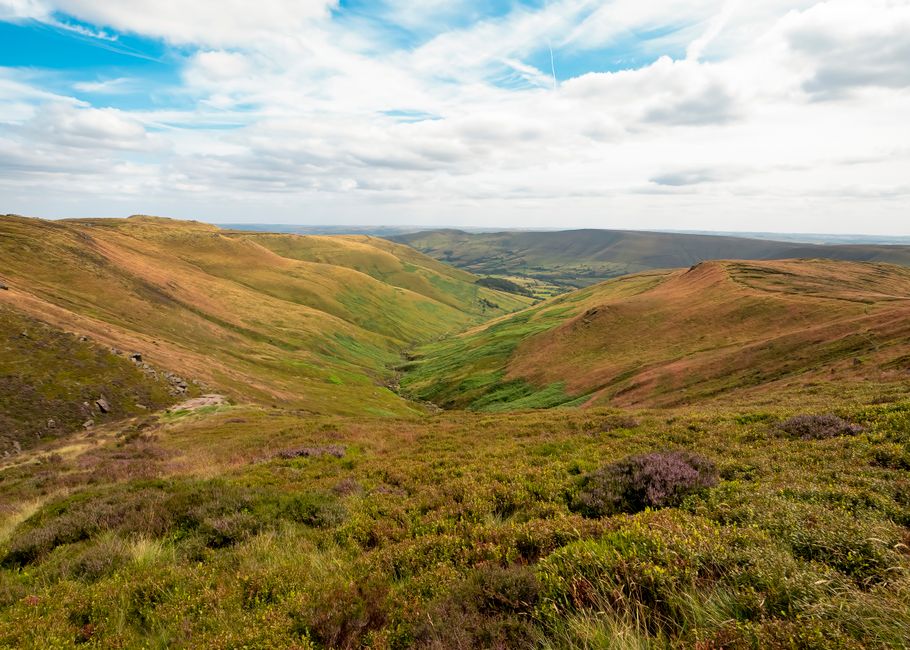
The Peak District is where England’s hills begin: a green upland of gritstone edges, wild heather moors, limestone dales, stone villages and grand country houses at the southern end of the Pennines, between Manchester and Sheffield. Founded in 1951, it was Britain’s first national park, and it is still one of its best loved. You come to walk up Mam Tor and Kinder Scout, cross the stepping stones in Dovedale, go underground in the caverns of Castleton, cycle the old railway tunnels of the Monsal Trail, tour Chatsworth House, eat a Bakewell pudding where it was invented and finish the day by the fire in a village pub. Trains along the Hope Valley line from Manchester and Sheffield reach the heart of the hills without a car. Give it two or three days for the highlights, or a week to walk both the dark moors in the north and the gentle limestone dales in the south.
Right now in Peak District (Castleton)
- Wed 6–11°C 43–53°F 1 mm Partly cloudy
- Thu 4–11°C 40–51°F 1 mm Partly cloudy
- Fri 9–14°C 48–58°F 4 mm Partly cloudy
Weather: MET Norway (CC BY 4.0) · Air quality: OpenAQ · Rates: ECB
Top tours in Peak District
See all tours for Peak District →
From local operators, with prices and reviews; you check availability and book on Viator, our partner. We may earn a commission at no extra cost to you. How we earn money
Peak District at a glance
- Best for: hill and moorland walking, show caves, stately homes, cycling on traffic-free trails, rock climbing, pub lunches, village stays and easy breaks from Manchester, Sheffield and the Midlands.
- How long: 1 day for Castleton and Mam Tor; 2–3 days to add Chatsworth, Bakewell and Dovedale; a week for Kinder Scout, the Monsal Trail and the quieter dales.
- Best time: May, June and September for walking; August for purple heather on the moors; November and December for Christmas at Chatsworth. Weekends in summer are very busy.
- Getting in: Northern trains on the Hope Valley line link Manchester and Sheffield with Edale, Hope and Hathersage; other lines reach Buxton and Matlock.
- Getting around: by car, bus or on foot; car parks fill early on sunny weekends. As of October 2026, a House and Garden ticket at Chatsworth cost £35 for adults.
- Before you go: entry rules, money and general safety are in our United Kingdom travel guide.
The Peak District, area by area
The national park covers about 1,440 square kilometres, mostly in Derbyshire, and has two very different faces. The Dark Peak in the north and along the edges is high, peaty moorland on dark gritstone, wild and often wet. The White Peak in the centre and south is a limestone plateau of green fields and drystone walls cut by deep, wooded dales and rivers. Most visitors base themselves in the Hope Valley, Bakewell or Buxton.
Castleton and the Hope Valley
The village of Castleton sits beneath Mam Tor and the ruined Peveril Castle, with four show caves, Blue John stone shops, tea rooms and pubs. Hope, Bradwell and Hathersage further down the valley have railway stations and good walking from the door. Best for: first visits, caves and classic hill walks without a car.
Edale and Kinder Scout
Over the ridge from Castleton, Edale is a small village in a quiet valley at the start of the Pennine Way, the long-distance path to Scotland. Above it rises Kinder Scout, the highest ground in the Peak District, a wild plateau of peat and gritstone. Best for: serious walkers and anyone after big, empty landscapes.
Bakewell and Chatsworth
Bakewell, the largest town inside the park, is a handsome stone market town on the river Wye, home of the Bakewell pudding, with a Monday market and the start of the Monsal Trail. Chatsworth House and Haddon Hall are a few kilometres away. Best for: stately homes, gentle walks, cafés and a central base.
Buxton
Just outside the park’s western edge, Buxton is an elegant Georgian spa town with the restored Crescent and its spa hotel, a Victorian Opera House, the Pavilion Gardens and Poole’s Cavern. It has direct trains to Manchester and plenty of hotels. Best for: spa breaks, culture and rainy days.
Dovedale and the southern dales
In the south, the river Dove runs through a limestone gorge of rock pinnacles, caves and woods, reached from the villages of Ilam and Thorpe near the market town of Ashbourne. Tissington, with its hall and well-dressings, and Hartington, known for its cheese, are nearby. Best for: family walks, picnics and pretty villages.
Hathersage, Stanage and the Derwent Valley
On the eastern side, the gritstone cliffs of Stanage Edge look down over Hathersage, a village with outdoor shops and Little John’s grave in the churchyard. To the north, the Upper Derwent Valley’s reservoirs and dams, where the Dambusters practised in 1943, are ringed by forest walks and cycle paths. Best for: climbers, edge walks and reservoir cycle rides.
Top things to see in the Peak District
Prices and hours below were checked on the official sites in October 2026. They change, so check before you go.
The caverns of Castleton
Castleton has four show caves, all visited on guided tours, and each is different. The temperature underground stays cool all year, so bring a warm layer.
- Peak Cavern: the largest cave entrance in Britain, right in the village below the castle, where rope-makers once lived and worked. As of October 2026, adults pay £22.25 online or £24 at the door, children (5–15) £13.75 or £15, and a family ticket online costs £60. From April to October tours run hourly 10:00–17:00 (last tour 16:00); in winter there are three tours a day on weekdays outside school holidays.
- Speedwell Cavern: at the foot of the Winnats Pass, you go down 105 steps and travel by boat along a flooded 18th-century lead miners’ tunnel to a huge natural chamber. Adults pay £23.50 online or £25 at the door, children (5–15) £14.50 or £15.50. Open daily 10:00–17:00 from April to October (last tour 15:50) and 10:00–16:00 from November to March (last tour 15:00).
- Treak Cliff Cavern: the best place to see Blue John, the purple and yellow banded stone found only here, plus fine stalactites. Adults pay £16, students £14 and children (5–17) £10, or £14, £12 and £8 for early-bird slots before 10:50 booked online. Open 9:30–17:00 from March to October and 9:30–16:00 from November to February, with free parking.
- Blue John Cavern: a family-run cavern high on the side of Mam Tor with its own Blue John veins and a shop selling jewellery made from the stone.
All the caves close on Christmas Day and Boxing Day, and Peak and Speedwell also on New Year’s Day. Book online for the best prices; tours are not suitable for anyone who is very claustrophobic.
Mam Tor and the Winnats Pass
Mam Tor, the “Shivering Mountain”, rises 517 metres above Castleton, crowned by an Iron Age hillfort. From the car park near its summit, a paved path climbs to the top in about 20 minutes, and the ridge walk along the Great Ridge to Hollins Cross, Back Tor and Lose Hill is one of the finest short walks in England, with views over the Hope Valley and Edale. Below, the old main road, wrecked by landslips and abandoned in 1979, lies broken on the hillside. The Winnats Pass, a steep limestone gorge, is the dramatic road into Castleton from the west.
Chatsworth House
The home of the Dukes of Devonshire is one of England’s greatest country houses, with painted halls, a sculpture gallery, Old Master paintings and modern art, set in a huge park landscaped by Capability Brown on the river Derwent. Its 105-acre garden has the Emperor Fountain, the Cascade, a rock garden and a maze, and children love the farmyard and adventure playground.
Tickets. As of October 2026, a House and Garden ticket costs £35 for adults and £12 for children (3–16) from 1 October to 1 November 2026, and £28 and £10 on off-peak dates; Garden only costs £20 (off-peak £16), and the farmyard and playground £12. Booking online in advance gives free parking; otherwise the car park costs £10 (£7.50 off-peak). The house closes after 1 November and reopens for Christmas at Chatsworth from 7 November 2026 to 3 January 2027, with the house decorated, a light trail in the garden and, from 7 November to 13 December, a large Christmas market; Christmas tickets cost £40 for adults with the house, or £24 for the garden and light trail. Day tickets resume from mid-March. The walk across the park from Baslow or Edensor is free.
Haddon Hall
Near Bakewell, Haddon Hall is one of the most complete medieval and Tudor manor houses in England, little changed since the 17th century, with a long gallery, a medieval kitchen, wall paintings and terraced gardens above the river Wye; it often appears in period films. In 2026 it opened daily from 28 March to 7 October, then on 26–30 October, 10:00–16:00 (last entry 15:00), and reopens for its Mercatum Christmas artisan market from 11 November to 20 December 2026. As of October 2026 an adult ticket cost £29.50, with £26.55 for visitors who arrive by public transport or on foot; parking costs £4.40.
Dovedale and the stepping stones
The stepping stones across the river Dove below the cone-shaped hill of Thorpe Cloud are one of the Peak District’s most famous sights. From the pay car park near Ilam, it is an easy 15-minute walk along the river to the stones. Carry on up the dale to the rock spires of Ilam Rock and Pickering Tor, the arch of Reynard’s Cave and the limestone pinnacles of Dove Holes, about 5 km one way. After heavy rain, the stones can be under water; use the footbridge near the car park instead. Climbing Thorpe Cloud (287 m) gives a fine view of the dale.
Bakewell
Walk over the medieval bridge, look at the love locks on the footbridge, browse the Monday market and taste the original Bakewell pudding, a flaky pastry with jam and an egg-and-almond filling, different from the iced Bakewell tart sold in supermarkets. Two shops in the town claim the original recipe.
Walking and moorland safety
The Peak District is crossed by thousands of kilometres of footpaths and open access land, and walking is the reason most people come. The hills are not high, but the moors of the Dark Peak are wild: paths cross featureless peat bogs, cloud and rain arrive quickly, and every year the volunteer mountain rescue teams are called out to walkers who are lost, cold or injured.
Kinder Scout
At 636 metres, Kinder Scout is the highest point in the Peak District, a plateau of peat groughs and wind-carved gritstone tors. In 1932 the Mass Trespass on Kinder helped win the right to roam that later created Britain’s national parks. The classic circuit from Edale climbs Grindsbrook Clough or Jacob’s Ladder, follows the edge of the plateau past Kinder Downfall, a waterfall that blows backwards in strong winds, and takes most walkers 5 to 7 hours. In cloud, the top is notoriously hard to navigate.
How to walk the hills safely
- Check the forecast: look at a mountain forecast for the Peak District before you set off; conditions on Kinder and Bleaklow can be far worse than in the valleys.
- Navigate: carry a paper map and compass (OS Explorer OL1 covers the Dark Peak and OL24 the White Peak) and know how to use them; phone signal is patchy.
- Dress for the hills: walking boots with grip for wet gritstone and bog, waterproof jacket and trousers, warm layers, food, water and a head torch.
- Respect the land: leave gates as you find them, keep dogs on leads near livestock and ground-nesting birds, and never light fires or barbecues: moorland fires spread fast and are a serious problem in dry weather.
- In an emergency: call 999, ask for Police and then Mountain Rescue, and give your location.
See our hiking guide for gear and more routes.
Things to do in the Peak District
Cycle the Monsal Trail and the old railway lines
The Monsal Trail follows a former Midland Railway line for about 13.5 km (8.5 miles) from Blackwell Mill in Chee Dale to Coombs Road near Bakewell, crossing the Headstone Viaduct at Monsal Head and passing through six tunnels, the longest about 400 metres, lit in daylight hours. It is flat, traffic-free and good for families; bikes can be hired at Hassop Station and Blackwell Mill. In the south, the Tissington and High Peak Trails are also old railway lines; the national park runs bike hire centres at Parsley Hay and Ashbourne, where, as of October 2026, a full day’s adult hire cost £26. See our cycling guide.
Walk or climb at Stanage Edge
Stanage Edge is a 6 km wall of gritstone cliffs, one of the most famous climbing crags in Britain, and an easy, spectacular ridge walk with views over the Hope Valley. It starred in the 2005 film of Pride and Prejudice. Walk up from Hathersage or park below the edge.
Eat and drink like a local
Try a Bakewell pudding in Bakewell, oatcakes, Hartington Stilton, local lamb and real ale from the many small Derbyshire breweries in a stone pub with a fire. Many villages hold well-dressings in spring and summer, decorating their wells with pictures made of petals.
Rainy-day ideas
Go underground in the Castleton caves or Poole’s Cavern in Buxton, tour Chatsworth or Haddon Hall, swim in a spa town, see a show at the Buxton Opera House, or ride the steam trains of Peak Rail or the cable cars at the Heights of Abraham near Matlock Bath.
Getting to the Peak District
By train. The Hope Valley line between Manchester Piccadilly and Sheffield is the best way in: Northern runs an hourly stopping train calling at Edale, Hope (for Castleton), Bamford, Hathersage and Grindleford, seven days a week. Edale is about 45 minutes from Manchester. Northern also runs from Manchester to Buxton, about an hour, and East Midlands Railway from Derby and Nottingham to Matlock. From London, fast trains run from St Pancras to Sheffield or Derby and from Euston to Manchester, each about two hours.
By air. Manchester Airport is the nearest big airport, with trains into Manchester to connect for the Hope Valley or Buxton; East Midlands Airport is closer to the south of the park.
By car. The park is reached from the M1 on the east and the M60 and M67 around Manchester on the west; the A6 runs through Bakewell and Buxton. Roads are narrow and winding, and the Snake Pass (A57) and Woodhead Pass close in snow.
Getting around and parking
Buses. Buses link the main towns and villages, including services from Sheffield along the Hope Valley to Castleton and the TransPeak bus between Derby, Matlock, Bakewell and Buxton. As in the rest of England outside London, a single bus fare is capped at £3 until 1 January 2027, and at £2 for all of 2027. Services are thinner on Sundays and in winter, so check times before a walk that ends at a bus stop.
Parking. The Peak District is one of the most visited national parks in Britain, and on sunny weekends and bank holidays car parks at Castleton, Edale, Mam Tor, Dovedale, Stanage, the Upper Derwent and Bakewell can be full by mid-morning. Arrive early, or come by train. Most car parks are pay-and-display; the national park authority’s own car parks take coins, cards or an app, and as of October 2026 it sold a weekly parking permit for £20.50. Never park on verges, in gateways or on the narrow lanes: police and rangers ticket and tow cars that block access for farmers and emergency vehicles, and some villages have had to close roads on busy days.
When to go and how long to stay
The Peak District is cooler and much wetter than the cities around it: mild summers, damp and windy autumns, and cold winters with frost and some snow on the moors. The table uses the Met Office 1991–2020 averages for Buxton, at 307 metres the main station inside the hills; the valleys around Bakewell are a little milder and drier, and the tops of Kinder and Bleaklow colder and wetter.
| Season | Average high / low | Rainy days per month | What it’s like |
|---|---|---|---|
| Spring (Mar–May) | 8–15 °C / 2–6 °C | 12–13 | Lambs, bluebells and wild garlic in the dales, sunny spells, May the driest and sunniest month |
| Summer (Jun–Aug) | 17–19 °C / 9–11 °C | 13–14 | Long days for walking, well-dressings, heather in August, busiest car parks |
| Autumn (Sep–Nov) | 16 °C falling to 8 °C / 9 °C falling to 3 °C | 13–17 | Golden bracken and woods, fewer crowds in September, wet and windy from October |
| Winter (Dec–Feb) | about 6 °C / about 1 °C | 15–17 | Short days, frost and snow on the tops, passes can close, Christmas at Chatsworth |
Buxton records about 1,345 mm of rain a year, falling on about 172 days, with October to January the wettest months at 125–155 mm each and May the driest at about 80 mm. There are about 51 days of air frost a year. In practice, May, June and September are the best months for walking, with long days and calmer paths than the school summer holidays.
Peak District in 3 days
Day 1: Castleton: a cave tour in the morning, lunch in the village, then up Mam Tor and along the Great Ridge to Lose Hill. Day 2: Chatsworth House and garden, then Bakewell for a pudding and a walk by the river. Day 3: cycle the Monsal Trail from Bakewell to Monsal Head and beyond, or drive south to Dovedale for the stepping stones and Thorpe Cloud.
Peak District in a week
Add Kinder Scout from Edale on a clear day, Stanage Edge and Hathersage, Haddon Hall, the reservoirs of the Upper Derwent by bike, Eyam, the village that quarantined itself during the plague of 1665, a day in the spa town of Buxton with Poole’s Cavern, and the Tissington Trail and Hartington in the south.
Where to stay in the Peak District
- Castleton and the Hope Valley: inns, B&Bs and a youth hostel in walking country, with trains at Hope, Edale and Hathersage. Best for walkers without a car.
- Bakewell: hotels, inns and cottages in a lively market town, close to Chatsworth and the Monsal Trail.
- Buxton: the widest choice of hotels, including a spa hotel in the Crescent, with trains to Manchester.
- Ashbourne, Hartington and Ilam: quieter villages near Dovedale and the southern dales.
- Farm stays and campsites: self-catering cottages, barns and campsites across the park, from Edale to the White Peak.
Book well ahead for summer weekends, bank holidays and the Christmas season around Chatsworth.
Practical tips for the Peak District
- Start early: on sunny weekends the popular car parks fill by mid-morning; weekdays are much quieter.
- Use the train: the Hope Valley line puts you at the foot of Mam Tor and Kinder without parking worries.
- Book Chatsworth online: booking in advance gives free parking and is cheaper than paying on the day.
- Book cave tours: online prices are lower, and tours fill in school holidays.
- Carry cash and a map: some car parks and village shops are cash-only and phone signal is unreliable in the valleys.
- No barbecues: fires and barbecues are banned on the moors; take a flask instead.
What to pack for the Peak District
Walking boots with good grip, a waterproof jacket and trousers, warm layers, a hat and gloves (even in summer on the tops), a paper map and compass, a small rucksack with food and water, and a warm top for the caves, which stay chilly all year. Pack a head torch for winter walks and smart-casual clothes for a dinner in Bakewell or Buxton.
Peak District travel FAQ
Where is the best place to stay in the Peak District for a first visit?
Castleton or the Hope Valley if you want to walk and come by train, Bakewell for a central base near Chatsworth and the Monsal Trail, or Buxton for the widest choice of hotels.
Can you visit the Peak District without a car?
Yes. Hourly trains on the Hope Valley line from Manchester and Sheffield stop at Edale, Hope and Hathersage, and buses link Castleton, Bakewell, Buxton and Matlock, with single fares capped at £3 until 1 January 2027 and £2 in 2027.
How much does it cost to visit Chatsworth?
As of October 2026, a House and Garden ticket cost £35 for adults and £12 for children in October, less on off-peak dates; Christmas at Chatsworth tickets with the house cost £40. Booking online in advance gives free parking.
Which Castleton cave is best?
Speedwell Cavern for the boat trip through a flooded mine, Peak Cavern for its enormous entrance and history, and Treak Cliff Cavern for Blue John stone and stalactites. As of October 2026 adult tickets cost £14–£25 depending on the cave and how you book.
How long does it take to walk up Mam Tor?
About 20 minutes on a paved path from the car park near the top, or around an hour from Castleton. The Great Ridge walk on to Lose Hill and back to Castleton takes about 3 hours.
How hard is Kinder Scout?
It is a full-day walk of 5 to 7 hours from Edale with steep climbs and a boggy, confusing plateau. Go in clear weather with a map and compass, good boots and waterproofs.
Can you cycle the Monsal Trail?
Yes. It is a flat, traffic-free former railway of about 13.5 km with lit tunnels and the Headstone Viaduct, and bikes can be hired at Hassop Station and Blackwell Mill.
Are the Dovedale stepping stones always open?
They are free to visit at any time, but after heavy rain the river can cover them. Use the nearby footbridge and do not try to cross when the water is high.
Is parking a problem in the Peak District?
On sunny weekends and bank holidays, yes. Arrive before 9:00 or come by train, and never park on verges or narrow lanes, where cars are ticketed or towed.
Does it rain a lot in the Peak District?
Quite a lot: Buxton gets about 1,345 mm a year on about 172 days, twice as much as the cities around it. May is the driest month and October to January the wettest.
When is the best time to visit the Peak District?
May, June and September for walking with long days and fewer crowds, August for purple heather, and November and December for Christmas at Chatsworth.
How many days do you need in the Peak District?
Two or three days cover Castleton, Mam Tor, Chatsworth, Bakewell and Dovedale. A week lets you add Kinder Scout, the Monsal Trail, Stanage Edge and Buxton.
Nearby destinations
- Manchester31 km
- Liverpool77 km
- York83 km
- Birmingham97 km
- Stratford-upon-Avon129 km
- Eryri (Snowdonia)148 km
- Lake District148 km
- Cotswolds173 km
Sources and last review
Researched and last reviewed on 4 October 2026. Chatsworth ticket and Christmas prices: Chatsworth House Trust; Haddon Hall season and prices: Haddon Hall; cave prices and hours: Peak Cavern, Speedwell Cavern and Treak Cliff Cavern; parking permits and bike hire: the Peak District National Park Authority; bus fare cap: the Department for Transport; climate: Met Office 1991–2020 averages for Buxton. Prices, timetables and rules change, so check the official links before you go. For entry rules, money and general safety, see our United Kingdom travel guide; for more of the north, see our guides to York and the Lake District, and for gentler hills further south, the Cotswolds.
Plan your trip
Partner links: TravelerCenter may earn a commission if you book, at no extra cost to you.