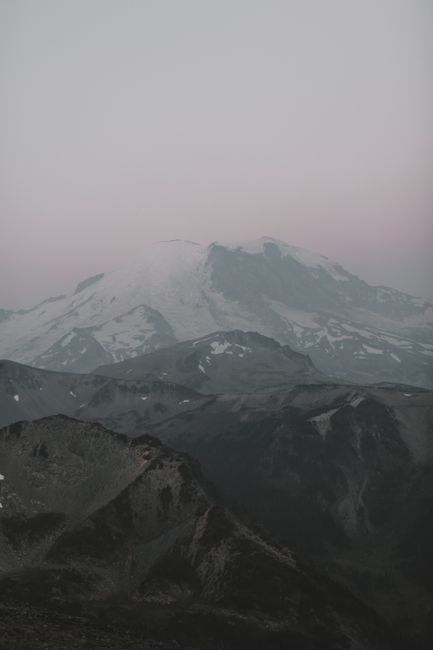
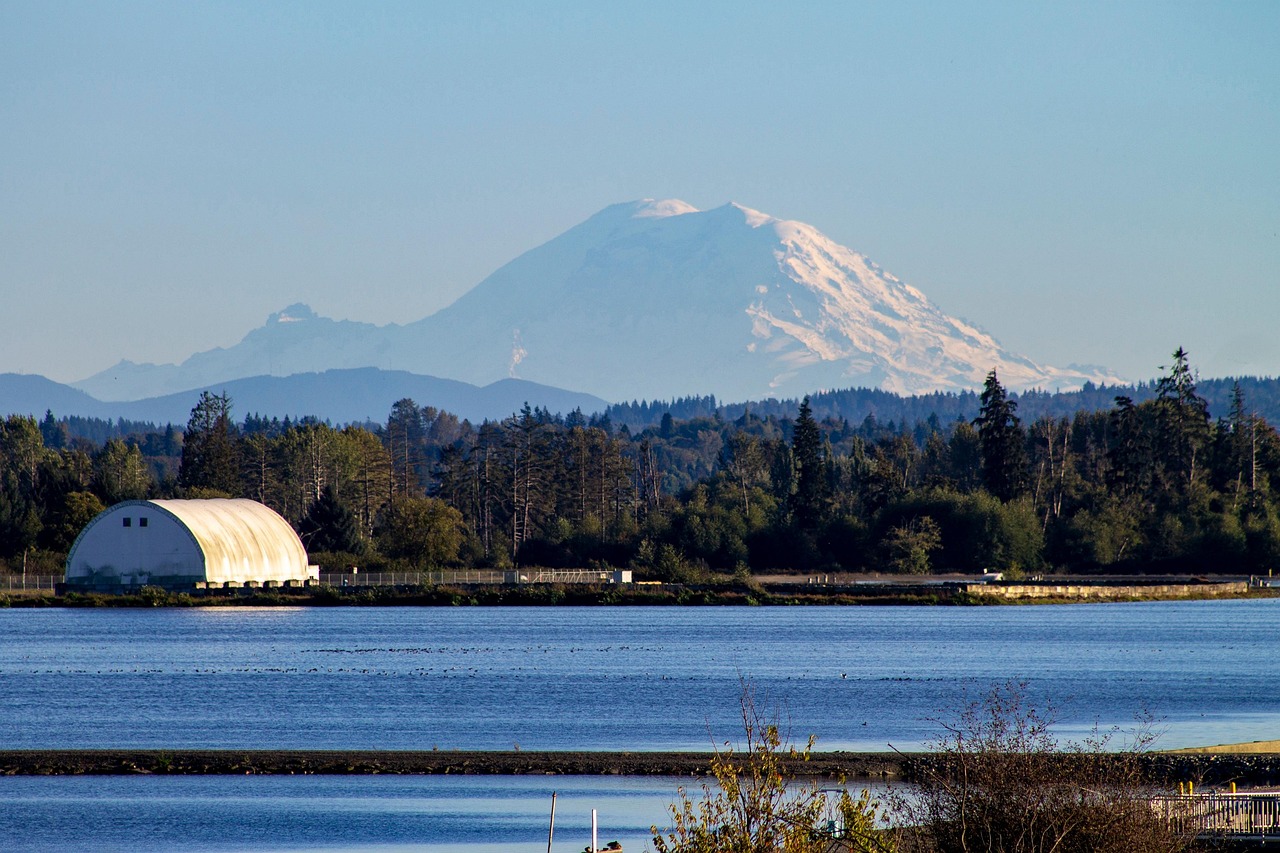
Mount Rainier rises 14,410 ft (4,392 m) above the forests of western Washington, an ice-covered volcano so large that it shapes the weather and fills the horizon from Seattle on clear days. The national park around it, one of the oldest in the United States, protects more than 25 glaciers, old-growth forests of giant cedars and Douglas firs, waterfalls and some of the finest wildflower meadows in North America. Most visitors head for Paradise on the south side, with its historic inn, visitor center and the Skyline Trail; Sunrise on the northeast side is the highest point you can drive to. It is an easy day trip from Seattle or Tacoma, but summer weekends are crowded, and in 2026 wildfires in the north of the park closed the Sunrise Road to cars for the rest of the season. Plan around the snow, the roads and the parking, and give the mountain at least a full day.
Right now in Mount Rainier National Park (Paradise)
- Wed8–19°C46–65°FClear
- Thu8–17°C47–63°FMostly clear
- Fri-2–8°C29–46°F5 mm rain
- Mon 12 Oct Columbus Day
Top tours in Mount Rainier National Park
See all tours for Mount Rainier National Park →
From local operators, with prices and reviews; you check availability and book on Viator, our partner. We may earn a commission at no extra cost to you. How we earn money
Mount Rainier at a glance
- Best months: late July to mid-September, when the high roads are open, the snow has melted from the meadows and the wildflowers peak (usually late July to mid-August). September brings fewer people and fall color; from November only the road to Paradise stays open, for snowshoeing and skiing.
- Time needed: one full day for Longmire, Paradise and the Skyline Trail; two or three days to add Sunrise, the east side and a longer hike.
- Getting there: Ashford, just outside the Nisqually Entrance, is 85 miles (137 km) from Seattle-Tacoma International Airport, about 2 hours by car, and 131 miles (211 km) from Portland’s airport. There is no public transport into the park.
- Fees (as of October 2026): $30 per car for 7 days, cards only. No timed entry reservation in 2026, and Mount Rainier is not one of the parks with the $100 non-resident fee.
- Before you go: entry rules for international visitors (ESTA or visa), driving and tipping are in our United States travel guide.
Entrance fees and passes (as of October 2026)
Every visitor needs an entrance pass. The park does not accept cash: pay by card at the staffed entrances, buy a 7-day vehicle pass online about three weeks ahead (a digital voucher is accepted for this pass), or buy one in local communities. Entrances are generally staffed in daylight; if you arrive outside those hours, pay at the next staffed entrance. Washington’s Discover Pass is for state parks only and is not valid here.
| Pass | Price | What it covers |
|---|---|---|
| Private vehicle | $30 | One non-commercial vehicle (up to 15 seats) and everyone in it, 7 days |
| Motorcycle | $25 | Up to 2 motorcycles, 4 riders, 7 days |
| Per person (foot or bike) | $15 | Each person 16 or over; under-16s free; 7 days |
| Mount Rainier annual pass | $55 | This park only, 12 months, one private vehicle |
| America the Beautiful pass | $80 residents / $250 non-residents | All national parks and federal recreation lands for 12 months |
| Commercial mini-bus / motor coach | $100 / $200 | Tour vehicles with 16–25 / 26+ seats |
For international visitors: the $100 per-person non-resident fee that started in 2026 applies at only 11 parks (Acadia, Bryce Canyon, Everglades, Glacier, Grand Canyon, Grand Teton, Rocky Mountain, Sequoia and Kings Canyon, Yellowstone, Yosemite and Zion). Mount Rainier is not one of them, so visitors from abroad pay the same $30 per car as Americans. The $250 non-resident America the Beautiful pass pays off only if your trip also includes some of those 11 parks, for example Glacier or Yellowstone. The last fee-free days of 2026, 27 October and 11 November, are for US citizens and residents only.
Timed entry and parking: 2026 and 2027
After trying timed entry reservations for the Paradise and Sunrise corridors in 2024 and for Sunrise in 2025, the park announced on 25 February 2026 that it would not require a timed entry reservation for any part of the park in 2026, and would manage crowds with parking and traffic measures instead. As of October 2026 the park had not announced whether reservations will return in 2027; check the park’s website in early spring.
- Arrive early or late: on the busiest summer weekends and holidays the wait at the Nisqually and White River entrances can top an hour. The park suggests entering before 7 a.m. or after 4 p.m., or at least before 10 a.m. or after 2:30 p.m.
- Weekdays are much quieter than weekends; Paradise, Sunrise and the trailheads between Longmire and Paradise fill first.
- No roadside parking: parking is not allowed along road edges. If a lot is full, have a backup plan, such as Longmire, Box Canyon or Reflection Lakes.
Roads, seasonal closures and the 2026 fires
The park is open all year, 24 hours a day, but most of its roads close in winter. Only the Nisqually Entrance in the southwest gives car access all year, to Longmire and, by day, to Paradise. From 1 November the road between Longmire and Paradise closes every night and reopens in the morning after snow clearing, and from 1 November to 1 May all vehicles must carry tire chains in the park, including four-wheel drives. Your GPS may send you to the wrong entrance or a closed gate; for the Nisqually Entrance use 39000 State Route 706 E, Ashford.
| Road | Status on 28 September 2026 | Seasonal closing (2026, subject to change) |
|---|---|---|
| Nisqually Entrance – Longmire – Paradise | Open | Open all year; Longmire–Paradise closes nightly in winter |
| Paradise Valley Road (one-way) | Open | 19 October |
| Ricksecker Point Road | Open | 20 October |
| Stevens Canyon Road | Open | 26 October |
| White River Road to the campground | Open, with one-lane delays of up to 30 minutes | 26 October |
| Sunrise Road | Closed to vehicles (fires); open to walkers and cyclists | Closed to cars for the rest of 2026 |
| SR 410 Chinook Pass and SR 123 Cayuse Pass | Open (state highways) | Close for winter; check WSDOT |
| Carbon River and Mowich Lake | No public access from SR 165 | Fairfax Bridge closed since April 2025 |
The 2026 fires: lightning started several fires in the north of the park in August 2026. The Grand Park 2 Fire, 3 miles (5 km) north of Sunrise, was 100% contained by late September, while the Wonderland Complex Fires (Garda Falls, West Fork and Pigeon) kept burning in remote valleys and were expected to burn until put out naturally. The Sunrise Road stays closed to private vehicles for the rest of 2026, though you can walk or bike up it; the Sunrise Visitor Center has closed for the season and there is no drinking water there. The Wonderland Trail between the Carbon River Suspension Bridge and Frozen Lake, the Northern Loop Trail, the Grand Park area and the trails north of Sourdough Ridge are closed until further notice. White River Road and campground reopened on 5 September 2026. In late September the park expected good air quality; when smoke drifts in, check air quality and smoke forecasts before hiking.
Other long-term closures: the Grove of the Patriarchs has been closed since floods damaged its suspension bridge in November 2021; construction of a new bridge is scheduled to begin in 2028 and take several summers. In 2026 Ohanapecosh Campground and the Ohanapecosh Visitor Center were closed for a rebuilding project running through November 2026. The Westside Road is an active geohazard zone, so cars must park at the Dry Creek barricade.
Safety on the mountain
Weather and snow: mountain weather changes fast, and wet, cold weather can come in any month. Snow lingers at 5,000–8,000 ft (1,500–2,400 m) into mid-July, so trails around Paradise may still be snow-covered in June; carry layers, rain gear, a map and traction devices early in the season, and don’t follow footprints across steep snow. Whiteouts happen quickly above Paradise. In winter, check the avalanche forecast before leaving the plowed areas.
A living volcano: the park describes Mount Rainier as more active than once believed. Mudflows (lahars) and glacial outburst floods can happen without warning and could affect river valleys, roads and campgrounds, including Longmire, Cougar Rock and White River. Read the information posted at campgrounds and inns, and if you hear a roar upstream or see rising, muddy water, move to high ground at once. Rivers and glacial streams are cold and fast, and rockfall is common along the Westside Road and near glaciers.
Wildlife: black bears, mountain goats, elk and marmots live in the park; keep your distance and never feed animals, including the bold jays and chipmunks at the picnic areas. Pets are not allowed on park trails. For emergencies call 911, though phone signal is patchy in much of the park.
Top things to see in Mount Rainier
Paradise and the Skyline Trail
At 5,400 ft (1,646 m), 19 miles (30 km) from the Nisqually Entrance, Paradise is the park’s heart: subalpine meadows full of lupine, paintbrush and avalanche lilies in summer, with the mountain and the Nisqually Glacier right above. The Henry M. Jackson Memorial Visitor Center has exhibits and rangers; from 13 October 2026 it opens 10 a.m. to 3:30 p.m., Friday to Monday only, until weather forces nightly gate closures. The paved Skyline Trail to Myrtle Falls (1 mile / 1.6 km round trip) is accessible with assistance, and the full Skyline Trail loop (5.5 miles / 8.8 km) climbs to Panorama Point, with views of the Nisqually Glacier and, on clear days, Mount St. Helens, Mount Adams and Mount Hood. Stay on the trails: the meadows are fragile.
Longmire
The park’s historic first headquarters, 7 miles (11 km) inside the Nisqually Entrance, with the year-round National Park Inn, the small Longmire Museum and the Trail of the Shadows loop around a meadow of mineral springs. The Wonderland Trail, which circles the mountain for 93 miles (150 km), passes through here.
Narada Falls, Christine Falls and Reflection Lakes
Between Longmire and Paradise, short stops lead to Christine Falls under a stone road bridge and to Narada Falls, a 168-ft (51 m) cascade reached by a short, steep path. Just past Paradise on the Stevens Canyon Road, Reflection Lakes mirror the mountain on calm mornings.
Sunrise
At 6,400 ft (1,950 m) on the northeast side, Sunrise is the highest point you can drive to in the park, with close views of the Emmons Glacier and trails to Sourdough Ridge, Frozen Lake and Burroughs Mountain. The road usually opens around 1 July and closes in mid-October; in 2026 it was closed to cars after August because of the fires, but open to hikers and cyclists, a long climb from the White River junction.
Ohanapecosh, Box Canyon and the Stevens Canyon Road
The Stevens Canyon Road links Paradise to the southeast corner in 23 miles (37 km), about 45 minutes, past Box Canyon, where the Muddy Fork has cut a narrow gorge 180 ft (55 m) deep, and down into the old-growth forests of Ohanapecosh. Silver Falls is an easy walk from the Ohanapecosh area.
Chinook Pass and Tipsoo Lake
On SR 410 at the park’s eastern edge, the log entrance arch at Chinook Pass and the small Tipsoo Lake below Naches Peak are favorites at sunset, with an easy loop around the lake and the Naches Peak Loop for wildflowers and views of the mountain.
Peaks and mountains
- Mount Rainier
Nature
- Christine Falls
- Narada Falls
- Reflection Lakes
- Skyline Trail
- Tipsoo Lake
Monuments
- Paradise Inn
- Sunrise Visitor Center
Other sights
- Henry M. Jackson Visitor Center
Other things to do in Mount Rainier
- Day hikes: more than 260 miles (420 km) of trails, from forest loops to alpine ridges. See our hiking guide.
- The Wonderland Trail: the 93-mile (150 km) loop around the mountain takes 10–14 days and needs a wilderness permit; in 2026 the northern section was closed by the fires.
- Climbing: summit climbs take two to three days on glaciers and need a climbing permit and a climbing fee; most first-timers go with a guide service.
- Winter at Paradise: snowshoeing (with ranger-led walks on winter weekends), cross-country skiing and sledding in the snow play area, when the road is open.
- Ranger programs at Paradise and Longmire in summer, and stargazing on clear nights away from city lights.
Getting there
The year-round route from Seattle is I-5 south, SR 512 east, SR 7 south to Elbe and SR 706 east through Ashford to the Nisqually Entrance. In summer, the east side is reached via SR 410 from Enumclaw (White River and Sunrise) or US 12 and SR 123 (Ohanapecosh). Park roads are winding, with a top speed limit of 35 mph (56 km/h) in most places, so allow plenty of time.
| From | Distance | Route and time |
|---|---|---|
| Seattle-Tacoma International Airport (SEA) | 85 miles (137 km) to Ashford | I-5, SR 512, SR 7 and SR 706; about 2 hours |
| Portland International Airport (PDX) | 131 miles (211 km) to Ashford | I-5 north, US 12, SR 7 and SR 706; about 2.5–3 hours |
| Yakima Air Terminal (YKM) | 134 miles (216 km) to Ashford | US 12 and SR 123 in summer; via Morton in winter |
| Longmire to Paradise | 12 miles (19 km) | About 25 minutes |
| Paradise to Ohanapecosh | 23 miles (37 km) | Stevens Canyon Road; about 45 minutes |
| White River Entrance to Sunrise | 13 miles (21 km) | About 45 minutes (closed to cars in 2026) |
Most visitors drive from Seattle; our Seattle page covers the airport and the city. Many trips combine Mount Rainier with Olympic National Park to the northwest and Mount St. Helens to the south, and Portland is an easy drive away.
Around Mount Rainier
- Ashford and Elbe: small gateway communities outside the Nisqually Entrance, with lodges, cabins, cafés and gear rental.
- Packwood: a base on US 12 for the southeast side and White Pass.
- Crystal Mountain: a ski resort just outside the northeast corner, with a summer gondola to mountain views.
- Mount St. Helens: the volcano that erupted in 1980, about 2.5 hours south, with views into its crater.
Nearby destinations
- Seattle95 km
- Portland (Oregon)165 km
- Olympic National Park178 km
- Victoria213 km
- Vancouver287 km
When to go and how long to stay
Mount Rainier is one of the snowiest places in the United States: Paradise averages 640 inches (16.2 m) of snow a year, and the high meadows are usually free of snow only from late July. July and August are the driest and sunniest months, with wildflowers from late July and the most crowds. September is often clear and calm, with fall color in the valleys by October. From November to May the park is a winter destination, reached only via Longmire.
| Season at Paradise | Average high | Average low | What it’s like |
|---|---|---|---|
| Spring (Apr–Jun) | 40–54 °F (4–12 °C) | 26–37 °F (−3 to 3 °C) | Deep snow on the ground, roads opening in stages; waterfalls at their fullest. |
| Summer (Jul–Aug) | 62–64 °F (17–18 °C) | 44–45 °F (7 °C) | Dry and sunny, wildflowers, all roads open; crowded at weekends. |
| Fall (Sep–Oct) | 57–46 °F (14–8 °C) | 41–33 °F (5–1 °C) | Clear spells, fall color and first snow; roads close from mid-October. |
| Winter (Nov–Mar) | 33–37 °F (1–3 °C) | 22–26 °F (−6 to −3 °C) | Heavy snow; only Longmire and Paradise open; tire chains required. |
Figures are NOAA 1991–2020 normals for the Paradise ranger station at about 5,430 ft (1,654 m), which gets about 116 inches (2,958 mm) of precipitation a year, most of it from October to March. Longmire, at about 2,760 ft (842 m), is around 12 °F (7 °C) warmer in summer, with highs near 75 °F (24 °C) in July and August.
Weather month by month
Mount Rainier in one day
Leave Seattle by 6 a.m., stop at Longmire, then Christine and Narada falls, and reach Paradise before the lots fill. Walk the Skyline Trail loop or to Myrtle Falls, have lunch at the Paradise Inn, then drive the Stevens Canyon Road past Reflection Lakes and Box Canyon before heading home.
Two or three days
Spend a night at Longmire, Paradise or Ashford to be on the trails early. Add Sunrise (when it is open to cars) for Burroughs Mountain or Sourdough Ridge, Tipsoo Lake at Chinook Pass at sunset and a forest walk at Ohanapecosh.
Where to stay near Mount Rainier
- Paradise Inn: the historic 1916 lodge at 5,420 ft (1,652 m), with 121 rooms, a dining room and café; generally open mid-May to early October.
- National Park Inn at Longmire: 25 rooms, a dining room and a general store, the only lodging in the park open all year. Both inns are run by Rainier Guest Services; book well ahead for summer.
- Ashford, Elbe, Packwood and Enumclaw: cabins, lodges and motels outside the entrances.
- Camping: Cougar Rock (178 sites, $20, late May to late September, reservations on Recreation.gov plus first-come sites) and White River (88 first-come sites, $20, late June to September); both close for 2026 on 12 October. Ohanapecosh was closed in 2026 for rebuilding. Fires were banned throughout the park from 26 June 2026.
Room taxes: Washington room rates are quoted before tax. Hotels outside the park add Washington state and local sales tax and, in many areas, a local lodging tax; check the total when you book.
Practical tips for Mount Rainier
- Check conditions on the park website on the day: road status, alerts, fire closures and the webcams to see whether “the mountain is out”.
- Food and fuel: there is no gas station in the park; fill up in Ashford, Packwood or Enumclaw, and bring food and water, especially to Sunrise.
- Vehicle limits: tunnel height limits are 12 ft 6 in (3.81 m) on the Stevens Canyon Road and 13 ft 1 in (3.99 m) on SR 123; RVs and trailers over 25 ft (7.6 m) are advised not to drive the Sunrise Road. Commercial vehicles may not use Chinook and Cayuse passes.
- Drones and pets: drones are banned; pets may not go on trails.
- Time zone: Pacific Time, with daylight saving time (it ends on 1 November 2026).
- Emergencies: call 911; the park’s main number for road and facility status is 360-569-2211.
What to pack for Mount Rainier
Bring layers even in August: a waterproof jacket, a warm fleece, a hat and gloves, plus sunglasses and strong sunscreen for the snow’s glare. Wear sturdy hiking shoes with good grip, carry microspikes or traction devices for snowy trails until mid-July, and take a map, a headlamp and plenty of water and food. In winter, tire chains are required by law in the park, along with warm, waterproof clothing and snowshoes.
Mount Rainier travel FAQ
How much does it cost to enter Mount Rainier National Park?
$30 per private vehicle, $25 per motorcycle or $15 per person on foot or bike, valid 7 days. There is no $100 non-resident fee at Mount Rainier, and the park does not accept cash.
Do I need a timed entry reservation for Mount Rainier?
Not in 2026: the park announced on 25 February 2026 that no part of the park would require one. As of October 2026 nothing had been announced for 2027.
Is Sunrise open?
Not to cars for the rest of 2026, because of the Grand Park 2 and Wonderland Complex fires; you may walk or cycle up the road. In normal years the Sunrise Road is open from about July to mid-October.
Can I drive to Paradise in winter?
Yes, via the Nisqually Entrance, by day: the road from Longmire closes every night from 1 November and opens in the morning after plowing. All vehicles must carry tire chains from 1 November to 1 May.
How far is Mount Rainier from Seattle?
Ashford, at the Nisqually Entrance, is 85 miles (137 km) from Seattle-Tacoma International Airport, about 2 hours by car; Paradise is another 19 miles (30 km).
When do the wildflowers bloom at Paradise?
Usually from late July to mid-August, after the snow melts; in snowy years they come later. Check the park’s wildflower status page.
Is the Grove of the Patriarchs open?
No. It has been closed since November 2021 floods damaged the suspension bridge; construction of a new bridge is scheduled to begin in 2028.
Is Mount Rainier an active volcano?
Yes. It is not erupting, but the park warns that mudflows and glacial outburst floods can happen without warning in its valleys. Read the posted information and move to high ground if you hear a roar or see rising, muddy water.
What is the best time to visit Mount Rainier?
Late July to mid-September, ideally on a weekday, for open roads, snow-free trails and wildflowers.
Plan your trip
Partner links: TravelerCenter may earn a commission if you book, at no extra cost to you.
Sources · last reviewed 4 October 2026
Researched and last reviewed on 4 October 2026. Fees and passes, the 2026 timed entry decision, road status and seasonal closing dates, the 2026 fires and closures, the Grove of the Patriarchs, campgrounds, lodging, visitor center hours, directions, tire chain rules, volcanic hazards and Paradise’s snowfall come from Mount Rainier National Park (National Park Service); the non-resident fee list and fee-free days from nps.gov; climate from NOAA’s 1991–2020 normals for the Paradise and Longmire stations. Drive times from the airports, some trail and waterfall details, the Wonderland Trail length and the room-tax note are flagged for checking. Conditions change quickly on the mountain, so check the park’s alerts before you travel. For entry rules, driving and tipping, see our United States travel guide.
Also: NOAA NCEI normals 1991–2020, Paradise Ranger Station (Mount Rainier) (climate)
Data: Weather: MET Norway (CC BY 4.0) · Rates: ECB · Holidays: Nager.Date · Costs: World Bank ICP and price levels · © OpenStreetMap contributors (ODBL) · Wikidata (CC0)