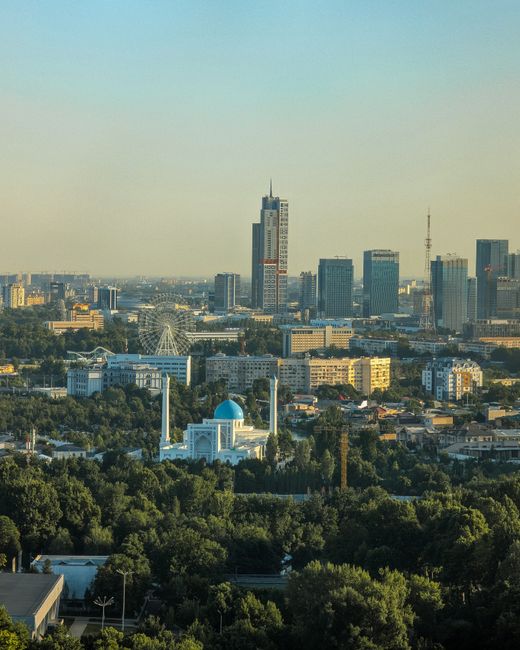
Tashkent, the capital of Uzbekistan and the largest city in Central Asia, is where most journeys along the Silk Road begin. Rebuilt as a Soviet model city after a devastating earthquake in 1966, it is green and spacious, with wide avenues, fountains, parks and grand public buildings, and it is changing fast, with new museums, business towers and restaurants. Its history is older than it looks: the old town around the Chorsu Bazaar and the Khast Imam complex, home to one of the world’s oldest Qurans, recalls the caravan city that stood here for two thousand years. Come for the turquoise dome of Chorsu, plov cooked in giant cauldrons, the decorated stations of the Tashkent Metro, Soviet modernist architecture, the museums of applied arts and history, the opera at the Navoi Theater, and quick escapes to the mountains at Chimgan, Charvak and Amirsoy. Tashkent is also the country’s transport hub, with the main international airport and high-speed trains to Samarkand, Bukhara and, since 2026, Khiva. The best months are April, May, September and October.
Right now in Tashkent
- Wed8–21°C46–69°FPartly cloudy
- Thu9–24°C48–76°FClear
- Fri11–24°C52–75°FClear
Top tours in Tashkent
See all tours for Tashkent →
From local operators, with prices and reviews; you check availability and book on Viator, our partner. We may earn a commission at no extra cost to you. How we earn money
Tashkent at a glance
- Best for: bazaars, food, museums, Soviet architecture and metro stations, nightlife, and access to the mountains.
- How long: 1–2 days for the city, plus a day in the mountains.
- Best time: April to May and September to October; July and August are hot, and winter is cold and gray.
- Getting there: by air to Tashkent International Airport, about 6 km (4 miles) from the center; by high-speed train from Samarkand, Bukhara and Khiva; by road from Kazakhstan.
- Getting around: by metro, which is cheap and fast, and by ride-hailing taxi.
- Good to know: distances are large, and the sights are spread out; use the metro and taxi apps.
- Before you go: visas, the registration rule, money and general safety are in our Uzbekistan travel guide.
Tashkent’s areas and where to stay
Tashkent sprawls across a plain watered by canals. The old town lies to the west, around Chorsu and Khast Imam; the modern center spreads around Amir Timur Square; and new districts stretch north and east.
The center: Amir Timur Square
Around Amir Timur Square, Independence Square and the pedestrian Sayilgoh Street (known as Broadway), the center has the big hotels, ministries, museums, theaters and many restaurants, with metro stations close by. It is the most practical base for a short stay.
Tashkent City
West of the center, the new Tashkent City district has glass towers, a park with lakes and fountains, a shopping mall and international hotels. It is modern, clean and lively in the evening.
The old town
Around Chorsu Bazaar, the Kukeldash Madrasa and Khast Imam, the old town has narrow lanes of single-story houses, mosques and markets. A few guesthouses and hostels give you an authentic neighborhood feel, with the metro nearby.
Mirzo Ulugbek and Yunusabad
Leafy residential districts north and northeast of the center, with the TV tower, parks, cafés and good-value hotels and apartments, linked to the center by metro.
Where to stay in Tashkent
- Center: big hotels near Amir Timur Square, theaters and the metro.
- Tashkent City: international hotels in the new business district.
- Old town: guesthouses and hostels near Chorsu Bazaar.
- Mirzo Ulugbek and Yunusabad: quieter neighborhoods with good value.
Book ahead in spring and autumn, when conferences and tour groups fill the larger hotels.
Top things to see in Tashkent
Tashkent’s story in brief
Known in early sources as Chach or Shash, Tashkent (“stone city”) grew as an oasis town on the trade routes between the steppe and the cities of Transoxiana, and was ruled in turn by Sogdians, Turks, Arabs, the Samanids, the Mongols and the Timurids. In the 19th century it belonged to the Khanate of Kokand until Russian troops took it in 1865; it became the capital of Russian Turkestan, with a European-style new town laid out beside the old one. In the Soviet era, Tashkent became the fourth-largest city of the USSR. On April 26, 1966, an earthquake destroyed much of the old town, and the city was rebuilt with wide avenues, apartment blocks and monumental public buildings by workers from across the Soviet Union. Since independence in 1991, it has been the capital of Uzbekistan, and new districts, parks and museums are still transforming it.
The Khast Imam complex
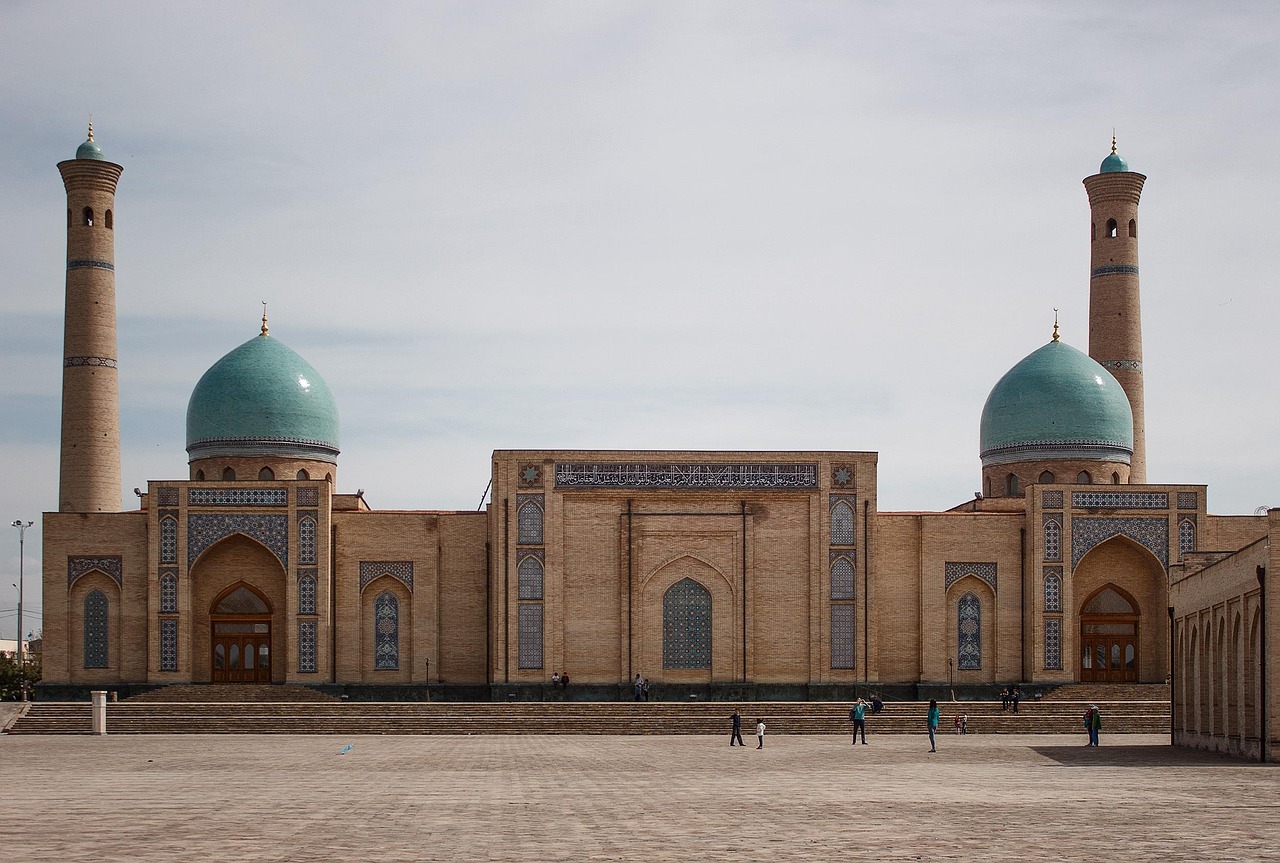
The religious heart of Tashkent, Khast Imam (Hazrat Imam), groups the 16th-century Barak Khan Madrasa, the Kaffal Shashi mausoleum, the modern Hazrat Imam Friday Mosque and the library of the Muyi Muborak madrasa. The library holds the Uthman Quran, a huge 7th-century manuscript on deer skin, considered one of the oldest surviving copies of the Quran; it was brought to Samarkand by Timur, taken to Russia in 1869 and returned in 1924. A vast new Center of Islamic Civilization has been built nearby. Dress modestly, and women should cover their hair in the mosque and library.
Chorsu Bazaar and Kukeldash Madrasa
Under a giant turquoise dome, Chorsu Bazaar is the city’s most famous market, selling meat, spices, dried fruit, nuts, bread, pickles and cheese on its circular floors, with fruit, vegetables, clothes and household goods spreading into the surrounding halls and lanes. It is busiest in the morning. Next door, the 16th-century Kukeldash Madrasa is one of the largest madrasas in Central Asia.
Amir Timur Square and Independence Square
At the center of the city, an equestrian statue of Amir Timur stands in a park of plane trees, overlooked by the domed Amir Timur Museum, with its exhibits on the Timurid era, the clock towers and the Hotel Uzbekistan, a landmark of Soviet modernism. A short walk west, Mustaqillik (Independence) Square is a vast ceremonial space of fountains, monuments and government buildings, with the Memorial to the Grieving Mother honoring those who died in World War II.
The Tashkent Metro
Opened in 1977, the Tashkent Metro was the first in Central Asia, and its older stations are underground palaces of marble, chandeliers, ceramics and mosaics, each with its own theme: Kosmonavtlar, with blue glass and portraits of cosmonauts; Alisher Navoi, with domes and ceramic panels; and Toshkent and Mustaqillik Maydoni, with chandeliers and marble. Photography in the metro has been allowed since 2018. Rides are very cheap, paid with a contactless card or QR ticket. The newer overground Circle Line serves the outer districts.
Museums
- State Museum of Applied Arts: set in a 19th-century diplomat’s house decorated by master craftsmen, with ceramics, suzani, jewelry and carved wood.
- State Museum of History of Uzbekistan: archaeology from the Stone Age to the present, including Buddhist sculpture from Termez.
- State Museum of Arts of Uzbekistan: Central Asian, Russian and European painting and decorative arts.
- Museum of Victims of Political Repression: the history of Soviet-era repression in Uzbekistan, set in a park.
More classic sights
- Alisher Navoi Theater of Opera and Ballet: built in 1947, partly by Japanese prisoners of war, with halls decorated in regional styles; tickets for opera and ballet are inexpensive.
- Minor Mosque: a white marble mosque with a turquoise dome on the banks of the Ankhor canal, opened in 2014.
- Tashkent TV Tower: a 375 m (1,230 ft) tower with an observation deck and revolving restaurant.
- Earthquake Memorial: a monument to the 1966 earthquake and the rebuilding of the city.
- Soviet modernist buildings: the Hotel Uzbekistan, the Palace of the Friendship of Peoples and the mosaics on apartment blocks around the city.
Other things to do in Tashkent
Food and drink
Tashkent has the country’s best restaurants and street food. Don’t miss the Central Asian Plov Center (Besh Qozon), where plov is cooked in enormous cauldrons and served at lunchtime to hundreds of diners; plov is traditionally a midday dish, and many plov centers close once the pots are empty. Try somsa from the tandoor, shashlik, lagman, manti and naryn, and Tashkent’s version of the round bread, lighter than Samarkand’s. The city also has excellent Korean, Georgian, Russian and international restaurants, rooftop bars and coffee shops. See our Georgia and South Korea guides for the origins of some favorites.
Parks, markets and nightlife
The city’s parks and promenades, such as Tashkent City Park, the Ankhor canal and the Japanese Garden, are busy on summer evenings. Yangiobod flea market on weekends sells Soviet memorabilia and old household goods. Bars, clubs and live music venues are concentrated in the center and Tashkent City.
Theater and culture
The Navoi Theater stages opera and ballet; the Ilkhom Theater, founded in 1976, was one of the first independent theaters in the Soviet Union. Check programs locally. See our city sightseeing guide.
Day trips from Tashkent
- Chimgan and Beldersay: mountain slopes about 80 km (50 miles) northeast, with hiking, horseback riding and chairlifts in summer, and skiing in winter.
- Charvak reservoir: a turquoise lake below the mountains, with beaches, resorts and water sports in summer.
- Amirsoy: a modern mountain resort about 65 km (40 miles) from the city, with gondolas, ski runs in winter, and hiking and mountain biking in summer.
- Chatkal mountains: part of the Western Tien-Shan World Heritage Site, with walnut forests, rivers and hiking trails; some areas require reserve permits.
- The Fergana Valley: Kokand, Margilan and Rishton are better as a two- or three-day trip by train over the Kamchik Pass.
- Samarkand: possible as a long day trip by high-speed train, but better with at least one night. See our Samarkand guide.
Nearby destinations
- Samarkand268 km
Getting there and getting around
By air
Tashkent International Airport (TAS), named after Islam Karimov and about 6 km (4 miles) south of the center, is the country’s main gateway, with flights from Istanbul, Dubai, Seoul, Delhi, Frankfurt, Moscow, Almaty and many more; see our Istanbul and Kazakhstan guides. Taxis by app take 15–30 minutes to the center. Domestic flights link Tashkent with Samarkand, Bukhara, Urgench, Nukus and the Fergana Valley in about an hour.
By train
High-speed Afrosiyob trains leave from Tashkent’s main station for Samarkand in a little over two hours and Bukhara in about four hours, and since May 2026 the Jaloliddin Manguberdi high-speed train has run to Khiva in about seven and a half hours. Regional trains serve the Fergana Valley, and overnight trains run to Urgench, Nukus and Termez. Buy tickets on railway.uz, the official site and app of Uzbekistan Railways, or at stations, with your passport.
By road
The main crossing to Kazakhstan is about 20 km (12 miles) north of the center, with shared taxis and buses on to Shymkent and Almaty. Shared taxis to Samarkand and the Fergana Valley leave from the city’s bus stations and bazaars.
Around town
The metro is the quickest way around, with four lines; rides are very cheap. Ride-hailing apps such as Yandex Go and MyTaxi are inexpensive and reliable; avoid unofficial taxis. Buses cover the whole city. Distances are large, so walking is best within neighborhoods.
When to go and how long to stay
Tashkent has a continental climate. Spring, from March to May, is green and pleasant, with rain showers and warm days by May. Summer, from June to August, is hot and dry, with average highs of 34–36 °C (92–97 °F); the city’s trees, fountains and canals help, and the nearby mountains are cooler. Autumn, from September to November, is warm and sunny at first, then cool. Winter, from December to February, is cold and damp, with frosty nights and occasional snow. The table uses the 1991–2020 climate normals for the Tashkent station of Uzhydromet, as submitted to the World Meteorological Organization (WMO): average daily highs and lows, total precipitation, and days with at least 1 mm of rain or snow.
| Month | Average high / low | Rain (days with 1 mm or more) | What to expect |
|---|---|---|---|
| January | 7 °C (45 °F) / −1 °C (30 °F) | 55 mm (2.2 in), 14 days | Cold and gray; skiing nearby |
| February | 10 °C (49 °F) / 0 °C (32 °F) | 72 mm (2.8 in), 14 days | Cold; the wettest month |
| March | 16 °C (61 °F) / 6 °C (42 °F) | 66 mm (2.6 in), 14 days | Spring rains; Navruz |
| April | 22 °C (72 °F) / 10 °C (50 °F) | 63 mm (2.5 in), 13 days | Warm and green |
| May | 28 °C (83 °F) / 14 °C (58 °F) | 41 mm (1.6 in), 11 days | Excellent; busy |
| June | 34 °C (92 °F) / 18 °C (65 °F) | 17 mm (0.7 in), 8 days | Hot; mountain season |
| July | 36 °C (97 °F) / 20 °C (68 °F) | 3 mm (0.1 in), 4 days | The hottest month |
| August | 35 °C (95 °F) / 18 °C (65 °F) | 2 mm (0.1 in), 3 days | Hot and dry; melons |
| September | 30 °C (85 °F) / 13 °C (56 °F) | 5 mm (0.2 in), 4 days | Warm; Independence Day |
| October | 22 °C (72 °F) / 8 °C (47 °F) | 24 mm (0.9 in), 8 days | Mild and golden |
| November | 14 °C (58 °F) / 4 °C (39 °F) | 51 mm (2.0 in), 11 days | Cool; rains return |
| December | 9 °C (48 °F) / 0 °C (32 °F) | 58 mm (2.3 in), 13 days | Cold; New Year lights |
Tashkent receives about 460 mm (18 in) of precipitation a year, mostly from November to May.
One day in Tashkent
Start at Chorsu Bazaar and the Kukeldash Madrasa, walk or take a taxi to Khast Imam, then have plov at the Central Asian Plov Center at lunchtime. In the afternoon, visit the Museum of Applied Arts, ride the metro through Kosmonavtlar and Alisher Navoi stations, and end at Amir Timur Square and Broadway, with an evening at the Navoi Theater or Tashkent City.
Two to three days
Add the history and art museums, the Minor Mosque and the TV tower, and a day in the mountains at Chimgan, Charvak or Amirsoy.
What a trip to Tashkent costs
Prices are approximate, for October 2026, converted at about 11,800 som to the US dollar.
| Item | Typical cost |
|---|---|
| Metro ride | about 2,000–3,000 UZS (about US$0.20–0.25) |
| Taxi from the airport to the center by app | 30,000–70,000 UZS (about US$2.50–6) |
| Plate of plov at a plov center | 40,000–60,000 UZS (about US$3.40–5.10) |
| Dinner in a good restaurant | 200,000–400,000 UZS (about US$17–34) per person |
| Museum entry | 30,000–80,000 UZS (about US$2.50–6.80) |
| Opera or ballet ticket | 50,000–200,000 UZS (about US$4.20–17) |
| Afrosiyob train to Samarkand, economy | about 250,000–350,000 UZS (about US$21–30) |
| Mid-range hotel double, per night | 600,000–1,300,000 UZS (about US$50–110) |
Practical tips for Tashkent
- Use the metro and taxi apps: distances are large, and app taxis avoid haggling.
- Eat plov at lunchtime: plov centers serve it from late morning until it runs out.
- Go to Chorsu early: the market is liveliest in the morning.
- Book trains early: Afrosiyob seats from Tashkent sell out in spring and autumn.
- Keep registration slips: hotels register you; keep the slips until you leave Uzbekistan.
- Card or cash: cards work in hotels, malls and many restaurants, but bazaars want cash.
Safety
Tashkent is a safe city, with low levels of violent crime. Watch for pickpockets in Chorsu Bazaar, on the metro and in crowds. Use app-based taxis rather than unofficial drivers, especially at night. Traffic is heavy and fast on the wide avenues; use underpasses and crossings. Avoid photographing government buildings, the Senate and the presidential residence, police and military sites, and take care with photography near official buildings around Independence Square. Carry your passport, as police may check it. Tashkent is in an active earthquake zone; follow instructions if you feel a tremor. In an emergency, call 101 for fire, 102 for police and 103 for an ambulance.
What to pack for Tashkent
Light clothes for summer and a warm coat for winter, smart-casual clothes for the theater and good restaurants, modest clothes and a scarf for women at Khast Imam, comfortable walking shoes, sunscreen and a hat from May to September, and an umbrella in spring. Uzbekistan uses 220 V, with round two-pin plugs. See our hiking shoes, rain jackets and travel adapters guides.
Tashkent travel FAQ
How many days do I need in Tashkent?
One to two days for the main sights, plus a day if you want to visit the mountains at Chimgan, Charvak or Amirsoy.
How do I get from Tashkent airport to the city center?
By ride-hailing taxi in about 15–30 minutes; the airport is about 6 km south of the center.
Can I take photos in the Tashkent Metro?
Yes. Photography in the metro has been allowed since 2018, though you should avoid photographing police officers.
What is the Uthman Quran?
A 7th-century manuscript of the Quran, considered one of the oldest in the world, kept in the library of the Khast Imam complex.
When is Chorsu Bazaar open?
Every day, from early morning until late afternoon; it is busiest in the morning, and some sections close earlier on Mondays.
How do I get from Tashkent to Samarkand?
By Afrosiyob high-speed train in a little over two hours, by domestic flight, or by shared taxi in about 4–5 hours.
Is Tashkent worth visiting?
Yes, for a day or two: its bazaars, food, metro, museums and Soviet architecture are very different from the historic cities further west.
What is the best time to visit Tashkent?
April to May and September to October. July and August are hot, and winter is cold and damp.
Is Tashkent safe?
Yes. Take the usual care with belongings in crowds and use app-based taxis.
Can I cross from Tashkent to Kazakhstan?
Yes. The main road crossing is about 20 km north of the center, and there are flights and buses to Almaty and Shymkent. See our Kazakhstan guide.
Plan your trip
Partner links: TravelerCenter may earn a commission if you book, at no extra cost to you.
🇺🇿 Useful Uzbek phrases for Tashkent
All 38 Uzbek phrases: restaurant, hotel, emergencies, romance (printable) →
Sources · last reviewed 4 October 2026
Researched and last reviewed on 4 October 2026. Visas and registration: the Ministry of Foreign Affairs of Uzbekistan and the Uzbek government services portal; photography, taxis, earthquakes and money: the UK government’s factual safety pages; climate normals: Uzhydromet via the World Meteorological Organization’s 1991–2020 normals; the exchange rate: the Central Bank of the Republic of Uzbekistan. The 2026 high-speed train to Khiva is from local press reports. The Uthman Quran’s history, the metro’s opening and photography rule, monument dates, distances, opening patterns, the new Center of Islamic Civilization, journey times and typical prices are general references or estimates, flagged for checking. Prices and rules change, so check locally before you go. For entry rules, money and general safety, see our Uzbekistan travel guide.
Data: Weather: MET Norway (CC BY 4.0) · Rates: ECB · Costs: World Bank ICP and price levels · Wikidata (CC0)