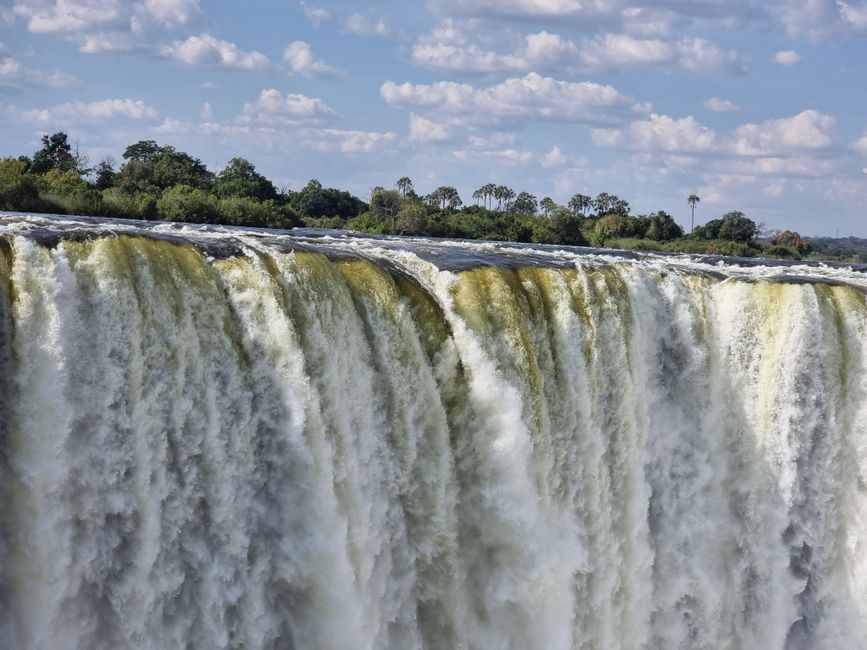
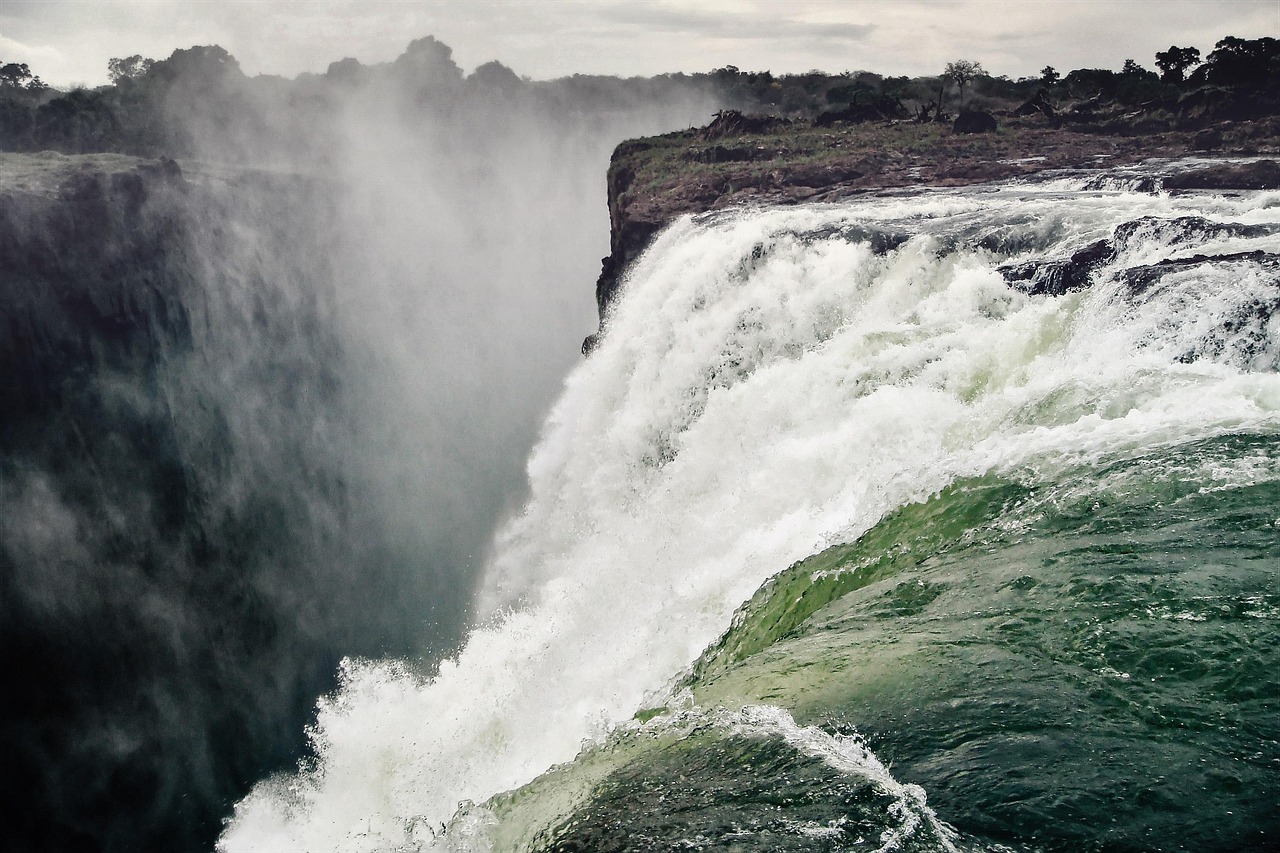
Victoria Falls is the town on the Zimbabwean side of one of the world’s great natural wonders. Here the Zambezi River, more than 1.7 km (1 mile) wide, drops about 108 m (355 ft) into a narrow chasm, creating the largest curtain of falling water on Earth, according to Zimbabwe Parks and Wildlife (ZimParks). The local name, Mosi-oa-Tunya, means “the smoke that thunders,” and at high water the spray rises hundreds of meters, visible from far away. Zimbabwe has the longer share of the falls and the best overall views: the path through the rainforest on the opposite side of the gorge looks straight across at the Main Falls, Livingstone Island and Horseshoe Falls, and the spray waters a lush forest of ferns, palms and mahogany. The town itself is small, safe-feeling and walkable, with colonial-era hotels, riverside lodges, craft markets and warthogs grazing on the lawns. It is also the adventure capital of southern Africa: white-water rafting through the gorges, the bungee jump from the 1905 Victoria Falls Bridge, helicopter flights, sunset cruises on the upper Zambezi, and game drives in the neighboring Zambezi National Park. Hwange National Park, Chobe in Botswana and Livingstone in Zambia are all within easy reach. The falls are at their fullest from about March to May and at their lowest around October and November.
Right now in Victoria Falls
- Wed 19–32°C 67–89°F 1 mm Light showers
- Thu 21–32°C 70–90°F Partly cloudy
- Fri 22–33°C 72–91°F Mostly clear
Weather: MET Norway (CC BY 4.0)
Top tours in Victoria Falls
See all tours for Victoria Falls →
From local operators, with prices and reviews; you check availability and book on Viator, our partner. We may earn a commission at no extra cost to you. How we earn money
Victoria Falls at a glance
- Best months: March to May for the biggest flow and spray; June to August for strong flow with clearer views; September to December for low water, rafting and Devil’s Pool on the Zambian side.
- Time needed: two to three nights for the falls and a couple of activities; four or five to add Chobe, Livingstone or Hwange.
- Getting there: Victoria Falls International Airport (VFA) is about 20 km (12 miles) south of town, with direct flights from Johannesburg and other African hubs.
- Costs (as of October 2026): rainforest entry for international day visitors was reported at US$58 in 2026, after VAT was added to park fees.
- Before you go: visas, money and the KAZA UNIVISA are covered in our Zimbabwe travel guide.
Victoria Falls areas and who each one suits
The town center
The center, along Livingstone Way and Park Way, has the craft markets, banks, cafés, restaurants, activity booking offices and a growing number of hotels and guesthouses. It is a 15- to 20-minute walk to the rainforest entrance. It suits travelers who want to walk to restaurants and the falls.
The Victoria Falls Hotel and the gorge
The grand Victoria Falls Hotel, opened in 1904, stands above the Batoka Gorge with a view of the bridge and the spray. Its terrace is a classic spot for high tea or a sundowner even if you’re not staying there. The path from the hotel leads to the bridge and the rainforest.
The riverside upstream
Upstream of the falls, along Zambezi Drive and the edge of the Zambezi National Park, lodges and hotels sit on the riverbank, with sunset cruise jetties nearby. It’s quieter, with more wildlife, and suits couples and safari-minded travelers; transfers or taxis take you into town.
Lodges on the edge of town
Several lodges and private reserves south and west of town overlook waterholes, where elephants and buffalo drink, and offer a safari atmosphere close to town.
Top things to see in Victoria Falls
The rainforest walk
The path inside Victoria Falls National Park follows the edge of the gorge opposite the falls, with numbered viewpoints from Devil’s Cataract, beside the statue of David Livingstone, through the Main Falls and Livingstone Island to Horseshoe Falls, Rainbow Falls and Danger Point, facing the bridge. Allow two hours. At high water you’ll be drenched, so bring a raincoat or rent one at the gate, protect your camera, and wear shoes with grip. At low water, you can see the cliff face and the rock layers clearly. The park covers about 23 km² (9 square miles), according to ZimParks.
Park entry fees
ZimParks charges a conservation fee to enter the rainforest. In early 2026, after VAT was applied to tourism services, ZimParks raised the fees; as reported at the time, international day visitors pay:
| Rainforest entry (international visitors) | Per person |
|---|---|
| — | — |
| Main gate (2026, as reported) | US$58 |
| VIP gate (2026, as reported) | US$174 |
| Moonlight viewing (2026, as reported) | US$116 |
| Main gate (ZimParks 2023 schedule, before VAT) | US$50 |
SADC nationals and Zimbabweans pay lower rates. Pay in US dollars or by card at the gate. The rainforest is generally open from about 06:00 to 18:00; check the gate for current times.
Lunar rainbows
On nights around the full moon, when the water is high (roughly April to July), the spray can create a lunar rainbow, a faint silvery arc lit by moonlight. ZimParks runs special moonlight viewings on these nights.
Victoria Falls Bridge
Built in 1905 as part of a planned Cape-to-Cairo railway, the bridge spans the gorge between Zimbabwe and Zambia, 128 m (420 ft) above the river. You can walk onto it from the Zimbabwe border post with a gate pass, take a guided bridge tour that explores the structure beneath the deck, or watch bungee jumpers.
The Big Tree and the Zambezi riverside
A short drive upstream, the “Big Tree,” a huge baobab, once marked a crossing point for early travelers. The riverside road through the Zambezi National Park is good for spotting elephants, hippos and crocodiles.
Victoria Falls with children and on a budget
Families enjoy the rainforest walk, the crocodile ranch and nature sanctuary, a sunset cruise and the markets. On a budget, the rainforest entry and a walk to the bridge are the essentials; many lodges have pools, and craft markets and local restaurants are inexpensive.
Other things to do in Victoria Falls
Adventure activities
- White-water rafting: the Batoka Gorge below the falls has some of the world’s most famous commercial rapids. The best season is low water, from about August to December, when full-day trips run the classic rapids; at the highest water, from about March to June, trips are shorter or suspended.
- Bungee, gorge swing and zip line: from the bridge and the gorge edge, run by licensed operators.
- Helicopter flights: the “Flight of Angels,” 12 to 15 minutes over the falls and the river, is the best way to grasp the falls’ scale.
- Sunset cruises: drinks and snacks on the upper Zambezi, with hippos, elephants and spectacular sunsets.
- Canoeing and fishing: guided canoe trips on the upper Zambezi and tigerfish angling.
- Game drives and walks: in the Zambezi National Park and private areas near town.
See our boat trips and hiking guides.
Food and drink
Victoria Falls has a lively dining scene for a small town. Try game such as kudu, eland and warthog, Zambezi bream, and Zimbabwean dishes such as sadza with relish; the famous boma dinners combine a buffet of local food (including mopane worms for the brave) with drumming and dancing. High tea at the Victoria Falls Hotel, sundowners at riverside decks and cafés overlooking the gorge are local traditions. Zimbabwean craft beers and South African wines are widely available.
Crafts and markets
The craft markets near the town center sell stone sculpture, wood carvings, baskets and textiles; bargain politely. The Elephant’s Walk shopping village has galleries and cafés.
Day trips from Victoria Falls
Livingstone and the Zambian side
Walk or drive across the bridge to Zambia to see the falls from the other side, with the Knife-Edge Bridge, the Boiling Pot trail and, in low water, Devil’s Pool on Livingstone Island. Livingstone town is about 10 km (6 miles) from the border. See our Livingstone guide.
Chobe National Park
Kasane, the gateway to Chobe in Botswana, is about 80 km (50 miles) west through the Kazungula border. Day trips include a morning boat cruise, lunch and an afternoon game drive. See our Chobe National Park guide.
Hwange National Park
Hwange’s Main Camp is about 195 km (121 miles) southeast via the A8 and Cross Mabale, according to ZimParks; it is best as an overnight trip. See our Hwange National Park guide.
Zambezi National Park
Just upstream of town, this park has riverside drives, fishing camps and lodges, with elephants, buffalo and sable antelope; international visitors paid US$15 per day under ZimParks’ 2023 schedule.
Nearby destinations
- Livingstone10 km
- Hwange National Park148 km
- Chobe National Park171 km
Getting there and getting around
By air
Victoria Falls International Airport (VFA) has direct flights from Johannesburg, Cape Town, Nairobi, Addis Ababa, Windhoek and other cities, and domestic flights from Harare. Taxis and pre-booked transfers take about 20 to 30 minutes to town. Visas on arrival and the KAZA UNIVISA are issued at the airport for eligible nationalities.
By road
Victoria Falls is about 440 km (275 miles) from Bulawayo on the A8, and about 80 km (50 miles) from Kasane in Botswana via Kazungula. Intercity coaches link the town with Bulawayo and Harare.
Crossing to Zambia
The Zimbabwe border post is a short walk from the rainforest entrance; the Zambian post is on the far side of the bridge. Taxis wait on both sides. If you need a Zimbabwe visa and plan to cross back, buy a double-entry visa or the KAZA UNIVISA (US$50, valid for 30 days), which also allows day trips to Botswana through Kazungula. Many nationalities don’t need a visa for Zambia.
Getting around
The center is walkable by day; taxis are inexpensive for the riverside lodges and at night. Most activity operators include hotel pickups.
When to go and how long to stay
There are two calendars at Victoria Falls. The local weather has a rainy season from about November to March, a cool dry season from about May to August, and a hot dry season in September and October. The falls’ flow lags behind the rain, because water takes months to arrive from the upper Zambezi: it rises from about January, peaks from about March to May, and falls to its lowest in about October and November. On October 5, 2026, the Zambezi River Authority measured the flow at Victoria Falls at 343 m³ per second (compared with 272 m³/s a year earlier), well below the long-term annual average of 1,100 m³/s, typical of the low-water season.
| Month | Average high | Average low | Rain | Rain days |
|---|---|---|---|---|
| Jan | 30 °C (85 °F) | 18 °C (65 °F) | 168 mm (6.6 in) | 14 |
| Feb | 29 °C (85 °F) | 18 °C (64 °F) | 126 mm (5.0 in) | 10 |
| Mar | 30 °C (85 °F) | 17 °C (63 °F) | 70 mm (2.7 in) | 7 |
| Apr | 29 °C (85 °F) | 14 °C (57 °F) | 24 mm (1.0 in) | 2 |
| May | 27 °C (81 °F) | 10 °C (49 °F) | 3 mm (0.1 in) | 1 |
| Jun | 25 °C (77 °F) | 6 °C (43 °F) | 1 mm (0 in) | 0 |
| Jul | 25 °C (77 °F) | 6 °C (42 °F) | 0 mm (0 in) | 0 |
| Aug | 28 °C (82 °F) | 8 °C (47 °F) | 0 mm (0 in) | 0 |
| Sep | 32 °C (89 °F) | 13 °C (55 °F) | 2 mm (0.1 in) | 1 |
| Oct | 33 °C (92 °F) | 17 °C (63 °F) | 27 mm (1.0 in) | 4 |
| Nov | 32 °C (90 °F) | 18 °C (65 °F) | 64 mm (2.5 in) | 8 |
| Dec | 30 °C (86 °F) | 18 °C (65 °F) | 174 mm (6.8 in) | 13 |
| Year | 29 °C (85 °F) | 14 °C (56 °F) | 657 mm (26 in) | 60 |
Figures are the Meteorological Services Department’s 1961–1990 averages for Victoria Falls, as published by the World Meteorological Organization.
Events worth planning around
Full-moon nights in the high-water months bring the lunar rainbow viewings. Victoria Falls has also hosted music festivals and a marathon in some years; check local listings. Christmas and New Year are busy with regional visitors.
How long to stay: 1, 2 and 3 days
- One day: the rainforest walk in the morning, a helicopter flight, and a sunset cruise.
- Two days: add rafting or a bridge activity, and the Zambian side of the falls.
- Three days: add a day trip to Chobe or a game drive in the Zambezi National Park.
Where to stay in Victoria Falls
- Historic hotels: the Victoria Falls Hotel and other classic hotels within walking distance of the falls.
- Town-center hotels and guesthouses: mid-range options close to restaurants and the rainforest.
- Riverside lodges: on the upper Zambezi, with sunset views and wildlife.
- Waterhole lodges: lodges overlooking waterholes on the edge of town.
- Budget: backpacker lodges and campsites in town.
Typical costs in Victoria Falls
| Item (as of October 2026) | US dollars |
|---|---|
| — | — |
| Rainforest entry, international day visitor (2026, as reported) | $58 |
| KAZA UNIVISA (official) | $50 |
| Ordinary single-entry Zimbabwe visa (official) | $30 |
| Sunset cruise with drinks | about $60–100 |
| Helicopter flight, 12–15 minutes | about $170–220 |
| Full-day white-water rafting | about $150–200 |
| Bungee jump from the bridge | about $160–200 |
| Day trip to Chobe | about $150–220 |
| Mid-range hotel, double, per night | about $120–250 |
Visa fees are official (Zimbabwe Department of Immigration and Zambia Department of Immigration for the KAZA UNIVISA); the rainforest fee is as reported in 2026; other prices are typical ranges, and all are quoted in US dollars.
Safety in Victoria Falls
- River safety at the falls: stay on marked paths in the rainforest and behind the fences; rocks are slippery, especially at high water, and some viewpoints have sheer drops with no barrier. Keep children close.
- The Zambezi: never swim in the river except on supervised activities; currents above the falls are strong, and hippos and crocodiles live along the banks. On rafting and canoe trips, wear the helmet and life jacket provided and follow the guides’ instructions.
- Wildlife in town: elephants, buffalo and warthogs wander through the town and along the roads, especially at dawn and dusk. Keep your distance, don’t walk after dark, and take a taxi at night.
- Malaria: Victoria Falls is a malaria area, with the highest risk from about November to April. Take preventive medicine as advised by a travel-health professional and use repellent.
- Heat: October and November often top 33 °C (91 °F); carry water and use sun protection.
- Belongings and touts: politely decline street sellers and unofficial money changers; use official activity booking offices.
- Emergencies: the general emergency number is 999; private clinics in town handle most problems, and serious cases are evacuated, so carry insurance with evacuation cover.
Practical tips for Victoria Falls
- Cash: bring small US dollar notes for tips, markets and taxis; cards work at most hotels and activity operators.
- Raincoat: essential from about February to July on the rainforest walk; rentals are available at the gate.
- Book ahead: helicopter flights and rafting in high season; hotels for Christmas, Easter and August.
- Visas: decide before you arrive whether you need a single-entry, double-entry or KAZA UNIVISA.
What to pack for Victoria Falls
Bring a waterproof jacket or poncho, a waterproof camera bag or dry bag, quick-dry clothes, sandals with straps or water shoes for the spray and rafting, a sun hat, sunglasses and SPF 50 sunscreen, insect repellent, a warm layer for June to August evenings and cruises, and an adapter for type G sockets. See our rain jackets, water shoes and travel adapters guides.
Victoria Falls travel FAQ
When is the best time to visit Victoria Falls?
For maximum water and spray, from about March to May; for good flow with clearer views, June to August; for low water, rafting and Devil’s Pool on the Zambian side, about September to December.
How much does it cost to enter Victoria Falls in Zimbabwe?
In 2026, the rainforest fee for international day visitors was reported at US$58 at the main gate, after ZimParks added VAT; the schedule on ZimParks’ website (2023) shows US$50. Lower rates apply to SADC nationals and Zimbabweans.
Is the Zimbabwe or Zambia side of Victoria Falls better?
Zimbabwe has the longer frontage and the best views of the Main Falls; Zambia gets you closer to the water, with the Knife-Edge Bridge and seasonal Devil’s Pool. If you can, see both.
Do I need a visa for Victoria Falls?
It depends on your nationality. US, UK, Canadian, Australian and most European travelers can get a Zimbabwe visa on arrival or online (US$30 for most single entries; US$55 for British nationals). The KAZA UNIVISA (US$50) covers Zimbabwe and Zambia.
Is the KAZA UNIVISA still available?
Yes. It is still issued at Victoria Falls Airport, the Victoria Falls border, the Kazungula border and Harare Airport, for US$50. It covers multiple entries to Zimbabwe and Zambia for up to 30 days, plus day trips to Botswana through Kazungula.
When can you see a lunar rainbow at Victoria Falls?
On nights around the full moon when the water is high, roughly April to July. ZimParks runs moonlight viewings on these nights for an extra fee.
Will I get wet at Victoria Falls?
In the high-water months, from about February to July, yes: the spray can soak you on the rainforest path. Wear a raincoat and protect your camera. In the low-water months, you’ll stay mostly dry.
When is the best time for rafting on the Zambezi?
During low water, from about August to December, when full-day trips run the classic rapids of the Batoka Gorge. At the highest water, from about March to June, trips are shortened or suspended.
How far is Victoria Falls from Chobe?
About 80 km (50 miles) to Kasane, roughly an hour’s drive plus the Kazungula border. Day trips to Chobe are easy to arrange.
How many days do you need in Victoria Falls?
Two or three nights for the rainforest walk, a helicopter flight, a cruise and an adventure activity; four or five to add the Zambian side and a day in Chobe.
Sources and last review
Researched and last reviewed on 5 October 2026. Falls dimensions, the park’s area and the distance to Hwange: ZimParks; rainforest fees: ZimParks’ published 2023 schedule, with the 2026 VAT-inclusive rates as reported by the travel trade press (flagged for checking); visa fees: Zimbabwe’s Department of Immigration; the KAZA UNIVISA: the Zambia Department of Immigration and Zimbabwe’s e-visa portal; Zambezi flow: the Zambezi River Authority; climate: the Meteorological Services Department’s 1961–1990 averages for Victoria Falls via the World Meteorological Organization. High- and low-water months, rainforest opening hours, the lunar rainbow season, rafting seasons, bridge details, distances, flights, malaria seasons and typical prices are general references or estimates, flagged for checking. For entry rules and money, see our Zimbabwe travel guide.
Plan your trip
Partner links: TravelerCenter may earn a commission if you book, at no extra cost to you.