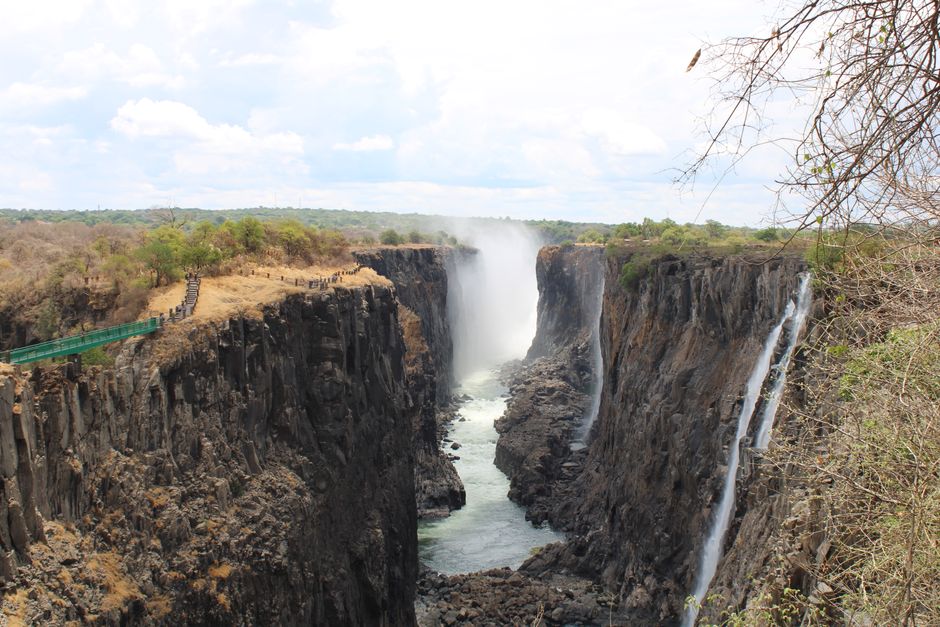
Livingstone is Zambia’s gateway to Victoria Falls and one of the most enjoyable bases in southern Africa. The town, named after the Scottish explorer David Livingstone, who reached the falls in 1855, lies about 10 km (6 miles) from the Zambian side of Mosi-oa-Tunya, “the smoke that thunders.” From Zambia, you get close to the water: the path to the Knife-Edge Bridge leads through the spray to a viewpoint above the Boiling Pot, a trail descends to the river below the bridge, and from the upper Zambezi, small boats cross to Livingstone Island on the very lip of the falls. In the low-water months, from about late August to late December, you can swim in Devil’s Pool, a natural rock pool right at the edge of the 108 m (355 ft) drop, with an expert guide holding on. Livingstone itself has a relaxed colonial-era main street, the country’s national museum of history and ethnography, a railway museum, and good restaurants, while riverside lodges upstream look out over the Zambezi, with hippos and elephants passing by. White-water rafting, sunset cruises, helicopter and microlight flights, and the small Mosi-oa-Tunya National Park with its guarded white rhinos fill the days. Victoria Falls town in Zimbabwe is just across the bridge, and Chobe in Botswana is about an hour away over the Kazungula bridge.
Right now in Livingstone
- Wed 19–32°C 67–89°F 2 mm Showers
- Thu 20–32°C 69–90°F Partly cloudy
- Fri 22–33°C 72–92°F Mostly clear
Weather: MET Norway (CC BY 4.0)
Top tours in Livingstone
See all tours for Livingstone →
From local operators, with prices and reviews; you check availability and book on Viator, our partner. We may earn a commission at no extra cost to you. How we earn money
Livingstone at a glance
- Best months: March to May for the biggest flow; June to August for strong flow and clearer views; late August to December for low water, Devil’s Pool and rafting.
- Time needed: two to three nights for the falls, Livingstone Island and an activity; four or five to add Chobe or the Zimbabwean side.
- Getting there: Harry Mwaanga Nkumbula International Airport (LVI) is a few kilometers from town, with direct flights from Johannesburg and Cape Town and domestic flights from Lusaka.
- Costs (as of October 2026): entry to the falls on the Zambian side is US$20 for international visitors, payable to the National Heritage Conservation Commission (NHCC), according to the Livingstone Island operator; Livingstone Island boat tours cost from US$149.
- Before you go: visas, money and the KAZA UNIVISA are covered in our Zambia travel guide.
Livingstone areas and who each one suits
The town center
Livingstone’s main street, Mosi-oa-Tunya Road, is lined with early 20th-century buildings with verandas, banks, supermarkets, cafés, craft shops and tour booking offices. Guesthouses and backpacker lodges in and around the center suit budget travelers and those who want to walk to restaurants. Taxis to the falls take about 15 minutes.
The falls and the riverbank near the border
Two large hotels stand on the riverbank right next to the falls, inside the national park area, with zebras and giraffes grazing on the lawns and a private path to the falls. This area suits travelers who want to visit the falls at dawn and dusk without a drive.
The upper Zambezi riverside
Upstream from the falls, along the road toward Kazungula, a string of lodges, from tented camps to luxury river lodges, sits on the Zambezi’s banks, some on islands. Sunset cruises leave from jetties here, and hippos and elephants are frequent visitors. It suits couples and safari lovers seeking peace; most lodges include transfers to the falls.
Between town and the falls
The road between Livingstone and the falls passes several mid-range hotels and the Mosi-oa-Tunya National Park entrance, handy for both the town and the falls.
Top things to see in Livingstone
The Zambian side of Victoria Falls
The falls on the Zambian side include the Eastern Cataract and views across to the Main Falls. A path leads to the Knife-Edge Bridge, which crosses a chasm to a point facing the Eastern Cataract and the Victoria Falls Bridge; at high water, you’ll be soaked. The Boiling Pot trail descends steeply to the river’s edge beneath the bridge, where the water swirls after leaving the falls. In the low-water months, much of the Zambian cliff can be dry, but you can see the rock face and walk out on the riverbed with guides. Entry is US$20 for international visitors, according to the Livingstone Island operator, with lower rates for SADC nationals and Zambians.
Livingstone Island and Devil’s Pool
Small boats take you from the riverside launch site to Livingstone Island, where David Livingstone first saw the falls. Guided tours limited to 32 guests per session include a walk to the edge, a meal on the island, and, depending on the season and water level, a swim in one of the pools. According to the operator, Green Safaris:
- Devil’s Pool is usually open from about late August to late December, subject to water levels.
- Angel’s Pool is open from about January to late August, when the water is higher.
- Walking safaris across the exposed rocks of the falls to the island are offered from September 1 to late December; August walks depend on water levels.
- The minimum age to visit the island is 8, and to swim in any pool, 12.
Book well ahead for September to December.
Mosi-oa-Tunya National Park
The park protects the falls and a small game area upstream along the river, where you can see white rhinos (guarded around the clock by wildlife scouts on foot), elephants, giraffes, zebras, buffalo and antelope on short game drives or guided rhino walks.
Livingstone Museum
Zambia’s oldest museum has displays on the country’s archaeology, history, ethnography and natural history, and a collection of David Livingstone’s letters, maps and belongings.
Railway Museum and the town’s history
The Railway Museum displays steam locomotives and the history of the railway that reached the falls in the early 1900s and made Livingstone the capital of Northern Rhodesia until 1935.
Livingstone with children and on a budget
Children enjoy the rhino walks, the museum and sunset cruises; Livingstone Island has minimum ages. On a budget, the falls entry, the Boiling Pot trail, the museum and the town’s markets are inexpensive, and backpacker lodges arrange affordable activities.
Other things to do in Livingstone
Adventure activities
- White-water rafting: the Batoka Gorge below the falls is one of the world’s great rafting rivers, best in low water from about August to December; at the highest water, from about March to June, trips are shortened or suspended.
- Microlight and helicopter flights: microlights give an open-air bird’s-eye view of the falls; helicopters fly over the falls and the gorges.
- Bungee, gorge swing and zip lines: from the Victoria Falls Bridge and the gorge edge.
- Sunset cruises: on the upper Zambezi, with drinks, snacks and wildlife.
- Canoeing and fishing: guided canoe trips upstream and tigerfish angling.
- Horse riding and walking: guided rides and walks along the river.
See our boat trips and hiking guides.
Food and drink
Livingstone’s restaurants serve everything from Zambian nshima with village chicken and bream to pizza, burgers and Indian curries. Riverside lodges and the hotels at the falls offer high tea and sundowners, and cafés on the main street are popular for coffee and cake. Try Mosi, the local lager named after the falls. Lunch on Livingstone Island is one of the most memorable meals in Africa.
Culture and markets
The Mukuni village, home of the Leya people, offers guided cultural visits; the Maramba market and craft markets near the falls sell baskets, carvings and textiles. The Lwiindi ceremony of the Tonga and Leya people is held in July.
Day trips from Livingstone
Victoria Falls, Zimbabwe
Walk or drive across the Victoria Falls Bridge to see the Main Falls from Zimbabwe’s rainforest path, with the best overall views. Check visa rules: many nationalities don’t need a visa for Zambia but do for Zimbabwe. See our Victoria Falls guide.
Chobe National Park
Kasane, the gateway to Chobe in Botswana, is about 65–70 km (40–45 miles) from Livingstone via the Kazungula bridge. Day trips include a boat cruise and a game drive. See our Chobe National Park guide.
Hwange National Park
Zimbabwe’s largest park is a few hours beyond Victoria Falls, best as an overnight trip. See our Hwange National Park guide.
Kafue National Park
Kafue’s southern section is a few hours north by road, an easy add-on for self-drivers heading toward Lusaka.
Nearby destinations
- Victoria Falls10 km
- Hwange National Park151 km
- Chobe National Park179 km
Getting there and getting around
By air
Harry Mwaanga Nkumbula International Airport (LVI), about 5 km (3 miles) from town, has direct flights from Johannesburg and Cape Town and domestic flights from Lusaka. Victoria Falls International Airport in Zimbabwe, about 30 km (19 miles) away, offers more connections. The KAZA UNIVISA is available at Livingstone’s airport.
By road
Livingstone is about 470 km (290 miles) from Lusaka on the paved T1 highway, about six to seven hours by car or coach. The Victoria Falls Bridge links Livingstone with Victoria Falls town in Zimbabwe, and the Kazungula bridge, about 65 km (40 miles) west, links with Kasane in Botswana. Coaches connect Livingstone with Lusaka daily.
Getting around
Taxis are plentiful and inexpensive; agree on the fare in advance or ask your lodge to book a driver. Most activity operators include transfers from lodges. Walking between the town and the falls isn’t recommended, because the road has heavy traffic and wildlife, including elephants.
When to go and how long to stay
Livingstone has a rainy season from about November to March, a cool, dry season from about May to August, and a hot, dry season in September and October, when temperatures often reach 35 °C (95 °F). The falls follow the river: they rise from about January, peak from about March to May, when the spray can block the view and soak you, and are lowest in about October and November, when much of the Zambian side’s cliff is dry. On October 5, 2026, the Zambezi River Authority measured the flow at Victoria Falls at 343 m³ per second, well below the long-term annual average of 1,100 m³/s, typical of the low-water season.
| Month | Average high | Average low | Rain |
|---|---|---|---|
| Jan | 31 °C (88 °F) | 19 °C (67 °F) | 175 mm (6.9 in) |
| Feb | 31 °C (87 °F) | 19 °C (66 °F) | 133 mm (5.2 in) |
| Mar | 31 °C (88 °F) | 18 °C (64 °F) | 83 mm (3.3 in) |
| Apr | 31 °C (87 °F) | 15 °C (59 °F) | 20 mm (0.8 in) |
| May | 29 °C (84 °F) | 11 °C (52 °F) | 2 mm (0.1 in) |
| Jun | 26 °C (80 °F) | 8 °C (47 °F) | 0 mm (0 in) |
| Jul | 26 °C (79 °F) | 8 °C (46 °F) | 0 mm (0 in) |
| Aug | 30 °C (86 °F) | 11 °C (52 °F) | 0 mm (0 in) |
| Sep | 34 °C (92 °F) | 15 °C (60 °F) | 1 mm (0.1 in) |
| Oct | 36 °C (96 °F) | 19 °C (67 °F) | 11 mm (0.4 in) |
| Nov | 34 °C (93 °F) | 20 °C (68 °F) | 78 mm (3.1 in) |
| Dec | 32 °C (89 °F) | 20 °C (67 °F) | 142 mm (5.6 in) |
| Year | 31 °C (87 °F) | 15 °C (60 °F) | 646 mm (25 in) |
Figures are the Zambia Meteorological Department’s 1991–2020 normals for Livingstone, as published by the World Meteorological Organization.
Events worth planning around
Full-moon nights at high water bring lunar rainbows over the falls. The Lwiindi ceremony takes place in July, and Christmas and Easter are busy with regional visitors.
How long to stay: 1, 2 and 3 days
- One day: the Zambian side of the falls and the Boiling Pot trail in the morning, Livingstone Island at lunchtime, and a sunset cruise.
- Two days: add rafting or a microlight flight, and the Zimbabwean side of the falls.
- Three days: add a day trip to Chobe, a rhino walk or the Livingstone Museum.
Where to stay in Livingstone
- Hotels at the falls: two large hotels next to the falls, with direct access and wildlife on the grounds.
- Riverside lodges upstream: intimate lodges and tented camps on the Zambezi, some on islands, with cruises and canoeing.
- Town center: mid-range hotels, guesthouses and backpacker lodges close to restaurants and shops.
- Self-catering: cottages and apartments in and around town.
Typical costs in Livingstone
| Item (as of October 2026) | US dollars | About kwacha |
|---|---|---|
| — | — | — |
| Victoria Falls entry, Zambian side (NHCC fee, as stated by the operator) | $20 | K394 |
| Livingstone Island Breezer tour, green / peak season (operator rate) | $149 / $159 | K2,935 / K3,132 |
| Livingstone Island lunch tour, green / peak season (operator rate) | $199 / $209 | K3,920 / K4,117 |
| Livingstone Island walking safari, plus $20 NHCC fee (operator rate) | $100 | K1,970 |
| KAZA UNIVISA (official) | $50 | K985 |
| Sunset cruise with drinks | about $60–100 | about K1,200–2,000 |
| Full-day white-water rafting | about $150–200 | about K2,950–3,950 |
| Mid-range lodge, double, per night | about $100–250 | about K1,970–4,925 |
The KAZA UNIVISA fee is official (Zambia Department of Immigration); Livingstone Island prices and the NHCC fee are as published by the operator, Green Safaris; other prices are typical ranges. Conversions use about K19.70 to US$1.
Safety in Livingstone
- River safety at the falls: stay on marked paths and behind barriers; the Knife-Edge Bridge and trails are slippery when wet, and some cliff edges are unfenced. Never enter the river or approach the edge of the falls except on licensed Livingstone Island tours, where guides decide whether swimming is safe.
- Devil’s Pool: swim only with the licensed operator, follow every instruction, and respect the age limits; swimming is allowed only when water levels are deemed safe.
- The Zambezi: hippos and crocodiles live along the river; don’t swim, wade or walk at the water’s edge, and wear life jackets on boats and canoes.
- Wildlife on the roads: elephants and buffalo cross the roads between town and the river lodges, especially at dawn, dusk and night; don’t walk after dark.
- Malaria: Livingstone is a malaria area, with the highest risk from about November to April. Take preventive medicine as advised by a travel-health professional and use repellent.
- Heat: October and November often reach 35 °C (95 °F); drink plenty of water.
- Belongings: keep valuables out of sight in town and markets, and use booked taxis at night.
- Emergencies: call 999 for the police; Livingstone has private clinics and a general hospital. Carry travel insurance with evacuation cover.
Practical tips for Livingstone
- Book Livingstone Island early: Devil’s Pool slots sell out in September and October.
- Cash: carry kwacha for taxis, markets and small purchases, and US dollars in small notes for fees and tips.
- Raincoat: essential at the falls from about February to July.
- Visas: if you’ll cross to Zimbabwe, decide between a single-entry, double-entry or KAZA UNIVISA.
What to pack for Livingstone
Bring a swimsuit and quick-dry clothes for Livingstone Island, water shoes with grip (non-slip shoes can also be rented at the launch site), a waterproof jacket or poncho, a dry bag for your phone and camera, a sun hat, sunglasses and SPF 50 sunscreen, insect repellent, a warm layer for cool winter evenings, and an adapter for type G sockets. See our water shoes, rain jackets and travel adapters guides.
Livingstone travel FAQ
When is Devil’s Pool open?
Usually from about late August to late December, subject to water levels, according to the operator, Green Safaris. From about January to late August, when the water is higher, Angel’s Pool is open instead.
How much does Devil’s Pool cost?
Devil’s Pool is visited as part of Livingstone Island boat tours, which cost from US$149 (green season) or US$159 (peak) for the Breezer, up to US$199–209 for lunch tours, according to the operator; tours include park fees and a meal.
How much is the Victoria Falls entry fee in Zambia?
US$20 for international visitors, payable to the National Heritage Conservation Commission at the falls entrance, according to the Livingstone Island operator. SADC nationals and Zambians pay less.
Do I need a visa for Livingstone?
Not if you’re from one of the 167 countries Zambia exempts, including the US, UK, Canada, the EU countries, Australia and Japan. If you’ll cross to Zimbabwe, you may need a Zimbabwe visa or the US$50 KAZA UNIVISA.
Is the Zambian or Zimbabwean side of the falls better?
Zimbabwe has the best overall views of the Main Falls; Zambia gets you closer to the water, with the Knife-Edge Bridge, the Boiling Pot and Livingstone Island. Try to see both.
When is the best time to visit Livingstone?
March to May for the fullest falls; June to August for strong flow and clearer views; late August to December for Devil’s Pool, walking to Livingstone Island and rafting.
What is the minimum age for Devil’s Pool?
According to the operator, the minimum age to visit Livingstone Island is 8, and to swim in any of its pools, 12, accompanied by a responsible adult.
How far is Livingstone from Victoria Falls town in Zimbabwe?
About 10 km (6 miles) to the falls and border, then across the bridge; Victoria Falls town is a further 1–2 km (about 1 mile) on the Zimbabwean side.
How far is Livingstone from Chobe?
About 65–70 km (40–45 miles) to Kasane via the Kazungula bridge, roughly an hour’s drive plus border formalities.
How many days do you need in Livingstone?
Two to three nights for the falls, Livingstone Island and an activity; four or five nights to add the Zimbabwean side and a day trip to Chobe.
Sources and last review
Researched and last reviewed on 5 October 2026. Livingstone Island seasons, rates, group sizes, age limits and the NHCC falls fee: the operator, Green Safaris (livingstoneisland.com); visa exemptions and the KAZA UNIVISA: the Zambia Department of Immigration; Zambezi flow: the Zambezi River Authority; the exchange rate: the Bank of Zambia; climate: the Zambia Meteorological Department’s 1991–2020 normals for Livingstone via the World Meteorological Organization. The town’s history, museum and park details, high- and low-water months, rafting seasons, distances, flights, malaria seasons and typical prices are general references or estimates, flagged for checking. For entry rules and money, see our Zambia travel guide.
Plan your trip
Partner links: TravelerCenter may earn a commission if you book, at no extra cost to you.