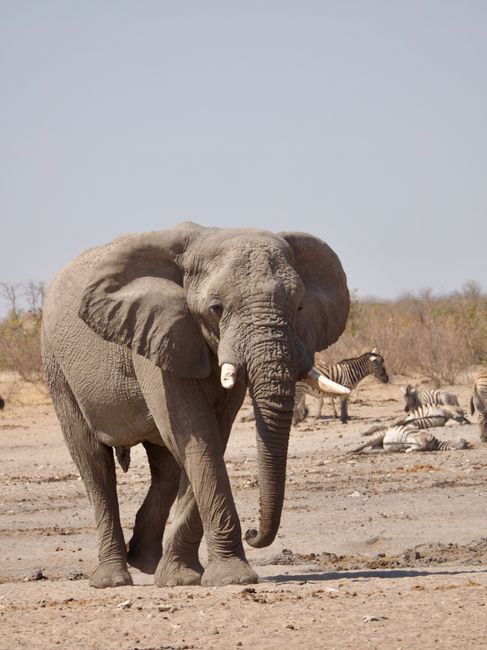
Hwange National Park is Zimbabwe’s largest park and one of the great elephant sanctuaries of Africa. Covering about 14,650 km² (5,660 square miles) of Kalahari sand, teak and mopane woodland, open grassland and seasonal pans in the country’s northwest, it is home to the largest elephant population in Zimbabwe, according to Zimbabwe Parks and Wildlife (ZimParks), with herds that gather in their hundreds at waterholes in the dry season. Lions, leopards, buffalo, giraffes, zebras, cheetahs and spotted hyenas are all present, along with rare sable and roan antelope and one of the continent’s most important populations of the endangered painted dog (African wild dog). ZimParks counts about 100 mammal species and nearly 400 bird species. Because the park has no permanent rivers in most areas, many of its waterholes are fed by boreholes, which keeps animals in the park through the long dry season and makes the waterholes the center of the action. Hwange is about two to three hours by road from Victoria Falls, making it an easy addition to a falls trip, and it combines self-drive routes and simple ZimParks camps with luxury lodges in private concessions. The best months are the dry ones, from about July to October.
Right now in Hwange National Park (Hwange Main Camp)
- Wed17–32°C63–89°F2 mm rain
- Thu19–31°C65–87°FPartly cloudy
- Fri18–31°C65–88°FMostly clear
Top tours in Hwange National Park
See all tours for Hwange National Park →
From local operators, with prices and reviews; you check availability and book on Viator, our partner. We may earn a commission at no extra cost to you. How we earn money
Hwange at a glance
- Best months: July to October, when animals concentrate at waterholes; September and October are hottest and best for elephants. November to March is green, good for birds and newborn animals.
- Time needed: at least two nights; three to five nights to explore Main Camp and Sinamatella or a private concession.
- Getting there: Main Camp is about 195 km (121 miles) from Victoria Falls and about 306 km (190 miles) from Bulawayo, according to ZimParks; light aircraft fly to airstrips near the park.
- Costs (as of October 2026): ZimParks’ published 2023 schedule lists a daily conservation fee of US$20 for international day visitors and US$10 per day for those staying in the park; 2026 increases after VAT may apply.
- Before you go: visas, money and the KAZA UNIVISA are covered in our Zimbabwe travel guide.
Conservation fees, camps and park rules
Daily conservation fees
ZimParks charges a daily conservation fee per person, plus vehicle and accommodation fees. Rates for Hwange’s Main Camp, Robins and Sinamatella in ZimParks’ published schedule (2023, in US dollars):
| Visitor category | Day visitor, per day | Staying in the park, per day |
|---|---|---|
| — | — | — |
| International visitors | US$20 | US$10 |
| SADC nationals | US$15 | US$8 |
| Zimbabweans | US$5 | US$3 |
In early 2026, ZimParks raised fees across its parks as value-added tax was applied to tourism services; comparable fees at Mana Pools rose from US$20 to US$24 for international visitors, so expect Hwange’s fees to be higher than the 2023 figures. Check with ZimParks before you go. Lodges in private concessions usually include fees in their rates.
Gates and opening hours
Main Camp is the principal entrance, 23 km (14 miles) of paved road from the Bulawayo–Victoria Falls highway at Cross Mabale. Sinamatella in the north and Robins in the northwest are reached from the highway and the Pandamatenga road. Gates open around sunrise and close around sunset, typically about 06:00 to 18:00; you must be in camp or out of the park by closing time, and driving after dark is not allowed for self-drivers.
Park rules
- Stay in your vehicle except at designated picnic sites, hides and camps.
- Stick to the roads and observe speed limits; many roads are sand or gravel.
- Don’t feed animals or leave food accessible at campsites.
- Give elephants space, especially breeding herds with calves; ZimParks specifically cautions visitors about elephants with calves.
- Book accommodation through ZimParks or your operator in advance; camps are small.
Hwange areas and who each one suits
Main Camp and the east
Main Camp, in the northeast near the town of Dete, is the most accessible area, with ZimParks chalets, cottages and a campsite, a shop and fuel (when available). Nearby, the open grasslands and pans around Nyamandhlovu Pan (with its viewing platform), Dom Pan, Guvalala and the Kennedy pans are excellent for elephants, buffalo and lions in the dry season. Several private lodges sit just outside the park boundary and in concessions near Main Camp. It suits first-time visitors and short stays.
The southeast concessions
South of Main Camp, the Linkwasha and Makalolo areas, with the open Ngamo plains, are leased to safari operators running upmarket tented camps with guided drives and walks. These areas have some of the park’s best game viewing and very few vehicles.
Sinamatella
Sinamatella, in the north, is perched on a high ridge above the Lukosi River valley, with sweeping views. The area has rocky hills, riverine bush and the Mandavu Dam, good for hippos and crocodiles. It suits self-drivers and repeat visitors seeking quieter roads.
Robins and the northwest
Robins Camp, in the far northwest near the Botswana border, is remote and wild, with the Nantwich area’s pans, known for lions. It can be reached from Victoria Falls via the Pandamatenga road. It suits adventurous self-drivers with a 4×4.
Top things to see and do in Hwange
Waterhole game viewing
Hwange’s pumped and natural pans are where the drama happens in the dry season. Herds of elephants arrive in the afternoon, drinking, bathing and wallowing in mud, while buffalo, zebra, giraffes, kudu and sable wait their turn and lions watch from the shade. Spend time at a viewing platform or hide, such as at Nyamandhlovu Pan near Main Camp, rather than rushing between them.
Guided game drives
Lodges and ZimParks-licensed guides run morning and afternoon drives in open vehicles; in the private concessions, night drives with spotlights reveal genets, civets, porcupines, aardvarks and hunting lions.
Walking safaris
Walking with a professional guide, one of Zimbabwe’s strengths, is offered in the concessions and from some lodges. Expect to learn about tracks, birds and trees, and to approach animals carefully on foot.
Painted dogs
Hwange is one of Africa’s strongholds of the endangered painted dog. Packs range widely, so sightings are never guaranteed; your chances are best early in the dry season, when they den. The Painted Dog Conservation center near Dete explains research and anti-poaching work and is open to visitors.
Overnight platforms and hides
ZimParks offers overnight stays on raised platforms at Guvalala and Makwa pans, where you can watch animals drink through the night.
Birding
With nearly 400 species, Hwange is excellent for birds: ground hornbills, secretary birds, kori bustards, raptors and, in the rainy season, migrant species such as European bee-eaters and storks.
Other things to do near Hwange
Food and drink
Lodges include meals, typically with breakfast before the morning drive, brunch, afternoon tea and dinner around a fire. ZimParks camps are self-catering, and supplies in Dete and Hwange town are limited, so stock up in Victoria Falls or Bulawayo. Look out for sadza, grilled meat and local vegetables at lodge bomas.
Conservation and the waterholes
Hwange lies on the edge of the Kalahari, and most of the park has no permanent surface water. Over the decades, boreholes were drilled to keep pans filled through the dry season, and today the park, lodges and conservation groups share the work of running pumps, many now solar-powered, and maintaining them. The waterholes support Hwange’s great elephant numbers but also concentrate grazing pressure around them, a balance that park managers watch closely. Some lodge rates include a conservation levy that funds pumping, anti-poaching patrols and research; ask your lodge how its contributions are used.
Photography tips
Position yourself at a waterhole with the sun behind you: east-facing banks for afternoon light and west-facing for morning. A beanbag on the vehicle window steadies long lenses, and a lens of 300 mm or more helps with shy animals such as sable. The dust of the dry season gives warm, hazy light at sunset; protect your gear from it.
Community visits
Villages near Dete and the park boundary offer cultural visits, craft projects and school programs supported by lodges and conservation organizations; ask your lodge about responsible visits.
Day trips and nearby
Victoria Falls
About 195 km (121 miles) from Main Camp via the A8, Victoria Falls is the obvious partner for Hwange. See our Victoria Falls guide.
Chobe and Kasane
From Robins or Victoria Falls, the Kazungula border leads to Kasane and Chobe National Park in Botswana. See our Chobe National Park guide.
Livingstone
Livingstone, on the Zambian side of the falls, is a short hop beyond Victoria Falls. See our Livingstone guide.
Bulawayo and Matobo
To the southeast, Bulawayo is about 306 km (190 miles) from Main Camp, and the Matobo Hills, with rhino tracking and San rock art, are just beyond.
Nearby destinations
- Victoria Falls148 km
- Livingstone151 km
- Chobe National Park269 km
Getting there and getting around
By road
According to ZimParks, Main Camp is reached from Bulawayo by driving 283 km (176 miles) toward Victoria Falls, then turning left at Cross Mabale and continuing 23 km (14 miles) on paved road to the park; from Victoria Falls, drive 172 km (107 miles) toward Bulawayo, turn right at Cross Mabale, and continue 23 km (14 miles). For Robins Camp, drive 46 km (29 miles) from Victoria Falls toward Hwange, then turn right at the Pandamatenga turnoff and continue 64 km (40 miles). Many visitors use lodge transfers from Victoria Falls, which take two to three hours.
By air
Charter flights and light-aircraft transfers from Victoria Falls and Harare land at airstrips near Main Camp and in the concessions; ZimParks notes that private aircraft need permission from Main Camp to land. Most visitors fly into Victoria Falls International Airport and continue by road or light aircraft.
Getting around the park
The road network links Main Camp, Sinamatella and Robins; some roads near Main Camp are paved or good gravel, but many are deep sand, best with a high-clearance 4×4, especially in the rainy season. Carry extra fuel and water, as supplies inside the park can be limited.
When to go and how long to stay
Hwange has a summer-rainfall climate. The dry season (May to October) is the best time to visit: water is scarce, animals gather at the pans, and the bush thins out. June and July have pleasant days and cold nights, sometimes near freezing at dawn; September and October are hot, often above 32 °C (90 °F), with the most dramatic elephant gatherings. The rainy season (November to April) turns the park green, with newborn animals and excellent birding, but animals spread out, some roads become difficult, and the malaria risk rises.
| Month | Average high | Average low | Rain | Rain days |
|---|---|---|---|---|
| Jan | 29 °C (85 °F) | 18 °C (65 °F) | 145 mm (5.7 in) | 12 |
| Feb | 29 °C (84 °F) | 18 °C (64 °F) | 129 mm (5.1 in) | 10 |
| Mar | 29 °C (84 °F) | 17 °C (62 °F) | 57 mm (2.2 in) | 7 |
| Apr | 28 °C (82 °F) | 13 °C (56 °F) | 20 mm (0.8 in) | 3 |
| May | 26 °C (79 °F) | 9 °C (48 °F) | 3 mm (0.1 in) | 1 |
| Jun | 24 °C (75 °F) | 5 °C (41 °F) | 0 mm (0 in) | 0 |
| Jul | 24 °C (75 °F) | 5 °C (40 °F) | 0 mm (0 in) | 0 |
| Aug | 27 °C (80 °F) | 7 °C (45 °F) | 1 mm (0 in) | 0 |
| Sep | 31 °C (88 °F) | 12 °C (54 °F) | 2 mm (0.1 in) | 1 |
| Oct | 32 °C (90 °F) | 16 °C (61 °F) | 21 mm (0.8 in) | 3 |
| Nov | 32 °C (89 °F) | 18 °C (64 °F) | 56 mm (2.2 in) | 7 |
| Dec | 30 °C (85 °F) | 18 °C (64 °F) | 126 mm (5.0 in) | 12 |
| Year | 28 °C (83 °F) | 13 °C (55 °F) | 560 mm (22 in) | 56 |
Figures are the Meteorological Services Department’s 1961–1990 averages for Hwange town, about 100 km (60 miles) northwest of Main Camp, as published by the World Meteorological Organization. Inside the park, nights in the dry season can be colder, especially in the open grasslands.
How long to stay: 2, 3 and 5 nights
- Two nights: a lodge near Main Camp with drives to the eastern pans.
- Three nights: two nights near Main Camp and a night at a platform or in the southeast concessions.
- Five nights: combine a southeast concession camp with Sinamatella or Robins, or with Victoria Falls.
Where to stay in Hwange
- ZimParks camps: chalets, cottages, lodges and campsites at Main Camp, Sinamatella and Robins; basic, self-catering and good value.
- Exclusive campsites and platforms: bush camps and overnight platforms at selected pans, booked through ZimParks.
- Concession camps: tented camps in the southeast and elsewhere, all-inclusive with guided activities.
- Lodges near Main Camp: lodges on the park’s edge near Dete, with drives into the park.
Typical costs in Hwange
| Item (as of October 2026) | US dollars |
|---|---|
| — | — |
| Conservation fee, international day visitor (ZimParks 2023 schedule) | $20 |
| Conservation fee, international visitor staying in the park (2023 schedule) | $10 |
| ZimParks chalet, per night | about $40–100 |
| Guided game drive from a lodge, per person | about $60–100 |
| Lodge near Main Camp, per person per night, all-inclusive | about $250–500 |
| Concession camp, per person per night, all-inclusive | about $500–1,200 |
| Road transfer from Victoria Falls, per person | about $80–150 |
Conservation fees are ZimParks’ published 2023 rates, and 2026 rates are likely higher after VAT; accommodation and activity prices are typical ranges. All are quoted in US dollars.
Safety in Hwange
- Wildlife: stay in your vehicle except at designated places, keep a respectful distance from elephants, especially breeding herds with calves, and never walk without a professional guide. Many lodges and camps are unfenced; don’t walk around after dark without an escort.
- Malaria: ZimParks cautions that Hwange is a malaria area; the highest risk is from about November to April. Use preventive medicine as advised by a travel-health professional, repellent and long sleeves.
- Sand roads: drive slowly, lower tire pressure in deep sand as advised, carry a spare and recovery gear, and avoid getting caught out after dark.
- Heat: October temperatures often exceed 32 °C (90 °F); carry plenty of water.
- Fuel and supplies: fill up in Victoria Falls or Hwange town; fuel in the park may not always be available.
- Emergencies: contact camp staff or your lodge; the general emergency number is 999. Carry insurance with evacuation cover.
Practical tips for Hwange
- Cash: bring US dollars in small notes for fees, tips and camp shops; card machines may not work in the park.
- Book ahead: ZimParks chalets, platforms and concession camps for July to October.
- Signal: mobile coverage is limited to around Main Camp and Dete.
- Time your visit: afternoons at the waterholes are usually the busiest with elephants.
What to pack for Hwange
Pack neutral clothes, warm layers, a hat and gloves for winter mornings and evening drives, a sun hat, sunglasses and SPF 50 sunscreen, insect repellent, binoculars, a camera with a zoom lens, a headlamp, a power bank, and, if self-catering, enough food and water. See our hiking shoes guide for walking safaris.
Hwange National Park travel FAQ
How much is the Hwange National Park entry fee?
ZimParks’ published 2023 schedule lists US$20 per day for international day visitors and US$10 per day for those staying in the park, with lower rates for SADC nationals and Zimbabweans. Fees were raised across ZimParks in 2026 after VAT was added, so check current rates.
How far is Hwange from Victoria Falls?
About 195 km (121 miles) to Main Camp, according to ZimParks: 172 km (107 miles) toward Bulawayo, then 23 km (14 miles) from Cross Mabale. It takes about two to three hours by road.
When is the best time to visit Hwange?
From July to October, when animals gather at the waterholes. September and October are hottest and best for big elephant herds.
Can I self-drive in Hwange National Park?
Yes. Roads around Main Camp are manageable in a normal vehicle in the dry season, but many roads are sand, so a high-clearance 4×4 is best, especially for Sinamatella, Robins and the rainy season.
Does Hwange have the Big Five?
ZimParks lists four of the Big Five: elephant, lion, leopard and buffalo. Rhinos are very rarely seen.
Can you see painted dogs in Hwange?
Yes. Hwange is one of the best places in Africa for painted dogs, though sightings aren’t guaranteed. The Painted Dog Conservation center near Dete explains conservation work.
Is there malaria in Hwange?
Yes. ZimParks advises visitors to take precautions; the risk is highest from about November to April.
Where should I stay in Hwange?
ZimParks camps at Main Camp, Sinamatella and Robins for value and self-catering; lodges near Main Camp for comfort; and concession camps in the southeast for exclusive game viewing.
How many elephants are in Hwange?
ZimParks says Hwange holds the largest elephant population in Zimbabwe; in the dry season, herds of hundreds can gather at a single waterhole.
How many days do you need in Hwange?
At least two nights; three to five nights let you combine Main Camp with a concession or Sinamatella.
Plan your trip
Partner links: TravelerCenter may earn a commission if you book, at no extra cost to you.
Sources · last reviewed 5 October 2026
Researched and last reviewed on 5 October 2026. Park size, wildlife and bird counts, camps, directions and distances, airstrip rules and the malaria and elephant cautions: ZimParks; conservation fees: ZimParks’ published 2023 rates, with 2026 VAT-related increases as reported by the travel trade press (flagged for checking); climate: the Meteorological Services Department’s 1961–1990 averages for Hwange town via the World Meteorological Organization. Gate times, area and pan names, concession details, painted dog information, rhino status and typical prices are general references or estimates, flagged for checking. For entry rules and money, see our Zimbabwe travel guide.
Data: Weather: MET Norway (CC BY 4.0) · Rates: ECB · Costs: World Bank ICP and price levels · Wikidata (CC0)