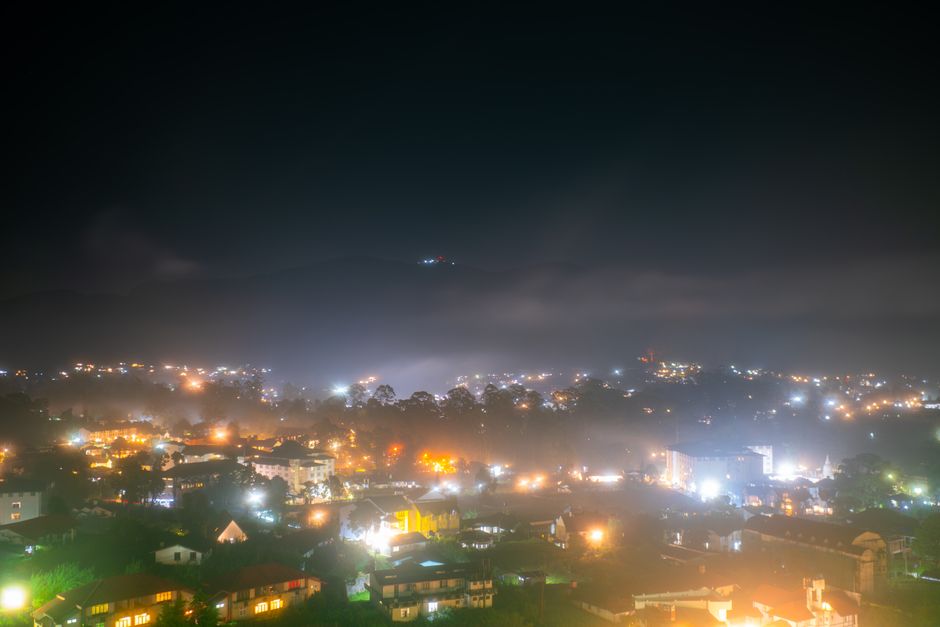
Nuwara Eliya is Sri Lanka’s highest town and its classic hill station, set at about 1,890 m (6,200 ft) in a valley below Pidurutalagala, the island’s highest mountain, and surrounded by some of the most famous tea estates in the world. British planters and officials, led by the explorer Samuel Baker in the 1840s, turned it into a cool-climate retreat, and it still wears its colonial past proudly: a red-brick Tudor-style post office, a racecourse, a golf course, a lake for boating, a public park full of flowers and grand old hotels where log fires burn in the evening. It is often called “Little England”, though its busy market streets, vegetable farms and Hindu temples are unmistakably Sri Lankan. Come for tea-factory tours and walks among the tea bushes, the high moorland of Horton Plains National Park and the sheer drop of World’s End, waterfalls along the mountain roads, and the cool, misty air. Nights are chilly all year, with lows around 10–14 °C (50–57 °F). Nanu Oya, the station for Nuwara Eliya, is again linked by train with Ella and Badulla since June 2026, but in October 2026 the line west toward Kandy was still being restored after Cyclone Ditwah.
Right now in Nuwara Eliya
- Wed14–21°C57–70°F5 mm rain
- Thu14–21°C57–70°F16 mm rain
- Fri14–20°C58–68°F13 mm rain
Top tours in Nuwara Eliya
See all tours for Nuwara Eliya →
From local operators, with prices and reviews; you check availability and book on Viator, our partner. We may earn a commission at no extra cost to you. How we earn money
Nuwara Eliya at a glance
- Best for: tea estates and factory tours, colonial architecture, Horton Plains and World’s End, waterfalls, cool weather and the scenic railway to Ella.
- How long: 2 days for the town, a tea factory and Horton Plains; 3 with waterfalls and Hakgala.
- Best time: January to April, when it is driest and clearest; April is the busy holiday season; October and November are the wettest months.
- Getting there: about 2.5–3 hours by road from Kandy and 5–6 hours from Colombo; trains from Nanu Oya, about 8 km (5 miles) away, run to Ella and Badulla.
- Getting around: on foot in town, and by tuk-tuk, car with driver or local bus to the estates, waterfalls and Horton Plains.
- Good to know: the high hills are cold at night; bring warm layers.
- Before you go: the ETA, the free-visa list, money and general safety are in our Sri Lanka travel guide.
Nuwara Eliya’s areas and where to stay
The town spreads along a valley between the market and bus stand in the north and Lake Gregory in the south, with the racecourse, golf course and Victoria Park in between, and hotels scattered over the surrounding slopes.
The town center
Around the main road, the market and the bus stand, the center is busy and practical, with banks, shops, bakeries and simple restaurants, plus budget hotels.
Around the golf course and Victoria Park
The old colonial quarter, with the Grand Hotel, the Hill Club, the post office and many Victorian-style bungalows now run as guesthouses, lies between the park, the golf course and the racecourse. It is the most atmospheric area, within walking distance of everything.
Lake Gregory and the hills
Around Lake Gregory and on the hillsides above it, newer hotels, guesthouses and holiday bungalows look over the water and the tea; they are quieter but need tuk-tuks.
Tea-estate bungalows
In the estates around Nuwara Eliya and on the road toward Hatton and Talawakele, restored planters’ bungalows offer the classic tea-country stay, with gardens, fires and walks through the plantations, best with your own transport.
Where to stay in Nuwara Eliya
- Colonial quarter: heritage hotels and guesthouses in old bungalows.
- Lake Gregory: modern hotels with views and lakeside walks.
- Town center: budget hotels near the market and buses.
- Tea estates: planters’ bungalows for a quiet retreat.
The town is packed in April, when Sri Lankans arrive for the holiday season around the Sinhala and Tamil New Year, and prices can double; book early.
Top things to see in Nuwara Eliya
Tea factories and estates
Nuwara Eliya grows some of Ceylon’s finest high-grown teas, light and fragrant. Several factories near town welcome visitors, among them Pedro, a few kilometers east, the Mackwoods Labookellie estate on the road to Kandy and the Bluefield and Damro estates along the road toward Ramboda; tours show the withering, rolling, drying and sorting of the leaf and end with a tasting in a tearoom with a view. Walking through the bushes past the pluckers is a highlight; keep to paths and ask before taking photographs.
Lake Gregory
Created by the British governor William Gregory in the 1870s, the lake at the southern end of town has a lakeside promenade, paddle boats, pony rides and food stalls. A small entry fee is charged for the park around it. It is pleasant in the late afternoon.
Victoria Park and the colonial town
Victoria Park, a well-kept garden of flowerbeds and old trees in the town center, is at its best from March to May and in August and September, and attracts birdwatchers looking for highland species. Walk on to see the brick post office of 1894, the Hill Club, a former planters’ club with a members-only feel, the Grand Hotel, built around a former governor’s residence, and the racecourse, which comes alive with horse races and festivities during the April season.
Hakgala Botanic Garden
About 10 km (6 miles) southeast, on the slopes of Hakgala Rock, this garden was founded in the 1860s as an experimental cinchona plantation and now has rose gardens, tree ferns, conifers and orchids, with monkeys in the trees. Nearby, the colorful Hindu Seetha Amman Temple is associated with the Ramayana epic, in which Sita was said to have been held captive by Ravana.
More classic sights
- Pidurutalagala: Sri Lanka’s highest mountain, at about 2,524 m (8,281 ft), rises above town; its summit holds communications installations and is not usually open to visitors.
- Lover’s Leap Waterfall: a short walk through tea gardens from the town’s northern edge.
- Ramboda Falls: a tall waterfall beside the road to Kandy, about 30 minutes north, with viewpoints and a restaurant.
- Single Tree Hill: a hilltop walk through tea estates with views over the town.
- Strawberry farms: pick-your-own farms and dessert cafés on the outskirts.
Other things to do in Nuwara Eliya
Horton Plains National Park
About 30 km (19 miles) south of town, Horton Plains is a high plateau of montane grassland and cloud forest at about 2,100–2,300 m (6,900–7,500 ft), part of the UNESCO-listed Central Highlands of Sri Lanka and managed by the Department of Wildlife Conservation. A loop trail of about 9.5 km (6 miles) crosses the plains to World’s End, where the escarpment drops about 870 m (2,850 ft) toward the lowlands, and returns via Baker’s Falls; allow 3–4 hours. Go early: the gates open around 6 a.m., and by mid-morning clouds usually fill the valley below World’s End. The park has its own entry fee for foreign visitors, plus vehicle and service charges, and enforces strict rules on plastic. Sambar deer graze near the visitor center, and the plains are home to endemic birds and lizards.
Food and drink
Nuwara Eliya is the place to drink tea: try a fresh brew at a factory tearoom or high tea at one of the colonial hotels. The town’s restaurants serve rice and curry, kottu and Chinese-Sri Lankan dishes, and the cool climate supplies vegetables, strawberries and dairy for the rest of the country. Market stalls sell warm corn and vadai on chilly evenings. Bars are mostly in the hotels, and alcohol is not sold on poya (full-moon) days.
The April season
Around the Sinhala and Tamil New Year in mid-April, Nuwara Eliya hosts the island’s busiest holiday season, with horse races, motor races, flower shows, parties and crowds; the town is lively but expensive and congested.
Golf and walking
The Nuwara Eliya Golf Club, laid out in 1889, is one of the oldest in Asia and welcomes visitors. Walking trails lead through the tea estates and up the hills around town. See our hiking guide.
Day trips from Nuwara Eliya
- Horton Plains and World’s End: the classic early-morning trip, about 1–1.5 hours each way by car.
- The train to Ella: from Nanu Oya through Pattipola, the highest station on the line, and Haputale to Ella, about 2.5 hours. See our Ella guide.
- Adam’s Peak (Sri Pada): the sacred mountain, climbed at night to reach the summit for sunrise, from the village of Dalhousie, about 2.5–3 hours by road; the pilgrimage season runs from about December to May.
- Kandy: the Temple of the Tooth and the botanic gardens, about 2.5–3 hours north. See our Kandy guide.
- Hatton and the Castlereagh reservoir: tea country, waterfalls and estate bungalows, about 1.5 hours west.
Nearby destinations
Getting there and getting around
By train
Nuwara Eliya’s railway station is Nanu Oya, about 8 km (5 miles) west of town, on the Main Line between Colombo, Kandy and Badulla. After Cyclone Ditwah, Sri Lanka Railways restored the line between Ambewela and Nanu Oya and resumed trains between Nanu Oya and Badulla, via Ella, on June 20, 2026, with four trains a day; its timetable listed a morning departure from Nanu Oya at 9 a.m., reaching Ella at about 11:27 a.m. In early October 2026, local media reported, citing the railway, that the sections between Kandy and Nanu Oya, including Hatton–Nanu Oya, were still being restored, so there were no trains from Nanu Oya toward Kandy and Colombo. Tuk-tuks and buses link the station with town in about 20 minutes. Check the current timetable before you travel.
By road
Nuwara Eliya is about 77 km (48 miles) from Kandy, a winding drive of about 2.5–3 hours past Ramboda Falls and the tea factories, and about 170 km (105 miles) from Colombo, 5–6 hours via Kandy or Hatton. Buses run frequently from Kandy, Colombo, Hatton, Badulla and Bandarawela, arriving at the main bus stand in the center. Many visitors arrive with a car and driver.
Around Nuwara Eliya
The center, park and colonial quarter are walkable. Tuk-tuks go to Lake Gregory, the tea factories and the station; agree on the fare first. For Horton Plains, hire a car or tuk-tuk with driver for the morning; your hotel can arrange it.
When to go and how long to stay
Nuwara Eliya has a cool highland climate, with days of about 19–22 °C (65–72 °F) and nights of 10–14 °C (50–57 °F); frosts occasionally form on clear nights from December to February. January to April is the driest and clearest period, ideal for Horton Plains and views. The southwest monsoon brings mist, wind and drizzle from May to September, and the wettest months are October and November. Weather changes quickly, and afternoons are often cloudy. The table uses the 1991–2020 climate normals for the Department of Meteorology’s Nuwara Eliya station, at 1,894 m (6,214 ft), as submitted to the World Meteorological Organization (WMO): average daily highs and lows, total rain, and days with at least 1 mm of rain.
| Month | Average high / low | Rain (days with 1 mm or more) | What to expect |
|---|---|---|---|
| January | 20 °C (68 °F) / 10 °C (51 °F) | 116 mm (4.6 in), 10 days | Clear, cold nights; occasional frost |
| February | 21 °C (70 °F) / 10 °C (50 °F) | 73 mm (2.9 in), 7 days | The driest month; clear mornings |
| March | 22 °C (72 °F) / 11 °C (51 °F) | 72 mm (2.8 in), 7 days | Dry and sunny; flowers in Victoria Park |
| April | 22 °C (72 °F) / 12 °C (53 °F) | 134 mm (5.3 in), 13 days | Holiday season; crowded and lively |
| May | 22 °C (71 °F) / 13 °C (56 °F) | 172 mm (6.8 in), 13 days | Monsoon mist arrives |
| June | 19 °C (67 °F) / 14 °C (57 °F) | 168 mm (6.6 in), 15 days | Windy and drizzly |
| July | 19 °C (65 °F) / 14 °C (56 °F) | 155 mm (6.1 in), 16 days | The coolest days; misty |
| August | 19 °C (66 °F) / 13 °C (56 °F) | 132 mm (5.2 in), 14 days | Showers and wind |
| September | 20 °C (67 °F) / 13 °C (55 °F) | 161 mm (6.3 in), 14 days | Mixed sun and showers |
| October | 20 °C (67 °F) / 13 °C (55 °F) | 247 mm (9.7 in), 19 days | The wettest month; landslide risk |
| November | 20 °C (68 °F) / 12 °C (54 °F) | 226 mm (8.9 in), 18 days | Very wet; cyclone risk |
| December | 19 °C (67 °F) / 12 °C (53 °F) | 183 mm (7.2 in), 15 days | Wet early, clearing later |
Nuwara Eliya receives about 1,840 mm (72 in) of rain a year, spread over about 160 rainy days.
Two days in Nuwara Eliya
Day one, a walk around Victoria Park and the colonial town, a tea factory tour and tasting in the afternoon, and dinner by the fire at a heritage hotel. Day two, Horton Plains and World’s End at dawn, back by lunch, and Lake Gregory or Hakgala Botanic Garden in the afternoon.
Three days
Add Ramboda Falls and the Labookellie estate, or ride the train from Nanu Oya to Ella and continue your trip from there.
What a trip to Nuwara Eliya costs
Prices are approximate, for October 2026, converted at about 330 rupees to the US dollar.
| Item | Typical cost |
|---|---|
| Horton Plains, foreign adult, with service charge and VAT | about 13,000–16,500 LKR (about US$40–50) |
| Car or tuk-tuk with driver to Horton Plains, half day | 7,000–12,000 LKR (about US$21–36) |
| Tea factory tour and tasting | free–1,500 LKR (up to about US$4.50) |
| High tea at a colonial hotel | 4,000–8,000 LKR (about US$12–24) |
| Rice and curry in town | 800–1,500 LKR (about US$2.40–4.50) |
| Tuk-tuk to Nanu Oya station | 800–1,200 LKR (about US$2.40–3.60) |
| Guesthouse double | 7,000–15,000 LKR (about US$21–45) |
| Heritage hotel double | 25,000–60,000 LKR (about US$76–180) |
Practical tips for Nuwara Eliya
- Start Horton Plains early: leave around 5:30 a.m. to reach World’s End before the clouds.
- Bring warm clothes: nights are cold, and many guesthouses have no heating.
- Check the railway: in October 2026, trains ran only east of Nanu Oya, toward Ella and Badulla.
- Avoid April if you dislike crowds: the holiday season fills the town.
- Carry cash: small guesthouses, tuk-tuks and park gates may not take cards.
- No plastic at Horton Plains: bags are checked, and plastic wrappers must be left at the gate.
Safety
Nuwara Eliya is safe and friendly; the main hazards are weather, roads and cliffs. Mountain roads are steep and winding, often with fog and rain; drive slowly and avoid traveling after dark. Heavy rain, especially from October to December, can trigger landslides that block roads; Cyclone Ditwah caused deadly landslides in the Central Province hill country in November 2025. Follow Department of Meteorology forecasts and Disaster Management Center warnings. At World’s End, there are no railings at the cliff edge, and people have fallen to their deaths; keep well back, especially in mist. Temperatures can drop sharply, so dress warmly for early-morning trips. Hikers may meet leeches in the rainy months. In an emergency, call 119 for police and 1990 for the Suwa Seriya ambulance.
What to pack for Nuwara Eliya
A warm fleece or jacket, a hat and gloves for dawn at Horton Plains, a rain jacket, comfortable hiking shoes with grip, sunscreen for the strong highland sun, leech socks in the rainy season, and clothes that cover shoulders and knees for temples. Sri Lanka uses 230 V, with British three-pin (type G) and round-pin (type D) sockets. See our rain jackets, hiking shoes and travel adapters guides.
Nuwara Eliya travel FAQ
Is Nuwara Eliya worth visiting?
Yes, for its tea estates, colonial architecture, cool climate and Horton Plains; it pairs well with Kandy and Ella.
How cold is Nuwara Eliya?
Days are mild, around 19–22 °C (65–72 °F), and nights drop to about 10–14 °C (50–57 °F), occasionally lower in January and February.
What is the best time to visit Nuwara Eliya?
January to April, when it is driest and clearest. October and November are the wettest months.
How do I get from Kandy to Nuwara Eliya?
By road in about 2.5–3 hours. In October 2026, the railway between Kandy and Nanu Oya was still being restored.
Can I take the train from Nuwara Eliya to Ella?
Yes. Trains from Nanu Oya, about 8 km (5 miles) from town, have run to Ella and Badulla since June 20, 2026, taking about 2.5 hours.
How do I visit Horton Plains from Nuwara Eliya?
By car or tuk-tuk with driver, leaving around 5:30 a.m.; the drive takes 1–1.5 hours, and the World’s End loop about 3–4 hours.
How many days do I need in Nuwara Eliya?
Two days for a tea factory, the town and Horton Plains; three with waterfalls and Hakgala.
Can you visit tea factories in Nuwara Eliya?
Yes. Pedro, Labookellie, Bluefield and Damro, among others, run tours and tastings, usually daily.
Why is Nuwara Eliya called Little England?
Because British planters and officials built it as a hill station in the 19th century, with a racecourse, golf course, Tudor-style post office and country-house hotels.
Is it safe to drive to Nuwara Eliya?
Yes, with care: roads are steep and winding, with fog and occasional landslides in heavy rain; a local driver is a good idea.
Plan your trip
Partner links: TravelerCenter may earn a commission if you book, at no extra cost to you.
🇱🇰 Useful Sinhala phrases for Nuwara Eliya
All 38 Sinhala phrases: restaurant, hotel, emergencies, romance (printable) →
Sources · last reviewed 4 October 2026
Researched and last reviewed on 4 October 2026. The Ambewela–Nanu Oya restoration and the Nanu Oya–Badulla train resumption and timetable: Sri Lanka Railways; the October 2026 status of the Kandy–Nanu Oya line: local media citing Sri Lanka Railways; Horton Plains management and visitor permits: the Department of Wildlife Conservation; climate normals: Sri Lanka’s Department of Meteorology via the World Meteorological Organization’s 1991–2020 normals; exchange rate: the Central Bank of Sri Lanka. Altitudes, the town’s history and building dates, the Horton Plains fee and trail details, distances, travel times and typical prices are general references or estimates, flagged for checking. Prices and timetables change, so check the official sites before you go. For entry rules, money and general safety, see our Sri Lanka travel guide.
Data: Weather: MET Norway (CC BY 4.0) · Rates: ECB · Costs: World Bank ICP and price levels · Wikidata (CC0)