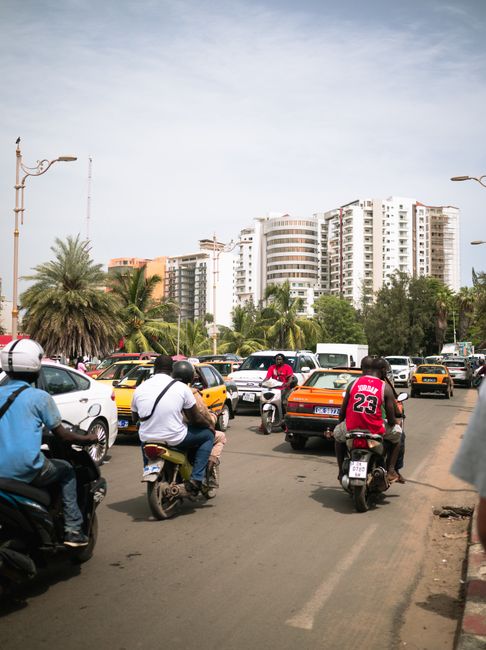
Dakar, Senegal’s capital, sits at the tip of the Cap-Vert peninsula, the westernmost point of mainland Africa, surrounded on three sides by the Atlantic. It’s a lively, stylish and creative city of more than a million people, with ocean views around almost every corner, sea breezes that keep it cooler than most of West Africa, and a reputation as one of the continent’s capitals of music and art. The biggest draw for visitors is Gorée Island, a short ferry ride away, whose House of Slaves and peaceful lanes make it one of the most moving places in Africa. In the city itself, you can climb the giant African Renaissance Monument, explore the Museum of Black Civilizations, wander the markets of the Plateau and the Médina, watch fishing pirogues land their catch at Soumbédioune, surf the reef breaks of Ngor and the Almadies, eat superb grilled fish by the sea, and dance to live mbalax late into the night. Dakar is also the base for trips to the pink Lac Rose, the Bandia wildlife reserve and the beaches of the Petite Côte. The city can feel hectic, with heavy traffic and persistent sellers, but its energy, warmth and teranga (hospitality) quickly win people over.
Right now in Dakar
- Wed25–29°C78–84°F11 mm rain
- Thu26–28°C79–83°F15 mm rain
- Fri27–28°C80–83°F13 mm rain
Top tours in Dakar
See all tours for Dakar →
From local operators, with prices and reviews; you check availability and book on Viator, our partner. We may earn a commission at no extra cost to you. How we earn money
Dakar at a glance
- Best for: Gorée Island, history, art and music, seafood, surfing and an easy start to a Senegal trip.
- How long: 2–3 days for the city and Gorée; 4–5 with day trips.
- Best time: November to June, the dry season; December to April is the most comfortable.
- Getting there: fly into Blaise Diagne International Airport (DSS), about 45 km (28 miles) southeast of the city.
- Getting around: taxis (agree the fare first), ride-hailing apps, the TER train and the BRT bus.
- Good to know: many nationalities need no visa for up to three months; bring a yellow fever certificate if arriving from a risk country.
- Before you go: visas, money and general safety are in our Senegal travel guide.
Dakar’s areas and where to stay
Dakar spreads across the peninsula. The historic downtown, the Plateau, is at the southern tip near the port and the Gorée ferry; the west coast, from Fann to the Almadies, has the beaches, surf spots and many hotels.
The Plateau
The Plateau is Dakar’s colonial and administrative heart, with the Place de l’Indépendance, the Presidential Palace, the cathedral, the Kermel market hall, banks, offices and restaurants. It’s busy by day and quieter at night, and convenient for the ferry to Gorée.
The Médina and Soumbédioune
Northwest of the Plateau, the Médina is a dense, lively neighborhood built in the early 20th century, home to the Grand Mosque and a maze of tailors, markets and street food. On the coast nearby, the Soumbédioune bay has a fish market where pirogues land their catch in the late afternoon, and an artisans’ village.
Fann, Point E and Mermoz
Along the west coast, these residential districts have the university, embassies, the IFAN Museum, small hotels, guesthouses and good restaurants, as well as the Corniche Ouest road with its ocean views and exercise areas.
Ouakam and the Mamelles
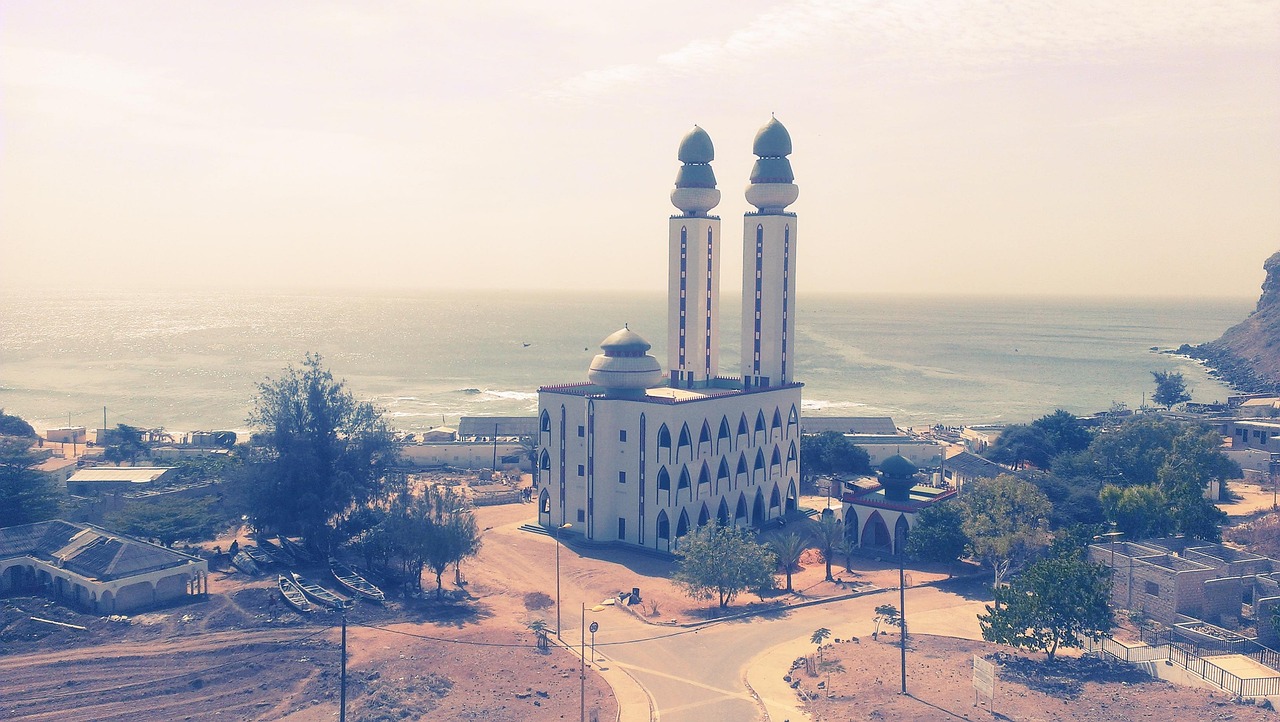
Ouakam, a traditional fishing village swallowed by the city, has the white Mosque of the Divinity on the shore and is overlooked by the Mamelles hills, topped by the lighthouse and the African Renaissance Monument.
The Almadies, Ngor and Yoff
At the western tip of the peninsula, the Almadies is Dakar’s upscale district of hotels, villas, seafood restaurants and nightclubs, with Pointe des Almadies, the westernmost point of the African mainland. Next door, Ngor has a small beach, surf breaks and boats to Ngor Island, and Yoff is a traditional Lebu fishing community with a long beach.
Where to stay in Dakar
- Plateau: central, near museums, markets and the Gorée ferry; business hotels and mid-range options.
- Almadies and Ngor: ocean views, beaches, surf and nightlife; resort-style and boutique hotels.
- Fann, Point E and Mermoz: quieter guesthouses and small hotels with easy access to the Corniche.
- Yoff: surf camps and simple guesthouses near the beach.
- Gorée Island: a few guesthouses for a peaceful night after the day visitors leave.
Top things to see in Dakar
Gorée Island
Just 3 km (2 miles) offshore, the car-free Island of Gorée was a European trading post from the 15th to the 19th century and a center of the Atlantic slave trade, and it has been a UNESCO World Heritage Site since 1978. Its narrow sandy lanes, ochre and pink colonial houses and bougainvillea make it beautiful, but the island is above all a place of memory. The House of Slaves (Maison des Esclaves), built in the late 18th century, has cramped cells and the “Door of No Return” opening onto the ocean; it’s visited by travelers, leaders and descendants of the enslaved from around the world. Also visit the historical museum in the old Fort d’Estrées, the women’s museum, the artists’ workshops, the church and the Castel, a rocky hill at the southern end with old gun emplacements and views of Dakar. Ferries leave from the Gorée terminal in Dakar’s port throughout the day, and the crossing takes about 20 minutes. Go early to avoid the crowds, and allow half a day or more.
The African Renaissance Monument
On one of the Mamelles hills above Ouakam, the African Renaissance Monument is a bronze statue of a man, a woman and a child facing the ocean. Unveiled in 2010, it stands about 49 m (160 ft) tall, taller than the Statue of Liberty without its pedestal, and is one of the largest statues in Africa. You can climb the long staircase for views over the city, and guided visits take you inside and up to an observation point in the man’s hat for a fee.
The Museum of Black Civilizations
Opened in 2018 near the new train station, the Museum of Black Civilizations (Musée des Civilisations noires) is a large, round modern building dedicated to the history, art and cultures of Africa and the African diaspora, with exhibits ranging from early humanity to contemporary art.
IFAN Museum of African Arts
The Théodore Monod Museum of African Art, run by IFAN (the Fundamental Institute of Black Africa) near the Place Soweto, has one of West Africa’s best collections of masks, textiles, sculptures and musical instruments from across the region.
The Plateau and its markets
Walk around the Place de l’Indépendance, see the 1920s Dakar Railway Station building and the cathedral, and browse the restored iron-and-glass Kermel Market, with flowers, fish, fruit and crafts. The vast Sandaga area and the streets around it are a hub of shops and street traders.
Mosques of Dakar
The Grand Mosque in the Médina, with its tall minaret, and the Mosque of the Divinity on the shore at Ouakam are among the city’s landmarks. Non-Muslims can sometimes visit outside prayer times with permission and a guide; dress modestly and remove your shoes.
Ngor Island and the Almadies
Take a short pirogue ride from Ngor beach to Ngor Island, with small beaches, surf spots, cafés and paths along the rocks. Then visit Pointe des Almadies, the westernmost point of mainland Africa, for sunset over the ocean.
Village des Arts and galleries
The Village des Arts, a community of artists’ studios near the airport road, welcomes visitors to see painters and sculptors at work. Dakar’s contemporary art scene is strong, and the city hosts the Dak’Art biennale in even-numbered years.
Other things to do in Dakar
Food and drink
Dakar is one of West Africa’s best food cities. Try thiéboudienne, fish and broken rice in tomato sauce, at lunchtime; yassa chicken or fish with onions and lemon; mafé peanut stew; and dibi, grilled lamb from a dibiterie. Seafood restaurants along the Almadies and Ngor coast serve grilled fish, lobster, oysters and prawns with sea views. Street snacks include fataya pastries and grilled corn, and drinks include bissap (hibiscus), bouye (baobab juice), spiced café Touba and sweet attaya tea. Alcohol is available in many restaurants, bars and hotels.
Music and nightlife
Dakar’s nightlife is legendary. Live mbalax, the energetic dance music made world-famous by Youssou N’Dour, plays late at clubs and bars, especially from Thursday to Saturday, and jazz, hip-hop and Afrobeats are popular too. Nights start late, often after midnight.
Surfing
Dakar has consistent surf, with reef and point breaks around Ngor, Ouakam, Yoff and the Almadies, and surf camps that offer lessons and board rental. The best waves come from about October to April. See our surfing guide.
Wrestling
Traditional wrestling (laamb) is Senegal’s most popular sport, combining strength, music and mysticism. Big matches are held at Dakar’s arena in the dry season; local bouts are held on beaches at weekends.
Shopping
Look for colorful fabrics, made-to-measure clothes from Médina tailors, leather goods, baskets, jewelry, glass paintings and drums at the Soumbédioune artisans’ village and Kermel market. Bargain with patience and good humor.
Day trips from Dakar
- Lac Rose (Lac Retba): the salt lake about 35 km (22 miles) northeast that can turn pink in the dry season, with salt collectors and dunes.
- Bandia Reserve: a wildlife reserve about 65 km (40 miles) southeast, with giraffes, rhinos, zebras and antelopes on guided drives.
- The Petite Côte: the beach resorts of Saly and Somone and its bird-filled lagoon, about 80 km (50 miles) south. See our beaches guide.
- Toubab Dialaw: an artists’ village on the coast south of Dakar, with guesthouses and cliffs.
- Saint-Louis: the UNESCO-listed former capital, about 260 km (160 miles) north; better as a two- or three-night trip. See our Senegal travel guide.
Nearby destinations
- Kololi156 km
Getting there and getting around
By air
Blaise Diagne International Airport (DSS) at Diass, about 45 km (28 miles) southeast of central Dakar, has direct flights from Europe, the US, the Middle East, North Africa and across West Africa, including connections through Paris, Brussels, Lisbon, Madrid, Casablanca and Istanbul. The drive to the Plateau or the Almadies takes about 45 minutes to an hour on the toll highway, longer at rush hour. Use the official taxi rank, an airport shuttle bus or a transfer booked through your hotel, and be wary of drivers who approach you pretending to know you. Flights to Ziguinchor and Cap Skirring in the Casamance leave from the same airport.
Trains and buses
The TER (Train Express Régional) is a modern electric commuter line from the central Dakar station to Diamniadio, on the way to the airport, and is a fast way to avoid traffic. The BRT rapid bus line runs north–south across the city on its own lanes. City buses (Dakar Dem Dikk) and the colorful but crowded cars rapides minibuses cover the rest.
Taxis and ride-hailing
Yellow-and-black taxis are everywhere; they don’t use meters, so agree the fare before getting in, and expect to pay more at night. Ride-hailing apps such as Yango and Heetch also operate. For trips out of town, hire a car with a driver.
Ferries
Ferries to Gorée leave from the Gorée terminal in the port. The overnight passenger ferry to Ziguinchor in the Casamance also leaves from Dakar’s port several times a week.
When to go and how long to stay
Dakar has a mild coastal climate for West Africa, thanks to the Atlantic and the cool Canary Current. From December to April, it’s dry and sunny, with highs around 25–26 °C (77–79 °F), cool evenings and a chilly sea. From May to June, it warms up, still mostly dry. The rainy season runs from about July to October, with heavy storms mainly in August and September, high humidity and highs around 30–31 °C (86–88 °F); streets can flood after downpours. The table uses the 1991–2020 climate normals for the Dakar-Yoff station of Senegal’s National Agency of Civil Aviation and Meteorology (ANACIM), as published by the World Meteorological Organization (WMO): average daily highs and lows, total precipitation, and days with at least 1 mm of rain.
| Month | Average high / low | Rain (days with 1 mm or more) | What to expect |
|---|---|---|---|
| January | 26 °C (79 °F) / 19 °C (65 °F) | 1 mm (under 0.1 in), 0 days | Dry, sunny; cool evenings |
| February | 25 °C (77 °F) / 18 °C (64 °F) | under 1 mm, 0 days | Coolest month; cold sea |
| March | 25 °C (77 °F) / 18 °C (65 °F) | under 1 mm, 0 days | Dry and breezy |
| April | 25 °C (77 °F) / 19 °C (66 °F) | under 1 mm, 0 days | Pleasant; Independence Day |
| May | 26 °C (79 °F) / 21 °C (69 °F) | under 1 mm, 0 days | Warming up |
| June | 29 °C (84 °F) / 24 °C (74 °F) | 7 mm (0.3 in), 1 day | Humid; good surf |
| July | 30 °C (86 °F) / 25 °C (77 °F) | 53 mm (2.1 in), 4 days | Rainy season begins |
| August | 30 °C (87 °F) / 25 °C (78 °F) | 166 mm (6.5 in), 10 days | Wettest month; storms |
| September | 31 °C (88 °F) / 25 °C (77 °F) | 138 mm (5.4 in), 9 days | Hot, humid and rainy |
| October | 31 °C (88 °F) / 26 °C (78 °F) | 26 mm (1.0 in), 2 days | Rains ending; warmest sea |
| November | 30 °C (86 °F) / 24 °C (74 °F) | under 1 mm, 0 days | Dry season returns |
| December | 28 °C (82 °F) / 21 °C (70 °F) | under 1 mm, 0 days | Dry and pleasant; festive |
Dakar receives about 390 mm (15 in) of rain a year, almost all from July to October.
One day in Dakar
Take an early ferry to Gorée and spend the morning at the House of Slaves, the museums and the Castel. Back in Dakar, have lunch on the Plateau, visit the Museum of Black Civilizations or the IFAN Museum, then head west to the African Renaissance Monument and finish with sunset and grilled fish at the Almadies.
Two to three days
Add the Médina and Soumbédioune, Ngor Island, a surf lesson, a night of live mbalax, and a day trip to Lac Rose or the Bandia Reserve.
What a trip to Dakar costs
Prices are approximate, for October 2026, converted at about 585 CFA to the US dollar.
| Item | Typical cost |
|---|---|
| Gorée ferry, non-resident adult, return | about 5,200 CFA (about US$9) |
| Taxi across the city | 2,000–5,000 CFA (about US$3.40–8.50) |
| Taxi or transfer from the airport | about 20,000–30,000 CFA (about US$34–51) |
| TER ride | about 500–1,500 CFA (about US$0.85–2.60) |
| Thiéboudienne at a local restaurant | 1,500–3,500 CFA (about US$2.60–6) |
| Seafood dinner in the Almadies | 10,000–25,000 CFA (about US$17–43) |
| Mid-range hotel double, per night | 40,000–90,000 CFA (about US$68–154) |
Practical tips for Dakar
- Go to Gorée early: morning ferries are quieter, and the island is calm before the day-trippers arrive.
- Agree taxi fares first: there are no meters; ask your hotel for typical prices.
- Carry cash: ATMs are common in Dakar but can run out; small notes help with taxis and markets.
- Use Orange Money or Wave: if you have a local SIM, mobile payments make life easier.
- Dress modestly in town: keep beachwear for beaches and pools.
Safety in Dakar
Dakar is generally welcoming, but it’s a big city, and petty crime has increased. Pickpocketing and bag snatching happen in crowded markets, on the Plateau and around the port, sometimes by thieves on scooters, so keep phones and bags out of sight. Be alert at ATMs, use machines inside banks or malls, and change money only at banks or reputable bureaus, as fake notes are sometimes passed in street exchanges. After dark, use taxis rather than walking, especially along the Corniche and in quiet streets, and don’t carry valuables. At the airport, avoid touts and drivers who pretend to know you. Demonstrations sometimes block main roads, including the highway to the airport, so follow local news and avoid crowds. The Atlantic around the peninsula has strong waves and currents: swim only at sheltered or supervised beaches, such as Ngor’s small bay, and follow local advice. Traffic is heavy and driving can be erratic, so cross roads carefully. Malaria occurs in Dakar, mainly in and after the rainy season, so use repellent. In an emergency, call 17 for the police and 15 for an ambulance.
What to pack for Dakar
Light, modest clothing that covers shoulders and knees, a light sweater or jacket for cool evenings from December to April, a scarf for visiting mosques, comfortable walking shoes and sandals, swimwear and a rash guard for surfing, a sun hat and high-factor sunscreen, insect repellent, a light rain jacket from July to October, your yellow fever certificate if required, and a European two-pin plug adapter. See our wetsuits, rain jackets and travel adapters guides.
Dakar travel FAQ
Is Dakar worth visiting?
Yes. Gorée Island alone makes it worthwhile, and the city’s museums, markets, food, music and surf easily fill two or three days.
How do I get to Gorée Island from Dakar?
Take the ferry from the Gorée terminal at Dakar’s port; it runs throughout the day and takes about 20 minutes.
How long should I spend on Gorée?
At least half a day to see the House of Slaves, the museums and the Castel; staying overnight lets you enjoy the island when it’s quiet.
How far is Dakar airport from the city?
Blaise Diagne International Airport is about 45 km (28 miles) from central Dakar, about 45 minutes to an hour by road.
Do I need a visa for Dakar?
Citizens of the US, Canada, the UK, most EU countries and many others don’t need a visa for stays of less than three months. See our Senegal travel guide for the full list.
What is the best time to visit Dakar?
December to April for dry, sunny and mild weather; June for surf and warmer seas before the rains. August and September are the wettest months.
Can you climb the African Renaissance Monument?
Yes. You can climb the steps for free views, and paid guided visits go inside and up to the viewing point near the top.
Can you swim in Dakar?
Yes, at sheltered beaches such as Ngor and on Ngor Island, but currents elsewhere can be strong; swim where locals swim and follow advice.
Is Dakar good for surfing?
Yes. Ngor, Ouakam, Yoff and the Almadies have consistent waves, with the best conditions from about October to April and surf camps for beginners.
Is Dakar safe for tourists?
Most visits are trouble-free. Watch for pickpockets in markets, take taxis at night, avoid demonstrations and be careful in the sea.
Plan your trip
Partner links: TravelerCenter may earn a commission if you book, at no extra cost to you.
🇫🇷 Useful French phrases for Dakar
All 38 French phrases: restaurant, hotel, emergencies, romance (printable) →
Sources · last reviewed 5 October 2026
Researched and last reviewed on 5 October 2026. Gorée Island’s UNESCO listing: the UNESCO World Heritage Center; visa exemptions: the Senegalese Tourism Promotion Agency; yellow fever and malaria: the US CDC; crime precautions, bogus airport drivers, fake notes, ATMs, mobile payments, demonstrations and emergency numbers: the UK government’s factual entry and safety pages, used for practical facts only; climate normals: Senegal’s National Agency of Civil Aviation and Meteorology via the World Meteorological Organization’s 1991–2020 normals (Dakar-Yoff station); the dollar rate: the European Central Bank. Attractions, museum details, the monument’s height, the Gorée ferry fare, transport, distances and typical prices are general references or estimates, flagged for checking. Prices and rules change, so check locally before you go. For visas, money and general safety, see our Senegal travel guide.
Data: Weather: MET Norway (CC BY 4.0) · Sea temperature: NOAA CoastWatch · Rates: ECB · Costs: World Bank ICP and price levels · Wikidata (CC0)