Short answer: pack comfortable shoes with real grip for Portugal’s hills and slippery stone pavements, a light layer for breezy evenings, and sun protection from May to September. Add a rain jacket for Porto, the north and the Azores outside summer, and hiking layers for Madeira’s peaks. Bring your passport or EU ID card, a card that works abroad, some euros, and a Type C/F plug adapter (230 V).

Portugal is small, but its weather is not all the same: Lisbon is sunny and hilly, Porto is much wetter, the Algarve is hot and dry in summer, and the islands have their own climates. This list works through essentials first, then clothes by season and region, then extras for surfing, hiking, beaches and wine trips. Climate figures are IPMA’s official 1991–2020 normals; anything that changes is marked as of October 2026.
Essentials checklist
Documents
- Passport or ID card. EU, EEA and Swiss citizens can use a national ID card. Non-EU visitors need a passport that meets Schengen rules, and since 10 April 2026 are registered in the EU’s Entry/Exit System (photo and fingerprints) at the border. ETIAS is not running yet as of October 2026. The full, current rules are on our Portugal travel guide.
- Travel insurance details, plus your EHIC (EU) or GHIC (UK) card if you have one. Neither card replaces insurance.
- Driving licence if you plan to hire a car, and your credit card for the deposit. Rental firms set their own rules; many ask drivers with a non-EU licence to also show an International Driving Permit, so check your booking terms before you go.
- Bookings on your phone, with offline copies: Pena Palace and Belém Tower time slots, Madeira trail QR codes (rangers check them at the trailhead), train e-tickets.
Money
- Two payment cards (a debit card and a credit card, kept separately). Contactless cards and phone wallets work almost everywhere in towns, and you can even tap a contactless bank card at Lisbon Metro gates and at marked validators in Porto.
- Some euro cash for small cafés, markets, village shops and Madeira’s buses, where tickets bought on board are cash only. Cash machines are called Multibanco; if a machine or card terminal offers to charge you in your home currency, choose euros.
Electricity and tech
- Plug adapter: Portugal uses the European Type C and Type F sockets (two round pins) at 230 V. Visitors from the UK, US, Canada and Australia need an adapter.
- Check the voltage on hair dryers and straighteners from North America: phone and laptop chargers usually handle 100–240 V, but some heating appliances don’t. A converter or a dual-voltage model avoids a burnt-out tool.
- Power bank for long days of maps, tickets and photos.
- Data: EU and EEA phone plans roam at home prices within fair-use limits. Others should check roaming fees or use an eSIM.
Health and small things
- Refillable water bottle: tap water is safe to drink across Portugal.
- Prescription medicines in their original boxes, plus blister plasters for all the walking. Pharmacies (green cross) are well stocked for everything else.
- Small cross-body bag or zipped day pack. Pickpockets work crowded trams and tourist spots, especially in Lisbon.
What to wear by season
Average daily highs from IPMA’s 1991–2020 normals, so you can see how much the regions differ. Nights are cooler, and the Atlantic wind can make the coast feel colder than the number suggests.
| Season | Average highs (Lisbon / Porto / Faro / Funchal / Ponta Delgada) | What to pack |
|---|---|---|
| Spring (Mar–May) | 19–23 / 17–20 / 19–24 / 21–22 / 18–20 °C | Layers: T-shirts, a light sweater, a packable rain jacket, long trousers and one pair of shorts for warm afternoons. |
| Summer (Jun–Aug) | 26–29 / 23–25 / 27–29 / 24–27 / 22–26 °C | Breathable cotton or linen, sun hat, sunglasses, high-SPF sunscreen, sandals plus walking shoes, and a light layer for windy evenings. |
| Autumn (Sep–Nov) | 18–27 / 17–24 / 20–26 / 23–27 / 20–25 °C | Summer clothes in September; by November add a warm layer, a waterproof jacket and closed shoes. |
| Winter (Dec–Feb) | 15–16 / 14–15 / 16–17 / 20–21 / 17–18 °C | A warm jacket or fleece, a waterproof outer layer, a scarf, waterproof shoes. Old houses can be chilly indoors. |
Days with rain (at least 1 mm) tell the real story: Porto averages 12–13 a month from November to January, Lisbon about 10, Faro 6–7, and Ponta Delgada in the Azores up to 15 in December. In July and August, Lisbon and Faro get almost none.
What to pack for each region
Lisbon: hills, cobbles and sun
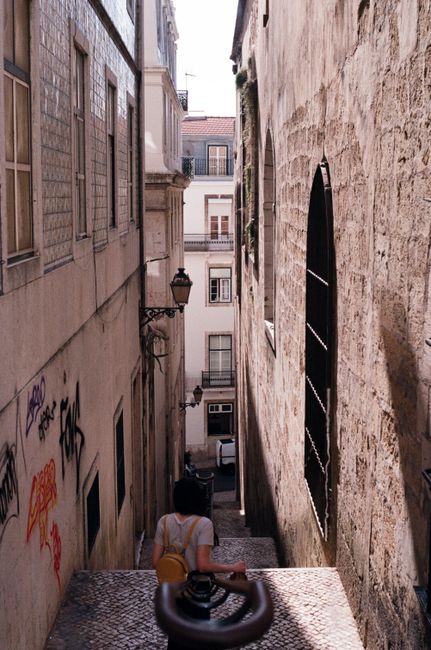
Your shoes matter more than anything else. The calçada (polished limestone paving) is slippery when dry and worse when wet, and the hills are steep, so choose trainers or walking shoes with rubber soles; leave heels and smooth-soled sandals for the evening. Viewpoints have little shade, so carry a hat and water in summer, and a light jumper for the breeze by the river. In churches, cover shoulders and knees; a thin scarf solves it. More on the city in our Lisbon guide.
Porto and the north: rain-ready
Porto gets about 1,150 mm of rain a year, most of it between October and April, with rain on 10–13 days a month from October to April. Pack a hooded waterproof jacket (more useful than an umbrella on windy bridges), water-resistant shoes with grip for the steep, wet granite streets, and a warm layer for cellar tours, which are cool all year. Summer is mild, with highs around 23–25 °C. See our Porto guide and, for the hotter inland wine country, the Douro Valley guide.
Algarve: sun and sea
Summer highs average 27–29 °C in Faro with almost no rain, so pack light: swimwear (at least two sets), a cover-up, sandals, high-factor sunscreen, a sun hat and sunglasses. Bring water shoes for rocky coves and a dry bag if you are doing boat or kayak trips to the sea caves. Evenings are warm, but a light layer helps on boat trips and in air-conditioned restaurants. Details in our Algarve guide.
Madeira: two climates in one day
Funchal is mild all year (highs of 20–27 °C), but the peaks are much cooler, often in cloud, and change fast. If you are hiking, pack proper walking shoes or boots with good tread, a waterproof shell, a warm fleece or insulated layer for sunrise at Pico do Areeiro, gloves in winter, and a head torch for the dark, wet tunnels on many levada and mountain trails. Swimwear for the Porto Moniz lava pools completes the bag. Trail rules are in our Madeira guide.
Azores: four seasons in a day
Mild but humid and windy, with sun, showers and fog often in the same afternoon. Layers are everything: a breathable waterproof jacket, a fleece, quick-dry trousers, and waterproof walking shoes for muddy crater trails. Pack swimwear even in winter for the hot springs at Furnas, and choose an old, dark swimsuit for the iron-rich water. Bring motion-sickness tablets if you are prone to it, for whale-watching boats and inter-island ferries. See our Azores guide.
Activity add-ons
Surfing
The west coast is cool all year. Ten-year satellite averages put the sea at Ericeira at about 14–15 °C from January to April and only 17–18 °C at its warmest in August and September, so surfers wear wetsuits year-round. Surf schools and shops rent boards and suits, which saves luggage; if you bring your own, think of a full suit for summer and a thicker one, plus boots, for winter. Add reef-safe sunscreen, a surf poncho for changing in car parks, and a dry bag for keys and phone. The south coast near Faro is warmer, about 20–21 °C in late summer; Madeira’s sea stays around 18–24 °C all year and the Azores’ about 17–23 °C.
Hiking
- Walking shoes or boots you have already worn in, with good tread for wet rock and mud.
- A waterproof shell and a warm mid-layer, even in summer on Madeira’s peaks and in the Azores.
- A head torch for Madeira’s levada tunnels.
- At least 1.5–2 litres of water, snacks and sun protection; many coastal trails, like the Rota Vicentina and the Algarve clifftops, have no shade.
- Your trail booking on your phone: most official trails in Madeira need an online booking and fee on the SIMplifica portal, and Mount Pico in the Azores needs a booked slot.
- Trekking poles if your knees dislike long descents; many island trails are steep and stepped.
Beach days
A quick-dry towel or sarong, swimwear, high-SPF sunscreen, a hat, water shoes for rocky beaches and lava pools, and a reusable bottle. A lightweight beach umbrella or sun tent is worth it with children on long, shadeless Algarve and Alentejo beaches. Remember the beach flags: red means no swimming, yellow means paddle only.
Wine and food trips
Closed shoes for vineyard terraces and cellar floors, a hat for Douro and Alentejo summers (inland it is far hotter than the coast), and a smart-casual outfit for dinner at a quinta. If you plan to bring bottles of port or Madeira home, pack padded wine sleeves and put bottles in your checked bag, because cabin liquid limits apply at airport security.
Gear for Portugal
Here is the gear our database links to Portugal’s main activities, from walking shoes and rain shells to snorkel and surf kit.
What you can leave at home
- Heavy winter coats, unless you are going to the mountains (Serra da Estrela) in winter; layers are more useful.
- Bottled water supplies: refill from the tap.
- Lots of cash: cards work almost everywhere; carry just enough for small purchases.
- Formal clothes: Portugal is casual; one smarter outfit is plenty.
- Wheelie bags for the old quarters: if you can, use a backpack or a small, sturdy case; cobbles and stairways in Alfama, Porto’s Ribeira and hilltop towns are hard on suitcase wheels.
Planning the route? See our Portugal itinerary for 7, 10 and 14 days and our guide to getting around Portugal.
Portugal packing FAQ
What plug do I need for Portugal?
Type C or Type F, the standard European two-round-pin plugs, at 230 V. Bring an adapter if your devices use UK, US or Australian plugs, and check that hair tools work at 230 V.
What shoes should I wear in Lisbon?
Comfortable trainers or walking shoes with grippy rubber soles. The polished stone pavements are slippery and the hills are steep; smooth soles and heels are a bad idea, especially after rain.
Do I need a rain jacket in Portugal?
From October to April, yes, especially for Porto, the north and the Azores, which get rain on 10–15 days a month in winter. In summer you can usually skip it on the mainland, but hikers on Madeira and in the Azores should always carry one.
Is the sea warm enough to swim without a wetsuit?
On the Algarve’s south coast in summer and early autumn, yes for most people, at around 20–21 °C. The west coast stays cool, around 17–18 °C at best near Ericeira, which is why surfers wear wetsuits all year. Madeira and the Azores are warmest in August and September.
What should I wear to visit churches?
Cover your shoulders and knees. A light scarf and trousers or a longer skirt are enough, and save swimwear for the beach.
Should I bring cash to Portugal?
A little. Cards and phone payments work almost everywhere in towns, but small cafés, markets and some buses (Madeira’s on-board tickets are cash only) need euros. Withdraw at a Multibanco machine and always choose to be charged in euros.
What do I need for Madeira’s levada walks?
Walking shoes with good grip, a waterproof jacket, a warm layer, water, snacks and a head torch for tunnels. Book most official trails online first on the SIMplifica portal: as of October 2026 it costs €4.50 per trail for visitors over 12.
What should I pack for the Azores in summer?
Even in summer, layers and a waterproof jacket. Highs are a pleasant 22–26 °C in Ponta Delgada, but fog, wind and showers roll in fast, and crater rims are cooler. Add swimwear for the hot springs and the sea, and walking shoes for muddy trails.
Sources
- Natural Earth · Public domain · fetched 3 Oct 2026
- © OpenStreetMap contributors · ODbL · fetched 3 Oct 2026
- Wikidata · CC0 · fetched 3 Oct 2026
Sources and last review
Researched and last reviewed by TravelerCenter on 3 October 2026. Climate figures are IPMA’s 1991–2020 normals for Lisbon, Porto, Faro, Funchal and Ponta Delgada. Entry rules come from the European Commission, as summarised on our Portugal guide; health and safety notes from the UK FCDO; payment details from Metro Lisboa, Andante and Madeira’s bus operators; Madeira trail fees from IFCN (Portaria 48/2026). Sea temperatures are ten-year satellite averages from seatemperature.info. Plug and voltage details are standard reference facts. Rules and prices change, so check the official links before you travel.