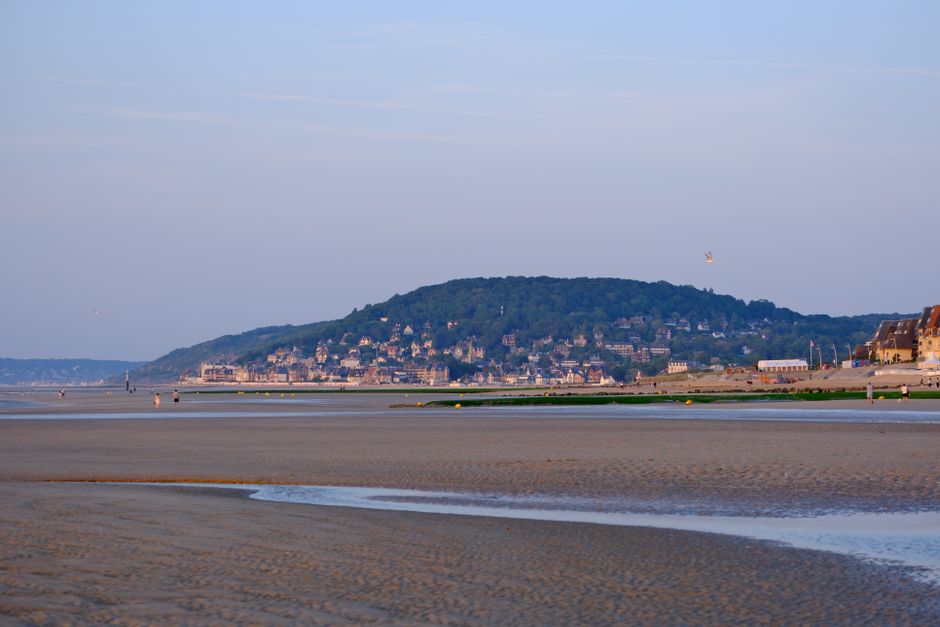
Normandy is the green, apple-growing region of northern France that runs along the English Channel from the chalk cliffs of Étretat to the bay of Mont-Saint-Michel. You come to stand on the D-Day beaches, now a UNESCO World Heritage site, walk the clifftops where the Impressionists painted, wander half-timbered Honfleur and Rouen, see Monet’s garden at Giverny, and eat cream, cheese and seafood with a glass of cider. It is close to Paris and easy to explore by car. Give it four days for the highlights, or a week to take it slowly.
Right now in Normandy (Bayeux)
- Wed 14–17°C 57–62°F 10 mm Rain
- Thu 13–15°C 55–58°F Partly cloudy
- Fri 11–16°C 52–60°F 7 mm Rain
Weather: MET Norway (CC BY 4.0) · Sea temperature: NOAA CoastWatch · Air quality: OpenAQ · Rates: ECB
Top tours in Normandy
See all tours for Normandy →
From local operators, with prices and reviews; you check availability and book on Viator, our partner. We may earn a commission at no extra cost to you. How we earn money
Normandy at a glance
- Best for: D-Day history, cliffs and coastal walks, Impressionist art and gardens, medieval towns, cider, cheese and seafood.
- How long: 2 days for the D-Day beaches, 4–5 days to add Honfleur, Étretat and Rouen, a week with Giverny and Mont-Saint-Michel.
- Best time: May to September; Giverny opens from 1 April to 1 November. Early June brings the D-Day anniversary events.
- Getting in: trains from Paris Saint-Lazare to Rouen, Caen and Bayeux, ferries from England to Caen-Ouistreham, Le Havre and Cherbourg, or a car from Paris.
- Big news: the D-Day landing beaches joined UNESCO’s World Heritage list in July 2026; the Bayeux Tapestry museum is closed until autumn 2027 and the tapestry is on loan to the British Museum in London.
- Before you go: entry rules, money and general safety are in our France travel guide.
Normandy’s areas, and who each suits
Normandy is big: from Giverny in the east to Mont-Saint-Michel in the west is about 300 km. It splits into a few areas with very different feels.
The D-Day coast: Bayeux and Caen
The Calvados and Manche coast between the Cotentin peninsula and Ouistreham holds the five landing beaches of 6 June 1944, with cemeteries, museums and memorials all along it. Bayeux, a small cathedral town spared by the war, is the classic base; Caen, rebuilt after the battle, has the Mémorial and William the Conqueror’s castle and abbeys. Best for: history lovers, veterans’ families and school groups.
The Côte Fleurie and the Pays d’Auge
East of Caen, the “flowery coast” has the glamorous resorts of Deauville and Trouville, with long sandy beaches and boardwalks, and the harbour town of Honfleur. Inland, the Pays d’Auge is the postcard Normandy of half-timbered farms, orchards and cheese villages: Camembert, Livarot and Pont-l’Évêque. Best for: couples, food lovers and weekenders from Paris.
The Alabaster Coast and Rouen
North of the Seine, white chalk cliffs run from Le Havre to Le Tréport, with Étretat’s arches, Fécamp and quiet pebble coves. Rouen, the regional capital on the Seine, has one of France’s best-preserved medieval centres. Best for: walkers, photographers and city-breakers.
The Seine valley and Giverny
Closest to Paris, the Eure department follows the looping Seine past Les Andelys and Richard the Lionheart’s Château Gaillard to Giverny, where Claude Monet lived and painted his water lilies. Best for: art lovers and easy day trips from Paris.
The Cotentin and the bay of Mont-Saint-Michel
The western Manche department is wilder: the Cotentin peninsula with Cherbourg and Cap de la Hague, the resort of Granville, and Mont-Saint-Michel in its tidal bay on the border with Brittany. See our Mont-Saint-Michel guide. Best for: nature, hiking and road trippers.
The D-Day beaches and museums
On 6 June 1944 more than 150,000 Allied troops landed on five beaches, code-named Utah and Omaha (American), Gold and Sword (British) and Juno (Canadian), at the start of the Battle of Normandy. In July 2026 UNESCO’s World Heritage Committee inscribed “The D-Day Landing Beaches, Normandy, 1944” on the World Heritage list: a serial site of six parts, the five beaches plus Pointe du Hoc, along about 80 km of coast. Visit with respect: these are war graves and places of memory. Prices and hours below were checked on the official sites in October 2026.
Omaha Beach and the Normandy American Cemetery
Omaha is a 7 km curve of sand between Vierville and Colleville-sur-Mer, under steep bluffs, where the Americans suffered the heaviest losses of the day. On the cliff above it, the Normandy American Cemetery, run by the American Battle Monuments Commission, holds the graves of nearly 9,400 war dead and nearly 1,600 names on its Walls of the Missing. As of October 2026 the grave plot areas are closed because of drought water restrictions (the visitor centre, memorial and chapel stay open), and online pre-registration is planned for visits from summer 2027; entry stays free. Entry is free; allow at least an hour for the visitor centre and the rows of white crosses and stars of David looking out to sea.
Pointe du Hoc and Utah Beach
At Pointe du Hoc, US Rangers climbed sheer cliffs under fire to reach German gun positions; the ground is still pitted with bomb craters and shattered bunkers. Further west, Utah Beach, at the base of the Cotentin, has a museum on the dunes where the troops came ashore, and inland Sainte-Mère-Église is famous for the paratroopers of the night before.
Arromanches, Gold, Juno and Sword
At Arromanches, the remains of the British Mulberry harbour, an artificial port towed across the Channel, still sit in the sea, best seen from the clifftop viewpoint. Nearby, the Longues-sur-Mer battery keeps its original guns. The Juno Beach Centre at Courseulles-sur-Mer tells the Canadian story, and at the eastern end, Pegasus Bridge, near Ouistreham, recalls the airborne landings that opened the battle. Commonwealth war cemeteries, including the largest at Bayeux, are scattered along this coast.
Mémorial de Caen
The best overview museum, covering the Second World War, D-Day and the Battle of Normandy, and the Cold War, with General Richter’s underground bunker. Allow half a day. As of October 2026 tickets are €20.80 for adults aged 19–64, €18.50 for ages 10–18 and over-65s, and €53 for a family pass; tickets are valid until 31 December 2026. It opens from 9:30 to 18:00 on most days; check the opening calendar for winter closures. The Mémorial also runs guided minibus tours of the beaches.
How to visit the beaches
The sites are spread over about 80 km with little public transport, so drive yourself or book a guided tour from Bayeux or Caen. A full day covers the American sector (Omaha, the cemetery, Pointe du Hoc, Utah) or the British and Canadian sector (Arromanches, Juno, Sword, Pegasus Bridge); two days cover both. Around 6 June each year, anniversary ceremonies, parades and parachute drops draw big crowds, and roads near official events can close, so book rooms early.
Bayeux and the Bayeux Tapestry in 2026–2027
Bayeux’s 70-metre embroidery tells the story of William the Conqueror’s invasion of England in 1066 and is listed by UNESCO as “Memory of the World”. As of October 2026, the Bayeux Tapestry Museum is closed for renovation, and the official Bayeux Museum site says it stays closed until autumn 2027, when a new museum is due to open. Meanwhile, the tapestry is on loan to the British Museum in London, where it is shown from 10 September 2026 to 11 July 2027. The British Museum reports that tickets up to 31 December 2026 have sold out, tickets for 1 January to 31 March 2027 go on sale on 21 October 2026, and later dates in early 2027; adult tickets cost £33 at peak times and under-16s go free.
Bayeux is still very much worth a visit: the Norman-Gothic cathedral, the old streets and water mills of the Aure, the Memorial Museum of the Battle of Normandy and the art and history museum (MAHB) are open, and you can explore the whole tapestry scene by scene, in high resolution, on the Bayeux Museum website. Bayeux is about 10–15 minutes’ walk from its station.
Monasteries and convents
- Abbey of Saint-Étienne, Caen
- Jumièges Abbey
Museums
- Bayeux Tapestry
- Rouen Maritime, River and Port Museum
Monuments
- Bayeux Cathedral
- Château Gaillard
- Normandy American Cemetery and Memorial
- Rouen Cathedral
Beaches
Coast, towns and gardens
Étretat
The famous white cliffs, arches and needle that Monet painted again and again. Climb the Falaise d’Amont, with its little chapel, for the view west, or the Falaise d’Aval for the arch, the Aiguille (needle) and the huge Manneporte arch beyond. Since a municipal order of April 2025, access to the beaches at the foot of the cliffs, the tunnel to the Trou à l’Homme and the cave known as the Chambre des Demoiselles has been closed because of rockfalls, and you must keep well back from cliff edges; the clifftop paths and viewpoints stay open. Parking in Étretat is paid all year from 9:00 to 19:00: in the centre €3 an hour, and in the outer car parks (Fréfossé, Grand Val, the station) €7.50 for five hours or €15 for the day (rates from 1 January 2025). Come early or late to avoid the crowds, and see our hiking guide for longer coastal walks.
Honfleur
A small harbour town at the mouth of the Seine, with tall slate-fronted houses around the Vieux Bassin, the old dock, and the wooden church of Sainte-Catherine, built by shipwrights. Boudin, a forerunner of Impressionism, was born here, and his museum shows the painters who gathered on this coast. It is lovely in the evening when day visitors leave. Cross the Pont de Normandie to Le Havre, a UNESCO-listed post-war city.
Rouen
Normandy’s capital packs hundreds of half-timbered houses into its old centre. See the Gothic cathedral that Monet painted in his famous series, the Gros-Horloge astronomical clock over the main street, the Place du Vieux-Marché where Joan of Arc was burned in 1431, and the Musée des Beaux-Arts, with one of France’s best Impressionist collections outside Paris. Rouen is an easy day trip from Paris by train, or a night on the way to the coast.
Giverny: Monet’s house and gardens
Monet lived in Giverny from 1883 to 1926 and created two gardens to paint: the flower-filled Clos Normand in front of his pink house, and the Japanese-inspired water garden with its green bridge and lily pond. The Fondation Claude Monet opens the house and gardens every day from 1 April to 1 November 2026, 10:00–18:00 (last entry 17:30), and closes for the winter. As of October 2026 tickets cost €13 for adults and €7 for children aged 7–17 and students, free under 7. Online booking is highly recommended; once the online quota is reached, expect long queues on site. E-tickets bought from 1 May 2026 cannot be changed. Allow 1½–2 hours. Pets, picnics, painting and large luggage are not allowed. The Musée des Impressionnismes is in the same village. Trains from Paris Saint-Lazare run to Vernon-Giverny station, about 5 km away, with buses, bikes or a walk for the last stretch.
Caen
William the Conqueror’s city was largely destroyed in the summer of 1944 and rebuilt in pale Caen stone. His great castle still dominates the centre, with the Musée des Beaux-Arts and the Normandy Museum inside its walls, and the two abbeys he and his wife Matilda founded, the Abbaye aux Hommes and the Abbaye aux Dames, survive. Add the Mémorial, a lively student scene and good restaurants, and Caen makes a practical base with frequent trains to Paris and Bayeux.
The Cotentin peninsula
Normandy’s wild north-west corner feels like a different country: granite villages such as Barfleur and Saint-Vaast-la-Hougue, the oyster beds of the east coast, and the high heather cliffs and lighthouses of Cap de la Hague and the Nez de Jobourg. Cherbourg, the ferry port, has the Cité de la Mer, a maritime museum in the old transatlantic terminal with a real nuclear submarine to tour.
Deauville, Trouville and the beaches
Deauville is the chic resort of Parisians, with its boardwalk lined with bathing cabins, racecourse, casino and the American Film Festival in early September. Trouville, across the river, is a more down-to-earth fishing town with a great fish market. The sandy beaches of the Côte Fleurie and the D-Day coast are wide and tidal, with cool water even in summer. See our beaches guide.
Mont-Saint-Michel
At Normandy’s western edge, the abbey island in its tidal bay deserves its own day and, ideally, a night. Our Mont-Saint-Michel guide covers tides, parking, the shuttle and guided bay crossings.
Things to do in Normandy
Follow the cider route
The signposted Route du Cidre loops through the Pays d’Auge between orchards and half-timbered farms. Producers marked “cru de cambremer” open their cellars to taste cider, pommeau (apple juice blended with calvados) and calvados, the apple brandy aged in oak. Pair them with the region’s cheeses: Camembert, Livarot, Pont-l’Évêque and Neufchâtel. If a whole day of tastings appeals, see our tasting guide.
Walk the coastal paths
The GR 21 follows the Alabaster Coast clifftops from Le Havre towards Le Tréport, and the GR 223 runs around the Cotentin, with spectacular stretches at Cap de la Hague. Stay on the marked paths and away from crumbling cliff edges.
Cycle the greenways
Long-distance routes cross Normandy: the Véloscénie from Paris to Mont-Saint-Michel, the Seine à Vélo along the river to Le Havre and Honfleur, and the Vélomaritime along the coast. Old railway lines make easy, flat greenways. See our cycling guide.
Eat Normandy
Butter and cream go into everything: sole normande, chicken vallée d’Auge with cider and cream, and moules à la crème. The coast supplies oysters from Isigny and Saint-Vaast, scallops (in season in winter) and Dieppe herring. Finish with teurgoule, a cinnamon rice pudding baked for hours, or apple tart, and a “trou normand”, a small calvados between courses.
Activities and best months
- Beaches and swimmingMore than 620 km of coastline with resort beaches such as Deauville, Cabourg, Trouville, Étretat, Granville and Dieppe, wilder beaches, lifeguards on family beaches in summer, and the D-Day beaches (Utah, Omaha, Gold, Juno, Sword). · source
- CyclingLa Vélomaritime (EuroVelo 4) crosses Normandy from Le Tréport to Mont-Saint-Michel along the Alabaster Coast, the Côte Fleurie resorts, the Côte de Nacre and the Cotentin coast, presented as a continuous route for families and friends. · source
- HikingThe GR21 follows the Alabaster Coast cliffs for about 190 km from Le Tréport to Le Havre through Étretat and Fécamp; the regional board's 9-day itinerary rates it 5 out of 5 for difficulty. · source
- SurfingAprMayJunJulAugSepOctNovA surf club at Siouville-Hague on the Cotentin peninsula (sandy beach by the Biville dunes) teaches beginners and other levels from April to November, board and wetsuit included. · source
Getting to Normandy
By train from Paris. Normandy’s regional trains, branded Nomad, leave from Paris Saint-Lazare. Rouen is roughly an hour and a quarter away, Caen about two hours and Bayeux a little more; there are also lines to Le Havre, Cherbourg and Granville. For Giverny, take the train to Vernon-Giverny.
By ferry from England and Ireland. Ferries sail to Caen-Ouistreham (for the D-Day beaches), Le Havre, Cherbourg and Dieppe, which is handy if you bring your own car.
By car. The A13 motorway runs from Paris to Rouen and Caen in about two and a half hours to Caen without traffic, and the A84 continues towards Mont-Saint-Michel. French motorways have tolls.
By air. Most international visitors fly into Paris; Normandy’s small airports (Caen-Carpiquet, Deauville) have limited flights.
Getting around Normandy
- Car: the easiest way to see the D-Day beaches, the Pays d’Auge, Étretat and the small villages. Roads are good and quiet outside towns and summer weekends.
- Train: good between the cities (Paris, Rouen, Caen, Bayeux, Le Havre, Cherbourg), but it does not reach the beaches, Étretat or Honfleur.
- Regional buses: Nomad coaches link Le Havre with Étretat and Honfleur, and Caen with the coast. Check timetables before you go; services are thinner on Sundays and outside summer.
- Guided tours: the practical choice for the D-Day beaches without a car, from Bayeux or Caen, half-day or full-day.
- Drinking and driving: France’s limit is 0.5 g/l of alcohol in the blood (0.2 g/l for new drivers). Cider and calvados count; plan a driver.
When to go and how long to stay
Normandy has a mild, changeable oceanic climate: rarely hot, rarely freezing, and showers in every season. The table uses Météo-France’s 1991–2020 normals for Caen-Carpiquet, near the D-Day coast. The coast is breezier than inland.
| Season | Average high / low | Rainy days per month | What it’s like |
|---|---|---|---|
| Spring (Mar–May) | 12–17 °C / 4–9 °C | 10 | Apple blossom in April and May, Giverny’s gardens open; fresh and changeable |
| Summer (Jun–Aug) | 21–23 °C / 11–13 °C | 8–9 | Mild and long days; beach season, D-Day anniversary in early June; busiest |
| Autumn (Sep–Nov) | 20 °C falling to 12 °C / 11 °C falling to 6 °C | 9 in September, 12–13 in October–November | Calm September, apple harvest and cider festivals in October; wetter later |
| Winter (Dec–Feb) | 8–9 °C / 3 °C | 11–14 | Grey, damp and windy; Giverny closed, quiet beaches, scallop season |
Caen gets about 740 mm of rain a year, spread fairly evenly, with the wettest months from October to December. Even in summer, pack for a shower.
Normandy in 4 days
Day 1: Rouen’s old town and cathedral, then drive to Étretat for sunset on the cliffs. Day 2: Honfleur, then on to Bayeux. Day 3: the American sector: Omaha, the American Cemetery, Pointe du Hoc. Day 4: Arromanches and Juno Beach, then the Mémorial de Caen.
Normandy in 2 days: a D-Day weekend
Base yourself in Bayeux. Day 1: the Mémorial de Caen in the morning, then Pegasus Bridge, Juno Beach and Arromanches. Day 2: Longues-sur-Mer, the American Cemetery and Omaha Beach, Pointe du Hoc, and Utah Beach if time allows.
Normandy in a week
Start with Giverny (April to October) on the way from Paris, add a day on the cider route in the Pays d’Auge, Deauville and Trouville, and end with a night at Mont-Saint-Michel.
Weather month by month
Averages from Météo-France normals 1991–2020, Caen-Carpiquet (airport) · Last reviewed 4 Oct 2026
Where to stay in Normandy
- Bayeux: the best base for the D-Day beaches, small and walkable with a station.
- Caen: a lively city with more hotels and restaurants, handy for the Mémorial and the British and Canadian beaches.
- Honfleur: charming and romantic, between the Côte Fleurie, the Pays d’Auge and Étretat.
- Rouen: for culture and train connections to Paris.
- Étretat or a farm B&B in the Pays d’Auge: for quiet nights in the countryside; you will need a car.
Book well ahead for the first week of June, around the D-Day anniversary, and for summer weekends on the coast.
Practical tips for Normandy
- Respect the memorials: dress and behave as you would at any cemetery, and don’t climb on monuments or take objects from the beaches.
- Cliffs: keep well back from the edges at Étretat and along the coast; rockfalls happen without warning, and access below the cliffs is restricted.
- Tides: the Channel has big tides; check tide times before beach walks and don’t get cut off below cliffs.
- Book Giverny online and arrive at opening time; it is one of Normandy’s busiest sites.
- Sundays and Mondays: small shops, some museums and village restaurants close; plan meals ahead.
- Time zone: Central European Time (CET/CEST), one hour ahead of the UK.
What to pack for Normandy
Layers and a waterproof jacket in every season: the weather changes quickly on the coast. Bring comfortable walking shoes with grip for cliff paths and cobbled old towns, and wellies or old trainers if you plan to walk on tidal sand. In summer add a sweater for evenings, sunscreen and swimwear for the (cool) sea. A cool bag is handy for cheese and cider to take home.
What to pack
- Day packs and anti-theft bagsCarries water, towel and sunscreen down the long stairways to Algarve coves.
- Dry bags and phone pouchesProtects phones and cameras from sand and spray on beaches reached by ferry or steep paths.
- Fleeces and warm layersSummits like Pico do Areeiro averaged about 11 °C over 2024, so a fleece is needed even in summer.
- HeadlampsLevada routes such as PR1 and PR9 pass through long, dark, wet tunnels.
- Hiking shoes and bootsMadeira's levadas and the Azores' crater rims are wet, rocky and slippery, so grippy shoes matter more than anywhere else in Portugal.
- Quick-dry beach towelsA sand-shedding quick-dry towel packs small for beach days and lido visits.
- Rain jacketsA packable shell covers showers and wind on coastal routes outside summer.
- Reef-friendly sunscreenSummer UV is strong on Portuguese beaches and there is little shade below the cliffs.
- Surf accessories (boots, leashes, wax)Neoprene boots keep feet warm in winter and protect them on rock and reef breaks.
- Trekking polesLong stone staircases and steep descents on Madeira's peaks and the Azores' crater rims are easier on the knees with poles.
- Water bottles and hydration packsRiding in the Algarve and Alentejo heat needs more water than you expect.
- Water shoesRocky coves, lava pools and weever fish in shallow sand make water shoes useful.
- WetsuitsOn the west and north coasts the sea stays around 16–18 °C even in summer, so a thin suit helps for long swims.
Normandy travel FAQ
How many days do you need in Normandy?
Four days covers the D-Day beaches, Bayeux, Honfleur, Étretat and Rouen. A week adds Giverny, the Pays d’Auge and Mont-Saint-Michel.
Can I see the Bayeux Tapestry in 2026?
Not in Bayeux. The museum is closed for renovation until autumn 2027, and the tapestry is at the British Museum in London from 10 September 2026 to 11 July 2027. You can view it online on the Bayeux Museum website.
Are the D-Day beaches a UNESCO World Heritage site?
Yes. In July 2026 UNESCO inscribed “The D-Day Landing Beaches, Normandy, 1944”: Utah, Omaha, Gold, Juno and Sword beaches and Pointe du Hoc.
Do I need a car to visit the D-Day beaches?
A car is easiest, as the sites are spread over about 80 km with few buses. Without one, book a guided tour from Bayeux or Caen.
Is the Normandy American Cemetery free?
Yes, entry is free. It holds nearly 9,400 graves and nearly 1,600 names on the Walls of the Missing, above Omaha Beach at Colleville-sur-Mer.
When is Monet’s garden at Giverny open?
Every day from 1 April to 1 November 2026, 10:00–18:00, with last entry at 17:30. Adult tickets are €13 (as of October 2026), and booking online is highly recommended.
Can I walk down to the beach under the cliffs at Étretat?
The town beach is open, but since April 2025 the beaches at the foot of the cliffs, the tunnel to the Trou à l’Homme and the Chambre des Demoiselles are closed because of rockfalls. The clifftop viewpoints are open.
What is the best base in Normandy?
Bayeux for the D-Day beaches, Honfleur for the coast and countryside, and Rouen for culture and trains. Many visitors split their stay between two of them.
How much is the Mémorial de Caen?
As of October 2026, €20.80 for adults, €18.50 for ages 10–18 and over-65s, and €53 for a family pass. Allow half a day.
What is the best time to visit Normandy?
May to September, with highs around 17–23 °C and Giverny in bloom. Early June is busy with D-Day anniversary events; October brings the apple harvest.
Can I visit Normandy as a day trip from Paris?
Giverny and Rouen work well as day trips from Paris. The D-Day beaches are possible on a long guided tour, but at least one night in Bayeux or Caen is far better.
Nearby destinations
- Mont-Saint-Michel95 km
- Saint-Malo128 km
- Brighton190 km
- Paris206 km
- Loire Valley215 km
- Brittany226 km
- Nantes227 km
- Jurassic Coast254 km
Sources
- © OpenStreetMap contributors · ODbL · fetched 3 Oct 2026
- Wikidata · CC0 · fetched 3 Oct 2026
Sources and last review
Researched and last reviewed on 3 October 2026. UNESCO listing of the D-Day beaches: Normandy Tourism and the Mémorial de Caen; the American Cemetery: the American Battle Monuments Commission; Mémorial de Caen prices and hours: the Mémorial; Bayeux Tapestry closure: Bayeux Museum (City of Bayeux), and the London loan: the British Museum; Giverny: the Fondation Claude Monet; Étretat parking: the town of Étretat; climate: Météo-France 1991–2020 normals for Caen-Carpiquet. Prices, timetables and rules change, so check the official links before you travel. For entry rules, money and general safety, see our France travel guide.
Plan your trip
Partner links: TravelerCenter may earn a commission if you book, at no extra cost to you.
🇫🇷 Useful French phrases for Normandy
All 38 French phrases: restaurant, hotel, emergencies, romance (printable) →