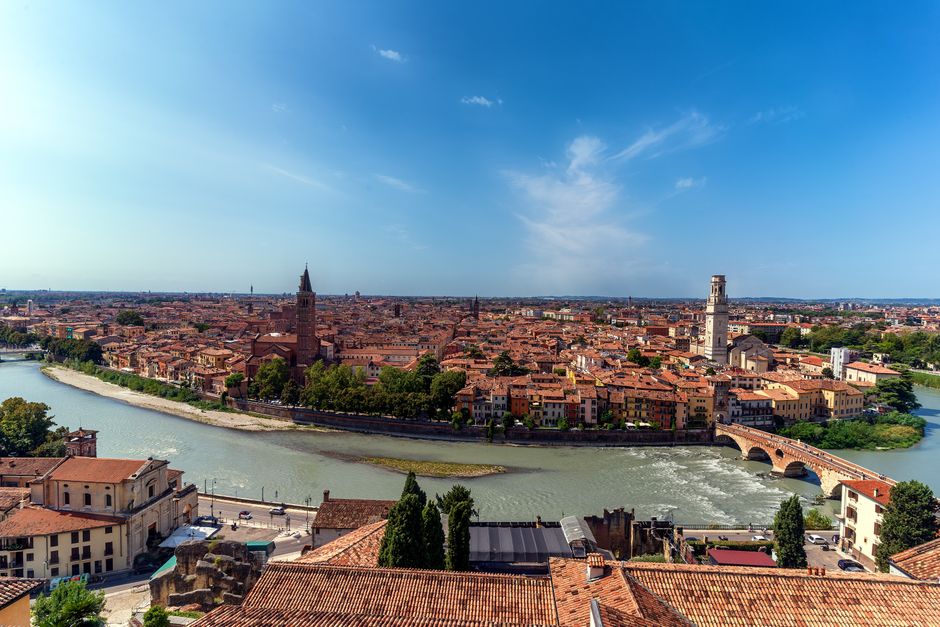
Verona is the city of Romeo and Juliet, a handsome, rose-coloured city on a loop of the River Adige between Venice and Milan, with a Roman amphitheatre at its heart where opera is sung under the stars every summer. You come to see the Arena, stand under Juliet’s balcony, wander the market square of Piazza delle Erbe, cross the battlemented bridge of Castelvecchio, climb to Castel San Pietro for the sunset, and sip Valpolicella wine in the hills. It is also the easiest gateway to Lake Garda, half an hour away. Give it two days for the city, three or four to add the lake and the wine country.
Right now in Verona
- Wed12–25°C53–77°F1 mm rain
- Thu17–22°C62–72°F13 mm rain
- Fri15–20°C60–68°F3 mm rain
Top tours in Verona
See all tours for Verona →
From local operators, with prices and reviews; you check availability and book on Viator, our partner. We may earn a commission at no extra cost to you. How we earn money
Verona at a glance
- Best for: Roman and medieval history, opera in the Arena, romance and Shakespeare, Italian food and wine, and day trips to Lake Garda.
- How long: 1–2 days for the city, 3–4 with Lake Garda and Valpolicella.
- Best time: April to June and September to October for walking; mid-June to mid-September for the Arena opera festival; December for the Christmas market.
- Getting in: Verona Porta Nuova station is on the Milan–Venice and Brenner lines; Verona airport is about 15 minutes away by shuttle bus.
- Save money: the official VeronaCard (€33 for 24 hours, €38 for 48 hours as of October 2026) covers the Arena, Juliet’s House, the museums and city buses.
- Before you go: entry rules, money and general safety are in our Italy travel guide.
Verona’s neighbourhoods and who each one suits
The historic centre sits inside a tight bend of the Adige, and almost everything a visitor wants is within a 20-minute walk. UNESCO listed the City of Verona as a World Heritage Site in 2000 for its urban layout and buildings from Roman times to the Venetian era.
Piazza Bra and the Arena
The huge square at the southern edge of the centre, with the Roman Arena, the city hall, café terraces on the “Liston” pavement, and the gate through the old walls towards the station. Lively all day and on opera nights. Best for: first visits and opera-goers.
The Roman and medieval core
Via Mazzini, the main shopping street, leads from Piazza Bra to Piazza delle Erbe, the old Roman forum, now a market square ringed by frescoed houses, and the elegant Piazza dei Signori next door, with the Torre dei Lamberti and the Scaliger Tombs. Juliet’s House is a few steps away. Best for: sightseeing, food and evening strolls.
Veronetta and Castel San Pietro
Across the river to the east, a lively student quarter with the Roman Theatre, the Giardino Giusti and the hill of Castel San Pietro, reached by stairs or a short funicular, with the best view over the city. Best for: younger travellers, good-value food and sunset views.
San Zeno
West of Castelvecchio, a village-like quarter around the great Romanesque basilica of San Zeno Maggiore, with local trattorias and a Saturday market feel. Best for: a quieter stay and authentic food.
Top things to see in Verona
Prices and hours below were checked on the official sites in October 2026. They change, so check before you go.
The Arena
Verona’s Roman amphitheatre, built in the 1st century AD, is one of the best preserved in the world. Its outer ring was largely destroyed by an earthquake in 1117, but the inner ring and the stone tiers survive, and the arena is still used for great shows. Walk through the arches, climb to the top tiers for the view over Piazza Bra, and imagine the gladiators and, today, the opera crowds. In February 2026 it hosted the closing ceremony of the Milano Cortina Winter Olympics, and in March the opening ceremony of the Paralympics.
As a monument, the Arena opens Tuesday to Sunday from 9:00 to 19:00 (closed on Mondays); on show days it closes early or does not open, so check the city museums’ website. Visits are included in the VeronaCard.
The Arena di Verona Opera Festival
Opera in the Arena is one of the great experiences of Italy: thousands of people on the ancient stone steps, candles lit at dusk, and huge productions of Aida, Carmen, Nabucco or Turandot. The festival began in 1913 with Aida. The 2026 festival, the 103rd, ran from 12 June to 12 September. As of October 2026, Fondazione Arena has announced the 104th festival for 11 June to 11 September 2027, with Aida (in its 1913 staging), La Traviata, Carmen and Nabucco, and the return of ballet to the Arena with Prokofiev’s Romeo and Juliet; the cheapest unreserved stone-step tickets start from about €22–25.
Tips. Book early for numbered seats in the stalls (poltronissime) and the lower tiers; the cheaper unnumbered stone tiers (gradinata) are first come, first served, so arrive early and bring a cushion (or rent one). Performances start around 21:00 and finish late, often after midnight. It can be hot at the start and cool by the end; bring a light layer. Sudden summer storms can stop a show; the Arena’s own rules decide whether tickets are refunded, so read them when you buy.
Juliet’s House (Casa di Giulietta)
A medieval house with a courtyard and a balcony linked, by tradition rather than history, to Shakespeare’s Juliet. Visitors touch the bronze statue of Juliet for luck and stand on the balcony for photos. Since 1 April 2026, the city has managed crowds with a new system: the courtyard and the house can be visited only with a ticket booked online for a time slot, with entry only through the Teatro Nuovo in Piazzetta Navona and the exit through the arch in Via Cappello. As of October 2026, the ticket for the courtyard route was reported at €5 and the full visit including the house at €12. VeronaCard holders also have to book their slot online. The house opens Monday afternoon and Tuesday to Sunday from 9:00 to 19:00 (last slot 18:30).
Castelvecchio and its bridge
The 14th-century castle of the Scaliger family, the lords of Verona, with red brick walls and swallowtail battlements, and the Ponte Scaligero, a fortified bridge across the Adige that is free to walk. Inside, the Museo di Castelvecchio, redesigned by the architect Carlo Scarpa, holds medieval sculpture and Venetian and Veronese paintings, and the equestrian statue of Cangrande della Scala. As of October 2026 a full ticket costs €9 (€6 for over-65s, €2 for EU visitors aged 18–25; free for children and with the VeronaCard). Open Tuesday to Sunday 10:00–18:00 (last entry 17:15), closed on Mondays.
Piazza delle Erbe, Piazza dei Signori and the Torre dei Lamberti
Piazza delle Erbe, on the site of the Roman forum, has a market, a Venetian column with the lion of Saint Mark and the Madonna Verona fountain. Through the arch, the quieter Piazza dei Signori has a statue of Dante, who found refuge in Verona in exile. The Torre dei Lamberti, about 84 metres tall, has a lift and steps to a panorama over the rooftops. Nearby, the Scaliger Tombs are elaborate Gothic monuments to the city’s medieval rulers.
Churches, the Roman Theatre and Castel San Pietro
San Zeno Maggiore, with its bronze doors and rose window, is one of the finest Romanesque churches in Italy. The Gothic church of Sant’Anastasia and the cathedral are close to the river. Across the Ponte Pietra, the Roman bridge rebuilt after the Second World War, the Roman Theatre and archaeological museum sit on the hillside, and a funicular or stairway leads to Castel San Pietro for the best sunset in town.
Romeo and Juliet beyond the balcony
Shakespeare never visited Verona, but the city has embraced the story. Besides Juliet’s House, you can see the so-called House of Romeo, a medieval Montecchi family house on Via Arche Scaligere (outside only), and Juliet’s Tomb, an empty red-marble sarcophagus in the crypt of the former San Francesco al Corso monastery, now the Museo degli Affreschi with frescoes from Verona’s palaces (Tuesday to Sunday 10:00–18:00). Letters to Juliet from around the world are still answered by volunteers of the Club di Giulietta. Around 14 February, the city celebrates “Verona in Love” with events and markets.
Christmas in Verona
From late November to early January, Christmas markets with wooden stalls fill squares in the centre, and a giant steel comet-star rises out of the Arena over Piazza Bra. It is a lovely time for a short, cold city break, with pandoro in every bakery.
Archaeological sites
- Verona Arena
Monuments
- Arco dei Gavi
Castles and forts
- Castelvecchio
Other sights
- Basilica of San Zeno
- Piazza delle Erbe
- Ponte Pietra
Churches and cathedrals
- Verona Cathedral
The VeronaCard
The city’s official museum card, sold by the municipality, costs €33 for 24 hours and €38 for 48 hours from first use, as of October 2026. It gives free or reduced entry to the main monuments and museums, including the Arena, Juliet’s House, Juliet’s Tomb, Castelvecchio, the Torre dei Lamberti and several churches, plus unlimited travel on city buses (not the airport bus), and discounts on tours and shows. Buy it on the official VeronaCard web app or at the tourist office (IAT) in Via Leoncino 61, by Piazza Bra. It pays for itself if you visit the Arena, Juliet’s House and two or three more sights in a day. Remember that Juliet’s House needs a booked slot even with the card.
Day trips: Lake Garda and the wine country
Lake Garda
Italy’s largest lake begins about 25 km west of Verona. The easiest trip is by train to Peschiera del Garda, about 15 minutes from Porta Nuova, then a walk around its star-shaped Venetian fortress or a boat to Sirmione, with its castle on the water and the Roman ruins of the Grotte di Catullo. ATV buses also run from Verona to the villages of the eastern shore, Lazise, Bardolino, Garda, Torri del Benaco and Malcesine, where a cable car climbs Monte Baldo. In the opera season, ATV’s OperaBus takes you from Piazza Bra back to the lake after the performance (€15 one way in 2026). Boats link the lake villages from spring to autumn. Gardaland, Italy’s biggest theme park, is near Peschiera.
Valpolicella and Soave
The hills just north of Verona are Valpolicella, the home of Amarone, Ripasso and Recioto red wines; many wineries offer tastings by appointment. East of the city, the walled village of Soave has a castle and white-wine cellars. Go with a tour or a designated driver. See our wine-tasting guide.
Further afield
Verona is on the main line between Milan and Venice, so both are easy day trips, as are Padua, Vicenza and Mantua. Northwards, the train climbs to Bolzano and the Dolomites in about 1.5 hours.
Activities and best months
- City sightseeingThe Roman Arena (now an opera venue), Juliet's House with its balcony, and Piazza delle Erbe on the old Roman forum.
- CyclingA cycle network links every Valpolicella town and climbs into the Valdadige among vineyards and olive groves, on paths open to families.
- Wine tastingValpolicella, the hill valley north of the city, is home to Amarone, Valpolicella Classico and Superiore, Ripasso and Recioto.
Getting to Verona
By train. Verona Porta Nuova, a 20-minute walk or short bus ride south of Piazza Bra, has fast trains to Milan (about 1 hour 15 minutes) and Venice (about 1 hour 10 minutes), Bologna and Rome, and trains north over the Brenner Pass to Bolzano, Innsbruck and Munich.
By air. Verona’s Valerio Catullo airport, at Villafranca, is about 12 km south-west. ATV’s airport shuttle runs to Porta Nuova station in about 15 minutes, roughly every 20 minutes in the day; the fare was reported at €7 in 2026. Venice, Bergamo and Milan airports also work, with train links.
By car. Verona sits at the crossing of the A4 (Milan–Venice) and A22 (Brenner) motorways. The historic centre is a limited traffic zone (ZTL) where unauthorised cars are fined by camera; park outside it in a public car park and walk.
Getting around Verona
- Walking: the best way; the centre is compact and largely pedestrian.
- Buses: ATV city buses link the station, centre and outskirts; free with the VeronaCard.
- Bikes and scooters: shared bikes are available, but the old streets are busy with pedestrians.
- Tourist train and hop-on buses: useful for San Zeno and Castel San Pietro if you have little time. See our city sightseeing guide.
When to go and how long to stay
Verona has a humid continental-to-Mediterranean climate typical of the Po plain: hot, sticky summers with thunderstorms, cold and sometimes foggy winters, and pleasant springs and autumns. The table uses the Italian Air Force’s 1991–2020 normals for Verona Villafranca (airport, 73 m).
| Season | Average high / low | Rainy days per month | What it’s like |
|---|---|---|---|
| Spring (Mar–May) | 14–24 °C / 4–13 °C | 5–8 | Fresh, flowering, perfect for walking |
| Summer (Jun–Aug) | 28–30 °C / 17–19 °C | 5–8 | Hot and humid, thunderstorms, opera season |
| Autumn (Sep–Nov) | 25 °C falling to 12 °C / 14 °C falling to 5 °C | 6–8 | Warm September, grape harvest, fog from November |
| Winter (Dec–Feb) | 7–10 °C / −1 to 0 °C | 5–8 | Cold, often foggy, Christmas market in December |
Verona gets about 770 mm of rain a year, spread fairly evenly, with September to November the wettest months. July is the hottest, with average highs around 30 °C; in a heatwave it can be much hotter, so plan sightseeing for the morning and evening.
Verona in 1 day
Morning: the Arena, then Via Mazzini to Juliet’s House (booked slot) and Piazza delle Erbe. Afternoon: Piazza dei Signori, the Torre dei Lamberti and Castelvecchio. Evening: cross the Ponte Pietra and climb to Castel San Pietro for sunset, then dinner in Veronetta, or the opera in summer.
Verona in 3 days
Add San Zeno, the Roman Theatre and the Giardino Giusti on day 2, and a day at Lake Garda (Sirmione or the eastern shore) or in the Valpolicella wineries on day 3.
Weather month by month
Where to stay in Verona
- Around Piazza Bra and Via Mazzini: central and lively, close to the Arena for opera nights.
- Piazza delle Erbe area: historic and atmospheric, with restaurants on the doorstep.
- Veronetta: better value, young and local.
- San Zeno: quiet and authentic.
- Near Porta Nuova: practical for trains and Lake Garda trips.
Book months ahead for opera nights, Vinitaly (the big wine fair, usually in April) and summer weekends, when prices rise sharply.
Eating and drinking
Try risotto all’Amarone, bigoli pasta with duck or sardines, pastissada (a slow-cooked stew, traditionally of horse meat), boiled meats with pearà (a peppery bread sauce), and, at Christmas, pandoro, the star-shaped cake invented in Verona. Order a glass of Valpolicella, Soave or Bardolino, or a spritz in Piazza delle Erbe.
Practical tips for Verona
- Book Juliet’s House: since April 2026 it is only by online time slot, including for VeronaCard holders.
- Check Arena hours: the monument closes early or stays shut on show days.
- Mind the ZTL: do not drive into the centre without a permit.
- Mondays: many civic museums, including Castelvecchio and the Arena monument, are closed.
- Opera dress: smart-casual is fine; bring a cushion and a light layer for the stone tiers.
- Heat: in July and August, sightsee early and carry water.
What to pack for Verona
Comfortable walking shoes for cobbles and stone, light breathable clothes and a hat in summer, a smart outfit and a cushion or light jacket for the opera, an umbrella for spring and autumn showers, and a warm coat for foggy winter days.
What to pack
- City walking shoesLisbon and Porto are steep, with polished limestone cobbles that get slippery, so grippy soles matter.
- Day packs and anti-theft bagsA small zipped or anti-theft bag makes crowded trams and viewpoints less stressful.
- Rain jacketsFrom October to April Porto and Lisbon see rain on roughly a third of days.
- Travel adapters and convertersPortugal uses Type C and F sockets at 230 V, so most visitors from outside Europe need an adapter.
- Water bottles and hydration packsRiding in the Algarve and Alentejo heat needs more water than you expect.
- Wine bottle travel protectorsPort and Douro wines bought at the quintas travel home safely in checked luggage with padded bottle protectors.
Verona travel FAQ
When is the Arena di Verona opera festival?
The 2026 festival ran from 12 June to 12 September. Fondazione Arena has announced the 2027 festival, the 104th, for 11 June to 11 September 2027.
How much are tickets for the opera at the Arena?
As of October 2026, the cheapest unnumbered stone-tier tickets for the 2027 festival started at about €22–25; numbered seats in the stalls and lower tiers cost much more. Book early for good seats.
Do I need to book Juliet’s House?
Yes. Since 1 April 2026, the courtyard and the house can be visited only with an online booking for a time slot, entering through the Teatro Nuovo, and VeronaCard holders must book too.
Is Juliet’s balcony free?
Not any more. Since April 2026 even the courtyard under the balcony needs a ticket, reported at €5, while the full visit including the house was reported at €12.
Is the VeronaCard worth it?
Usually, if you visit the Arena, Juliet’s House and two or more other sights in a day. As of October 2026 it costs €33 for 24 hours and €38 for 48 hours, with city buses included.
Can you visit the Verona Arena?
Yes, Tuesday to Sunday from 9:00 to 19:00, except when shows are being set up or performed. It is closed on Mondays and included in the VeronaCard.
How many days do you need in Verona?
One full day covers the main sights; two days let you add San Zeno, Castel San Pietro and an opera night. Add a day for Lake Garda or Valpolicella.
How do I get from Verona to Lake Garda?
By train to Peschiera del Garda in about 15 minutes, then a boat or bus to Sirmione, or by ATV bus to Lazise, Bardolino, Garda and Malcesine on the eastern shore.
How do I get from Verona airport to the city?
By ATV’s airport shuttle to Porta Nuova station, about 15 minutes, then walk or take a city bus to Piazza Bra. Taxis are available at the terminal.
Is Verona a good day trip from Venice or Milan?
Yes: fast trains take about 1 hour 10 minutes from Venice and about 1 hour 15 minutes from Milan. Staying overnight lets you enjoy the evening and the opera.
When is the best time to visit Verona?
April to June and September to October for pleasant walking weather; mid-June to mid-September for the opera; December for the Christmas market. July and August are hot and busy.
Nearby destinations
- Lake Garda33 km
- Padua69 km
- Venice104 km
- Bergamo107 km
- Bologna109 km
- Milan141 km
- St. Moritz148 km
- Lake Como148 km
Plan your trip
Partner links: TravelerCenter may earn a commission if you book, at no extra cost to you.
🇮🇹 Useful Italian phrases for Verona
All 38 Italian phrases: restaurant, hotel, emergencies, romance (printable) →
Sources · last reviewed 3 October 2026
Researched and last reviewed on 3 October 2026. Arena opera festival dates and programme: Fondazione Arena di Verona; Arena monument, Juliet’s House and museum hours, VeronaCard: the City of Verona and its civic museums; Castelvecchio prices: the Museo di Castelvecchio; Lake Garda buses and OperaBus: ATV Verona; climate: Italian Air Force 1991–2020 normals for Verona Villafranca from the WMO climate normals collection. The Juliet’s House ticket prices and the airport shuttle fare come from secondary sources. Prices, timetables and rules change, so check the official links before you go. For entry rules, money and general safety, see our Italy travel guide.
Also: italia.it · visitverona.it · Aeronautica Militare normals 1991–2020, Verona Villafranca (airport) (climate)
Data: Weather: MET Norway (CC BY 4.0) · Rates: ECB · Costs: World Bank ICP and price levels · © OpenStreetMap contributors (ODBL) · Wikidata (CC0)