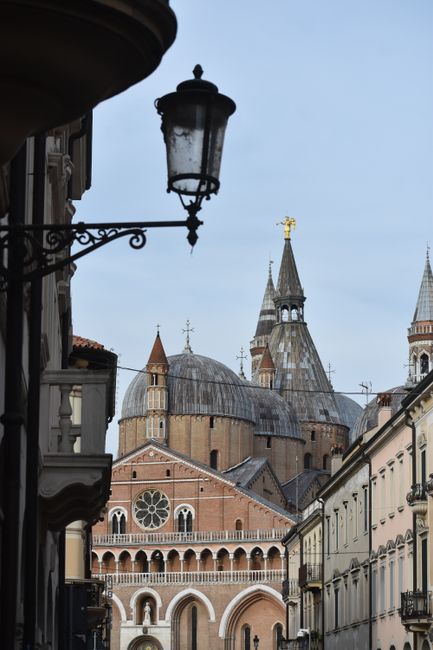
Padua (Padova in Italian) is a lively university city half an hour from Venice, and one of the great art cities of Italy that many visitors rush past. It holds Giotto’s frescoes in the Scrovegni Chapel, a turning point in Western painting, and seven more 14th-century fresco cycles that together form a UNESCO World Heritage Site, “Padua’s fourteenth-century fresco cycles”. It also has the vast Basilica of St Anthony, one of the most visited shrines in Italy, the oldest university botanical garden in the world, arcaded streets, busy market squares and an aperitivo culture fuelled by tens of thousands of students. Give it one full day, or two nights as a calmer, cheaper base for Venice and the Veneto.
Right now in Padua
- Thu16–23°C61–73°F15 mm rain
- Fri15–18°C58–65°F28 mm rain
- Sat13–20°C55–69°FClear
Top tours in Padua
See all tours for Padua →
From local operators, with prices and reviews; you check availability and book on Viator, our partner. We may earn a commission at no extra cost to you. How we earn money
Padua at a glance
- Best for: Giotto and medieval frescoes, the Basilica of St Anthony, university history, market squares and aperitivo, and an affordable base for Venice, Verona and the Euganean Hills.
- How long: 1 day for the Scrovegni Chapel, the Basilica and the squares; 2–3 days with the other fresco sites, the botanical garden and day trips.
- Best time: April to June and September to October. June brings the feast of St Anthony; summer is hot and humid.
- Book ahead: the Scrovegni Chapel. Booking is compulsory, it cannot be booked online for the same day, and only 25 people enter every 15 minutes.
- Getting in: trains from Venice take about 25–30 minutes on fast services; Padua is on the main lines to Verona, Milan and Bologna.
- Before you go: entry rules, money, trains and general safety are on our Italy travel guide.
Padua’s neighbourhoods and who each one suits
The historic centre is compact and flat, ringed by Renaissance walls and old canals, and runs for about 2 km from the station in the north to the Basilica of St Anthony and Prato della Valle in the south. Much of it is under arcades, which makes it pleasant to walk in rain or sun.
The station and the Arena
The area between the station and the Scrovegni Chapel, which sits in the gardens of the old Roman arena. Practical hotels, easy arrivals and departures for Venice, and the chapel a ten-minute walk away. Less charming in the evening.
The squares: Piazza delle Erbe, dei Signori and della Frutta
The medieval heart around the Palazzo della Ragione, with daily markets, the Caffè Pedrocchi, the university’s Palazzo Bo and dozens of bars that fill up for the evening spritz. Lively, central and great for food; it can be noisy at night.
Il Santo and Prato della Valle
The southern part of the centre, around the Basilica of St Anthony, the botanical garden and the huge oval square of Prato della Valle. Calmer, with pilgrims’ hotels and good-value rooms, and still a short walk or tram ride from everything.
The Ghetto and the Portello
Narrow lanes of the old Jewish quarter just off the squares, full of small restaurants and wine bars, and the canal-side Portello district to the east, by the university buildings. Characterful for those who like a student buzz.
Top things to see in Padua
Prices and hours were checked on the official sites in October 2026; check again before you go. Churches can close to visitors during services.
The Scrovegni Chapel
Giotto painted this small chapel between about 1303 and 1305 for the banker Enrico Scrovegni, covering every wall with scenes from the lives of the Virgin and Christ under a starry blue vault, and ending with the Last Judgement. The figures’ weight, emotion and real space changed European painting. To protect the frescoes, visits are tightly controlled:
- Booking is compulsory on the official site (cappelladegliscrovegni.it) or by phone; online, you can book only up to the day before. Without a booking, ask at the ticket desk of the Eremitani museums for any spare places.
- Groups of up to 25 people enter every 15 minutes, first spending about 15 minutes in an air-conditioned waiting room while the air settles, then about 15 minutes in the chapel.
- Be on time: collect your ticket well ahead at the Eremitani museums, about 100 m away, and be at the chapel entrance at least 5 minutes before your slot. If you are late, you have to book and pay again.
- No bags, food or drink inside (lockers are available), and no flash.
As of October 2026 the chapel is open every day from 9:00 to 19:00 (closed 1 May, 25–26 December and 1 January), and the ticket costs €16, including the Eremitani civic museums next door; reduced €11 for over-65s from the EU and groups, €6 for ages 6–17 and students, and free for under-5s. On many evenings from spring to early November there are extra night visits, sold separately.
The Basilica of St Anthony (Il Santo)
A huge brick basilica with eight domes and minaret-like towers, built after St Anthony of Padua died in 1231. Pilgrims queue to touch his tomb in the Chapel of the Ark, and the Treasury Chapel keeps his relics. Donatello’s bronze high altar and his equestrian statue of the Gattamelata in the square outside are masterpieces of the early Renaissance. Entry is free; dress modestly and keep quiet, as it is a working shrine.
The other fresco cycles: Padova Urbs Picta
The UNESCO site, listed in 2021, includes eight places with frescoes painted between 1302 and 1397: the Scrovegni Chapel, the Eremitani church, the Palazzo della Ragione, the Carrara palace chapel, the Baptistery of the Cathedral, the Basilica and convent of St Anthony, the Oratory of St George and the Oratory of St Michael. The Baptistery, covered in Giusto de’ Menabuoi’s frescoes of paradise, and the vast hall of the Palazzo della Ragione, with its giant wooden horse and astrological frescoes, are the highlights after Giotto. The Padova Urbs Picta Card covers the sites and city buses for 48 or 72 hours; check the current price and what it includes on the city’s official sites before you buy.
The Botanical Garden (Orto Botanico)
Founded by the university in 1545, this is the oldest university botanical garden in the world still in its original place, and a UNESCO World Heritage Site in its own right. A circular walled garden of medicinal plants sits beside a modern glasshouse, the Garden of Biodiversity. It is open Tuesday to Sunday; in October 2026 it closes at 18:00, then at 17:00 from 24 October. Tickets cost about €10.
More classic sights
- Palazzo Bo: the university’s historic seat, with the world’s oldest permanent anatomical theatre (1594) and the lectern Galileo taught from. Visits are by guided tour at set times; the weekend tour with the 20th-century Gio Ponti rooms costs €12.
- Prato della Valle: one of the largest squares in Europe, an oval garden ringed by a canal and 78 statues.
- Caffè Pedrocchi: the grand neoclassical café, open “without doors” day and night in the 19th century; try the mint coffee.
- The Cathedral and the Eremitani church: the Eremitani has what survives of Mantegna’s frescoes, badly damaged by bombing in 1944.
Other things to do in Padua
Markets and the spritz hour
Every morning except Sunday, the stalls of fruit, vegetables, cheese and flowers fill Piazza delle Erbe and Piazza della Frutta, and under the Palazzo della Ragione the old covered market halls sell meat, salami and cheese. In the early evening the same squares turn into one big open-air bar: the spritz, made with Aperol from Padua, is the drink, served with small snacks.
Food
Paduan cooking is Venetian countryside food: bigoli thick spaghetti with duck sauce, risotto, boiled meats with green sauce, and the local Padovana hen. Finish with tiramisù, which the Veneto proudly claims. The Euganean Hills, just south, make good red and white wines and sweet Fior d’Arancio; see our wine tasting guide.
The university and student life
The University of Padua, founded in 1222, is one of the oldest in the world: Galileo taught here, and Elena Cornaro Piscopia became the first woman in the world to earn a university degree here in 1678. Graduations are still celebrated noisily in the streets, with laurel wreaths and comic posters.
Day trips from Padua
Padua is one of the best bases in the Veneto: trains are fast and frequent, and hotels cost far less than in Venice.
Venice
Fast trains reach Venice Santa Lucia in about 25–30 minutes, so you can sleep in Padua and spend the day in the lagoon. Check the Venice access fee days before you go: see our Venice guide.
Verona and Vicenza
Verona, with its Roman arena and Juliet’s balcony, is about 40–50 minutes by fast train: see our Verona guide. Vicenza, the city of Palladio’s villas and buildings, is a quick stop on the way.
The Brenta Riviera and the Euganean Hills
Along the Brenta canal towards Venice stand the summer villas of Venetian nobles, the grandest being Villa Pisani at Stra; boats cruise the canal in season. South of the city, the volcanic Euganean Hills have vineyards, walking and cycling trails, Petrarch’s medieval village of Arquà Petrarca and the thermal spa towns of Abano and Montegrotto; see our cycling guide.
Bologna
About an hour south by high-speed train, Bologna is an easy, delicious day out: see our Bologna guide.
Nearby destinations
- Venice36 km
- Verona69 km
- Lake Garda97 km
- Bologna110 km
- Cortina d'Ampezzo127 km
- Piran133 km
- Dolomites136 km
- Trieste150 km
Getting there and getting around
By train
Padova station is on the main lines from Venice to Milan and from Venice to Bologna and Rome, so trains are frequent: about 25–30 minutes to Venice Santa Lucia on the fastest services (regional trains take a little longer), about 40–50 minutes to Verona, and about an hour to Bologna. From the station, the centre is a 10-minute walk or a short tram ride.
By air
Venice Marco Polo airport is about 45 minutes to an hour away by bus or car, and Treviso airport a similar distance; Verona and Bologna airports also work. Buses run from Venice airport to Padua station; otherwise take the bus to Venezia Mestre and change to the train.
Tram, bus and on foot
The centre is flat and best on foot or by bike. The tram line SIR1 runs north–south through the centre, from the station past the Eremitani and the Santo to Prato della Valle; a second line, SIR3, from the station east to Voltabarozzo, was due to open around the end of 2026. Buy tickets before you board.
Driving and the ZTL
Don’t drive into the historic centre. It is a limited-traffic zone (ZTL) watched by cameras, with some gates active around the clock and others from 8:00 to 23:30 on weekdays and from 14:00 on Sundays and holidays; fines follow you through your rental company. If your hotel is inside, ask it to register your number plate. Otherwise use the car parks around the edge of the centre or the park-and-ride by the tram line.
When to go and how long to stay
Padua lies on the flat Venetian plain, with hot, humid summers, chilly, often foggy winters, and rain spread through the year. There is no Padua station in the official WMO set, so the table uses the WMO 1991–2020 climate normals for Treviso Istrana (42 m), about 35 km to the north-east on the same plain: long-term average daily highs and lows, and days with at least 1 mm of rain.
| Season | Average high / low | Rainy days per month | What it’s like | Good for |
|---|---|---|---|---|
| Winter (Dec–Feb) | 8–10 °C / about 0 °C | 5–6 | Cold, damp and often foggy | Museums and frescoes without queues, Christmas markets |
| Spring (Mar–May) | 15–24 °C / 4–13 °C | 6–9 | Mild and green, showers in April and May | Walking the city, the Euganean Hills, Easter |
| Summer (Jun–Aug) | 28–31 °C / 17–19 °C | 7–9 | Hot and humid, with thunderstorms | The feast of St Anthony, evenings in the squares |
| Autumn (Sep–Nov) | 25 °C falling to 13 °C / 14 °C falling to 5 °C | 7–8 | Warm September, mists returning in November | Food and wine, quieter sights |
These are long-term averages; recent summers have been hotter. May, September and November are the wettest months, with about 95–110 mm of rain each.
Events worth planning around
- Feast of St Anthony (13 June): the city’s great religious festival, with a procession carrying the saint’s relics through the streets and pilgrims from all over the world. Book rooms ahead.
- Graduation season: in spring, summer and autumn, students celebrate their degrees in the squares with laurel wreaths and comic posters.
- December: Christmas markets and lights in the squares and Prato della Valle.
How long to stay: 1-, 2- and 3-day plans
1 day: the Scrovegni Chapel (booked) and the Eremitani museums in the morning, lunch around the market squares, then the Basilica of St Anthony, Prato della Valle and a spritz in Piazza delle Erbe.
2 days: add the Baptistery, the Palazzo della Ragione, Palazzo Bo and the botanical garden. 3 days: add a day in Venice or Verona, or the villas of the Brenta and the Euganean Hills.
Where to stay in Padua and the tourist tax
- Near the station: practical and good value, with the Scrovegni Chapel close by and quick trains to Venice.
- The squares: the most atmospheric, for food and nightlife; expect some noise.
- Il Santo and Prato della Valle: calmer, with good-value hotels.
- The Ghetto and Portello: lanes full of restaurants and student life.
- Abano and Montegrotto: spa hotels in the Euganean Hills, about 20 minutes away.
Padua tourist tax (imposta di soggiorno): charged per person per night, for up to 5 consecutive nights, and paid at your accommodation. The rates set by the city from July 2024 go up to about €3.50 a night in five-star hotels, with about €2.00 in B&Bs, guesthouses and holiday rentals. Ask your host or check comune.padova.it for the current amount.
Practical tips for Padua
- Book the Scrovegni Chapel early, at least a day ahead (online bookings are not possible for the same day) and well ahead at weekends and holidays.
- Arrive early for your slot: late arrivals lose their visit.
- Dress for the Basilica: shoulders and knees covered.
- Use the train: Padua is an easy, cheaper base for Venice, Verona and Vicenza.
- Watch for bikes in the pedestrian streets, and lock yours well if you rent one.
- Stay out of the ZTL with a car.
- Emergencies: call 112.
What to pack for Padua
Comfortable shoes for long, flat walks under the arcades. In summer bring light clothes, a hat, sunscreen, a refillable water bottle and insect repellent for warm evenings, plus a scarf or layer to cover your shoulders in churches. In spring and autumn, pack layers and a compact umbrella. In winter, a warm, waterproof coat: the fog and damp make it feel colder than the thermometer says. A small bag is best, since bags are not allowed in the Scrovegni Chapel.
Padua travel FAQ
Is Padua worth visiting?
Yes. Giotto’s Scrovegni Chapel alone is worth the trip, and the city adds the Basilica of St Anthony, seven more medieval fresco sites, the world’s oldest university botanical garden and lively squares, without Venice’s crowds or prices.
Do you need to book the Scrovegni Chapel?
Yes. Booking is compulsory, online at cappelladegliscrovegni.it or by phone, and online bookings close the day before. Without a booking you can only ask the ticket office for unsold places.
How much is the Scrovegni Chapel ticket?
As of October 2026, €16 for adults including the Eremitani civic museums, €11 reduced, €6 for ages 6–17 and students, and free for under-5s.
How long is the visit to the Scrovegni Chapel?
About 30 minutes in all: 15 minutes in a waiting room while the air settles, then 15 minutes inside the chapel. Be at the entrance at least 5 minutes before your slot.
Is the Basilica of St Anthony free?
Yes, entry is free. It is a working shrine, so dress modestly, keep quiet, and avoid visiting during services if you only want to look around.
How far is Padua from Venice?
About 40 km. Fast trains take about 25–30 minutes to Venice Santa Lucia, and regional trains a little longer, so Padua makes a good base for Venice.
How many days do you need in Padua?
One full day covers the Scrovegni Chapel, the Basilica and the squares. Two or three days let you see the other fresco sites, Palazzo Bo and the botanical garden, and make day trips.
Can I drive into Padua’s centre?
No. The centre is a camera-controlled ZTL. Park outside it, use the park-and-ride by the tram line, or ask your hotel to register your plate.
What is the Padova Urbs Picta Card?
A 48- or 72-hour pass for the city’s UNESCO fresco sites, including city buses. Check the current price and the Scrovegni booking rules for card holders on the official sites before you buy.
What is Padua famous for?
Giotto’s frescoes, St Anthony of Padua, one of the oldest universities in the world, where Galileo taught, the first university botanical garden, and the spritz hour in its market squares.
Plan your trip
Partner links: TravelerCenter may earn a commission if you book, at no extra cost to you.
🇮🇹 Useful Italian phrases for Padua
All 38 Italian phrases: restaurant, hotel, emergencies, romance (printable) →
Sources · last reviewed 4 October 2026
Researched and last reviewed on 4 October 2026. Scrovegni Chapel prices, hours and visit rules come from the Comune di Padova’s chapel site (cappellascrovegni.padovamusei.it) and the official booking site (cappelladegliscrovegni.it); Palazzo Bo prices from the University of Padua; ZTL gate hours from the Padua municipal police; climate from the WMO 1991–2020 normals for Treviso Istrana (Italian Air Force station, archived by NOAA). Botanical garden hours and prices, the tourist tax rates, the SIR3 tram opening and train times come from secondary sources and should be checked before you travel. Prices, timetables and opening hours change, so check the official sites before you go. For entry rules, money and safety, see our Italy travel guide.
Data: Weather: MET Norway (CC BY 4.0) · Air quality: OpenAQ · Rates: ECB · Costs: World Bank ICP and price levels · Wikidata (CC0)