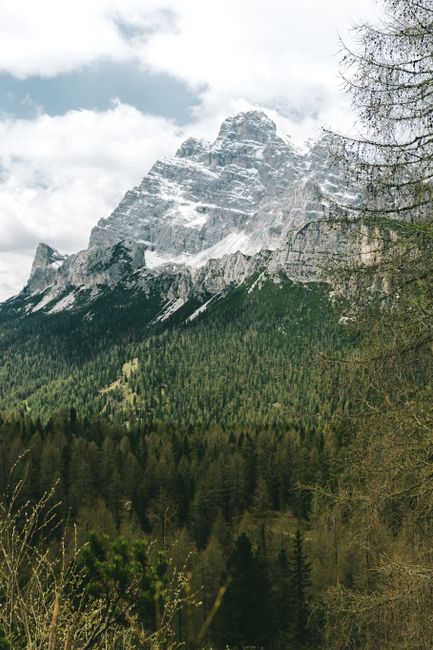
The Dolomites are the pale, jagged mountains of north-eastern Italy: towers and walls of rock that glow pink at sunset above green high pastures, wooden farmhouses and some of the best-run mountain villages in Europe. You come to hike from hut to hut, ride lifts to balconies like Seceda, walk around the Tre Cime di Lavaredo, take photos at Lago di Braies, ski the Sella Ronda in winter and eat dumplings and apple strudel at a rifugio. The valleys mix Italian, German and the old Ladin language, and Cortina d’Ampezzo has just hosted the 2026 Winter Olympics. Give it at least four days in summer, or a week to hike or ski.
Right now in Dolomites (Cortina d'Ampezzo)
- Thu9–13°C48–55°F10 mm rain
- Fri7–11°C45–53°F1 mm rain
- Sat5–14°C41–57°F1 mm rain
Top tours in Dolomites
See all tours for Dolomites →
From local operators, with prices and reviews; you check availability and book on Viator, our partner. We may earn a commission at no extra cost to you. How we earn money
The Dolomites at a glance
- Best for: hiking and hut-to-hut trekking, mountain photography, lifts to high viewpoints, skiing, via ferrata, road cycling over the passes and Alpine food.
- How long: 4–5 days for two valleys and the famous sights, 1–2 weeks to hike or ski properly.
- Best time: mid-June to late September for hiking, when lifts and huts are open; December to early April for skiing. Spring and late autumn are quiet, with many lifts, huts and hotels closed.
- Getting in: Venice, Verona, Innsbruck and Bolzano airports; trains to Bolzano, Bressanone and Dobbiaco; then buses into the valleys.
- Book ahead: in summer 2026, car access to the Tre Cime road, Lago di Braies (in high season), the Alpe di Siusi road (parking) and the Seceda lift all needed online bookings.
- Before you go: entry rules, money and general safety are in our Italy travel guide.
Where the Dolomites are, and the valleys to know
The Dolomites spread across three regions and several provinces: South Tyrol (the province of Bolzano), Trentino, and the Veneto (the province of Belluno), with a corner in Friuli. In 2009 UNESCO listed nine separate mountain groups of the Dolomites as a single World Heritage Site for their landscape and geology. There is no single “Dolomites town”: you pick a valley as a base, and each has its own lift system, trails and character.
Val Gardena
A busy, well-equipped valley in South Tyrol with three villages, Ortisei, Santa Cristina and Selva, under the Sassolungo and the Odle peaks. It has lifts to Seceda, Col Raiser and the Alpe di Siusi, wood-carving workshops, and direct access to the Sella Ronda ski circuit. Best for: first visits, families, and travellers without a car.
Alta Badia
A sunny, gentle valley around Corvara, La Villa and San Cassiano, under the Sella massif and the Sassongher, known for its food (several high-end restaurants), wide pastures and easy hiking and skiing. Best for: food lovers, families and relaxed hiking.
Cortina d’Ampezzo
The glamorous “Queen of the Dolomites” in the Veneto, ringed by the Tofane, Cristallo and Sorapiss, with a lively pedestrian centre, upmarket shops, and lifts to the Faloria, the Tofana, the Cinque Torri and the Lagazuoi. It is the closest base for the Tre Cime and Lago di Sorapis. Best for: stylish stays, mountain history and the eastern Dolomites.
Val Pusteria and the Sesto Dolomites
The long valley along the north of the range, with Dobbiaco, San Candido and Braies, the gateway to Lago di Braies and the northern side of the Tre Cime. Trains run along the valley. Best for: lakes, easy access by train and cycle paths.
Val di Fassa and the Trentino side
In Trentino, Canazei and the Val di Fassa lie under the Marmolada, the highest peak of the Dolomites at about 3,343 metres, with lifts to the Sella and Pordoi passes. Best for: skiers, hikers and good-value stays.
Language: Italian, German and Ladin
The Dolomites cross a language border. In South Tyrol, most people speak German as their first language: in the province’s 2024 language census, 68.6% declared themselves German-speaking, 27.0% Italian-speaking and 4.4% Ladin. Place names are bilingual or trilingual, so Ortisei is also St. Ulrich and Urtijëi, and Lago di Braies is the Pragser Wildsee. Ladin, a Rhaeto-Romance language, is spoken in Val Gardena and Alta Badia (and, in Trentino and the Veneto, in Val di Fassa, Livinallongo and Cortina’s heritage). Italian is understood everywhere; English is common in hotels and lifts. A “grüß Gott” or “bun dé” goes down well.
Top things to see in the Dolomites
Prices, dates and rules below were checked on the official sites in October 2026. They change every season, so check before you go.
Tre Cime di Lavaredo
The three giant rock towers on the border between South Tyrol and the Veneto are the symbol of the Dolomites. The classic loop around them starts at the Rifugio Auronzo (2,333 m) and passes the Rifugio Lavaredo, the Forcella Lavaredo and the Rifugio Locatelli, facing the famous north faces: about 10 km and 3–4 hours of easy to moderate walking, at high altitude.
The toll road and parking booking. The road from Misurina up to the Rifugio Auronzo car park is a toll road run by the municipality of Auronzo di Cadore. As of October 2026, cars can only drive up with an online booking made in advance on the municipality’s official portal, with the car’s number plate; the gate reads the plate. The toll is €40 for a car, €26 for a motorbike and €60 for a camper, valid for 12 hours from your booked time, and bookings can be cancelled free up to five days before. The road is generally open from late May to late October, weather permitting. Without a booking, take a summer bus from Auronzo, Dobbiaco or Cortina, or hike up from Val Fiscalina or the Rienza valley.
Seceda
From Ortisei, a gondola and cable car climb to the Seceda at about 2,500 m, where the grassy ridge ends in a sudden line of rock fins, the Odle, the view on countless postcards. Walk the ridge and down via the pastures and huts to Col Raiser or back to the lift.
Booking and prices. In 2026 the Ortisei–Furnes–Seceda lifts ran from 22 May to 2 November, 8:30–17:30. From summer 2026, tickets must be bought online for a fixed 30-minute time slot, and they are not refundable or changeable. As of October 2026 a return adult ticket costs €74 and one way €49, with half price for juniors (8–15) and children under 8 free with an adult. The Dolomiti Supersummer card is not valid on these lifts. Since summer 2025, local farmers have also charged a small fee (reported as €5) at a turnstile on the most photographed stretch of the ridge path, which crosses their land; the summit cross and main viewpoint can be reached without it.
Lago di Braies
A green-blue lake ringed by forest and the cliffs of the Croda del Becco, with wooden rowing boats and a boathouse that are among the most photographed scenes in the Alps. The level walk around the lake takes about an hour.
Summer access rules. The Braies valley has a traffic regulation every summer. In 2026 it ran from 1 July to 15 September, from 9:00 to 16:00: in those hours you could drive in only with an online booking (the official combined ticket cost €44 with a full-day transit permit, a guaranteed parking place and a €22 voucher for the lake’s restaurants and shops), or arrive by bus, bike or on foot. Bus 442 from Dobbiaco and Villabassa runs all year and needs an online booking during the regulation period; bus 439 from Monguelfo runs in high summer only. Outside the regulation period there are no restrictions, but the car parks (P2, P3, P4) are paid all year. Swimming is discouraged, as the lake is in a nature park. Go early in the morning or late in the day for calm water and fewer people.
Alpe di Siusi
Europe’s largest high-altitude meadow, a rolling plateau of pastures and huts at around 2,000 m under the Sassolungo and the Sciliar, perfect for easy walks, cycling and families. To protect it, the road from Siusi to Compatsch is closed to private cars from 9:00 to 17:00 when the cable car is running; you ride up from Siusi on the cable car, or drive before 9:00 or after 17:00. From 29 June 2026, parking on the plateau also required an online reservation, made up to six days ahead (€30 a day at Compatsch). Val Gardena’s lifts from Ortisei also reach it.
Cortina, the Lagazuoi and the Cinque Torri
Above Cortina, the Lagazuoi cable car from the Falzarego pass climbs to about 2,730 m, with a hut on the summit and First World War tunnels and trenches turned into an open-air museum. The Cinque Torri, a cluster of rock towers with restored war trenches, are reached by chairlift. Lago di Sorapis, a milky-turquoise lake under the Sorapiss, is a popular half-day hike from the Tre Croci pass; it has narrow, exposed sections and is very crowded in summer.
Protected areas
- Dolomiti Bellunesi National Park
- Fanes-Senes-Braies Nature Park
- Puez-Odle Nature Park
Peaks and mountains
- Antelao
- Monte Civetta
- Tofane
Other sights
- Sella Pass
Nature
- Alpe di Siusi
- Lago di Braies
Viewpoints
- Seceda
- Tre Cime di Lavaredo
Cortina after the 2026 Winter Olympics
Cortina hosted the Winter Olympics for the first time in 1956, and again in February 2026 as co-host of Milano Cortina 2026, followed by the Paralympics in March. It staged the women’s alpine skiing on the Olympia delle Tofane slope, curling in the 1956 Olympic Ice Stadium, and the bobsleigh, luge and skeleton races on a newly rebuilt sliding track. For visitors, this means refreshed slopes and facilities and a lot of Olympic memorabilia in town. Not every project was finished on time: a new gondola between Apollonio and Socrepes, meant for the Games, was not ready, and in May 2026 its contract was under a police investigation. As of October 2026 we could not confirm when it will open, so check the lift map before planning around it. Expect higher demand, and prices, in the first winters after the Games.
Hiking and rifugi
The Dolomites have one of the best trail networks in the world, from easy pasture walks to high, exposed routes, all numbered and signposted, with mountain huts (rifugi, Hütten) every few hours. The hiking season runs from about mid-June to late September, when most lifts and huts are open; high paths can keep snow into early July, and many huts close around the third week of September.
- Easy: the Alpe di Siusi meadows, the loop around Lago di Braies, the Pralongià plateau in Alta Badia, the Seceda ridge.
- Classic day hikes: the Tre Cime loop, Lago di Sorapis, the Puez-Odle plateau, the Adolf Munkel trail under the Odle in Val di Funes.
- Long-distance: the Alta Via 1 from Lago di Braies to Belluno, about 120 km in 8–10 days from hut to hut, and the tougher Alta Via 2.
- Via ferrata: protected climbing routes with fixed cables and ladders, many built in the First World War. Use proper equipment and a helmet, or go with a guide.
Staying in a rifugio. Huts serve hearty meals all day and offer dormitories or simple rooms with half board. For overnight stays, book directly with each hut, weeks or months ahead for July and August, especially on the Alta Via routes. Bring a sleeping-bag liner, cash as a back-up, and earplugs.
Safety. Summer afternoons often bring thunderstorms: start early and be off ridges and ferratas by early afternoon. Check the forecast, carry layers and a rain jacket, and turn back if the weather turns. In an emergency call 112. See our hiking guide.
Lifts and passes: Dolomiti Supersummer and Superski
Summer: Dolomiti Supersummer. The Dolomiti Supersummer card covers more than 100 summer lifts across the Dolomiti Superski valleys. As of October 2026 the adult prices were €67 for a day, €145 for 3 days out of 4, €185 for 5 days out of 7 and €415 for the season, with 30% off for under-18s and free travel for children under 8 with a paying adult; the 2026 summer card was valid until 8 November. Some popular lifts are excluded, notably Seceda, and many valleys also sell their own cards (such as the Gardena Card), which can be better value if you stay in one place. Single tickets are sold at every lift.
Winter: Dolomiti Superski. One pass covers about 1,200 km of slopes in twelve ski areas, including Cortina, Val Gardena, Alta Badia, Val di Fassa and Kronplatz. For winter 2026–27, trade press reported adult high-season prices of €89 for a day and €453 for six days, and the season was expected to run from 28 November 2026 to 11 April 2027; check the official site for final prices and opening dates. The Sella Ronda, a circuit of about 40 km of linked lifts and runs around the Sella massif through four valleys, is the classic day out for intermediate skiers. For a comparison with the French Alps, see our Chamonix guide.
More things to do
- Road cycling: the great passes, Sella, Pordoi, Gardena, Campolongo, Giau, are legendary climbs. Some passes are closed to cars for a few hours on special bike days in summer. See our cycling guide.
- Mountain biking and e-bikes: lift-served trails and e-bike hire in every valley.
- Paragliding: tandem flights from Col Rodella, Seceda and Cortina.
- Food: canederli (bread dumplings), speck, schlutzkrapfen (spinach ravioli), polenta with mushrooms, apple strudel, and South Tyrolean wines from the valleys around Bolzano. See our wine-tasting guide.
- Bolzano: the South Tyrol Museum of Archaeology, home of Ötzi the Iceman, and an arcaded old town with a market.
Activities and best months
- CyclingJunJulAugSepThe Sellaronda road loop over the Gardena, Sella, Pordoi and Campolongo passes (51.4 km, 1,674 m climbing) is moderately difficult; the passes close to cars one day each June for Sellaronda Bike Day.
- HikingJunJulAugSepHigh routes up to about 3,000 m past Marmolada and Lake Braies, best in summer and early autumn; South Tyrol lists 10 multi-day Dolomites High Mountain Trails from easy to very hard.
Getting to the Dolomites
By air. Venice (Marco Polo and Treviso) is best for Cortina and the eastern Dolomites, about 2–2.5 hours by bus or car; seasonal coaches run from Venice airport to Cortina. Verona is about 2 hours by road from Val Gardena via the Brenner motorway (A22). Innsbruck, in Austria, is about 1.5–2 hours from Val Gardena and Val Pusteria over the Brenner Pass. Bolzano has a small airport with a few routes. Milan and Munich work for longer road trips.
By train. The Brenner line from Verona to Innsbruck stops at Bolzano, Ponte Gardena/Chiusa and Bressanone, from where buses climb into Val Gardena and the other valleys. The Val Pusteria line runs from Fortezza to Brunico, Dobbiaco and San Candido. From Verona, Bolzano is about 1.5 hours by train.
By bus. South Tyrol’s public transport (Südtirolmobil / altoadigemobilità) is good and links the valleys, passes and lifts; many hotels give guests a card with free or discounted travel. In the Veneto, Dolomiti Bus serves Cortina and the Belluno valleys.
By car. A car gives the most freedom, but summer traffic on the passes is heavy, parking at trailheads is limited and, as above, several hotspots need advance booking or are closed to cars at peak hours. In winter, carry snow chains and use winter tyres.
When to go and how long to stay
The Dolomites have a mountain climate: cold, snowy winters; warm days and cool nights in summer, with frequent afternoon storms; and big differences with altitude. The table uses the 1991–2020 normals of the Italian Air Force weather service for Dobbiaco (1,222 m), in Val Pusteria near Lago di Braies and the Tre Cime. At 2,000–3,000 m, where you hike and ski, it is roughly 6–12 °C colder.
| Season | Average high / low | Rainy days per month | What it’s like |
|---|---|---|---|
| Spring (Mar–May) | 8–16 °C / −3 to 5 °C | 5–10 | Spring skiing up high until early April, then snowmelt; many lifts and huts closed in May |
| Summer (Jun–Aug) | 21–23 °C / 9–11 °C | 11–12 | Hiking season, warm days, cool nights, frequent afternoon storms; busiest in late July–August |
| Autumn (Sep–Nov) | 17 °C falling to 6 °C / 7 °C falling to −2 °C | 7–8 | Clear, golden September; larches turn yellow in October; lifts close from late September |
| Winter (Dec–Feb) | 1–3 °C / −8 to −7 °C | 4–5 | Cold, bright and snowy; ski season from late November or December |
At Dobbiaco, summer is the wettest season, with about 100–120 mm of precipitation a month in June to August, mostly in short storms; winter is dry and sunny. September is often the most settled month for hiking.
The Dolomites in 5 days (summer)
Days 1–2: Val Gardena: Seceda and the ridge walk, then the Alpe di Siusi by lift. Day 3: over the Gardena pass to Alta Badia and a walk on the Pralongià plateau. Day 4: Cortina, the Lagazuoi and the Cinque Torri. Day 5: the Tre Cime loop early in the morning (booked), and Lago di Braies at the end of the day.
The Dolomites in a week or more
Hike a section of the Alta Via 1 from hut to hut, try a beginner’s via ferrata with a guide, or cycle the passes. In winter, ski the Sella Ronda and spend a day each in Cortina and Alta Badia.
Weather month by month
Where to stay in the Dolomites
- Ortisei (Val Gardena): the most services and lifts, and buses everywhere; ideal without a car.
- Selva or Corvara: right on the Sella Ronda for skiing, and close to the passes for hiking.
- Cortina d’Ampezzo: stylish town life, close to the Tre Cime and Lagazuoi.
- Dobbiaco or San Candido: on the train line, close to Lago di Braies and the Tre Cime’s northern side.
- Canazei: good value for the Marmolada and the Sella passes.
- A rifugio: at least one night in a mountain hut is unforgettable.
Book early for July, August, Christmas and February. Many hotels close between mid-April and late May and from October to early December.
Practical tips for the Dolomites
- Book the bottlenecks: the Tre Cime road, Seceda lift slots, Alpe di Siusi parking and, in high summer, Lago di Braies all need online bookings.
- Start early: parking fills and storms build in the afternoon.
- Use the buses: they avoid parking stress and often connect with lifts.
- Respect the meadows: stay on paths, close gates, take your rubbish home and do not fly drones where they are banned.
- Cash and cards: cards are widely accepted, but carry some cash for huts.
- Insurance: make sure it covers hiking, skiing and mountain rescue, including helicopter evacuation.
What to pack for the Dolomites
In summer: hiking boots or trail shoes with good grip, a waterproof jacket, a warm fleece or light down layer, a hat and gloves for high lifts and early starts, sunglasses, high-factor sunscreen, a day pack, a refillable bottle and trekking poles for steep descents. For hut nights, a sleeping-bag liner, slippers and a head torch. In winter: ski clothing, thermal base layers, goggles, warm gloves and boots with grip for icy streets.
What to pack
- Day packs and anti-theft bagsA 20–30 litre pack carries layers, water, a head torch and snacks on full-day levada walks.
- Fleeces and warm layersSummits like Pico do Areeiro averaged about 11 °C over 2024, so a fleece is needed even in summer.
- HeadlampsLevada routes such as PR1 and PR9 pass through long, dark, wet tunnels.
- Hiking shoes and bootsMadeira's levadas and the Azores' crater rims are wet, rocky and slippery, so grippy shoes matter more than anywhere else in Portugal.
- Rain jacketsA packable shell covers showers and wind on coastal routes outside summer.
- Trekking polesLong stone staircases and steep descents on Madeira's peaks and the Azores' crater rims are easier on the knees with poles.
- Water bottles and hydration packsRiding in the Algarve and Alentejo heat needs more water than you expect.
Dolomites travel FAQ
Do I need to book the Tre Cime di Lavaredo road?
Yes. As of October 2026, cars can drive up to the Rifugio Auronzo only with an online booking made in advance with the number plate. The toll is €40 for a car, valid 12 hours; buses are the alternative.
Do you need a reservation for Lago di Braies?
Only during the summer traffic regulation, which in 2026 ran from 1 July to 15 September, 9:00–16:00. In those hours you need a booked parking ticket or a booked bus seat, or you arrive on foot or by bike.
Do I need to book the Seceda cable car?
Yes, from summer 2026 tickets are sold online for fixed 30-minute slots, and they are not refundable. A return cost €74 for an adult as of October 2026, and the Dolomiti Supersummer card is not valid on it.
Is there a fee to walk the Seceda ridge?
Since summer 2025, local landowners have charged a small fee, reported as €5, at a turnstile on the most famous section of the ridge path. The summit cross and the main viewpoint are reachable without paying it.
What is the Dolomiti Supersummer card?
A summer lift pass for more than 100 lifts in the Dolomiti Superski valleys. As of October 2026 it cost €67 for one day for adults, with multi-day and season options. Some lifts, such as Seceda, do not accept it.
What is the best base for a first trip to the Dolomites?
Ortisei in Val Gardena, for its lifts, buses and services, or Cortina d’Ampezzo for the eastern sights. If you have only a few days, stay in one valley rather than moving every night.
How do I get to the Dolomites without a car?
Fly to Venice, Verona or Innsbruck, take the train to Bolzano, Bressanone or Dobbiaco, or a coach from Venice to Cortina, then local buses. Many hotels give guests free or discounted travel passes.
What language do they speak in the Dolomites?
Italian everywhere, German as the main language in South Tyrol, and Ladin in Val Gardena, Alta Badia and a few other valleys. English is common in hotels and lifts.
When is the best time to hike in the Dolomites?
From late June to mid-September, when lifts and huts are open and the high paths are clear of snow. September is quieter and often the most settled; July and August are busiest.
When does the ski season start in the Dolomites?
Usually in late November or early December, running to early April. For winter 2026–27, the Dolomiti Superski season was expected to run from 28 November 2026 to 11 April 2027.
Is Cortina d’Ampezzo worth visiting after the Olympics?
Yes: it is one of the most beautiful bases in the Dolomites, with refreshed Olympic venues and great lifts. Not every Olympic project was finished, so check which new lifts are open before you go.
How many days do you need in the Dolomites?
Four or five days for two valleys and the big sights in summer. A week or more for hut-to-hut trekking, via ferrata, or a full ski holiday.
Nearby destinations
- Cortina d'Ampezzo9 km
- Zillertal83 km
- Zell am See-Kaprun93 km
- Innsbruck93 km
- Kitzbühel94 km
- Bavarian Alps118 km
- Venice131 km
- Triglav National Park132 km
Plan your trip
Partner links: TravelerCenter may earn a commission if you book, at no extra cost to you.
🇮🇹 Useful Italian phrases for Dolomites
All 38 Italian phrases: restaurant, hotel, emergencies, romance (printable) →
Traveler centers in Dolomites
Tourist information offices, visitor centers and travel agencies in Dolomites, from OpenStreetMap.
- Tourist information office
Azienda Turistica
- Tourist information office
Tourismusbüro Niederdorf - Ufficio Turistico di Villabassa
- Tourist information office
Tourismusinformation Sillian - Hochpustertal
- Tourist information office
Tourist office Selva Val Gardena
- Tourist information office
A. P. T. San Martino di Castrozza
- Travel agency
Alpina Tourdolomit
Sources · last reviewed 3 October 2026
Researched and last reviewed on 3 October 2026. Tre Cime toll road and booking: the municipality of Auronzo di Cadore; Lago di Braies access: the Braies valley tourist office; Alpe di Siusi road and parking: Alpe di Siusi Marketing; Seceda lifts: Seceda S.p.A.; Dolomiti Supersummer: the Alta Badia tourist board; language census: the Province of Bolzano; UNESCO listing: the Dolomites UNESCO Foundation; climate: Italian Air Force 1991–2020 normals for Dobbiaco from the WMO climate normals collection. Winter 2026–27 ski pass prices and dates come from trade press and must be confirmed with Dolomiti Superski. Rules, prices and mountain conditions change, so check the official links before you go. For entry rules, money and general safety, see our Italy travel guide.
Also: suedtirol.info · italia.it · Aeronautica Militare normals 1991–2020, Dobbiaco / Toblach (climate)
Data: Weather: MET Norway (CC BY 4.0) · Rates: ECB · Costs: World Bank ICP and price levels · © OpenStreetMap contributors (ODBL) · Wikidata (CC0)