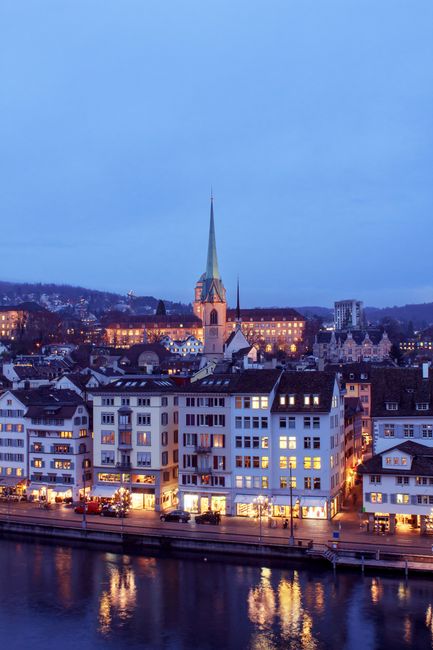
Zurich is Switzerland’s biggest city and its easiest front door: a clean, compact old town on both banks of the Limmat river, a lake you can swim in from June to September, and mountains on the horizon on a clear day. It is known for banks and expensive watches, but visitors come for something gentler: the church towers and guild houses of the Altstadt, Chagall’s stained glass in the Fraumünster, world-class art at the Kunsthaus, chocolate, river baths, nightlife in the old industrial quarter, and trains that reach Lucerne, the Rhine Falls and the Alps in an hour or two. The airport is only about 10 to 15 minutes from the main station. Give it two days for the city, three or four to add day trips.
Right now in Zurich
- Wed9–23°C48–74°FPartly cloudy
- Thu11–17°C52–62°F5 mm rain
- Fri6–13°C43–55°FCloudy
Top tours in Zurich
See all tours for Zurich →
From local operators, with prices and reviews; you check availability and book on Viator, our partner. We may earn a commission at no extra cost to you. How we earn money
Zurich at a glance
- Best for: a relaxed city break, art and history museums, lake and river swimming in summer, food and nightlife, Christmas markets, and an easy base for day trips by train.
- How long: 2 days for the old town, the lake and a museum or two; 3–4 days to add the Rhine Falls, Lucerne or a mountain.
- Best time: June to September for the lake baths and open-air life; late November to December for the Christmas markets; spring and autumn for museums and walks with fewer visitors.
- Getting in: Zurich Airport is Switzerland’s main international hub, with trains to Zürich HB (the main station) every few minutes.
- Getting around: on foot in the old town, by tram, bus and S-Bahn beyond. As of October 2026, the Zürich Card cost CHF 29 for 24 hours and CHF 56 for 72 hours for adults, with transport, the airport train and free entry to many museums.
- Before you go: money, rail passes, entry rules and mountain safety are in our Switzerland travel guide.
Zurich, area by area
Zurich sits at the north end of Lake Zurich, where the Limmat flows out of the lake towards the Rhine. The main station, Zürich HB, is at the top of the old town; from there Bahnhofstrasse runs south to the lake, and the two halves of the Altstadt face each other across the river. Most of what visitors want is within a 20-minute walk of the station.
The Altstadt: Niederdorf and Lindenhof
The east bank, known as the Niederdorf, is a lively maze of lanes, small squares, bars and restaurants around the twin towers of the Grossmünster. The west bank is quieter and older-feeling, with the Lindenhof (a tree-shaded terrace on the site of a Roman fort), St. Peter’s church and the Fraumünster. Best for: first visits, evening strolls and atmospheric hotels.
Bahnhofstrasse and the lake shore
Bahnhofstrasse is one of the world’s most expensive shopping streets, lined with jewellers, watch shops and department stores, and ends at Bürkliplatz on the lake. From here promenades follow both shores: the Utoquai and Zürichhorn park on the east side, the Mythenquai on the west. Best for: shopping, lake walks and boat trips.
Zurich West and Kreis 4
West of the station, the old industrial district of Zurich West has been turned into a quarter of bars, clubs, galleries and design shops, with shops in the arches of a railway viaduct (Im Viadukt) and a market hall. Kreis 4, around the Langstrasse, is the city’s multicultural, slightly gritty nightlife street. Best for: nightlife and food.
Seefeld and the university hill
South-east of the old town, Seefeld is a well-off residential quarter by the lake, close to the opera house and the Zürichhorn park. Above the old town, the university and ETH Zurich sit on a terrace with a fine view, reached by the little Polybahn funicular from Central. Best for: quieter stays near the water.
Top things to see in Zurich
Prices below were checked in October 2026. They change, so check the official sites before you go.
Grossmünster
The twin-towered Romanesque church on the east bank is Zurich’s emblem. It was here in the 1520s that the reformer Huldrych Zwingli preached the sermons that began the Reformation in German-speaking Switzerland, which is why the interior is so plain. Look for the bronze doors and the modern stained glass by Sigmar Polke and Augusto Giacometti. Entry to the church is free; the climb of about 187 steps up the Karlsturm tower costs a few francs and gives the best view over the old town and the lake.
Fraumünster and the Chagall windows
Across the river, the Fraumünster was founded in 853 as a convent for noblewomen. Its choir has five stained-glass windows by Marc Chagall, installed in 1970, glowing in deep blues, greens and reds; the transept has a large window by Augusto Giacometti. As of October 2026, entry cost CHF 5 with an audio guide, and was free for under-16s.
St. Peter and the Lindenhof
St. Peter’s church has the largest church clock face in Europe, almost 9 m across. A few steps away, the Lindenhof terrace looks over the Limmat to the Niederdorf, the university and the Grossmünster; it is a favourite spot for chess players under the lime trees and for the evening light.
Swiss National Museum
Right behind the main station, in a castle-like building from 1898 with a modern extension, the Landesmuseum tells the story of Switzerland from prehistory to today: medieval armour and altarpieces, carved and panelled rooms, costumes, and how a mountain country of farmers became one of the richest nations in the world. As of October 2026, entry cost CHF 13 for adults, CHF 10 reduced, and was free for under-16s and with the Zürich Card.
Kunsthaus Zürich
Switzerland’s largest art museum spans medieval paintings to the present, with strong holdings of Alberto Giacometti, Edvard Munch, the French Impressionists, Ferdinand Hodler and Swiss modernism; a large extension by David Chipperfield opened in 2021 across Heimplatz. As of October 2026, the collection ticket cost CHF 24 for adults and CHF 17 reduced, with special exhibitions including the collection at CHF 31; the collection is free on Wednesdays, and under-14s go free.
Lake Zurich and the river boats
The lake is at its best from the water. The Lake Zurich Navigation Company (ZSG) runs short cruises of about an hour and a half from Bürkliplatz, longer trips to Rapperswil with its castle and rose gardens, and small boats on the Limmat that pass under the low bridges of the old town. The short lake cruises and the Limmat boats are included in the Zürich Card, and boats are covered by the Swiss Travel Pass. See our boat trips guide.
Uetliberg
Zurich’s own mountain, 870 m high, rises just west of the city. The S10 train climbs from the main station to just below the summit in about 25 minutes; from the top (and from the lookout tower) you see the city, the whole lake and, on a clear day, the Alps from the Säntis to the Bernese Oberland. A well-marked ridge path, the Planetenweg, leads about two hours to Felsenegg, where a cable car drops to Adliswil for the train back. Note that the Zürich Card’s standard zones do not cover Uetliberg; you need an extra zone ticket.
Monuments
- Fraumünster
Churches and cathedrals
- Grossmünster
Museums
- Kunsthaus Zürich
- Museum Rietberg
- National Museum Zurich
Zoos and aquariums
- Zürich Zoo
Peaks and mountains
- Uetliberg
Things to do in Zurich
Swim in the lake and the river
In summer, Zurich lives in its Badis, wooden bathing houses on the lake and the river. The Frauenbad (women only by day) and the Männerbad on the Limmat turn into the Barfussbar, a bar where everyone is welcome, on summer evenings; the Oberer Letten river bath is free and a hangout for young locals, with people floating down the current and climbing out by the ladders. Lake lidos such as Utoquai and Mythenquai have diving boards, lawns and cafés. The season runs roughly from mid-May to mid-September; the water usually reaches 20–24 °C in July and August. Swim only in marked areas and never jump from bridges.
Chocolate
Zurich is a chocolate city. Try the truffles at the old confiseries around Paradeplatz, and visit the Lindt Home of Chocolate in Kilchberg, about 15 minutes by train or a lake boat from the centre, with a huge chocolate fountain, an interactive museum and tastings. As of October 2026, tickets started at around CHF 17 for adults; book a time slot at weekends and in school holidays.
More museums
The FIFA Museum near the station covers the story of world football; the Museum Rietberg, in a park villa, shows art from Asia, Africa, the Americas and Oceania; the Museum für Gestaltung covers design and posters; and the Zoo Zürich has a large rainforest hall and an elephant park. The Zürich Card gives free or reduced entry to most of them.
Food and nightlife
Try Zürcher Geschnetzeltes (sliced veal in a cream and mushroom sauce, with rösti), fondue or raclette in an old guild-house restaurant, and a cervelat sausage from a street stand. Zurich has a big bar and club scene in Zurich West and around the Langstrasse. Eating out is expensive: a main course in a simple restaurant easily costs CHF 30 or more, so lunch menus and supermarket picnics by the lake save money. The city’s roughly 1,200 public fountains give free drinking water.
Festivals and events
- Sechseläuten (April): the guilds parade in costume, and a snowman (the Böögg) is burned on a bonfire on Sechseläutenplatz; the faster its head explodes, the better the summer is supposed to be.
- Street Parade (August): one of the world’s biggest techno parades, with love mobiles circling the lake basin. The next edition is on Saturday 14 August 2027, from 13:00 to midnight.
- Zurich Film Festival (late September to October) and summer open-air cinemas on the lake.
- Christmas markets (late November to 24 December): an indoor market under a decorated tree in the main station hall, the singing Christmas tree on Werdmühleplatz, the Wienachtsdorf by the opera house and stalls in the Niederdorf.
Activities and best months
- Beaches and swimmingSwimming in the lake and rivers is part of Zurich summer life: the city's open-air 'Badi' range from lakeside baths with a sandy beach and a lido in a park on the lake's right shore to the river baths on the Limmat (Flussbad Oberer Letten, one of the most popular; another riverside bath is for good swimmers who can handle the current) and the historic wooden baths reserved for women or men.
- Boat tripsBoats of the Lake Zurich Navigation Company (ZSG) leave Bürkliplatz for round trips of various lengths along the lakeshore villages and to the 'Town of Roses', Rapperswil, plus brunch and party cruises; in summer they also call at Ufnau Island. Small electric Limmat boats sail from the National Museum past the Grossmünster to the lake. Zurich Tourism warns that low water can limit boat traffic, so check the current situation.
- City sightseeingZurich Tourism points first-time visitors to its top 10, with the Grossmünster and the Uetliberg among the classics. The Old Town is full of guild houses, winding lanes, courtyards and gardens, the city has more than 1,200 drinking-water fountains, and there are viewpoints, parks and lake cruises to round off a visit.
- CyclingZurich Tourism lists signposted cycling routes from the city along the lakes and through forests to the Canton of Schwyz, the Rhine Falls and Rapperswil, plus gravel, road, e-bike, family, para-cycling and bikepacking routes, and PubliBike rental bikes (with or without electric assist) for getting around town.
Day trips from Zurich
The Rhine Falls at Neuhausen, near Schaffhausen, are the largest waterfall in Europe by volume: 150 m wide and 23 m high, with up to 600,000 litres a second pouring over in summer. Trains take under an hour; walk the free paths on the Neuhausen side, pay about CHF 5 for the viewing platforms below Laufen Castle, or take a boat to the rock in the middle of the falls. Combine it with Stein am Rhein, a medieval town of painted houses. Lucerne is about 45 minutes away by train, with its covered bridges and lake boats; add Rigi or Pilatus for a full day. Basel and Bern are each about an hour away. For the high Alps, Engelberg and the Titlis are about two hours away; the Säntis, in eastern Switzerland, has views over six countries. North of the border, Lake Constance is about an hour away by train.
Nearby destinations
- Lucerne40 km
- Lake Constance66 km
- Basel74 km
- Vaduz78 km
- Interlaken92 km
- Bern95 km
- Black Forest107 km
- Colmar119 km
Getting to Zurich
By air. Zurich Airport (ZRH), about 10 km north of the city, is the hub of Swiss International Air Lines with flights from across Europe, North America, the Middle East and Asia. The airport station is under the terminal: trains run to Zürich HB every few minutes and take about 10 to 15 minutes, and direct trains also run to Lucerne, Bern, Basel and beyond. Tram 10 is a slower alternative.
By train. Zürich HB is the busiest station in Switzerland. Typical fastest journey times are about 45 minutes to Lucerne, 1 hour to Bern and Basel, 2 hours to Lugano through the Gotthard Base Tunnel and 2 hours 40 minutes to Geneva, with international trains to Milan, Munich, Stuttgart, Paris (TGV Lyria, about 4 hours) and Vienna, including night trains. Check times and buy tickets on sbb.ch or the SBB Mobile app.
By car. Swiss motorways need a vignette (CHF 40 a year as of October 2026). Driving and parking in the city centre are slow and expensive; leave the car at your hotel or at a park-and-ride.
Getting around Zurich and the Zürich Card
Trams are the backbone of Zurich’s public transport, run by the ZVV network, which also covers buses, S-Bahn trains, boats and a few funiculars. Tickets are sold by zone at machines and in the SBB Mobile and ZVV apps; zone 110 covers the city. Most sights in the old town are a short walk apart.
As of October 2026, the Zürich Card cost CHF 29 for 24 hours and CHF 56 for 72 hours (children aged 6–15: CHF 19 and CHF 37). It covers unlimited second-class travel in the city and the surrounding zones, including the trip between the main station and the airport, the Limmat boats and the short ZSG lake cruises, plus free admission to many museums and discounts on tours and in shops. Uetliberg needs an extra zone. Zurich Tourism says new prices apply from 13 December 2026, so check before buying. If you already have a Swiss Travel Pass, you don’t need the transport part: the pass covers Zurich’s trams, buses and boats and many museums.
When to go and how long to stay
Zurich has four distinct seasons. Summers are warm and fairly sunny, with thunderstorms on hot afternoons; winters are cold, grey and often foggy, with occasional snow; spring and autumn are mild and changeable. The table uses MeteoSwiss climate normals for 1991–2020 at Zürich-Fluntern, on the hill above the old town.
| Month | Average daily high | Average nightly low | What it’s like |
|---|---|---|---|
| January | 3.5 °C | −1.4 °C | Cold, often grey and foggy; Christmas markets end, winter sales |
| April | 14.8 °C | 5.1 °C | Spring blossom, Sechseläuten; changeable |
| July | 24.3 °C | 14.4 °C | Warm, lake and river baths, thunderstorms on hot afternoons |
| October | 13.8 °C | 7.1 °C | Crisp, often sunny; autumn colour on the Uetliberg |
Zurich gets about 1,110 mm of rain a year, spread across all months with the most in summer storms, and about 1,700 hours of sunshine. The lake is warm enough for most swimmers from late June to early September.
Zurich in 1 day
Walk down Bahnhofstrasse to the lake, see the Chagall windows in the Fraumünster and the view from the Lindenhof, cross to the Grossmünster and climb its tower, then wander the Niederdorf. In the afternoon, visit the Kunsthaus or the National Museum, or in summer go for a swim and a drink at a river bath. End with dinner in the old town.
Zurich in 3 days
Add a lake cruise and the Lindt Home of Chocolate, a morning on the Uetliberg and an evening in Zurich West. On the third day, take the train to the Rhine Falls and Stein am Rhein, or to Lucerne and one of its mountains.
Weather month by month
Where to stay in Zurich
- Altstadt and Niederdorf: boutique and historic hotels in the lanes; central and lively, noisier at weekends.
- Around the main station: the most practical base for day trips and the airport, with many chain hotels.
- Seefeld and the lake shore: calmer, close to the lake baths and the opera, with a few grand hotels.
- Zurich West and Kreis 4/5: design hotels and better value, close to bars and clubs.
- Near the airport (Oerlikon, Glattbrugg): cheaper rooms, 10 minutes by train from the city.
Zurich hotels are among the most expensive in Europe, and prices jump during big trade fairs, the World Economic Forum week in January (when many delegates stay in Zurich), the Street Parade and Christmas weekends. Book early and compare a stay just outside the centre.
Practical tips for Zurich
- Pay by card: cards and phones are accepted almost everywhere; prices are in Swiss francs, and euros, if accepted, come back as change in francs at a poor rate.
- Drink from the fountains: unless a sign says Kein Trinkwasser, the water is clean and cold.
- Plan for Sundays: most shops close, except those in the main station, the airport and a few other stations; museums and restaurants stay open.
- Check the Zürich Card zones: it covers the airport but not Uetliberg.
- Go to the Kunsthaus on a Wednesday: the collection is free that day.
- Watch the bike lanes: cyclists and e-scooters move fast; don’t walk in the red or yellow lanes.
What to pack for Zurich
Comfortable walking shoes, a light waterproof and layers in any season; swimwear, a towel and a dry bag for the river baths in summer; a warm coat, hat and gloves from November to March. Switzerland uses Type J plugs, so bring an adapter (two-pin European plugs fit). A refillable water bottle pays for itself with all those fountains.
What to pack
- City walking shoesLisbon and Porto are steep, with polished limestone cobbles that get slippery, so grippy soles matter.
- Day packs and anti-theft bagsCarries water, towel and sunscreen down the long stairways to Algarve coves.
- Dry bags and phone pouchesProtects phones and cameras from sand and spray on beaches reached by ferry or steep paths.
- Fleeces and warm layersIt is cooler at sea than on land, especially on morning whale-watching trips.
- Quick-dry beach towelsA sand-shedding quick-dry towel packs small for beach days and lido visits.
- Rain jacketsA windproof, waterproof shell keeps you warm on open boats, where wind and spray cool you quickly.
- Reef-friendly sunscreenSummer UV is strong on Portuguese beaches and there is little shade below the cliffs.
- Travel adapters and convertersPortugal uses Type C and F sockets at 230 V, so most visitors from outside Europe need an adapter.
- Water bottles and hydration packsRiding in the Algarve and Alentejo heat needs more water than you expect.
- Water shoesRocky coves, lava pools and weever fish in shallow sand make water shoes useful.
- WetsuitsOn the west and north coasts the sea stays around 16–18 °C even in summer, so a thin suit helps for long swims.
Zurich travel FAQ
Is the Zürich Card worth it?
Often, yes, if you use public transport and visit two or more museums. As of October 2026, it cost CHF 29 for 24 hours and CHF 56 for 72 hours, including the airport train. If you have a Swiss Travel Pass, you probably don’t need it.
How do I get from Zurich Airport to the city?
By train from the station under the terminal to Zürich HB, which takes about 10 to 15 minutes, with several departures an hour. Tram 10 also runs to the main station, more slowly. The Zürich Card and the Swiss Travel Pass cover the trip.
Can you swim in Lake Zurich?
Yes. The water is clean, and from about June to September locals swim at lake lidos and river baths in the city centre. Swim in marked areas, respect the boat lanes and don’t jump from bridges.
How much does it cost to see the Chagall windows?
As of October 2026, entry to the Fraumünster cost CHF 5, including an audio guide, and was free for children and teens under 16.
How many days do you need in Zurich?
Two days cover the old town, the lake and a museum or two. Stay three or four to add day trips to the Rhine Falls, Lucerne or a mountain.
Is Zurich expensive?
Yes, it is one of the most expensive cities in Europe for hotels and restaurants. Save with lunch menus, supermarket picnics, free fountain water, free museum days and a Zürich Card or Swiss Travel Pass.
When is the Zurich Street Parade?
The next Street Parade is on Saturday 14 August 2027, from 13:00 to midnight, around the lake basin. It is free to watch, and the city is packed, so book rooms early.
Can I do a day trip from Zurich to the Rhine Falls?
Easily. Trains to Neuhausen or Schloss Laufen am Rheinfall take under an hour. The paths on the Neuhausen side are free; the platforms below Laufen Castle cost about CHF 5, and boats run to the central rock in season.
Are shops open on Sundays in Zurich?
Most are closed. The shops in and under the main station, at the airport and at a few other big stations open every day, often until 21:00 or later.
Is the tap water safe to drink in Zurich?
Yes. Tap water is excellent, and almost all of the city’s roughly 1,200 public fountains have drinking water unless a sign says otherwise.
When is the best time to visit Zurich?
June to September for the lake, river baths and long evenings; December for Christmas markets; April–May and September–October for mild weather and lower hotel prices.
Plan your trip
Partner links: TravelerCenter may earn a commission if you book, at no extra cost to you.
🇩🇪 Useful German phrases for Zurich
All 38 German phrases: restaurant, hotel, emergencies, romance (printable) →
Sources · last reviewed 4 October 2026
Researched and last reviewed on 4 October 2026. Zürich Card prices and coverage: Zürich Tourism (zuerich.com) and the ZVV transport network; Street Parade date: streetparade.com; museum prices: the Swiss National Museum, Kunsthaus Zürich and the Fraumünster; climate: MeteoSwiss 1991–2020 normals for Zürich-Fluntern. The Lindt Home of Chocolate price, the Rhine Falls platform and boat prices, the Karlsturm fee and train times come partly from secondary sources and are flagged for checking. Prices, timetables and rules change, so check the official links before you go. For rail passes, money, entry rules and mountain safety, see our Switzerland travel guide.
Also: zuerich.com · MeteoSwiss normals 1991–2020, Zurich Fluntern (climate)
Data: Weather: MET Norway (CC BY 4.0) · Air quality: OpenAQ · Rates: ECB · Costs: World Bank ICP and price levels · © OpenStreetMap contributors (ODBL) · Wikidata (CC0)