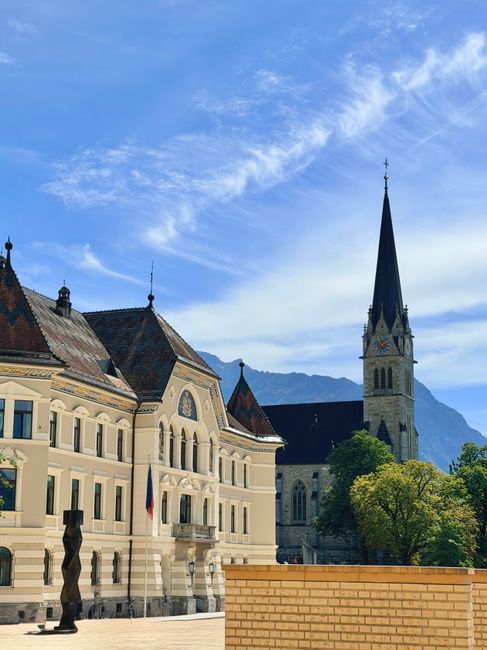
Vaduz is the capital of Liechtenstein and one of the smallest capitals in Europe: a small town on the floor of the Rhine valley, with a castle on a ledge above it, vineyards climbing the slope and the Swiss Alps across the river. The princely family still lives in that castle, which you can’t visit, but almost everything else is within a few minutes’ walk along the pedestrian Städtle: a striking modern art museum, the national museum with the princely treasures, a stamp museum, a neo-Gothic cathedral and the parliament. Add a walk up to the castle, a tasting at the Prince’s winery and an afternoon on the Rhine dam, and Vaduz makes a pleasant day trip from Zurich or a calm base for hiking and skiing in the mountains above. Public transport is cheap, the town is safe and compact, and one day is enough for the sights; stay longer for the Alps.
Right now in Vaduz
- Wed 11–23°C 51–74°F Partly cloudy
- Thu 12–17°C 54–62°F 25 mm Heavy rain
- Fri 8–14°C 47–56°F 2 mm Partly cloudy
Weather: MET Norway (CC BY 4.0)
Top tours in Vaduz
See all tours for Vaduz →
From local operators, with prices and reviews; you check availability and book on Viator, our partner. We may earn a commission at no extra cost to you. How we earn money
Vaduz at a glance
- Best months: May to October for walks and the mountains; mid-December to early April for skiing in nearby Malbun. Mean temperatures in Vaduz run from about 1–2 °C in January to about 19 °C in July and August, with afternoon highs near 25 °C in July (1991–2020, MeteoSwiss data for Vaduz, calculated by TravelerCenter).
- Days needed: 1 for the town and its museums; 2–3 to add Triesenberg, Malbun and a hike; more for the Liechtenstein Trail.
- Getting there: no airport; train to Sargans or Buchs (Switzerland) or Feldkirch (Austria), then a LIEmobil bus. About 1¼ hours from Zurich.
- Getting around: on foot in town; LIEmobil buses to the rest of the country (single tickets from CHF 3).
- Budget level: Swiss prices for hotels and food; cheap buses, free entry for under-16s at the main museums. See our Liechtenstein country guide for money, entry rules and costs.
Vaduz’s areas and who each one suits
Vaduz is a small town of a few thousand people, so it is easy to get your bearings. The main road and the bus stops (Vaduz Post, Vaduz Städtle) run along the valley floor, the castle sits on its rock shelf about 120 m above, and the Rhine flows past on the western edge.
- The Städtle: the pedestrian main street and its squares, with the museums, the Liechtenstein Center tourist office, cafés, souvenir shops and the government quarter. Where you will spend most of your time.
- Mitteldorf and the castle slope: the old village core north of the centre, with the Red House, the Prince’s vineyards and the footpaths up to the castle.
- The Rhine and the Rheinpark: the national football stadium, sports grounds and the Rhine dam path, with the old wooden bridge across to Sevelen in Switzerland.
- The hillside above town: quiet residential areas and roads climbing towards Triesenberg, with views across the valley.
Top things to see in Vaduz
Kunstmuseum Liechtenstein and the Hilti Art Foundation
The Kunstmuseum Liechtenstein, the state museum of modern and contemporary art, is a black cube of tinted concrete and basalt on the Städtle. It shows changing exhibitions from its own collection, from the late 19th century to today, and international shows; one ticket also covers the white cube next door of the Hilti Art Foundation, with classic modern works. As of October 2026 it is open Tuesday to Sunday from 10:00 to 17:00, Thursday until 20:00, closed Mondays, and closed on 1 January, 24, 25 and 31 December. Tickets cost CHF 15, reduced CHF 10, and are free for children and young people up to 16; admission is free every Wednesday. From 29 September to 29 October 2026 the upper floor of the Kunstmuseum is closed for exhibition changes and a reduced price applies. The museum café is open daily.
Liechtenstein National Museum
The Liechtenstein National Museum (Liechtensteinisches LandesMuseum) occupies a former inn and administrative building on the Städtle, joined to a modern extension cut into the hill. Its permanent exhibition covers the country’s geology, nature, prehistory, the Romans, the Walser settlers, the princely house and Liechtenstein’s transformation from a poor farming country into a modern state. As of October 2026 it is open Tuesday to Sunday from 10:00 to 17:00 and Wednesday until 20:00, closed Mondays (but open on Easter Monday, Whit Monday, 1 May and 26 December) and closed 24, 25 and 31 December and 1 January. Admission is CHF 10, or CHF 7 for students, seniors and visitors with disabilities; children and teenagers up to 16 go free, and so do holders of the Swiss Museum Pass. An audio guide is available, and the whole museum is barrier-free.
The Treasure Chamber
The Treasure Chamber (SchatzKammer) displays precious objects from the princely collections and private lenders: jewellery, weapons, Fabergé eggs and other pieces, plus a piece of moon rock. It opens daily from 10:00 to 17:00, and the combined ticket with the National Museum costs CHF 13 (CHF 10 reduced) as of October 2026. Tickets are sold at the National Museum and the Postal Museum.
The Postal Museum
Liechtenstein has issued its own stamps since 1912, and they are famous among collectors for their artwork and printing. The small Postal Museum on the Städtle shows the country’s stamps, original designs, printing techniques and postal history, along with temporary exhibitions. It opens daily from 10:00 to 17:00, and admission has been reported as free. It is a good place to buy current Liechtenstein stamps and postcards.
Vaduz Castle
Vaduz Castle dominates the town from its rock shelf. Parts date back to the 12th century; it was burned in 1499, rebuilt, and restored and enlarged in the early 20th century. Since 1938 it has been the home of the reigning princes, so it is closed to the public. You can still walk up to it: a signposted footpath climbs from the Städtle through the woods and vineyards in about 20–30 minutes, with fine views over the valley, the Rhine and the Swiss mountains, and you can continue on forest paths above it. Please respect the private grounds. The one day the castle garden opens to everyone is National Day, 15 August.
Cathedral of St Florin and the government quarter
The neo-Gothic Cathedral of St Florin, built in the 1870s to plans by the Viennese architect Friedrich von Schmidt and raised to cathedral status when the Archdiocese of Vaduz was created in 1997, stands at the south end of the Städtle; it is free to enter outside services. Nearby, the old Government Building (1905), with its decorated façade and coat of arms, faces the modern Landtag (parliament) building with its steep roof, opened in 2008, across Peter Kaiser Square.
The Red House and the Hofkellerei
North of the centre in Mitteldorf, the Red House (Rotes Haus), a medieval tower house with a stepped gable, stands among vineyards and is one of Vaduz’s most photographed buildings; it is privately owned and seen from outside. Just below the castle, the Hofkellerei des Fürsten von Liechtenstein, the Prince’s winery, makes wine from the Herawingert vineyard in Vaduz and from the family’s estates in Austria. Its shop and tasting room are open to visitors; check opening hours and book group tastings in advance.
The Rhine, walks and bikes
Vaduz is the best place to sample Liechtenstein’s walking without a mountain climb. The Liechtenstein Trail, a 75 km route through all eleven municipalities opened in 2019, passes through town, so you can follow it north to Schaan or south to Triesen for a few hours, with the LIstory app telling the stories of the sights on the way. The Rhine dam path is flat, traffic-free and good for walking, running and cycling, with views of the Swiss Alps across the river; it is part of the long-distance Rhine cycle route. Cross the historic wooden bridge to Sevelen and you are in Switzerland. LIEmobil’s LIEbike scheme rents bikes, and e-bikes make the climb to Triesenberg possible for most people. See our hiking guide, our cycling guide and our city sightseeing guide.
Day trips from Vaduz
- Triesenberg and Malbun: LIEmobil buses climb from Vaduz to Triesenberg, with its Walser Museum and views, and through the tunnel to Malbun (about 1,600 m). In summer, take the chairlift to Sareis and hike; in winter, ski. The 2026/27 ski season runs from 19 December 2026 to 4 April 2027, and an adult day pass costs CHF 55.
- The Fürstensteig: the famous cliff path starts at Gaflei above Triesenberg; it is exposed and only for experienced, sure-footed hikers in dry weather.
- Balzers and Gutenberg Castle: the castle on its hill in the south of the country, a short bus ride away.
- Schaan and the Unterland: Liechtenstein’s largest village, then the quiet farming villages and the Eschnerberg history trail.
- Feldkirch (Austria): a pretty medieval town with the Schattenburg castle, reached directly on bus line 11.
- Werdenberg (Switzerland): a tiny, perfectly preserved wooden town with a castle above a lake, near Buchs across the Rhine.
- Further afield: Lake Constance to the north, Zurich, St. Moritz and the Engadine to the south, and Innsbruck to the east. See also our Switzerland guide and our Austria guide.
Nearby destinations
- St. Anton am Arlberg56 km
- Lake Constance59 km
- St. Moritz75 km
- Zurich78 km
- Lucerne93 km
- Lake Como128 km
- Lake Maggiore131 km
- Lugano133 km
Getting there and getting around
From Zurich, Switzerland and Austria
Liechtenstein has no airport and Vaduz has no main-line station. From Zurich airport or city, take a train to Sargans (about an hour), then LIEmobil bus line 11 or 12E to Vaduz Post; or take a train to Buchs SG, then bus 12 to Schaan and bus 11 to Vaduz. From Austria and Germany, take the train to Feldkirch and bus 11 to Vaduz. Door to door, the Kunstmuseum Liechtenstein estimates about 1¼ hours from Zurich, 2 hours from Basel and 2½ hours from Munich or Innsbruck. By car, leave the Swiss A13 motorway at the Sevelen/Vaduz exit and cross the Rhine; remember the Swiss or Austrian motorway vignette.
Buses and fares
LIEmobil buses link Vaduz with every village in Liechtenstein and with Sargans, Buchs and Feldkirch. As of October 2026 a single ticket costs CHF 2 for a short hop of up to five stops, CHF 3 for one zone, CHF 4 for two zones and CHF 5 for three or more zones; a day ticket costs CHF 5, CHF 7 or CHF 9. Children up to 16 and holders of a Swiss half-fare card pay reduced fares, children under 6 travel free with an adult, and Swiss GA travelcard holders ride free. Buy from the driver with a contactless card (no cash needed), or use the SBB Mobile or FAIRTIQ apps.
On foot and by car
The centre is small and flat and best explored on foot: the Städtle is pedestrianised, and the castle is a 20–30 minute walk uphill. If you drive, use the car parks around the centre, such as the Zentrum and Marktplatz car parks; traffic is heaviest at commuter times.
Museum tickets and passes
As of October 2026: Kunstmuseum CHF 15 (free on Wednesdays), National Museum CHF 10, National Museum with the Treasure Chamber CHF 13, and under-16s free at both. Holders of the Swiss Museum Pass get into the National Museum free. On National Day, 15 August, both the National Museum and the Kunstmuseum are free and open until 20:00.
When to go and how long to stay
Vaduz is a year-round destination. Spring brings blossom and fresh green slopes but snow still lingers on the mountains; summer is warm, with afternoon highs around 23–25 °C and frequent thunderstorms, as June to August are the wettest months; September and October are often clear and settled, with the grape harvest; winter is cold and frequently grey in the valley, with snow above. The 1991–2020 averages for the MeteoSwiss station in Vaduz are 1.4 °C in January and 19.4 °C in July, with about 960 mm of rain a year. The warm Föhn wind can bring sudden mild, dry and gusty days, especially in spring and autumn. The biggest day of the year is National Day on 15 August, with a ceremony on the meadow below the castle, the castle garden open to all, a festival in the Städtle and fireworks at night; book accommodation early for it.
1 day in Vaduz
Arrive by mid-morning, pick up a map at the Liechtenstein Center, and visit the National Museum and the Treasure Chamber. After lunch on the Städtle, see the Kunstmuseum and the Hilti Art Foundation (free on Wednesdays), then walk up to the castle for the view. End with a glass of wine at the Hofkellerei or a stroll on the Rhine dam at sunset before the bus back to Sargans or Feldkirch.
2–3 days with Vaduz as a base
Add a day in the mountains: bus to Triesenberg and Malbun, ride the chairlift to Sareis and hike, or walk the Fürstensteig from Gaflei if you are experienced. On another day, walk a stage of the Liechtenstein Trail to Schaan or Balzers, see Gutenberg Castle, or cross the border to Feldkirch or Werdenberg. In winter, swap the hike for a ski day in Malbun.
Where to stay in Vaduz
Vaduz has only a handful of hotels, mostly mid-range to upmarket business and boutique hotels near the Städtle, and prices are at Swiss levels. Alternatives:
- Schaan: next door, with the youth hostel and more hotels, and the best bus connections.
- Triesen and Balzers: quieter, a little cheaper, on the bus line south.
- Triesenberg and Malbun: mountain hotels and guesthouses with views, best for hikers and skiers.
- Across the Rhine: hotels in Buchs, Sargans or Feldkirch can be cheaper and are close to the railway.
Book ahead for National Day, school holidays and big events at the Rheinpark stadium.
Practical tips for Vaduz
- Tourist office: the Liechtenstein Center on the Städtle has maps, souvenirs and the souvenir passport stamp (reported at CHF 3; not an official entry stamp).
- Mondays: the National Museum and the Kunstmuseum close on Mondays; the Treasure Chamber and the Postal Museum open daily.
- Money: prices are in Swiss francs; cards are accepted almost everywhere, and euros are often accepted at a poor rate.
- Language: German is the official language; English is widely understood in tourist places. A friendly Hoi (hello) goes a long way.
- Sundays: most shops close, but museums and many cafés open.
- Safety: Vaduz is very safe. In the mountains, start early, check the weather and turn back on exposed paths if it is wet. Emergency numbers: 112, or 117 police, 144 ambulance.
What to pack for Vaduz
Comfortable walking shoes for the castle path and the Rhine dam, a light rain jacket for summer storms, and layers, because evenings can be cool even in summer. If you plan to hike, bring hiking shoes with good grip, a sun hat and water. In winter, pack warm, waterproof clothes. Sockets are Swiss type J, which also take two-pin type C plugs; see our plug adapter guide.
Vaduz travel FAQ
Can you visit Vaduz Castle?
No. It is the private home of the princely family and closed to the public. You can walk up to it in about 20–30 minutes for the view, and the castle garden opens on National Day, 15 August.
How do I get from Zurich to Vaduz?
Take a train to Sargans (about an hour), then LIEmobil bus 11 or 12E to Vaduz Post. The whole trip takes about 1¼ hours.
How much does the Kunstmuseum Liechtenstein cost?
As of October 2026, CHF 15, reduced CHF 10, free for under-16s and free for everyone on Wednesdays. The ticket includes the Hilti Art Foundation.
What are the opening hours of the Liechtenstein National Museum?
Tuesday to Sunday from 10:00 to 17:00 and Wednesday until 20:00; closed Mondays. Admission is CHF 10, or CHF 13 with the Treasure Chamber.
Where can I get a Liechtenstein passport stamp in Vaduz?
At the Liechtenstein Center tourist office on the Städtle, for a small fee (reported at CHF 3). It is a souvenir, not an official entry stamp.
Is one day enough for Vaduz?
Yes for the museums, the Städtle and the walk to the castle. Stay longer to hike or ski in the mountains above.
Is Vaduz expensive?
Hotels and restaurants are at Swiss prices. Buses are cheap, the castle walk and the Rhine are free, and under-16s get into the main museums free.
Can I pay in euros in Vaduz?
Often, but at a poor rate and with change in Swiss francs. Cards are the easiest way to pay.
How do I get from Vaduz to Malbun?
By LIEmobil bus via Triesenberg, or by car in about 20–25 minutes. In winter, Malbun’s 2026/27 ski season runs from 19 December 2026 to 4 April 2027.
What is there to do in Vaduz on a Monday?
The two main museums are closed, but the Treasure Chamber and the Postal Museum open daily, and you can walk to the castle, along the Rhine or on the Liechtenstein Trail.
Is Vaduz worth visiting?
Yes, for a relaxed day of art, history and views, especially combined with the mountains or with a trip through Switzerland and Austria.
Sources and last review
Researched and last reviewed on 4 October 2026. Museum prices and hours come from the Kunstmuseum Liechtenstein and the Liechtenstein National Museum (including the Treasure Chamber and the Postal Museum hours); bus routes and fares from LIEmobil and the National Museum’s directions; Malbun season dates and prices from Bergbahnen Malbun; climate averages were calculated by TravelerCenter from MeteoSwiss open data for the Vaduz station (1991–2020). The official tourism site (tourismus.li) could not be read during our check, so the passport stamp fee, Postal Museum admission, the castle walk time, the National Day programme and some building dates come from secondary sources and are flagged for checking. Prices, timetables and rules change, so check the official sites before you travel.
Plan your trip
Partner links: TravelerCenter may earn a commission if you book, at no extra cost to you.
🇩🇪 Useful German phrases for Vaduz
All 38 German phrases: restaurant, hotel, emergencies, romance (printable) →