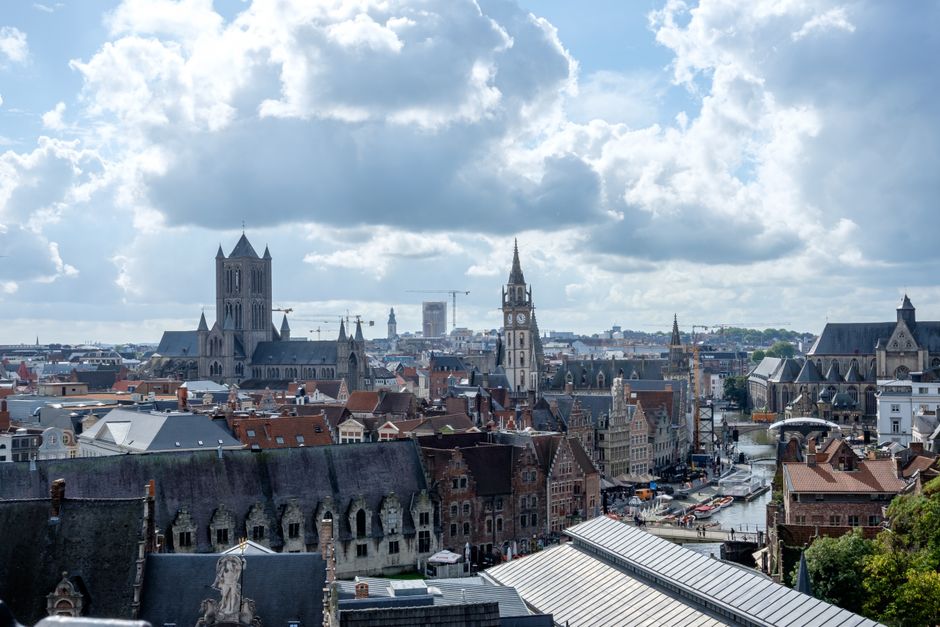
Ghent is the Flemish city that feels most lived-in: a medieval port of guildhalls and church towers along the Leie and Scheldt rivers, home to one of Belgium’s biggest universities, with students on bikes, canal-side terraces and a lively food and music scene. It holds one of the most important paintings in Europe, the Van Eyck brothers’ Ghent Altarpiece in St Bavo’s Cathedral, plus a moated castle in the middle of town, a belfry with a gilded dragon on top and the most photographed quayside in Flanders, the Graslei and Korenlei. Give it two days; three if you add the museums or a day trip to Bruges or Antwerp.
Right now in Ghent
- Wed 11–20°C 52–67°F 7 mm Cloudy
- Thu 11–15°C 52–58°F 5 mm Showers
- Fri 8–15°C 46–60°F 6 mm Light rain
Weather: MET Norway (CC BY 4.0) · Rates: ECB
Top tours in Ghent
See all tours for Ghent →
From local operators, with prices and reviews; you check availability and book on Viator, our partner. We may earn a commission at no extra cost to you. How we earn money
Ghent at a glance
- Best for: Flemish art and the Ghent Altarpiece, medieval architecture, canal boat trips, a lively student and café scene, festivals and a less crowded alternative to Bruges.
- How long: 2 days for the cathedral, the castle, the belfry and the quays; 3 days to add STAM, the MSK and S.M.A.K. or a day trip.
- Best time: May, June and September for mild weather; mid-July for the Gentse Feesten; December for the Christmas market and Winterfeesten.
- Getting in: trains from Brussels take about 30 minutes, from Bruges about 25 minutes and from Antwerp about 50 minutes; Gent-Sint-Pieters station is a 10-minute tram ride from the centre.
- Getting around: walk and use De Lijn’s trams. As of October 2026, the CityCard Gent costs €49 for 48 hours and €55 for 72 hours and includes museums, trams and buses, a boat trip and a day’s bike hire.
- Driving: the whole centre is a low-emission zone and foreign cars (except Dutch ones) must be registered; a circulation plan blocks driving across the centre. Park and walk, or come by train.
Ghent, area by area
Medieval Ghent grew where the Leie meets the Scheldt, and its centre is compact: from St Bavo’s Cathedral to the castle is a ten-minute walk past the belfry, St Nicholas’ Church and the old harbour. The main station, Gent-Sint-Pieters, is about 2 km south, next to the Citadelpark museums. The R40 ring road runs around the centre.
The historic centre: Graslei, Korenlei and the three towers
The famous row of towers, St Nicholas’ Church, the Belfry and St Bavo’s Cathedral, lines up between the Korenmarkt and the Sint-Baafsplein. Below them, the Graslei and Korenlei face each other across the Leie, lined with guildhouses from the Romanesque to the baroque. Best for: first visits and atmospheric hotels.
Patershol and the Vrijdagmarkt
Behind the castle, the Patershol is a maze of medieval lanes full of small restaurants. Nearby, the big Vrijdagmarkt square, with its statue of Jacob van Artevelde, has bars, a Friday market and the Dulle Griet, a huge 15th-century cannon. Best for: dinner and evening walks.
Kunstenkwartier and Citadelpark
South of the centre, the “arts quarter” has the MSK (Museum of Fine Arts) and S.M.A.K. (contemporary art) facing each other in Citadelpark, STAM city museum in the old Bijloke abbey, and the Overpoort student street. Best for: museums, good-value hotels and easy access to the station.
Top things to see in Ghent
Prices and hours below were checked on the official sites in October 2026. They change, so check before you go. Children and teenagers pay little or nothing at most Ghent museums.
St Bavo’s Cathedral and the Ghent Altarpiece
Completed by Jan van Eyck in 1432, the Adoration of the Mystic Lamb, better known as the Ghent Altarpiece, is a polyptych of oil-painted panels so detailed you can count the hairs on the angels’ heads. One panel, the Just Judges, has been missing since it was stolen in 1934. It is shown in a climate-controlled glass case in the Mystic Lamb Visitor’s Centre inside St Bavo’s Cathedral. Entry to the cathedral itself, with its Rubens altarpiece, baroque pulpit and crypt, is free.
Tickets. As of October 2026, the altarpiece alone costs €12.50, or €16 with the 60-minute augmented-reality tour, which uses AR glasses (or a tablet) to show the panels’ history and the restoration; children under 12 pay €8 for the AR tour. The CityCard Gent gives €10 off, but you must reserve online first. The visitor centre opens Monday to Saturday 10:00–17:00 and Sunday 13:00–17:00 (last AR tour at 16:00). Restoration: the third and final restoration phase, of the upper panels, is due to finish in spring 2027. Until then, high-quality photographs replace seven of the panels in the cathedral, and you can watch the restorers at work behind glass at the MSK until 31 December 2026.
Gravensteen (Castle of the Counts)
The moated stone castle of the Counts of Flanders, built in 1180 on older foundations, rises right in the middle of the city. Climb the keep and the battlements for views over the rooftops, see the old weapons and the grim torture exhibits, and walk the ramparts above the Leie. The audio guide, included in the ticket, comes in a historical version or a comic one told by a Belgian comedian. As of October 2026, tickets cost €15 for adults, €7.50 for ages 19 to 25 and €3 for ages 13 to 18; children under 12 enter free. It opens every day 10:00–18:00 (last entry 16:40), except 24, 25 and 31 December and 1 January.
The Belfry
Ghent’s 91-metre belfry, part of the UNESCO-listed belfries of Belgium and France, kept the city’s charters and its bells; the gilded dragon on top has watched over the city since 1377. A lift runs from the first floor to the upper galleries for a 360° view. The carillon plays on Sunday mornings between 11:00 and noon, with extra concerts in July and August. As of October 2026 a ticket costs €13, €6.50 for students under 26 and €2.60 for under-19s; under-12s enter free. It opens daily from 10:00 to 18:00 (secondary source). The tower is not accessible for wheelchair users.
Graslei, Korenlei and St Michael’s Bridge
The two quays of Ghent’s medieval harbour are free to wander and at their best at dusk, when locals sit on the waterside steps with a drink. On the Graslei, look for the 12th-century Stapelhuis (grain storehouse) and the guildhall of the free boatmen; on the Korenlei opposite, the stepped gables of the brewers’ and tanners’ houses. St Michael’s Bridge gives the postcard view of the three towers. Most boat tours leave from here.
STAM, the Ghent City Museum
In the Bijloke abbey and a modern glass wing, STAM tells the city’s story from the Middle Ages to now. Start on the huge aerial photograph of the city you can walk across; it is a good first stop. As of October 2026, tickets cost €14, €6.50 for under-26s and nothing for under-19s and CityCard holders; the abbey gardens and café are pleasant for lunch.
MSK and S.M.A.K.
The MSK (Museum voor Schone Kunsten) has Flemish art from the Middle Ages to the 20th century, with works by Hieronymus Bosch, Rubens and James Ensor, and, until 31 December 2026, the live restoration studio of the Ghent Altarpiece. It opens Tuesday to Friday 9:30–17:30 and weekends 10:00–18:00 (closed Mondays). As of October 2026, a standard ticket costs €15, rising to €19 during the Jenny Montigny exhibition from 10 October 2026; children and teenagers pay only a few euros. Opposite, S.M.A.K. is one of Belgium’s leading museums of contemporary art, with changing exhibitions and a collection running from Joseph Beuys to Belgian artists of today; both are included in the CityCard.
St Nicholas’ Church, the Great Butchers’ Hall and the Werregarenstraat
St Nicholas’ Church on the Korenmarkt, in grey-blue Scheldt Gothic stone, is free to enter. The Groot Vleeshuis (Great Butchers’ Hall, 1408) sells East Flemish produce under its timber roof, and the Werregarenstraat, a narrow alley near the town hall, is covered in ever-changing graffiti that anyone can add to.
Museums
- Belfry of Ghent
- Museum of Fine Arts Ghent (MSK)
- STAM, Ghent City Museum
Churches and cathedrals
- St Bavo's Cathedral
- St Nicholas' Church, Ghent
Historic centres
- Graslei and Korenlei
Castles and forts
- Gravensteen
Boats, bikes and food in Ghent
Boat trips on the Leie and Lieve
Several companies run guided boat trips of about 40 to 50 minutes through the medieval centre from the Graslei, the Korenlei and the Kraanlei, most of the year, weather permitting. One trip is included in the CityCard Gent, which also covers a day on the hop-on, hop-off water tram. Low bridges mean you sit close to the water: on a sunny day it is the most relaxing hour in town. See our boat trips guide.
Cycling
Ghent is one of the best cycling cities in Belgium, with a car-light centre and riverside paths out to the villages of the Leie valley, such as Sint-Martens-Latem, home of a famous group of painters. More ideas are in our cycling guide.
What to eat and drink
Try Gentse waterzooi, a creamy stew of chicken or fish and vegetables; stoverij, beef braised in beer; Tierenteyn mustard from the shop on the Groentenmarkt; and cuberdons, purple cone-shaped raspberry sweets sold from carts. For beer, the old cafés of the Vrijdagmarkt and Graslei serve hundreds of Belgian brews, and Ghent’s own jenever (gin) is poured in tiny glasses.
Festivals and Christmas in Ghent
Gentse Feesten 2027
For ten days every July, the Gentse Feesten (Ghent Festivities) turns the whole centre into one of Europe’s largest free street festivals, with music, theatre and street performers on more than a dozen squares, from morning until late at night. The 2027 edition runs from Friday 16 to Sunday 25 July 2027. Hotels fill up and prices rise, so book early; if you want a quiet visit, avoid those dates.
Winterfeesten and the Christmas market 2026
The Gentse Winterfeesten run from Thursday 3 December 2026 to Sunday 3 January 2027, now until the end of the Christmas school holidays. More than 150 chalets fill the squares from the Korenmarkt, with its Ferris wheel, to the Sint-Baafsplein, Botermarkt and Goudenleeuwplein, and there is an ice rink under the Stadshal (city pavilion). The Gravensteen is lit up as a winter castle during the festival. Check the organisers’ site for daily opening times.
Light Festival and other events
The Ghent Light Festival, when light artworks fill the streets for a few winter evenings, is held about every three years; the last was in 2024, and the city says the next edition is planned for 2027, with dates still to be announced.
Activities and best months
- Boat tripsDe Bootjes van Gent runs a 40-minute guided boat trip along the waterways of the medieval centre, past its monuments, with tickets sold online. The CityCard Gent includes one boat trip. · source
- City sightseeingGhent's UNESCO-listed Belfry on Sint-Baafsplein is the middle of the city's three towers, between St Bavo's Cathedral and St Nicholas' Church; its gilded dragon has watched over the city since 1377 and a lift from the first floor helps with the climb to the view. Tickets are EUR 13; the carillon plays on Sundays from 11:00 to noon, with extra concerts in July and August. · source
- CyclingVisit Gent says Ghent has the largest low-traffic pedestrian zone in Europe and is easy to explore by bike. Bikes can be rented at the two main stations (Gent-Sint-Pieters and Dampoort) and in the centre, and the CityCard includes one day's bike hire; route brochures at the visitor office cover the Green Belt waterside paths, the Lys (Leie) region villages and a castles route. · source
Day trips from Ghent
- Bruges: the canal city, about 25 minutes by train, is the classic day trip; arrive early to beat the crowds.
- Antwerp: Rubens, the cathedral, fashion and the port, about 50 minutes by train.
- Brussels: the Grand-Place and the museums, about 30 minutes by train.
- The coast: Ostend and the beaches are about 45 minutes away by direct train; from there the Kusttram runs along the whole Belgian coast.
Nearby destinations
Getting to Ghent
By train. Gent-Sint-Pieters is on the main line from Brussels (about 30 minutes) to Bruges (about 25 minutes) and Ostend, with direct trains to Antwerp and Lille. From Brussels Airport there are direct trains in about an hour. From London, take the Eurostar to Brussels-Midi and change; your Eurostar ticket can include the onward train to any Belgian station. Tram 1 runs from Sint-Pieters to the Korenmarkt in about 10 minutes. Train times are from SNCB’s timetables and change; check before you go.
By car. Ghent lies where the E40 (Brussels–Ostend) meets the E17 (Antwerp–Lille). Two things to know: since 2017 the circulation plan splits the centre into sectors you cannot drive between without going back out to the R40 ring road; and the whole area inside the R40 is a low-emission zone (LEZ). As of October 2026, diesel cars need Euro 5 or newer to enter free (Euro 4 with a paid pass), and most petrol cars from the late 1990s on are allowed; the Flemish government decided not to tighten the rules and will look again in 2027. Cars with foreign number plates, except Dutch ones, must be registered online, free of charge, no later than the day after you enter; approval can take up to 14 days, so do it before you travel. Use the park-and-ride sites at the edge of town or the central car parks, which are signposted from the ring road.
Getting around Ghent and the CityCard
The centre is walkable. De Lijn runs the trams and buses; as of October 2026 a single ticket costs €3 for 60 minutes (in the app, by text or by tapping a contactless bank card on board), a day ticket €9, a 3-day ticket €18 and a 10-journey card €22; children under 6 travel free with a paying adult. Bikes are everywhere; ride carefully on the tram tracks.
The CityCard Gent gives one free entry to the main sights and museums (12 museums, including the Gravensteen, the Belfry, STAM, the MSK and S.M.A.K., and their temporary exhibitions), unlimited trams and buses, a boat trip, a day of bike hire and €10 off the Ghent Altarpiece. As of October 2026 it costs €49 for 48 hours and €55 for 72 hours. It is sold only in person, at the tourist office, museums and many hotels, not online. With the castle, the belfry and two museums it already pays for itself. Under-18s get into most Ghent museums for free or very little, so they do not need one.
When to go and how long to stay
Ghent has a mild, damp maritime climate: cool summers, mild winters and some rain in every month, heaviest from late summer to December. The table uses the Royal Meteorological Institute of Belgium’s (KMI/IRM) 1991–2020 climate statistics for the municipality of Ghent.
| Season | Average temperature | Average high | Rain per month | Sunshine per month | What it’s like |
|---|---|---|---|---|---|
| Winter (Dec–Feb) | 3.9–4.5 °C | 6.7–7.6 °C | 61–93 mm | 55–82 hours | Grey and damp, occasional frost; Winterfeesten and cosy cafés |
| Spring (Mar–May) | 7.0 °C rising to 13.6 °C | 11.1–18.6 °C | 46–63 mm | 139–219 hours | The driest season; terraces open, blossom in the parks |
| Summer (Jun–Aug) | 16.4–18.4 °C | 21.3–23.4 °C | 72–91 mm | 210–224 hours | Pleasantly warm, showers possible; Gentse Feesten in July |
| Autumn (Sep–Nov) | 15.1 °C falling to 7.4 °C | 20.0–10.4 °C | 74–89 mm | 164 falling to 71 hours | Often mild in September; Film Fest Gent in October |
Ghent gets about 876 mm of rain a year, spread over some 137 days, and about 1,760 hours of sunshine, with an average temperature of 10.9 °C.
Ghent in 2 days
Day 1: St Bavo’s and the Ghent Altarpiece at opening time, the Belfry, St Nicholas’ Church and the Graslei and Korenlei, a boat trip, then the Gravensteen in the afternoon and dinner in the Patershol. Day 2: STAM in the morning, the MSK or S.M.A.K. in Citadelpark, the Werregarenstraat graffiti alley and the Vrijdagmarkt, and a drink on the quays at sunset.
Ghent in 3 days
Add a day trip to Bruges or Antwerp, or a bike ride along the Leie to Sint-Martens-Latem; in summer, finish with a swim at the Blaarmeersen lake.
Weather month by month
Averages from RMI normals 1991–2020, Semmerzake · Last reviewed 4 Oct 2026
Where to stay in Ghent
- Historic centre: boutique hotels and B&Bs near the Graslei, the castle and the Korenmarkt; atmospheric, central and priciest.
- Patershol and Vrijdagmarkt: small hotels and apartments close to restaurants and nightlife.
- Near Gent-Sint-Pieters: modern chain hotels next to the station and Citadelpark, a short tram ride from the sights; best for day trips.
- Old docks and Dampoort: newer apartments by the water, with trains to Bruges and Antwerp.
Book well ahead for the Gentse Feesten in July and for weekends in December. A city tax per room per night is added to hotel bills.
Practical tips for Ghent
- Book the altarpiece: reserve a time slot online, especially for the AR tour and if you have a CityCard.
- Mind Mondays: the MSK and several museums close on Mondays; the Gravensteen, the Belfry and the cathedral stay open.
- Leave the car: between the LEZ and the circulation plan, driving in the centre is slow; register foreign cars before you go.
- Language: Ghent speaks Dutch (Flemish); English is widely spoken, and a “dank u” (thank you) is appreciated.
What to pack for Ghent
A light waterproof or umbrella in every season, comfortable shoes for cobbles and the castle’s steep steps, layers for changeable weather, and a warm coat, hat and gloves from November to March. In summer, add a light jacket for evenings on the quays.
What to pack
- City walking shoesLisbon and Porto are steep, with polished limestone cobbles that get slippery, so grippy soles matter.
- Day packs and anti-theft bagsA small zipped or anti-theft bag makes crowded trams and viewpoints less stressful.
- Dry bags and phone pouchesSpray soaks phones and cameras on open boats to the Algarve caves and on whale-watching trips.
- Fleeces and warm layersIt is cooler at sea than on land, especially on morning whale-watching trips.
- Rain jacketsA windproof, waterproof shell keeps you warm on open boats, where wind and spray cool you quickly.
- Reef-friendly sunscreenSun reflects off the water on cruises and cave tours.
- Travel adapters and convertersPortugal uses Type C and F sockets at 230 V, so most visitors from outside Europe need an adapter.
- Water bottles and hydration packsRiding in the Algarve and Alentejo heat needs more water than you expect.
- Water shoesKayak and small-boat trips to the Algarve grottoes land on rock and wet sand.
Ghent travel FAQ
How much does it cost to see the Ghent Altarpiece?
As of October 2026, €12.50 for the altarpiece alone or €16 with the augmented-reality tour (€8 for children under 12 on the AR tour). The CityCard Gent gives €10 off if you reserve online.
Is the Ghent Altarpiece being restored?
Yes. The final restoration phase, of the upper panels, is due to finish in spring 2027. Meanwhile, photographs replace seven panels in the cathedral, and you can watch the restorers at the MSK until 31 December 2026.
How much is the Gravensteen?
As of October 2026, €15 for adults, including the audio guide; €7.50 for ages 19 to 25, €3 for ages 13 to 18 and free for younger children. It opens daily 10:00–18:00, with last entry at 16:40.
Is the CityCard Gent worth it?
Usually, for adults who visit three or four sights. As of October 2026 it costs €49 for 48 hours and €55 for 72 hours, and includes the main museums, the castle and the belfry, trams and buses, a boat trip and a day’s bike hire. Buy it in person; it is not sold online.
When are the Gentse Feesten in 2027?
From Friday 16 to Sunday 25 July 2027, in squares all over the centre. Most events are free.
When is the Ghent Christmas market in 2026?
The Gentse Winterfeesten, with more than 150 chalets, a Ferris wheel and an ice rink, run from 3 December 2026 to 3 January 2027.
Can I drive into Ghent with a foreign car?
Yes, if it meets the low-emission zone rules, but you must register it online first (free; Dutch cars are exempt) no later than the day after you enter. The circulation plan also stops you driving across the centre, so park and walk.
Ghent or Bruges?
Bruges is smaller, prettier and much busier with day-trippers; Ghent is a bigger, livelier university city with great art and nightlife. They are only 25 minutes apart by train, so many people stay in Ghent and visit Bruges for the day.
How many days do you need in Ghent?
Two days for the altarpiece, the castle, the belfry, the quays and a museum; three to add a day trip to Bruges or Antwerp.
When is the next Ghent Light Festival?
The city says the next edition is planned for 2027; the dates had not been announced in October 2026. The last one was held in 2024.
Sources
- © OpenStreetMap contributors · ODbL · fetched 4 Oct 2026
- Wikidata · CC0 · fetched 4 Oct 2026
Sources and last review
Researched and last reviewed on 4 October 2026. Altarpiece tickets, hours and restoration: St Bavo’s Cathedral and Visit Gent; restoration studio, MSK hours and prices: MSK Gent; Gravensteen prices and hours: the City of Ghent’s Historic Houses; Belfry, STAM and the CityCard Gent: Visit Gent and De Lijn; Gentse Feesten 2027: the City of Ghent; Winterfeesten 2026: the organisers and the City of Ghent; Light Festival: the City of Ghent; low-emission zone and foreign-car registration: the City of Ghent; tram and bus fares: De Lijn; boat trips: the operators; climate: KMI/IRM 1991–2020 climate statistics for the municipality of Ghent. Belfry opening hours and train times come partly from secondary sources and are flagged for checking. Prices, timetables and rules change, so check the official links before you go. If you are travelling on to the Netherlands, see our Zeeland guide for the coast just over the border, and our Rotterdam guide.
Plan your trip
Partner links: TravelerCenter may earn a commission if you book, at no extra cost to you.
🇳🇱 Useful Dutch phrases for Ghent
All 38 Dutch phrases: restaurant, hotel, emergencies, romance (printable) →