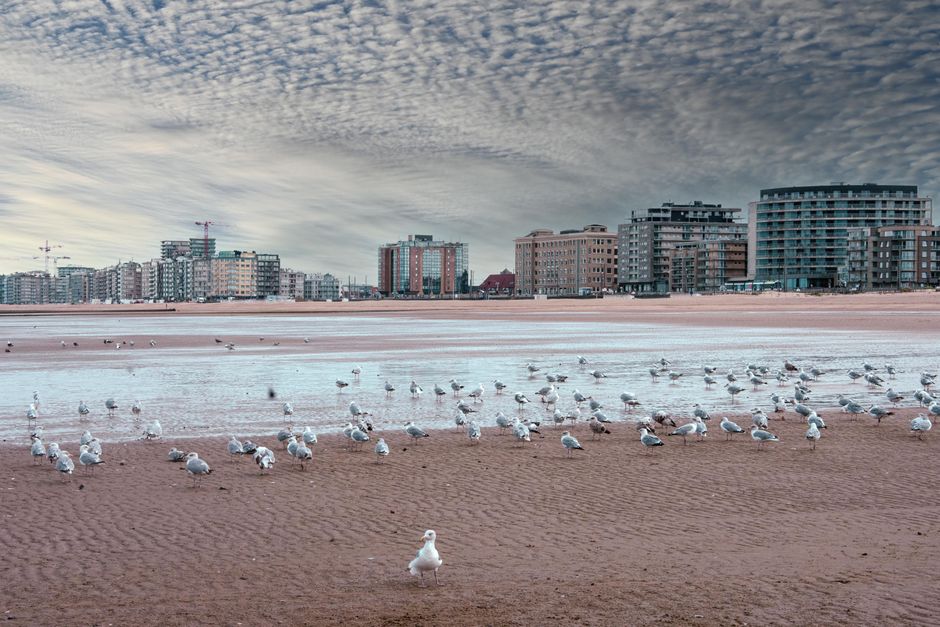
Ostend (Oostende) is the “queen of the Belgian seaside”: a lively town with a long sandy beach, a wide promenade lined with apartment blocks and Belle Époque galleries, a fishing harbour where you can eat shrimp straight from the boats, and a surprising amount of art, from James Ensor’s house to the Mu.ZEE museum. It is the biggest town on Belgium’s 67-km coast and the hub of the Kusttram, the coastal tram that runs from the French border to the Dutch one. You come for the sea air, long beach walks, seafood and easy day trips; Bruges is only 15 minutes away by train. A day is enough for the town; stay two or three to enjoy the beach and explore the coast.
Right now in Ostend
- Wed 13–17°C 55–63°F 10 mm Rain
- Thu 12–15°C 54–58°F 4 mm Showers
- Fri 11–17°C 51–62°F 14 mm Rain
Weather: MET Norway (CC BY 4.0) · Sea temperature: NOAA CoastWatch · Rates: ECB
Top tours in Ostend
See all tours for Ostend →
From local operators, with prices and reviews; you check availability and book on Viator, our partner. We may earn a commission at no extra cost to you. How we earn money
Ostend at a glance
- Best for: beach holidays and seaside walks, seafood, James Ensor and Belgian art, the Atlantic Wall at Raversyde, and touring the coast by tram.
- How long: 1 day for the town, the harbour and a museum; 2–3 days with the beach, Raversyde and the Kusttram.
- Best time: July and August for beach days and lifeguards; June and September for quieter, mild weather; any season for bracing walks.
- Getting in: trains from Bruges take about 15 minutes, from Ghent about 40 minutes and from Brussels about 1 hour 15 minutes; the station is by the harbour, a few minutes’ walk from the centre.
- Getting around: walk the promenade, rent a bike or take the Kusttram. As of October 2026, a De Lijn day ticket for the tram costs €9.
- Swimming: only in supervised zones when lifeguards are on duty; in 2026 they were on all beaches daily from 1 July to 31 August.
Ostend, area by area
The town centre sits on the west side of the harbour mouth. The station, the yacht harbour and the Mercator are on the harbour side; the shopping streets lead a few blocks north to the seafront. The Zeedijk promenade runs west along the beach past the Kursaal casino and the Venetian Galleries to Mariakerke and Raversyde.
The centre and the Zeedijk
The Wapenplein square, St Peter and Paul’s Church with its neo-Gothic spires, the shopping streets, James Ensor’s house, the Kursaal and the main beach. Best for: first visits and sea-view hotels.
The harbour and the Visserskaai
Along the Visserskaai (fishermen’s quay), seafood restaurants and stalls sell grey shrimp, fish soup and whelks. A free ferry crosses the harbour channel to the east bank. Best for: seafood and harbour walks.
Oosteroever and Mariakerke
The east bank (Oosteroever) has Fort Napoleon, newer apartments and a quieter beach stretching towards Bredene. To the west, Mariakerke is a calmer residential beach area with the little Our Lady of the Dunes church, on the tram line to Raversyde. Best for: quieter beach stays.
Top things to see in Ostend
Prices and hours below were checked on the official sites in October 2026. They change, so check before you go.
The beach and the promenade
Ostend’s wide, sandy beach runs for several kilometres, divided by wooden groynes and backed by the promenade. In summer it fills with beach cabins, deckchairs and beach bars; in winter it is a place for long, windy walks. Dogs are allowed freely from 1 October to 31 March; in April, May, June and September only before 10:00 and after 18:30, and in July and August only before 10:00 and after 20:00, except in a few dog-friendly zones. See our beaches guide.
Mu.ZEE at the Venetian Galleries
Mu.ZEE is Belgium’s museum of Belgian modern and contemporary art from 1880 to today, with the world’s largest collections of James Ensor and Léon Spilliaert, both from Ostend, and Constant Permeke. Its home on the Romestraat is closed for a major renovation, with reopening planned for 2028. Meanwhile, Mu.ZEE shows exhibitions in the elegant Venetian Galleries (Venetiaanse Gaanderijen) on the seafront, built in 1900–1903; the current one, on small sculpture, runs until 3 January 2027. As of October 2026, tickets cost €12 (€3 for ages 13 to 25; free for children up to 12), and it opens Tuesday to Sunday 10:00–17:30.
James Ensor House
The painter James Ensor (1860–1949), famous for his masks and skeletons, lived above his family’s souvenir and shell shop in the Vlaanderenstraat. Visit the shop, his blue salon with a copy of The Entry of Christ into Brussels and an experience centre about his work. As of October 2026, tickets cost €14 (€9 for students, €6 for ages 6 to 14). It opens 10:00–18:00 and is closed on Mondays, except on Flemish public holidays and in school holidays.
The Mercator and the Amandine
The Mercator, a three-masted training ship built in Scotland in 1932, has been moored in the yacht harbour between the station and the town hall since 1960. As of October 2026, entry costs €8 for adults (€6 under 14, free under 6), and it opens 10:00–17:00 every day except Monday (last entry 16:15). A combined ticket with the Amandine, the last Ostend trawler to fish off Iceland, now a museum on the Visserskaai, costs €13.
Fort Napoleon
Built by Napoleon’s troops in 1811 to guard the harbour against the British, this five-sided brick fort in the dunes of the east bank later served the Germans in both world wars. A new story trail tells its history through the walls themselves. As of October 2026, entry costs €9 (€7 for children up to 12, free under 6), and it opens Tuesday to Sunday 10:00–18:00. Take the free harbour ferry across from the town side.
Atlantikwall Raversyde
In the dunes west of Ostend, the Raversyde estate preserves one of the best-kept stretches of Hitler’s Atlantic Wall: more than 60 bunkers, gun positions and observation posts linked by some 2 km of trenches and tunnels, plus the Battery Aachen from the First World War. The 2026 season runs from 14 March to 15 November: on weekdays (closed Monday) from 10:30 to 17:00, last entry 15:15, and every day from 10:30 to 18:00 during Flemish school holidays, weekends and public holidays. As of October 2026, tickets cost €10 for adults, €4 for ages 6 to 17 and €26 for a family. The Kusttram stops nearby.
Museums
- Ensor House
- Mercator (training ship)
- Mu.ZEE
- Raversyde Atlantic Wall Museum
Monuments
- Leopold II Monument, Ostend
Castles and forts
- Fort Napoleon
The Belgian coast and the Kusttram
Belgium’s coastline is short, straight and almost all sandy beach, backed by dunes and resort towns linked by the Kusttram (Coast Tram), one of the longest tram lines in the world. It runs about 67 km from De Panne, by the French border, to Knokke-Heist, near the Netherlands, stopping in Ostend at the station and along the seafront. Trams run every 10, 15 or 20 minutes during the day, depending on the season, and every 30 minutes in the evening; the full ride takes over two hours.
Tickets. The Kusttram uses ordinary De Lijn tickets. As of October 2026, a single ticket costs €3 for 60 minutes (in the app, by text or by tapping a contactless bank card on board), a day ticket €9 and a 3-day ticket €18 (half price for ages 6 to 11; under-6s travel free with a paying adult). On busy summer days trams can be full; travel early.
- De Haan: 20 minutes east, a small resort of Belle Époque villas protected from high-rise building, with dunes and a quieter beach.
- Knokke-Heist and Het Zwin: at the eastern end, the chic resort of Knokke, with galleries and boutiques, and the Zwin nature reserve, a tidal marsh famous for birds. From here, the Zeeland coast is just across the border.
- Nieuwpoort: west of Ostend, a yachting port with the King Albert I Memorial and the “Westfront” visitor centre on the First World War floods that stopped the German advance.
- De Panne: the last stop, with the Westhoek dunes and a wide beach for sand yachting.
Swimming and beach safety
Swimming is allowed only in zones watched by lifeguards. In 2026, lifeguards were on duty at all of Ostend’s beach posts every day from 1 July to 31 August, 10:00–18:30; in June and early September (until about mid-month) and on some May and June weekends, only the main posts at Mariakerke, Koninginnelaan, the Kursaal and Oosthelling were staffed. Swimming is banned near the harbour. The North Sea is cool: water is usually around 17–19 °C in August and well below 10 °C in winter, and strong currents and tides change the beach quickly, so follow the flags and lifeguards’ instructions. Ostend is also one of Belgium’s main surfing spots; see our surfing guide.
Seafood
Grey North Sea shrimp (grijze garnalen) are the local treasure: eat them peeled on bread, in a tomato stuffed with shrimp (tomate crevette) or as crisp shrimp croquettes. Mussels and fries, sole and fish soup are on every menu.
Activities and best months
- Beaches and swimmingJulAugSwimming in the sea is allowed only in zones with lifeguards: in 2026 all posts were staffed daily from 1 July to 31 August, 10:00-18:30, with four posts (Mariakerke, Koninginnelaan, Kursaal, Oosthelling) open on set days from mid-May and until 13 September. Swimming is banned at post 11 (Louisastraat). · source
- City sightseeingFort Napoleon has a new story trail about its history (with a version for children) and a tourist information desk; it is open Tuesday to Sunday 10:00-18:00, adults EUR 9. · source
- SurfingVisit Oostende lists the Inside Outside club, which teaches surfing on the North Sea beach (Outside, near the Thermae Palace) and windsurfing and sailing on the Spuikom lake (Inside), with private, group and parent-child sessions. The sports beach there is also used for windsurfing, catamaran sailing and kayaking. · source
Day trips from Ostend
- Bruges: the medieval canal city is about 15 minutes by train, with several trains an hour.
- Ghent: about 40 minutes by direct train, for the Ghent Altarpiece and the castle.
- Along the coast: any of the resorts above by Kusttram, or by bike on the coastal cycle paths; see our cycling guide.
Nearby destinations
Getting to Ostend
By train. Oostende station is the end of the main line from Brussels via Ghent and Bruges, with direct trains about every half hour; Brussels takes about 1 hour 15 minutes, Ghent about 40 minutes and Bruges about 15 minutes. From Brussels Airport allow about two hours, usually with one change. The Kusttram stops outside the station. Train times are approximate; check SNCB before you go.
From Britain. There is no longer a passenger ferry from Ostend to England; the last one stopped in 2013. Drivers use the ferries from Dunkirk or Calais to Dover, or the Channel Tunnel from Calais, all about an hour to 90 minutes by car from Ostend. By train, take the Eurostar from London to Brussels-Midi and change for Ostend; a Eurostar ticket can include the onward train.
By air and car. Ostend-Bruges Airport has mainly holiday and cargo flights; most visitors fly into Brussels. Ostend is at the end of the E40 motorway from Brussels; parking is easiest in the station car parks and garages near the seafront, and street parking is paid in most zones, including on Sundays.
When to go and how long to stay
The sea keeps Ostend cooler in summer than inland Belgium, and it is often windy. The table uses the Royal Meteorological Institute of Belgium’s (KMI/IRM) 1991–2020 climate statistics for the municipality of Ostend; KMI’s coastal wind figures come from its Middelkerke station, next to the town.
| Season | Average temperature | Average high | Rain per month | Sunshine per month | What it’s like |
|---|---|---|---|---|---|
| Winter (Dec–Feb) | 4.1–4.8 °C | 6.8–7.5 °C | 56–86 mm | 54–86 hours | Grey, windy and damp; bracing beach walks and quiet museums |
| Spring (Mar–May) | 6.5 °C rising to 12.6 °C | 10.2–16.6 °C | 41–54 mm | 144–230 hours | The driest and one of the sunniest seasons, but the sea is still cold |
| Summer (Jun–Aug) | 15.4–17.6 °C | 19.3–21.9 °C | 63–84 mm | 223–238 hours | Fresh and breezy, rarely hot; beach season with lifeguards in July and August |
| Autumn (Sep–Nov) | 15.0 °C falling to 7.6 °C | 19.3–10.5 °C | 74–88 mm | 171 falling to 68 hours | Mild September, then storms and big seas; good for surfers |
Ostend gets about 800 mm of rain a year, less than inland Flanders, and about 1,840 hours of sunshine, more than Brussels or Ghent, with an average temperature of 10.5 °C. Days above 25 °C are rare, about 16 a year, so even in summer bring a jacket for the evening breeze.
Ostend in 1 day
Morning on the beach and the promenade to the Venetian Galleries and Mu.ZEE, lunch of shrimp on the Visserskaai, the James Ensor House and the Mercator in the afternoon, and sunset on the western pier.
Ostend in 3 days
Add Atlantikwall Raversyde and Fort Napoleon on day 2, and a Kusttram day ticket on day 3 to explore De Haan and Knokke, or a train trip to Bruges.
Weather month by month
Averages from RMI normals 1991–2020, Oostende Airport · Last reviewed 4 Oct 2026
Where to stay in Ostend
- On the Zeedijk: sea-view hotels and apartments on the promenade; ask for a front-facing room.
- Town centre: small hotels and B&Bs near the shops, restaurants and museums, a short walk from the beach.
- Near the station and harbour: convenient for trains and the Kusttram.
- Mariakerke and Oosteroever: holiday apartments by quieter beaches.
Summer weekends and the school holidays in July and August fill up early; outside the season, prices fall sharply. A tourist tax is added to hotel bills.
Practical tips for Ostend
- Swim only by a lifeguard post and check the flags; currents can be strong.
- Check museum days: Mu.ZEE, the Mercator, Fort Napoleon and Raversyde close on Mondays (Ensor House too, outside holidays), and Raversyde closes for winter after 15 November 2026.
What to pack for Ostend
A windproof jacket in every season, a warm layer for evenings, comfortable shoes for the promenade and the dunes at Raversyde, and an umbrella. In summer, add swimwear, sunscreen (the breeze hides how strong the sun is), sunglasses and a beach towel; in winter, a hat, scarf and gloves for beach walks.
What to pack
- City walking shoesLisbon and Porto are steep, with polished limestone cobbles that get slippery, so grippy soles matter.
- Day packs and anti-theft bagsCarries water, towel and sunscreen down the long stairways to Algarve coves.
- Dry bags and phone pouchesProtects phones and cameras from sand and spray on beaches reached by ferry or steep paths.
- Quick-dry beach towelsA sand-shedding quick-dry towel packs small for beach days and lido visits.
- Rain jacketsFrom October to April Porto and Lisbon see rain on roughly a third of days.
- Reef-friendly sunscreenSummer UV is strong on Portuguese beaches and there is little shade below the cliffs.
- Surf accessories (boots, leashes, wax)Neoprene boots keep feet warm in winter and protect them on rock and reef breaks.
- Travel adapters and convertersPortugal uses Type C and F sockets at 230 V, so most visitors from outside Europe need an adapter.
- Water shoesRocky coves, lava pools and weever fish in shallow sand make water shoes useful.
- WetsuitsOn the west and north coasts the sea stays around 16–18 °C even in summer, so a thin suit helps for long swims.
Ostend travel FAQ
Can you swim in the sea at Ostend?
Yes, but only in supervised zones when lifeguards are on duty: in 2026, every day from 1 July to 31 August at all beach posts, plus some days in May, June and early September at the main posts. The water is cool, around 17–19 °C at best in August.
How much does the Kusttram cost?
It uses normal De Lijn tickets. As of October 2026, €3 for a single journey of up to 60 minutes, €9 for a day ticket and €18 for three days; under-6s ride free with a paying adult.
How do I get from Ostend to Bruges?
By train in about 15 minutes, with several departures an hour. It is an easy half-day or day trip.
Is there a ferry from Ostend to England?
No. The passenger ferry stopped in 2013. Use the ferries from Dunkirk or Calais to Dover, the Channel Tunnel, or the Eurostar from Brussels.
Is Mu.ZEE open?
Its main building is closed for renovation until a planned reopening in 2028, but Mu.ZEE is showing exhibitions in the Venetian Galleries on the seafront, Tuesday to Sunday 10:00–17:30; tickets cost €12 as of October 2026.
Are dogs allowed on the beach in Ostend?
Freely from 1 October to 31 March. In April, May, June and September only before 10:00 and after 18:30; in July and August only before 10:00 and after 20:00, except in a few dog zones.
When is Atlantikwall Raversyde open?
In 2026, from 14 March to 15 November, closed on Mondays outside holidays. As of October 2026, an adult ticket costs €10.
How many days do you need in Ostend?
One day for the town, the beach and a museum; two or three to add Raversyde, Fort Napoleon and a trip along the coast by Kusttram.
What is the best time to visit Ostend?
July and August for beach days and lifeguards; June and September for mild weather with fewer people; autumn and winter for storms, surfing and quiet seaside walks.
Sources
- © OpenStreetMap contributors · ODbL · fetched 4 Oct 2026
- Wikidata · CC0 · fetched 4 Oct 2026
Sources and last review
Researched and last reviewed on 4 October 2026. Beach rules, lifeguards, dogs, parking and Fort Napoleon: Visit Oostende; Mu.ZEE renovation, venue, prices and hours: Mu.ZEE; James Ensor House: ensorhuis.be; the Mercator and the Amandine: Zeilschip Mercator; Atlantikwall Raversyde: Provinciedomein Raversyde; Kusttram service and fares: De Lijn; climate: KMI/IRM 1991–2020 climate statistics for the municipality of Ostend. Sea temperatures, train times and the end of the Ostend–Ramsgate ferry come from general or secondary sources and are flagged for checking. Prices, timetables and rules change, so check the official links before you go. Across the border, see our Zeeland guide, and for the other side of the Channel, our London guide.
Plan your trip
Partner links: TravelerCenter may earn a commission if you book, at no extra cost to you.
🇳🇱 Useful Dutch phrases for Ostend
All 38 Dutch phrases: restaurant, hotel, emergencies, romance (printable) →