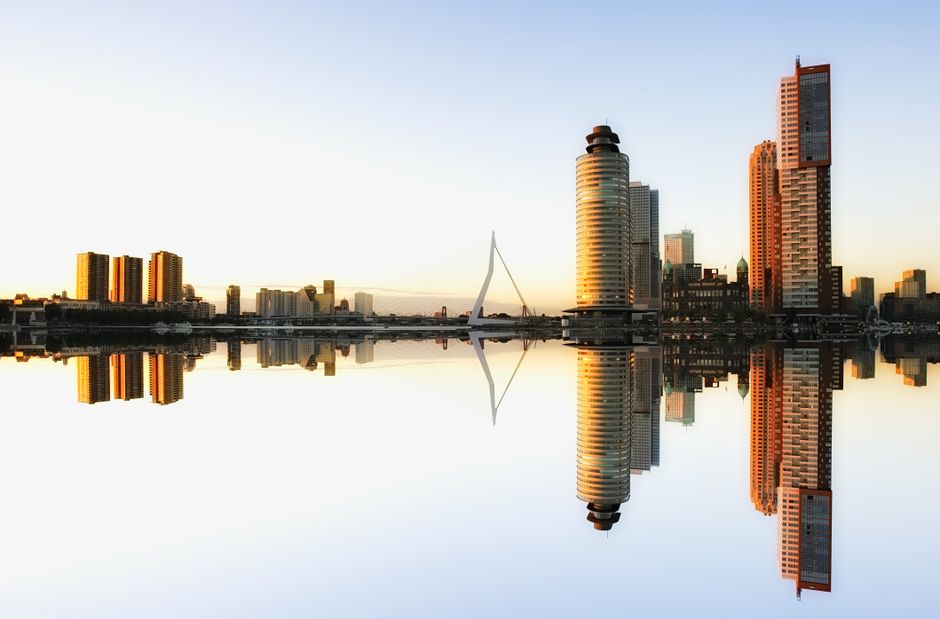
Rotterdam is the Netherlands’ bold, modern city: its old centre was destroyed by bombing on 14 May 1940, and it rebuilt itself as an open-air gallery of daring architecture on the banks of the wide River Maas. You come to see the horseshoe-shaped Markthal and the tilted Cube Houses, cross the white Erasmus Bridge, look into the mirrored bowl of Depot Boijmans, climb the Tornado staircase at the new Fenix museum, take a boat through Europe’s largest port and ride a waterbus to the 18th-century windmills of Kinderdijk. It is about 40 minutes from Amsterdam and 25 minutes from Schiphol by fast train, with excellent food and nightlife and fewer crowds than the capital. Give it two days, or three with Kinderdijk and a trip to Delft or The Hague.
Right now in Rotterdam
- Wed 13–20°C 56–67°F 5 mm Cloudy
- Thu 12–15°C 53–58°F 4 mm Light showers
- Fri 11–16°C 52–60°F 13 mm Rain
Weather: MET Norway (CC BY 4.0) · Air quality: OpenAQ · Rates: ECB
Top tours in Rotterdam
See all tours for Rotterdam →
From local operators, with prices and reviews; you check availability and book on Viator, our partner. We may earn a commission at no extra cost to you. How we earn money
Rotterdam at a glance
- Best for: modern architecture, harbour views, museums, food halls and street food, nightlife, windmills at Kinderdijk and an easy, less crowded city break.
- How long: 1 day for the Markthal, the Cube Houses, the Erasmus Bridge and a harbour tour; 2–3 days to add Depot Boijmans, Fenix, Delfshaven and Kinderdijk.
- Best time: April to September for terraces, boat trips and Kinderdijk in full season; the city is a good all-weather choice, with most sights indoors or covered.
- Getting in: trains from Amsterdam take about 40 minutes on the fastest service; Rotterdam Centraal is also on the Eurostar route from Brussels, Paris and London.
- Getting around: on foot, by RET metro and tram (tap a contactless card), by water taxi or bike.
- Before you go: entry rules, money and general safety are in our Netherlands travel guide.
Rotterdam, area by area
The city centre lies on the north bank of the Maas, between Rotterdam Centraal station and the river; the Erasmus Bridge leads south to the old harbour districts of Kop van Zuid and Katendrecht. Distances are bigger than in Amsterdam, but the metro, trams and water taxis link everything quickly.
The centre and Blaak
From the angular glass roof of Rotterdam Centraal, the Lijnbaan, one of Europe’s first car-free shopping streets (1953), leads towards City Hall and the Laurenskerk, the only medieval building in the centre to survive the bombing. East of it, around Blaak station, stand the Markthal, the Cube Houses and the old harbour (Oude Haven) with its terraces. Best for: first visits and short stays.
The Museum Park and Witte de Withstraat
Depot Boijmans, the Kunsthal, Het Nieuwe Instituut (architecture and design) and the Natural History Museum surround the Museumpark, a short walk from Witte de Withstraat, the city’s liveliest street for bars, galleries and restaurants. Best for: culture and evenings out.
Kop van Zuid, Wilhelminapier and Katendrecht
Across the Erasmus Bridge, the old quays have become Rotterdam’s skyline: Hotel New York in the former head office of the Holland America Line, from where emigrants sailed to America; Rem Koolhaas’s stacked towers of De Rotterdam; and, across the Rijnhaven, Katendrecht (“De Kaap”), a former sailors’ district now full of restaurants and the new Fenix museum. Best for: views, food and design-hotel stays.
Delfshaven and Het Park
Delfshaven, west of the centre, is the old harbour that survived the war, with a canal, gabled houses, a working windmill and the church where the Pilgrim Fathers prayed before sailing for America in 1620. Het Park, at the foot of the Euromast tower, is the city’s green lung. Best for: a slower, older Rotterdam.
Top things to see in Rotterdam
Prices and hours below were checked on the official sites in October 2026. They change, so check before you go.
Markthal
This giant horseshoe of apartments, designed by MVRDV and opened in 2014, arches over a covered market hall of food stalls, shops and restaurants. Look up: the inside of the arch is covered with a huge, colourful mural of fruit, flowers and insects, one of the largest artworks in the country. Entry is free. As of October 2026 the market hall opened Monday to Thursday 10:00–20:00, Friday 10:00–21:00, Saturday 10:00–20:00 and Sunday 12:00–18:00, with a supermarket open longer; restaurants with their own entrances keep their own hours. There is a large car park underneath.
The Cube Houses
Right next to the Markthal, architect Piet Blom’s yellow Cube Houses (Kubuswoningen, 1984) are tilted 45 degrees on concrete poles, like a forest of trees. People live in them; one, the Kijk-Kubus show cube, is open to visitors for a few euros, so you can see how furniture fits under sloping walls. Walk underneath to the Oude Haven for a drink by the old boats.
The Erasmus Bridge and the skyline
The Erasmus Bridge (1996), nicknamed “the Swan” for its single bent pylon and white cables, is the symbol of the new Rotterdam. Walk or cycle across it to Wilhelminapier for the best views back over the river, especially at sunset, then have a drink at Hotel New York.
Depot Boijmans Van Beuningen
The world’s first publicly accessible art storage building, a mirrored bowl designed by MVRDV and opened in 2021, lets you walk among more than 150,000 works from the Boijmans Van Beuningen museum’s collection, from old masters to modern design, and see restorers at work. A rooftop forest and restaurant crown the building. As of October 2026, adults paid €20, students €10.50, and under-18s entered free; you need a time slot, so book online (a ticket machine at the entrance sells remaining slots). From 9 October 2026 to 29 March 2027 a €2.50 surcharge applies for the Marisol exhibition. The museum’s main building next door is closed for a long renovation, expected to reopen around 2030.
Fenix and the Tornado
Opened in May 2025 in a former harbour warehouse on Katendrecht, Fenix is a museum about migration told through art, photography and personal stories, in the port from which millions left Europe. On the roof, the Tornado, a double spiral staircase of wood and steel designed by MAD Architects, climbs to a viewing platform about 30 metres up with views over the Rijnhaven and the skyline. Fenix is closed on Mondays except on public holidays and during school holidays.
Euromast
The 185-metre Euromast tower by Het Park has a viewing platform at 100 metres and a rotating glass lift that climbs to the top. As of October 2026 it opened daily from 9:30 to 22:00, with a standard adult ticket around €17.50, more for the full “Complete” experience; book online.
More museums and landmarks
The Kunsthal, designed by Rem Koolhaas, has changing exhibitions; the Maritime Museum explains the port’s history with ships in its harbour; the SS Rotterdam, a former Holland America Line ocean liner, is moored as a hotel you can tour; and the Witte Huis (1898) on the Oude Haven was once Europe’s tallest office building. Rotterdam Centraal station, reopened in 2014, is a sight in itself.
Other sights
- Cube Houses (Kubuswoningen)
- Euromast
- Markthal
Viewpoints
- Erasmus Bridge
Monuments
- Diergaarde Blijdorp
- Kinderdijk Windmills
- Van Nelle Factory
Kinderdijk: the windmills
About 15 km east of Rotterdam, Kinderdijk is the most famous windmill landscape in the Netherlands: 19 windmills built around 1740 to pump water out of the low-lying polders, lined up along the canals and reed beds. It is a UNESCO World Heritage Site and a working water-management system.
Tickets. As of October 2026, admission cost €21 for adults and €9 for children aged 4–12, with under-4s free, and online tickets are 10% cheaper than at the cash desk. The ticket covers all the visitor locations: two museum mills you can climb inside, a boat tour along the mills, the Wisboom steam pumping station, a short film and an exhibition. In 2026 the site opened from 9:00 to 17:30 between 6 March and 1 November, and from 10:30 to 16:00 from 2 November to the end of December; it closes on Christmas Day. The Netherlands Museum Pass gives no discount. Arrive at opening time or late in the day to enjoy the mills without coach groups.
By water from Rotterdam. The Waterbus (line 20) leaves from the Erasmusbrug stop in central Rotterdam; change at Ridderkerk De Schans for the small Driehoeksveer ferry, which takes you to Kinderdijk in a few minutes. The Driehoeksveer is not part of the Waterbus, so you need a separate ticket for it. On Fridays, Saturdays and Sundays, the private WaterShuttle sails direct from Rotterdam to the entrance in under half an hour; its ticket is sold separately, for example together with your Kinderdijk admission on the official website. Bikes travel free on the boats.
By bus or car. Bus 489 runs twice an hour from Rotterdam Kralingse Zoom metro station (metro lines A, B and C from the centre), taking about 35 minutes. Drivers park, between mid-March and 1 November, at De Kabelbaan in Alblasserdam with a shuttle bus to the entrance (€9.75 per car in 2026, bought with your admission); parking is only allowed with an admission ticket. See our boat trips guide and cycling guide for more ways to explore by water and by bike.
Things to do in Rotterdam
Take a harbour tour
Rotterdam is Europe’s largest port. Spido harbour tours leave from near the Erasmus Bridge for 75-minute trips past docks, cranes and container ships, with longer trips to the vast Maasvlakte container terminals and the Delta Works storm barrier at the coast in summer.
Ride a water taxi
Small, fast water taxis zip between dozens of stops along the Maas, from the centre to Hotel New York, Katendrecht and the Euromast. Book in the app or at the stops; it is a fun way to cross the river.
Eat and drink
Rotterdam is one of the most diverse cities in Europe, and it shows on the plate: Surinamese roti and sandwiches, Turkish, Cape Verdean and Moroccan food, plus the Markthal’s stalls and Katendrecht’s restaurants. Try local craft beer, and in summer, rooftop bars and terraces on the Oude Haven and Witte de Withstraat.
Architecture walks and bike rides
Rotterdam is best understood on an architecture tour on foot or by bike, from the Cube Houses and the Markthal to the Timmerhuis, De Rotterdam and the station. Cycle lanes are wide and the city is flat. See our city sightseeing guide.
Activities and best months
- Boat tripsRoyal Spido sails all year from Willemsplein at the foot of the Erasmus Bridge: the 75-minute Highlights & Harbour Tour (two-thirds city, one-third port) passes the Erasmus Bridge, De Hef, the Euromast, the ss Rotterdam, Katendrecht and Hotel New York; a 2.5-hour tour goes deeper into the port. The Waterbus and WaterShuttle also leave from the Erasmus Bridge for the Kinderdijk windmills, under 30 minutes away. · source
- City sightseeingRotterdam's tourist board lists its must-sees: Depot Boijmans Van Beuningen (the world's first public art depot), the Fenix migration museum, historic Delfshaven, the 38 yellow Cube Houses by Piet Blom, the medieval Laurenskerk with its tower view, the Markthal with its Horn of Plenty ceiling, Trompenburg arboretum, the Nederlands Fotomuseum and Portlantis on the Maasvlakte. · source
Getting to Rotterdam
From Amsterdam and Schiphol. NS Intercity Direct trains on the high-speed line take about 40 minutes from Amsterdam Centraal and about 25 minutes from Schiphol; a small supplement applies on the Intercity Direct between Schiphol and Rotterdam, sold at machines and in the NS app. Slower Intercity trains via Leiden and The Hague need no supplement. As of October 2026, a second-class single from Amsterdam Centraal cost about €20 and from Schiphol about €16.40. You can also tap a contactless bank card at the gates.
From abroad. Eurostar trains from Brussels, Paris and London stop at Rotterdam Centraal on the way to Amsterdam. Rotterdam The Hague Airport, north of the city, has flights to a handful of European cities; bus 33 links it to Rotterdam Centraal.
From The Hague and Delft. Trains from Den Haag Centraal take about 25 minutes (about €6.40 in 2026), and metro line E (RandstadRail) runs between the two city centres.
Getting around Rotterdam
RET runs the metro, trams and buses; check in and out with a contactless bank card or phone, or buy a day ticket in the RET app. The centre is walkable, but the metro saves time to Delfshaven and Kralingse Zoom, and tram 23 crosses the Erasmus Bridge. Water taxis and the Waterbus link the riverbanks. Rent a bike to cover more ground; there are also shared bikes at stations.
When to go and how long to stay
Rotterdam has the same mild, changeable sea climate as the rest of the western Netherlands, with breezy weather along the river. The table uses the WMO 1991–2020 normals for Rotterdam The Hague Airport, about 6 km north of the centre.
| Season | Average high / low | Rainy days per month | What it’s like |
|---|---|---|---|
| Spring (Mar–May) | 10–18 °C / 3–8 °C | 9–10 | Kinderdijk and the boat tours back in full swing, tulips nearby, often sunny and dry |
| Summer (Jun–Aug) | 21–23 °C / 11–13 °C | 10–11 | Terraces, rooftop bars, festivals and the Summer Carnival parade; the liveliest season |
| Autumn (Sep–Nov) | 19 °C falling to 10 °C / 11 °C falling to 4 °C | 11–14 | Mild September, then wind and rain; the wettest months, good for museums |
| Winter (Dec–Feb) | 6–7 °C / about 1–2 °C | 11–14 | Short, grey days, occasional frost; quieter and cheaper |
The station records about 880 mm of rain a year on about 134 days, with April the driest month and August to December the wettest. May is the sunniest month, with about 225 hours of sunshine. April to September is best for Kinderdijk and boat trips.
Rotterdam in 1 day
Arrive at Rotterdam Centraal, walk down the Lijnbaan to the Laurenskerk, then breakfast or lunch in the Markthal and visit the Cube Houses. In the afternoon, walk across the Erasmus Bridge to Wilhelminapier and Katendrecht and climb the Tornado at Fenix. End with a harbour tour or a water taxi back and dinner on Witte de Withstraat.
Rotterdam in 3 days
Add Depot Boijmans and the Kunsthal, Delfshaven and the Euromast, then spend a day at Kinderdijk by Waterbus or WaterShuttle. On the third day, take the train to Delft for its canals and blue pottery, or to The Hague and the beach at Scheveningen.
Weather month by month
Averages from KNMI normals 1991–2020, Rotterdam The Hague Airport · Last reviewed 4 Oct 2026
Day trips from Rotterdam
Delft, 15 minutes by train, is a small canal town of Vermeer, Delft Blue pottery and the royal tombs in the Nieuwe Kerk. Dordrecht, the oldest city in Holland, is reached by Waterbus. Gouda has its cheese market on Thursday mornings in summer. The Hague has the Mauritshuis and the North Sea beach. To the south-west, the dams and storm barriers of the Delta Works lead into Zeeland, with wide beaches about an hour’s drive away. Amsterdam and Utrecht are each under an hour by train.
Nearby destinations
Where to stay in Rotterdam
- Centre and Blaak: chain and boutique hotels near the station, the Markthal and the Cube Houses; easiest for short stays.
- Kop van Zuid and Wilhelminapier: hotels with river and skyline views, including Hotel New York.
- Museum Park and Witte de With: lively streets, good restaurants and art on your doorstep.
- On the water: the SS Rotterdam liner, moored at Katendrecht, is an unusual hotel.
Hotels in Rotterdam are usually cheaper than in Amsterdam, so some visitors stay here and visit Amsterdam by train.
Practical tips for Rotterdam
- Book Depot Boijmans: entry is by time slot, and weekend slots fill up.
- Check Kinderdijk boats: the WaterShuttle runs only Friday to Sunday, and the Driehoeksveer needs its own ticket.
- Mondays: some museums, including Fenix and Depot Boijmans, close on Mondays outside holidays.
- Wind: bridges and the riverfront can be very windy; bring a layer even in summer.
- Pay by card: cards and phones work almost everywhere, including all public transport.
What to pack for Rotterdam
Comfortable walking shoes, a windproof and waterproof jacket for the bridges and boat trips, layers, sunglasses for bright river light, and a contactless card for transport. For Kinderdijk, add sturdy shoes for the dyke paths and a warm layer for the boat.
What to pack
- City walking shoesLisbon and Porto are steep, with polished limestone cobbles that get slippery, so grippy soles matter.
- Day packs and anti-theft bagsA small zipped or anti-theft bag makes crowded trams and viewpoints less stressful.
- Dry bags and phone pouchesSpray soaks phones and cameras on open boats to the Algarve caves and on whale-watching trips.
- Fleeces and warm layersIt is cooler at sea than on land, especially on morning whale-watching trips.
- Rain jacketsA windproof, waterproof shell keeps you warm on open boats, where wind and spray cool you quickly.
- Reef-friendly sunscreenSun reflects off the water on cruises and cave tours.
- Travel adapters and convertersPortugal uses Type C and F sockets at 230 V, so most visitors from outside Europe need an adapter.
- Water shoesKayak and small-boat trips to the Algarve grottoes land on rock and wet sand.
Rotterdam travel FAQ
Is the Markthal free to visit?
Yes. Entry is free. As of October 2026 the market hall opened Monday to Thursday 10:00–20:00, Friday until 21:00, Saturday until 20:00 and Sunday 12:00–18:00.
How much are Kinderdijk tickets?
As of October 2026, €21 for adults and €9 for children aged 4–12 at the cash desk, with 10% off when you book online; under-4s are free. The ticket includes the museum mills, a boat tour, the Wisboom pumping station and a film.
How do I get from Rotterdam to Kinderdijk by waterbus?
Take Waterbus line 20 from the Erasmusbrug stop and change at Ridderkerk De Schans to the Driehoeksveer ferry, which needs a separate ticket. On Fridays to Sundays the WaterShuttle sails direct in under 30 minutes. Bus 489 from Kralingse Zoom is the all-week land option.
Do I need to book Depot Boijmans?
Yes, entry is by time slot. Adults paid €20 and under-18s go free as of October 2026, with a €2.50 surcharge during the Marisol exhibition until 29 March 2027.
Can you go inside the Cube Houses?
Yes, one of them. The Kijk-Kubus show cube is furnished and open to visitors for a small fee; the other cubes are private homes, so please respect the residents.
How long is the train from Amsterdam to Rotterdam?
About 40 minutes by Intercity Direct on the high-speed line, which needs a small supplement between Schiphol and Rotterdam, or a little over an hour by regular Intercity via The Hague.
Is Rotterdam worth visiting?
Yes, especially if you like architecture, food and a less touristy city. It feels completely different from Amsterdam, and it is the best base for Kinderdijk, Delft and the Delta Works.
Is the Museum Boijmans Van Beuningen open?
The main museum building is closed for renovation and is expected to reopen around 2030. You can see the collection at Depot Boijmans next door.
How many days do you need in Rotterdam?
One day covers the Markthal, the Cube Houses, the Erasmus Bridge and a harbour tour. Two or three days let you add the museums, Delfshaven and a day at Kinderdijk.
When is the best time to visit Kinderdijk?
Between March and October, when the full season runs from 9:00, ideally first thing in the morning or late afternoon. On National Mill Days and some summer days the mills turn and fly their flags.
Sources
- © OpenStreetMap contributors · ODbL · fetched 4 Oct 2026
- Wikidata · CC0 · fetched 4 Oct 2026
Sources and last review
Researched and last reviewed on 4 October 2026. Markthal hours: Markthal Rotterdam; Depot Boijmans prices and time slots: Museum Boijmans Van Beuningen; Fenix hours: Fenix; Euromast hours and prices: Euromast; Kinderdijk prices, hours, parking and public transport: Kinderdijk UNESCO World Heritage (Stichting Werelderfgoed Kinderdijk); trains and contactless travel: NS; climate: WMO 1991–2020 climate normals for Rotterdam The Hague Airport. Prices, timetables and rules change, so check the official links before you go. For entry rules and money, see our Netherlands travel guide; for the capital, our Amsterdam guide.
Plan your trip
Partner links: TravelerCenter may earn a commission if you book, at no extra cost to you.
🇳🇱 Useful Dutch phrases for Rotterdam
All 38 Dutch phrases: restaurant, hotel, emergencies, romance (printable) →